
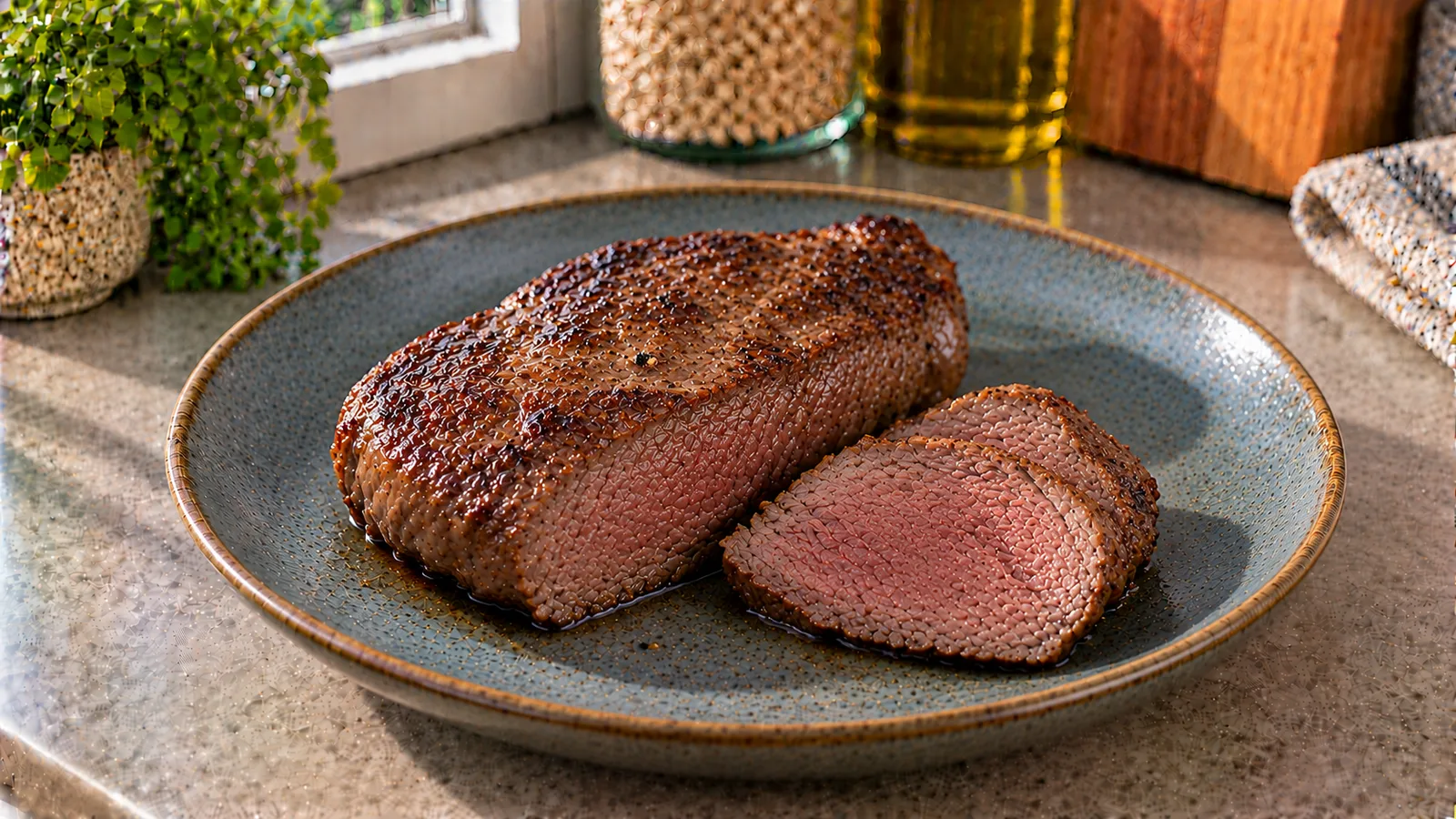
Venison can be relatively lean, but there is no single calorie value for every animal, cut or recipe. The USDA SR Legacy entry for raw deer meat provides 120 kcal per 100 g, while its entry for roasted deer meat provides 158 kcal per 100 g. These are two different reference states: the higher value for cooked meat mainly reflects a lower water content per 100 g, not the creation of calories in the oven.
If you are weighing venison for your food diary, first decide whether the weight is raw or cooked, whether bone and visible fat are included, and whether the dish has added oil, butter, bacon or sauce. The figures here refer specifically to deer meat rather than all products sold as game or venison.
Venison nutrition: raw versus roasted deer
The USDA records Game meat, deer, raw (FDC 173855) and Game meat, deer, cooked, roasted (FDC 175085) provide the following reference figures. Both describe edible meat, without bones or recipe additions.
| Nutrient | Raw deer, 100 g | Roasted deer, 100 g |
|---|---|---|
| Energy | 120 kcal | 158 kcal |
| Protein | 22.96 g | 30.21 g |
| Fat | 2.42 g | 3.19 g |
| Carbohydrate | 0 g | 0 g |
| Dietary fibre | 0 g | 0 g |
| Iron | 3.4 mg | 4.47 mg |
| Water | 73.57 g | 65.23 g |
Sources: USDA FoodData Central, raw deer (173855) and USDA FoodData Central, roasted deer (175085). The values are reference averages, not measurements of your individual piece of meat. Both carbohydrate values are for plain meat, not a stew thickened with flour or a ready-made marinade.
The higher protein number for roasted venison does not mean heat adds protein to the portion. As water is lost, protein and other components make up more of each 100 g of finished meat. To compare your intake, use the correct reference for the weighing stage rather than alternating between the two.
Calories in 50–250 g of venison
The next table shows edible boneless meat, weighed at the stated stage. It is calculated from the two USDA calorie values, with each result rounded to the nearest whole kilocalorie.
| Edible weight | Raw deer | Roasted deer |
|---|---|---|
| 50 g | 60 kcal | 79 kcal |
| 75 g | 90 kcal | 119 kcal |
| 100 g | 120 kcal | 158 kcal |
| 125 g | 150 kcal | 198 kcal |
| 150 g | 180 kcal | 237 kcal |
| 200 g | 240 kcal | 316 kcal |
| 250 g | 300 kcal | 395 kcal |
The formula is simple: calories = edible grams × kcal per 100 g ÷ 100. For example, 150 g of cooked deer meat is approximately 237 kcal, whereas 150 g of raw deer meat is approximately 180 kcal. They should not be treated as the same physical portion before and after roasting, because the weight changes.
If a restaurant says a venison steak weighs 200 g, find out whether that is a raw menu weight or the cooked amount on the plate. If a packaged product has a nutrition label, prioritize the label for that product and its stated preparation state. The distinction between a manufacturer's serving and the portion actually eaten is explored in our portion size versus serving size guide.
Why does cooked venison have more calories per 100 g?
Cooking generally reduces the water content of meat. This concentrates the remaining energy per gram, even if the total energy in the original piece stays broadly similar when no ingredients are added and rendered fat or drippings are not counted differently. The USDA raw and roasted records are not measurements of one identical roast tracked through a controlled experiment, so they cannot establish one universal cooking-loss percentage.
Consider an illustrative batch: you start with 250 g of raw edible deer meat, approximately 300 kcal based on the raw reference. Suppose it weighs 190 g after roasting. Using the roasted reference, 190 g would also be approximately 300 kcal after rounding. The near match illustrates why weighing stage matters; it does not predict that every venison cut loses exactly 60 g.
A very lean backstrap, a shoulder cooked slowly with liquid and a trimmed leg roast may lose different amounts of moisture. Braising in stock can also lead to water absorption rather than a simple reduction. Do not apply a fixed raw-to-cooked conversion factor without knowing your recipe's actual yield.
Which venison are you eating?
In everyday English, venison most often means deer meat, but shops and menus can specify different deer species and different cuts. Farm-raised deer and hunted deer may vary in feeding, age, activity and fat cover. A lean loin does not necessarily have the same energy as a fattier shoulder or commercially ground venison with fat added.
Also, deer is not identical to elk, moose, reindeer, antelope or wild boar, even if these meats appear together in a game-meat section. The USDA figures above are explicitly for deer. Use a species-specific entry when another animal is identified, and read ingredient lists on mixed game sausages, burgers and pies.
For comparisons with more familiar cuts, our beef-steak calorie guide discusses why lean and fatty steak portions differ. The pork tenderloin guide provides another example of how meat cuts and cooking states affect calorie estimates. Compare equal edible cooked weights, not a bone-in joint with a boneless steak.
Bone, trim and mince: what belongs on the scale?
A whole venison joint can include bone, thick tendons and visible fat that you will not eat. The nutrition table is based on the consumed meat. For example, if a raw bone-in portion weighs 400 g but you trim away 100 g of bone and other discarded material, the remaining 300 g is the weight relevant to the raw reference. The waste percentage in this example is not an average for all venison cuts.
For a cooked joint, it can be easier to weigh the meat after carving and removing bone. Record the weight that actually reaches the plate. If you eat the rendered fat or use pan drippings in gravy, consider those ingredients in the recipe rather than silently assuming all fat was discarded.
With venison mince, examine the package: some products are plain ground deer meat; others add pork fat or another meat to improve texture. A generic lean-deer reference can underestimate the calories of a blended burger. Sausages and cured or smoked products may also have added starch, sugar or much more salt.
What oil, sauce and side dishes add
Plain roasted venison is only one ingredient in a finished dinner. Added cooking fat can make a measurable difference even when the meat is lean.
| Item in an illustrative plate | Quantity | Estimated calories |
|---|---|---|
| Roasted deer meat | 150 g | 237 kcal |
| Olive oil retained in the food | 10 g | 90 kcal |
| Meat plus retained oil | — | 327 kcal |
This calculation assumes approximately 9 kcal per gram of oil and that the stated oil amount is actually eaten. If some stays in the pan, the consumed amount is lower. The accompanying potatoes, vegetables, sauce or bread must be added separately. For a practical explanation of fats in recipes, see our olive-oil calorie and portion guide.
Creamy mushroom sauces, pastry crusts, bacon wrapping and sweet glazes can change the total considerably. A venison casserole should be calculated from its complete ingredient list, including any cooking liquid or gravy consumed, and divided by the finished portions. Its calories cannot be inferred from meat alone.
Protein, iron and the wider nutritional picture
The USDA roasted-deer reference contains approximately 30.21 g of protein per 100 g. A cooked 150 g serving would therefore contribute roughly 45.3 g of protein. The same reference reports 4.47 mg of iron per 100 g, giving approximately 6.7 mg in a 150 g serving. These are estimates for that database food, not guarantees for all species or cuts.
Venison can fit into a balanced diet as a protein source, but claims that it automatically builds muscle, cures iron deficiency or causes weight loss would be unjustified. Total dietary pattern, energy intake and personal health context matter. People with diagnosed iron deficiency should follow clinical advice rather than relying on one food.
Wild game safety and chronic wasting disease
Wild-harvested deer needs careful handling and a reliably identified source. USDA guidance notes that hunted game is not handled in exactly the same inspection system as conventional livestock and stresses rapid chilling and hygienic preparation. Keep raw meat separate from ready-to-eat foods and use a food thermometer for the cooking method and local safety guidance; surface colour alone is not a dependable safety test.
The CDC warns against consuming deer that appear sick, are found dead or test positive for chronic wasting disease (CWD). In areas where CWD is present, follow local wildlife authorities' guidance about testing and processing, and consider testing before eating the meat. A negative appearance alone does not replace testing recommendations. The CDC also advises avoiding exposure to high-risk tissues such as the brain and spinal cord during field dressing. See the CDC's current CWD guidance and USDA advice on wild game handling.
Cooking precautions and CWD-related sourcing precautions address different issues. Do not imply that a normal roasting temperature is a validated way to eliminate prion-related CWD risks. For hunters, use the guidance of the health and wildlife authorities in the relevant region.
A consistent way to log venison
Choose deer, raw if the meat was weighed raw, or deer, roasted if you weighed plain cooked meat. Exclude bones and uneaten trimmings. Record cooking oils, marinades, stuffing and sauces separately, and use a packaged-product label for minced, cured or mixed-meat items. Do not assign the same 100 g number to every form of venison.
Primary nutrition sources: USDA SR Legacy FDC 173855, Game meat, deer, raw; USDA SR Legacy FDC 175085, Game meat, deer, cooked, roasted. Calories and portion examples are rounded calculations based on those specific database foods.