
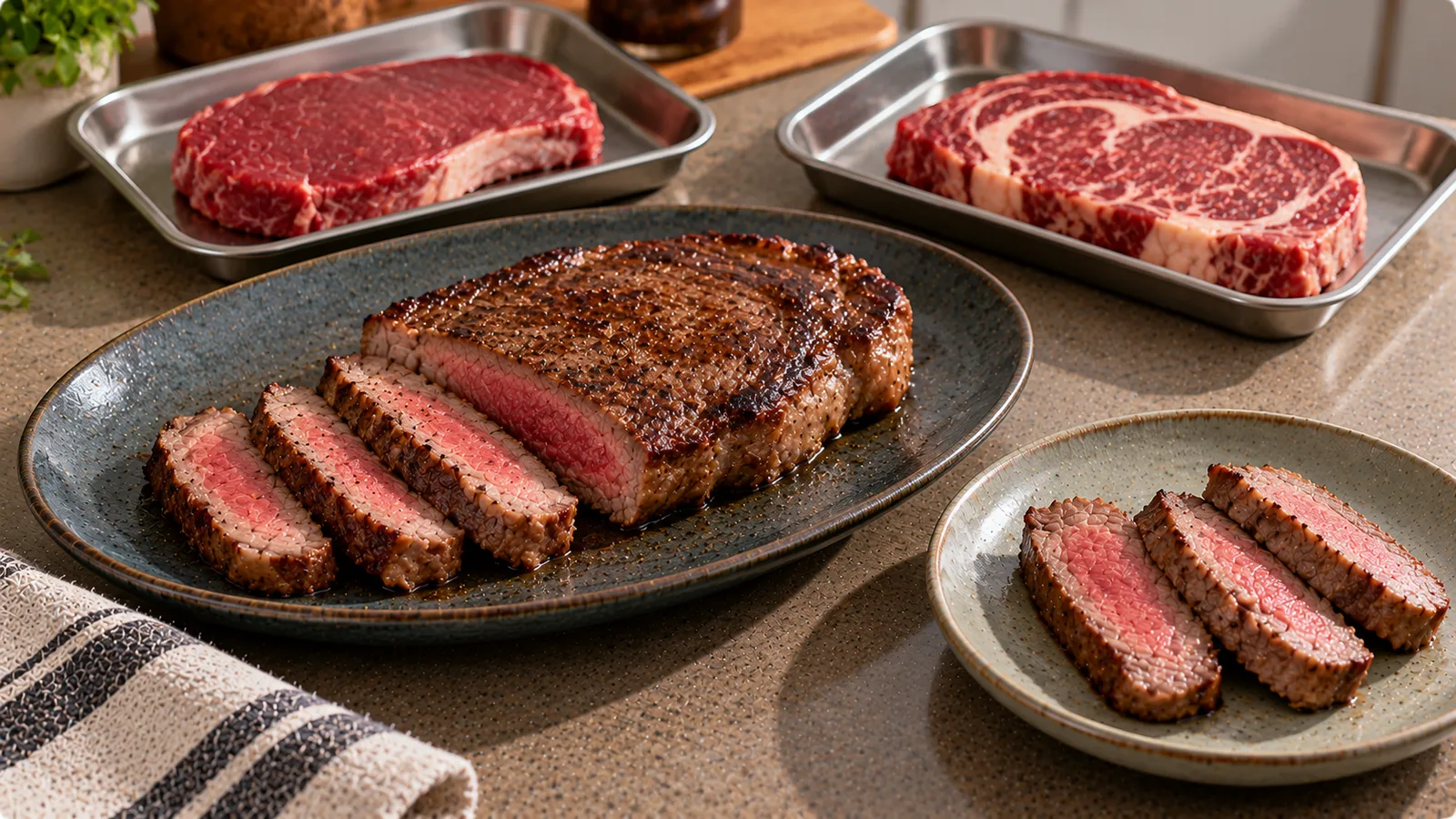
The calories in beef steak depend on more than the size of the steak.
The cut, fat content, trimming, cooking method and whether you weigh the meat raw or cooked can all change the number you should enter in a food diary.
A lean fillet steak and a heavily marbled ribeye may provide similar amounts of protein per serving, but they can have noticeably different calorie totals.
For a useful estimate, start with the specific cut and its edible weight, then account for cooking fat and sauces.
How many calories are in beef steak?
There is no single calorie value that accurately describes every steak.
The following ranges are broad, illustrative estimates for plain beef steak without added oil, butter, breading or sauce.
| Type of steak | Calories per 100 g | Protein per 100 g |
|---|---|---|
| Raw, relatively lean | 120–170 kcal | 20–23 g |
| Raw, moderately fatty | 170–230 kcal | 18–22 g |
| Cooked, relatively lean | 170–230 kcal | 26–32 g |
| Cooked, with substantial marbling or retained fat | 250–350 kcal | 23–30 g |
These are not fixed values for every steak in each category.
Actual values depend on the anatomical cut, fat grade, visible fat, cooking yield and the food-composition entry used.
For a plain cooked steak that is relatively lean, approximately 200 kcal per 100 g of edible meat can be a practical illustrative starting point.
For a heavily marbled steak, use a cut-specific value rather than assuming it has the same calories as lean beef.
Calories by steak cut
Steak names differ between countries and butchers. The following comparison describes typical characteristics rather than guaranteeing a specific calorie number.
| Cut | Typical characteristic | Calorie consideration |
|---|---|---|
| Fillet or tenderloin | Usually relatively lean | Often lower in calories than heavily marbled cuts |
| Sirloin | Variable fat and external fat cap | Depends on trimming and marbling |
| Ribeye | Often visibly marbled | Can be relatively energy-dense |
| Rump steak | Often moderately lean | Fat content depends on the specific portion |
| Strip steak | Variable marbling and fat edge | Whether the fat edge is eaten matters |
| T-bone or porterhouse | Includes bone and two muscle sections | Bone weight must be excluded from edible portions |
A cut name alone does not establish exact nutrition.
For more precise information, use a matching record in USDA FoodData Central or the nutrition information supplied with the meat.
Steak calories by serving size
Using an illustrative value of 200 kcal and 29 g protein per 100 g of cooked edible steak:
| Cooked edible steak | Calories | Protein |
|---|---|---|
| 75 g | 150 kcal | 21.8 g |
| 100 g | 200 kcal | 29 g |
| 125 g | 250 kcal | 36.3 g |
| 150 g | 300 kcal | 43.5 g |
| 175 g | 350 kcal | 50.8 g |
| 200 g | 400 kcal | 58 g |
| 250 g | 500 kcal | 72.5 g |
| 300 g | 600 kcal | 87 g |
The table assumes the same relatively lean cooked-steak composition for every portion.
It does not include butter, oil, sauce or side dishes.
A fattier steak may contain substantially more calories at the same weight.
Raw steak versus cooked steak
Beef usually loses water during cooking.
As the meat becomes lighter, the nutrients remaining in it become more concentrated per 100 g.
This is why a cooked-steak entry often shows more calories and protein per 100 g than a raw-steak entry.
Cooking does not create calories simply by removing water.
Example: a 200 g raw steak
Suppose a steak contains:
- 200 g raw edible beef.
- 150 kcal per 100 g raw.
- No added cooking fat.
Its initial estimated calories are:
200 × 150 ÷ 100 = 300 kcal.
After cooking, the steak weighs 150 g.
If the weight loss consists only of water, with no meaningful energy lost in rendered fat or juices, the steak still contains approximately 300 kcal.
The calculated value per 100 g cooked is:
300 ÷ 150 × 100 = 200 kcal.
Both descriptions refer to the same steak:
- 200 g raw at 150 kcal per 100 g.
- 150 g cooked at 200 kcal per 100 g.
In reality, cooking can also remove fat and energy-containing juices. The example illustrates water loss rather than an exact cooking conversion.
Should you weigh steak before or after cooking?
Either approach works when you use the matching nutrition entry.
| Weight measured | Nutrition entry to use |
|---|---|
| Raw boneless steak | Raw beef, matching cut and fat level |
| Cooked boneless steak | Cooked beef, matching cut and fat level |
| Raw bone-in steak | Entry accounting for edible yield |
| Cooked bone-in steak | Cooked edible meat after excluding bone |
| Steak cooked in butter | Steak plus the butter actually consumed |
| Steak served with sauce | Steak plus sauce, unless already included in a prepared-dish entry |
The most common mistake is weighing a cooked steak and entering its weight under a raw-beef record.
This mixes two different bases of measurement.
How much do fat and marbling matter?
Fat provides approximately 9 kcal per gram, compared with approximately 4 kcal per gram for protein.
A steak with more fat can therefore have a higher calorie density.
Consider two 200 g cooked steaks:
- A lean steak estimated at 200 kcal per 100 g contains about 400 kcal.
- A fattier steak estimated at 300 kcal per 100 g contains about 600 kcal.
The difference is 200 kcal, even though the edible weights are identical.
These figures illustrate the calculation. They are not universal values for fillet or ribeye.
Visible fat versus marbling
Visible fat may form a strip along the edge of a steak.
Marbling refers to fat distributed within the muscle.
If you leave the external fat on the plate, it should not be counted as eaten.
Marbling cannot generally be removed after cooking, so it remains part of the edible meat.
Choose a nutrition entry that reflects the actual steak as closely as possible.
How cooking methods change steak calories
Grilled steak
A plain grilled steak without substantial added fat is relatively straightforward to track.
Use the cooked edible weight and a matching cooked-beef entry.
Some fat may drip away during grilling.
Pan-seared steak
Pan-searing may involve oil, butter or both.
If approximately 5 g of added oil is retained in the consumed portion:
5 × 9 = approximately 45 kcal.
A steak estimated at 400 kcal would then contribute approximately:
400 + 45 = 445 kcal.
Do not automatically count all the oil poured into the pan as consumed.
Some may remain in the pan, while some may be absorbed by the steak.
Butter-basted steak
Butter-basting involves repeatedly spooning melted butter over the steak.
The calories added depend on how much butter remains on the meat or is consumed with the pan juices.
For example, 10 g of butter contains approximately 72 kcal.
That does not mean every steak basted with 10 g of butter absorbs all 72 kcal.
If you cannot measure the retained amount, record a reasonable estimate rather than treating the full amount as certain.
Steak with creamy sauce
Peppercorn sauce, cream sauce and butter-based sauces can increase the meal's calories.
Track them separately unless the nutrition entry already includes the sauce.
Does steak doneness change calories?
Rare, medium and well-done steaks can have different cooked weights because they lose different amounts of water.
However, doneness alone does not provide a reliable calorie value.
The result depends on:
- Starting weight.
- Cut and fat content.
- Cooking temperature and time.
- Fat rendered during cooking.
- Final edible weight.
A well-done steak may contain more calories per 100 g than the same steak cooked rare because it has lost more water.
That does not mean the entire steak necessarily contains more calories.
For tracking, use the weight and nutrition entry that best match the final food.
Steak protein by portion
Beef steak is a source of complete protein.
Using the illustrative value of 29 g protein per 100 g cooked:
| Cooked edible portion | Protein |
|---|---|
| 100 g | 29 g |
| 150 g | 43.5 g |
| 200 g | 58 g |
| 250 g | 72.5 g |
The actual protein content varies by cut and fat content.
Fattier steak may provide less protein per 100 g because more of the weight consists of fat.
Other nutrients in beef steak
Depending on the cut and preparation, beef steak can provide:
- Vitamin B12.
- Iron.
- Zinc.
- Selenium.
- Phosphorus.
- Niacin.
- Vitamin B6.
Beef contains haem iron, which is generally more readily absorbed than non-haem iron from many plant foods.
Exact nutrient amounts vary between cuts and food-composition records.
For verified values, consult USDA FoodData Central.
Plain steak contains very little carbohydrate. Most carbohydrates in a steak meal come from sides, breading or sauces.
How to calculate a bone-in steak
A T-bone or porterhouse steak includes bone that is not eaten.
Suppose a cooked steak weighs 350 g including the bone.
After eating, the bone and other uneaten parts weigh 80 g.
The edible portion is:
350 − 80 = 270 g.
At an illustrative 220 kcal per 100 g of cooked edible steak:
270 × 220 ÷ 100 = 594 kcal.
If you entered the full 350 g as edible steak, the result would be 770 kcal.
The difference is 176 kcal.
The actual calories depend on the two muscle sections, their fat content and any cooking additions.
Restaurant steak: what does 250 g mean?
A menu may list a steak as 200 g, 250 g or 300 g.
That number may refer to the raw weight before cooking.
It may also include bone for certain cuts.
Do not assume that a 250 g menu steak produces 250 g of cooked edible meat.
When possible, check:
- Whether the stated weight is raw or cooked.
- Whether the cut includes bone.
- Whether the steak has a substantial fat edge.
- Whether butter or oil is used.
- Whether sauce is included.
If the information is unavailable, record the estimate as approximate.
Example: steak dinner calories
Consider a meal with:
| Food | Amount | Illustrative calories |
|---|---|---|
| Cooked lean steak | 180 g | 360 kcal |
| Roasted potatoes | 200 g | 190 kcal |
| Green salad | 100 g | 20 kcal |
| Olive oil in dressing | 10 g | 90 kcal |
| Total | 660 kcal |
These values are examples, not a guaranteed total.
The potatoes may contain additional cooking oil, and the steak may be fattier than assumed.
If the potatoes were roasted with oil, include that oil rather than relying on a plain-potato estimate.
Steak versus ground beef
Steak and ground beef both come from cattle, but their nutrition can differ substantially.
Ground beef is often labelled by fat percentage, such as 5%, 10% or 20% fat.
Steak fat content depends on the cut, trimming and marbling.
A lean steak may be similar in energy density to lean ground beef.
A heavily marbled steak may be much closer to a higher-fat ground-beef product.
Use the correct food entry rather than assuming all beef products contain the same calories.
How much steak should you eat?
There is no single ideal steak portion for every adult.
Portion size depends on your overall diet, energy needs, protein requirements and personal preferences.
For tracking purposes, a cooked edible portion of 100–200 g is easy to calculate, but that range is not a universal dietary recommendation.
It is also useful to consider how frequently you eat red meat.
The World Cancer Research Fund recommends limiting red meat intake to approximately 350–500 g cooked weight per week for people who eat it, while consuming little, if any, processed meat.
This is a population-level cancer-prevention recommendation, not a required serving size for one meal.
Source: World Cancer Research Fund — Limit red and processed meat.
Food safety: cooking steak
For whole beef steaks, the USDA recommends a minimum internal temperature of 63°C (145°F) followed by a 3-minute rest.
Use a food thermometer in the thickest part.
Ground beef has different temperature guidance and should not be treated as an intact steak.
Official reference: USDA FSIS — Safe Minimum Internal Temperature Chart.
Follow stricter product-specific or local public-health instructions where applicable.
How to log steak accurately
For a home-cooked steak:
- Identify the cut.
- Check whether the steak is lean or heavily marbled.
- Choose raw or cooked weight.
- Weigh only the edible portion.
- Exclude bone and uneaten fat.
- Select a matching food-composition entry.
- Add consumed oil, butter and sauces.
- Record side dishes separately.
For restaurant steak, note the cut, menu weight, cooking method and uncertainty.
The most important factors are usually the cut, fat content and edible weight, not whether you estimate the last few grams perfectly.