
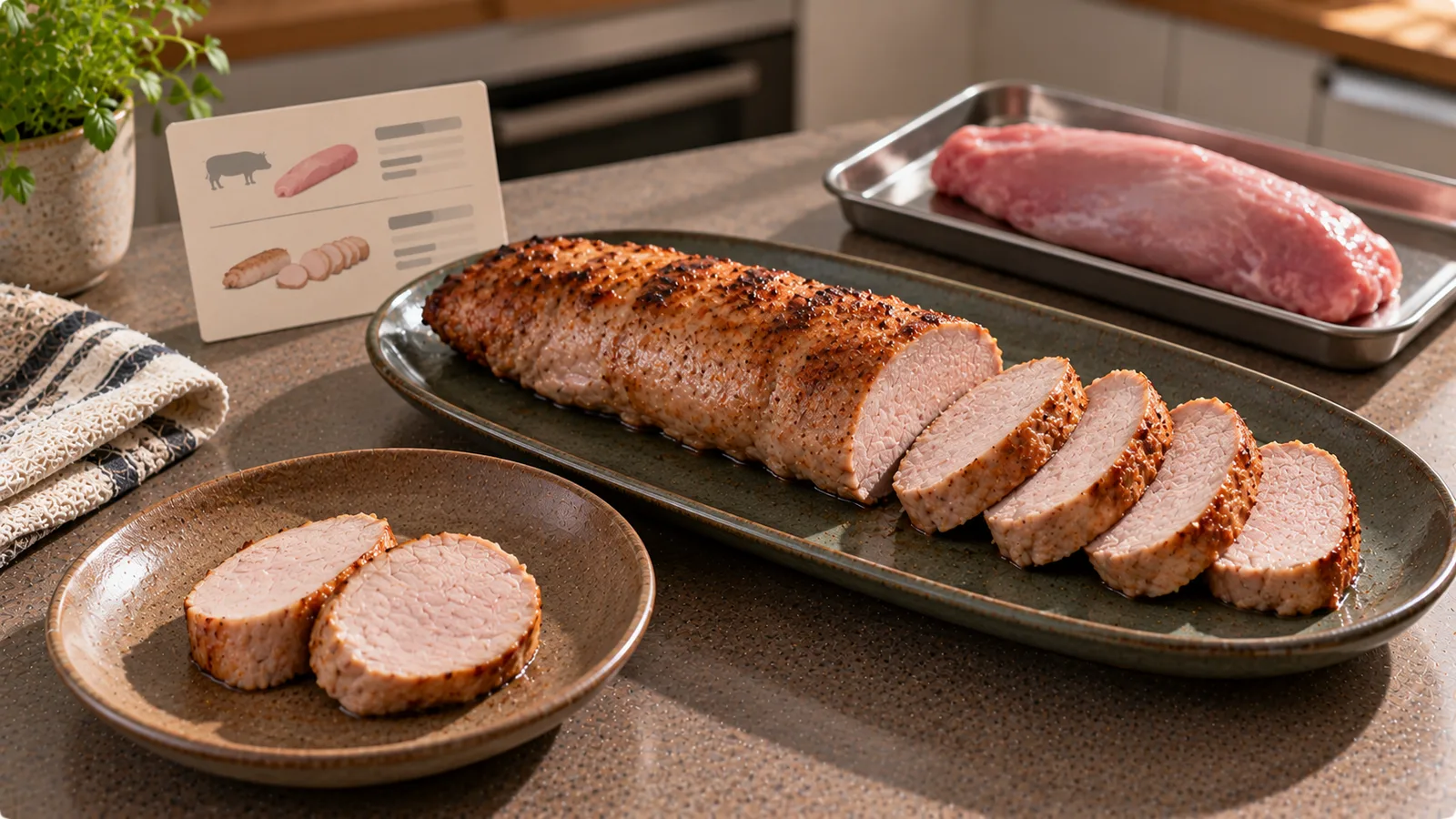
Pork tenderloin is one of the leaner cuts of pork. It provides substantial protein without the fat content of many other pork cuts.
But how many calories does it contain?
The answer depends on whether you weigh it raw or cooked, how much visible fat remains and whether you add oil, butter, sauce or breading.
As a practical starting estimate:
- 100 g raw, trimmed pork tenderloin: approximately 120 kcal and 21 g protein.
- 100 g cooked, roasted pork tenderloin: approximately 145 kcal and 26 g protein.
These are rounded reference estimates, not universal values. Actual nutrition varies with trimming, cooking method, water loss and the specific food-composition entry.
Pork tenderloin nutrition per 100 g
The following values are approximate examples for plain pork tenderloin without added cooking fat.
| Nutrient | 100 g raw | 100 g roasted |
|---|---|---|
| Calories | 120 kcal | 145 kcal |
| Protein | 21 g | 26 g |
| Fat | 4 g | 4.5 g |
| Carbohydrates | 0 g | 0 g |
The estimates are rounded and should not be interpreted as a direct laboratory analysis of one particular product.
For more precise values, select a matching raw or cooked entry in USDA FoodData Central or another reliable food-composition database.
The main point is that the cooked version usually has more calories and protein per 100 g because cooking removes water.
That does not mean cooking creates protein or calories.
Calories by serving size
If you use the reference values above, portion estimates look like this:
| Portion | Raw tenderloin | Roasted tenderloin |
|---|---|---|
| 100 g | 120 kcal | 145 kcal |
| 125 g | 150 kcal | 181 kcal |
| 150 g | 180 kcal | 218 kcal |
| 175 g | 210 kcal | 254 kcal |
| 200 g | 240 kcal | 290 kcal |
| 250 g | 300 kcal | 363 kcal |
These columns describe different weighing states.
A 150 g raw portion is not equivalent to a 150 g cooked portion.
Do not use the cooked column for meat weighed before cooking.
Protein by serving size
| Portion | Raw tenderloin | Roasted tenderloin |
|---|---|---|
| 100 g | 21 g | 26 g |
| 125 g | 26 g | 33 g |
| 150 g | 32 g | 39 g |
| 175 g | 37 g | 46 g |
| 200 g | 42 g | 52 g |
| 250 g | 53 g | 65 g |
All figures are rounded estimates.
Raw versus cooked pork tenderloin
Pork tenderloin loses water during cooking.
For example, imagine that:
- You start with 200 g of raw, trimmed tenderloin.
- The raw meat contains approximately 240 kcal.
- After roasting, the meat weighs 165 g.
- No oil or other calorie-containing ingredient is added.
If the change is mainly water loss and there is no meaningful loss of fat or juices containing energy, the cooked portion still contains approximately 240 kcal.
The calculated energy density would be:
240 ÷ 165 × 100 = 145 kcal per 100 g cooked, rounded.
This example illustrates the relationship between raw and cooked weights.
Actual cooking losses vary. Some fat and nutrient-containing juices may leave the meat, so a real cooked-food composition entry is preferable when available.
Why the cooked weight matters
Suppose you weigh 150 g of pork tenderloin after cooking.
Using 120 kcal per 100 g raw would give:
150 × 120 ÷ 100 = 180 kcal.
But using the illustrative cooked value of 145 kcal per 100 g gives:
150 × 145 ÷ 100 = 218 kcal.
The difference is caused mainly by the mismatch between raw and cooked measurements.
Pork tenderloin versus pork loin
Pork tenderloin and pork loin are different cuts.
Pork tenderloin is a narrow, relatively small and lean muscle.
Pork loin is a larger cut that may be sold with different amounts of fat attached.
Their calorie values can overlap, particularly when both are well trimmed, but they should not automatically be treated as identical foods.
Other cuts can differ more substantially:
| Pork product | What affects its calories? |
|---|---|
| Tenderloin | Trimming and cooking losses |
| Pork loin | Fat cap and trimming |
| Pork chop | Cut, visible fat and bone |
| Pork shoulder | Intramuscular fat and trimming |
| Pork belly | Much higher fat content |
| Breaded pork schnitzel | Coating and absorbed frying oil |
Use a food entry that matches the actual cut and preparation.
Does pork tenderloin contain carbohydrates?
Plain, unseasoned pork tenderloin contains essentially no carbohydrates.
Carbohydrates can appear when the meat is prepared with:
- Sweet marinades.
- Barbecue sauce.
- Honey glaze.
- Flour or breadcrumbs.
- Sweetened packaged seasoning mixes.
The meat itself is not the source of those added carbohydrates.
How much fat is in pork tenderloin?
Trimmed tenderloin is relatively lean, but it is not completely fat-free.
Fat content depends on:
- How thoroughly visible fat and silverskin are removed.
- The particular animal and cut.
- The reference database entry.
- Whether cooking fat is added.
- Whether cooking juices and rendered fat are consumed.
Do not assume that every package of tenderloin has the same fat percentage.
If the package provides nutrition information, use those figures for the raw product when appropriate.
How cooking oil changes the calories
A lean cut can become a higher-calorie meal when cooked with additional fat.
Consider a 200 g raw portion of tenderloin:
- Meat: approximately 240 kcal.
- Olive oil added to the pan: 10 g.
- Oil energy: approximately 90 kcal.
If all the oil is consumed, the meal contains approximately:
240 + 90 = 330 kcal, before sauces or side dishes.
If some oil remains in the pan, the actual amount consumed may be lower.
For accurate tracking, record the oil used and make a reasonable adjustment for any measurable amount left behind.
Cooking method comparison
| Method | Main consideration |
|---|---|
| Oven roasting | Usually little added fat if cooked plainly |
| Air frying | Added oil depends on the recipe |
| Pan searing | Oil or butter can increase calories |
| Grilling | Marinades and sauces may add energy |
| Breaded frying | Breading and absorbed oil change the nutrition |
| Slow cooking | Sauces and cooking liquids affect the finished dish |
The cooking method alone does not determine calories. The ingredients and amounts matter.
What is an edible serving?
Pork tenderloin is generally sold as a boneless cut.
However, you may remove silverskin, connective tissue or visible fat before cooking.
For accurate calculations, distinguish:
- Purchased weight.
- Trimmed raw edible weight.
- Cooked edible weight.
- Actual portion eaten.
Example:
You purchase 500 g of tenderloin and remove 30 g of trimmings.
The remaining raw edible meat weighs 470 g.
Using the illustrative 120 kcal per 100 g:
470 × 120 ÷ 100 = 564 kcal for the trimmed raw meat.
If the finished roast is divided into three equal portions, that is approximately 188 kcal of meat per portion, before any added fat.
This method avoids counting trimmings you did not eat.
Is pork tenderloin a good protein source?
Yes. Pork tenderloin provides substantial complete protein, along with nutrients naturally found in pork, including thiamin, vitamin B6, vitamin B12, zinc and selenium.
Exact micronutrient amounts depend on the cut, preparation and database entry.
For a meal, protein intake also depends on portion size.
Using the illustrative cooked value:
- 100 g cooked: approximately 26 g protein.
- 150 g cooked: approximately 39 g protein.
- 200 g cooked: approximately 52 g protein.
There is no need to eat a particular amount of pork to reach a protein target. Other foods can provide protein as well.
How to cook pork tenderloin safely
For whole cuts of pork, the US food-safety guidance lists a minimum internal temperature of 63°C / 145°F, followed by a 3-minute rest.
Check the thickest part with a food thermometer.
Ground pork has a different recommended temperature and should not be treated as a whole cut.
See FoodSafety.gov — Safe Minimum Internal Temperatures.
The final temperature affects food safety and cooking yield; visual colour alone is not a reliable substitute for a thermometer.
How to log pork tenderloin in a food diary
The simplest method is to match the database entry to the moment you weighed the meat.
If weighed raw
- Trim the meat.
- Weigh the raw edible portion.
- Select a raw pork tenderloin entry.
- Add oil, sauce and other ingredients separately.
- Divide the cooked recipe into the portions actually eaten.
If weighed cooked
- Weigh the cooked edible portion.
- Select a cooked pork tenderloin entry matching the cooking method.
- Check whether the entry includes added fat.
- Add any oil, glaze or sauce not included in the entry.
Avoid mixing a raw weight with cooked nutrition values.
If cooking for several people
For a shared dish, calculate the total raw ingredients and their calories first.
After cooking, weigh the finished edible meat and divide the recipe according to the portions served.
This approach can be more accurate than assuming a fixed cooking loss.
A practical meal example
Imagine a plate containing:
- 150 g roasted pork tenderloin: approximately 218 kcal.
- 250 g boiled potatoes: approximately 190 kcal.
- 200 g steamed broccoli: approximately 70 kcal.
- 10 g olive oil: approximately 90 kcal.
Estimated total:
218 + 190 + 70 + 90 = 568 kcal.
These are illustrative values; actual results depend on the ingredients, preparation and amount of oil consumed.
The pork contributes most of the protein, while the potatoes and broccoli add carbohydrates, fibre and other nutrients.
The takeaway
For a quick estimate, plain trimmed pork tenderloin contains approximately:
- 120 kcal and 21 g protein per 100 g raw.
- 145 kcal and 26 g protein per 100 g roasted.
The most important step is not memorizing one calorie number. It is choosing values that match the cut, trimming, cooking method and weight you actually measured.