
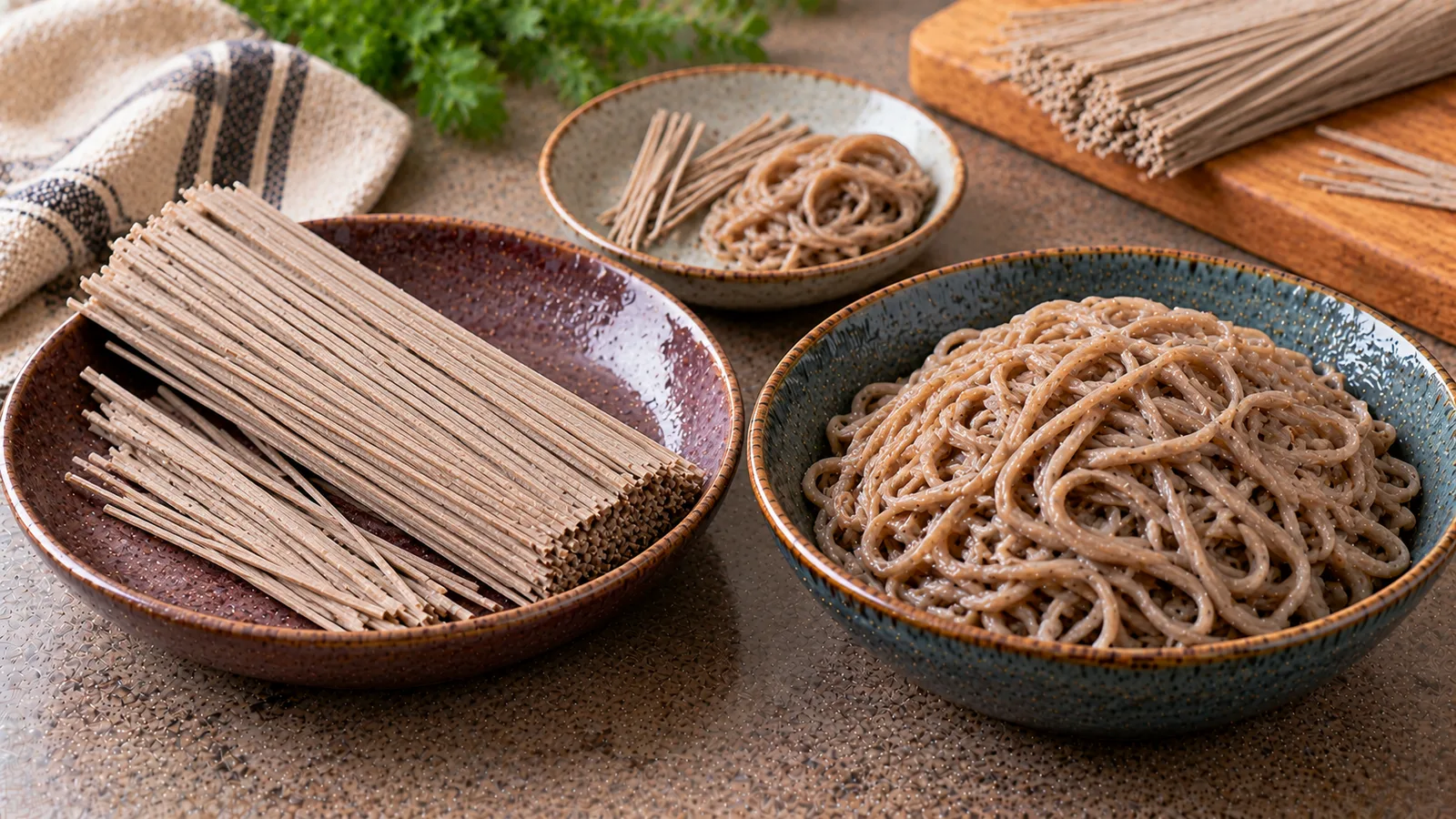
Soba are Japanese-style noodles traditionally associated with buckwheat. Their calorie count depends most of all on whether the weight you have recorded is dry or cooked. A dry bundle and a plate of noodles do not represent the same amount of water, and two packages called soba need not contain the same proportions of buckwheat and wheat. Here is a weight-based method using two identified USDA SR Legacy food records, with the limits of those figures made explicit. It is a food-composition guide, not a claim that every brand behaves identically.
Soba calories at a glance
The USDA SR Legacy reference for dry Japanese soba, FDC 168906, supplies 336 kcal per 100 g. The distinct record for cooked Japanese soba, FDC 168907, supplies 99 kcal per 100 g. These are two reference foods, not a measured before-and-after trial of the same packet. A bowl containing 200 g of noodles matching the cooked reference supplies about 198 kcal before any dressing. In contrast, 60 g of dry noodles supplies about 202 kcal before boiling. Both statements can be true without implying that cooking destroys calories.
USDA nutrition: what the records actually describe
The dry reference supplies approximately 14.38 g protein, 74.62 g carbohydrate and 0.71 g fat per 100 g. The cooked reference has 5.06 g protein, 21.40 g carbohydrate and 0.10 g fat per 100 g. Concentration changes as water is absorbed; the components have not automatically disappeared. The carbohydrate figures follow the US database convention, which can differ from the separation of carbohydrate and fibre on European labels. Use brand packaging when comparing products. Neither reference entry supplies an automatic guarantee of a particular buckwheat content, fibre amount or allergen status.
Dry portions before cooking
Start by measuring the dry noodles you put in the pot. At the dry reference, 50 g = 168 kcal, 60 g = about 202 kcal, 75 g = 252 kcal, and 100 g = 336 kcal. A 60 g bundle is a useful worked example, not a universally recommended amount; choose the serving for the actual meal. In a recipe for two people, two measured 75 g dry portions have 504 kcal of noodles in total. Divide cooked noodles after draining, rather than mixing up the pan's water weight with the original dry ingredients.
Cooked portions and the water effect
Using the separate cooked USDA entry, 100 g cooked = 99 kcal, 150 g = approximately 149 kcal, 200 g = 198 kcal, and 250 g = approximately 248 kcal. These numbers work when the cooked noodles resemble that reference. Do not apply 99 kcal per 100 g to an arbitrary homemade batch whose actual water uptake is substantially different. A cup is also not a fixed gram weight: the shape of the noodle, packing and whether it is still wet will affect the volume. Weigh a cooked plate whenever possible.
| Portion / reference | Approximate kcal | Basis |
|---|---|---|
| 50 g dry | 168 kcal | dry USDA |
| 60 g dry | 202 kcal | dry USDA |
| 75 g dry | 252 kcal | dry USDA |
| 100 g dry | 336 kcal | dry USDA |
| 100 g cooked | 99 kcal | cooked USDA |
| 150 g cooked | 149 kcal | cooked USDA |
| 200 g cooked | 198 kcal | cooked USDA |
| 250 g cooked | 248 kcal | cooked USDA |
A worked batch: use your own cooked yield
Consider an illustrative, not universal, cooking test: weigh 70 g dry soba and suppose the drained noodles weigh 210 g. The initial noodles contain about 235 kcal (70 × 336 ÷ 100). If no calorie-bearing ingredient is added and loss into the water is ignored for this simplified estimate, the entire 210 g cooked batch still represents about 235 kcal, or 112 kcal per 100 g cooked. That figure differs from the independent USDA 99 kcal cooked reference because this sample uses its own 3:1 yield. If your yield is 175 g or 245 g, the calculated density changes. Record both weights at least once for a frequently used brand.
Why buckwheat percentage and gluten labels matter
Buckwheat is not wheat, but commercial soba may be made from buckwheat flour mixed with wheat flour. Check the ingredient list and, when gluten avoidance is medically necessary, appropriate gluten-free labelling and cross-contact information. The Celiac Disease Foundation specifically lists some soba noodles among wheat-containing products. A dark colour or the word “buckwheat” is not an allergen certification. This article does not judge a product safe for coeliac disease based on nutrition numbers. A high buckwheat percentage also does not give a single guaranteed calorie number; water, flour blend and added ingredients still vary.
How sauce and oil change the bowl
Plain noodles are only one component of a serving. For a transparent example, 75 g dry soba supplies 252 kcal using the reference. Add 5 g of oil, about 45 kcal using the common 9 kcal/g energy estimate, and the subtotal reaches 297 kcal, before vegetables, tofu, broth or sweetened dressing. Soy-based sauces can contribute salt and possibly sugar; the amount depends on the bottle and poured quantity. A restaurant bowl may include oil that cannot be seen in the finished dish. Enter each measured topping separately instead of calling the entire bowl “99 kcal per 100 g”.
Shopping, weighing and meal-prep decisions
Read the manufacturer's nutrition panel first, paying attention to whether it is expressed per 100 g dry, per portion or as prepared. Some fresh or precooked soba comes hydrated in sealed packets; its per-100 g number should not be treated as a dry product. When meal-prepping, note how many grams of dry noodles were cooked and how many plates were served. For a shared batch, distribute calories by weighed cooked portions after mixing thoroughly; this is more reliable than guessing that each plate contains precisely half the noodles if servings are visibly different.
Practical examples that prevent double counting
Example A: you log 60 g dry soba, then cook it. Keep approximately 202 kcal for noodles even if its cooked weight is 180 g. Example B: you receive 200 g plain cooked soba without a dry weight; 198 kcal is a reasonable USDA-reference estimate, not a label-specific fact. Example C: a stir-fry uses 60 g dry soba and 10 g oil. The reference subtotal is about 292 kcal before other ingredients. When a sauce's calories are unknown, do not silently mark them zero. A small measured amount of oil may matter more than a substantial change in cooked water weight.
A simple method you can repeat
Choose one consistent accounting path: either use the package's dry-weight calories for the raw amount used, or use a credible cooked-food entry with a weighed cooked amount. For a particular batch, dividing dry calories by measured cooked yield is often the most transparent route. Do not add the dry-calorie total to the cooked-calorie total; they describe the same noodles at different stages. Keep recipe entries for dressing, protein and vegetables separate, and revisit the label if you switch brands. That approach preserves both accuracy and the practical simplicity of a quick food diary.