
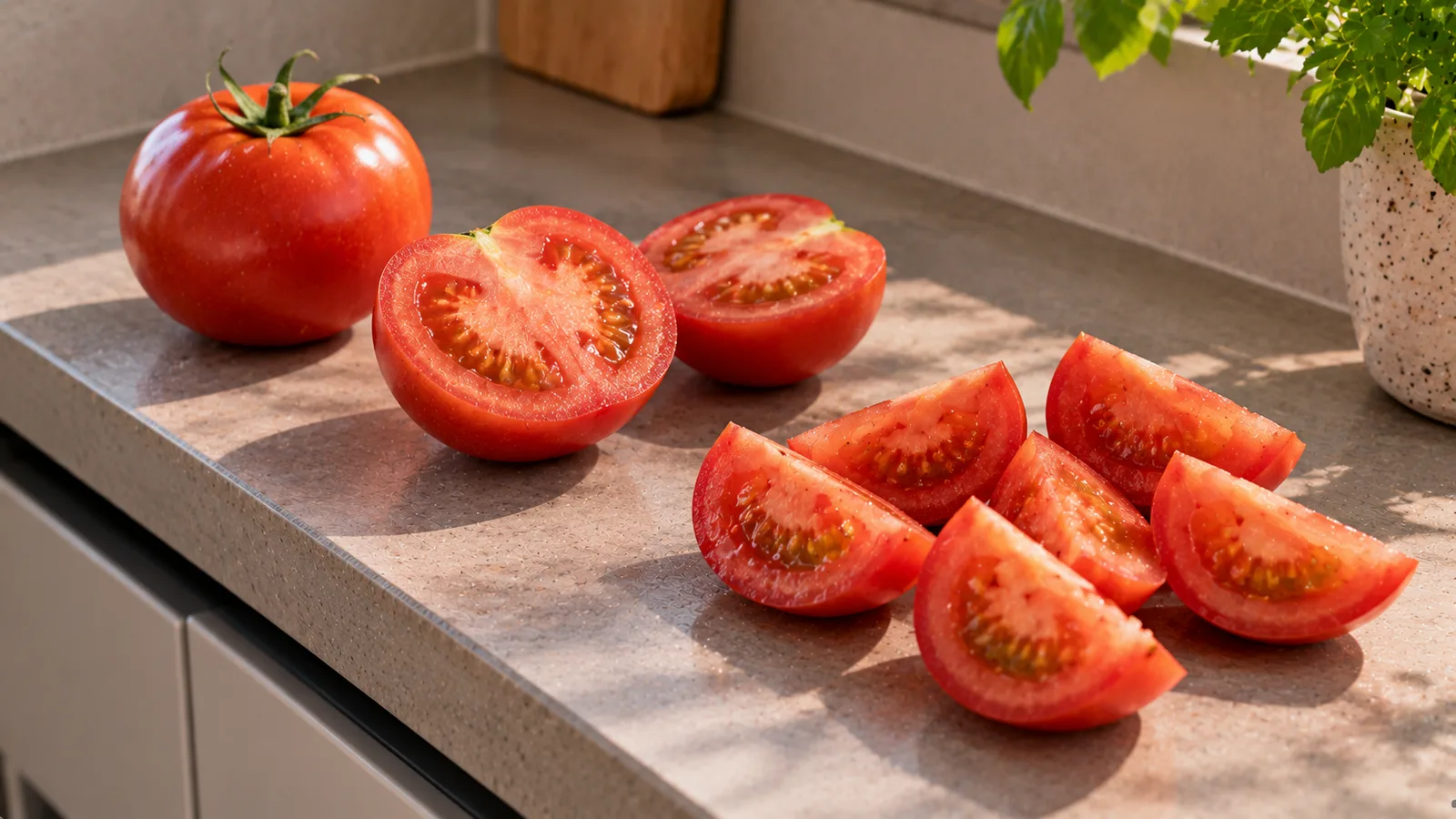
Tomatoes are low in calories because most of their weight comes from water.
As a practical reference, 100 g of raw red tomatoes contains about 18 kcal.
The exact number for an individual tomato depends mainly on its weight. Variety, ripeness and the specific nutrition database can also produce small differences.
Tomato calories at a glance
| Amount | Approximate calories |
|---|---|
| 50 g | 9 kcal |
| 100 g | 18 kcal |
| 150 g | 27 kcal |
| 200 g | 36 kcal |
| 250 g | 45 kcal |
| 300 g | 54 kcal |
These values are for plain raw tomatoes without oil, dressing or other additions.
How many calories are in one tomato?
“One tomato” is not a precise serving size because tomatoes vary considerably in size.
Using 18 kcal per 100 g as a practical reference:
| Tomato portion | Example weight | Approximate calories |
|---|---|---|
| Small tomato | 90 g | 16 kcal |
| Medium tomato | 120 g | 22 kcal |
| Large tomato | 180 g | 32 kcal |
| Very large tomato | 250 g | 45 kcal |
If accuracy matters, weighing the edible portion is more reliable than choosing “one tomato” from a database.
Calories in cherry tomatoes
Cherry tomatoes are smaller, but their calories per 100 g are broadly similar to ordinary raw tomatoes.
For example:
| Cherry tomatoes | Approximate weight | Approximate calories |
|---|---|---|
| 50 g | 50 g | 9 kcal |
| 100 g | 100 g | 18 kcal |
| 150 g | 150 g | 27 kcal |
| 200 g | 200 g | 36 kcal |
Counting individual cherry tomatoes is less reliable because their size varies.
If you eat a handful or a bowl of them, total weight is the more useful measurement.
Calories in grape tomatoes
Grape tomatoes also have a similar calorie density.
A practical estimate remains around 18 kcal per 100 g for plain raw tomatoes.
The difference between tomato varieties is usually less important for calorie tracking than the difference in portion size or added ingredients.
Basic nutrition in 100 g of raw tomatoes
Approximate values for raw red tomatoes:
| Nutrient | Per 100 g |
|---|---|
| Calories | 18 kcal |
| Protein | 0.9 g |
| Carbohydrate | 3.9 g |
| Fiber | 1.2 g |
| Fat | 0.2 g |
Tomatoes also provide vitamin C, potassium and carotenoids such as lycopene.
Values can vary slightly between varieties and nutrition databases.
Why tomatoes are low in calories
Raw tomatoes contain a large amount of water and relatively little fat.
That means a fairly large physical portion can contain relatively few calories.
For example, 250 g of plain tomatoes is only around 45 kcal using the 18 kcal per 100 g reference.
This does not mean tomatoes make an entire meal on their own. It simply explains their low energy density.
How to calculate calories for any tomato portion
If your tomato weighs 175 g and the reference value is 18 kcal per 100 g:
175 × 18 ÷ 100 = 31.5 kcal
So the portion contains approximately 32 kcal.
The same method works for any weight.
Raw vs cooked tomatoes
Cooking tomatoes does not create calories by itself.
However, cooking changes water content, so the calorie value per 100 g can differ depending on how much water is lost.
This is important when comparing:
- raw tomatoes;
- roasted tomatoes;
- stewed tomatoes;
- tomato sauce;
- tomato paste.
The more concentrated the product becomes, the less useful it is to assume that its calories per 100 g are identical to raw tomatoes.
For a broader explanation of this issue, see Raw vs Cooked Weight: Which Should You Use for Calories?.
Fresh tomatoes vs tomato sauce
Plain fresh tomatoes and prepared tomato sauce should not automatically be logged as the same food.
A sauce may contain:
- oil;
- sugar;
- vegetables;
- cheese;
- meat;
- other ingredients.
Even a sauce made only from tomatoes can become more concentrated as water evaporates.
Use the nutrition information for the actual sauce whenever it is available.
Tomato paste is different
Tomato paste is much more concentrated than fresh tomato.
A spoonful may look small, but comparing it gram-for-gram with raw tomato is misleading because much of the original water has been removed.
When tracking tomato paste, choose a database entry specifically for tomato paste rather than a generic raw tomato entry.
The biggest calorie difference often comes from what you add
Plain tomatoes contribute relatively few calories.
A tomato salad can be very different depending on additions.
For example:
200 g tomatoes
≈ 36 kcal
Add:
- 10 g olive oil: roughly 90 kcal;
- 40 g feta: often around 100 kcal, depending on the product.
The tomatoes are still low in calories, but the complete dish is no longer a 36 kcal serving.
This is why it is useful to distinguish the calories in the tomato from the calories in the whole recipe.
Tomatoes in salads
If you are tracking a mixed salad, you can either:
- weigh the tomatoes separately; or
- calculate the entire recipe and divide it into portions.
The second approach is often easier when preparing several servings at once.
Ingredients such as oil, cheese, avocado, nuts and dressing usually affect the total calories more than small differences between tomato varieties.
Tomatoes in sandwiches and wraps
A few tomato slices in a sandwich usually contribute relatively few calories.
If precise tracking is not necessary, estimating a small tomato portion may be sufficient.
If you are tracking closely, weigh the tomato before assembling the sandwich or use the weight of the portion added.
Canned tomatoes
Canned tomatoes can also be relatively low in calories, but products differ.
Check whether the can contains:
- tomatoes only;
- tomato juice;
- added sugar;
- oil;
- seasonings or other ingredients.
For packaged products, the nutrition declaration on the specific product is usually more useful than a generic tomato entry.
Drained or undrained?
If a canned product gives nutrition information for the product as sold, make sure your logged amount corresponds to that state.
A drained portion and a portion including liquid may have different weights.
The same principle applies to many packaged foods: match the state you weigh with the state described by the nutrition data.
Do tomato varieties have different calories?
There can be small differences among:
- beefsteak tomatoes;
- Roma tomatoes;
- cherry tomatoes;
- grape tomatoes;
- vine tomatoes.
For most everyday calorie tracking, these differences are minor compared with:
- how much tomato you actually eat;
- whether it is raw or concentrated;
- whether oil or other ingredients are added.
Choosing the correct general tomato type and using a realistic portion is usually more important than searching for an exact calorie value for every cultivar.
Should you weigh tomatoes?
You do not necessarily need to weigh every tomato.
Weighing is most useful when:
- you want more precise calorie tracking;
- the portion is unusually large;
- tomatoes are part of a recipe you are calculating;
- you are learning what common portions look like.
For ordinary meals, a reasonable portion estimate may be enough depending on your goal.
Example: tomato and feta salad
Suppose your salad contains:
- 250 g tomatoes;
- 100 g cucumber;
- 40 g feta;
- 10 g olive oil.
The tomatoes contribute approximately:
250 × 18 ÷ 100 = 45 kcal
But you should calculate the cucumber, feta and oil separately to estimate the complete salad.
This example shows why “tomato salad calories” cannot be inferred from tomatoes alone.
Example: tomatoes added to pasta
Suppose you add 300 g of fresh tomatoes to a pasta dish.
The tomatoes contribute approximately:
300 × 18 ÷ 100 = 54 kcal
If you also use pasta, olive oil, cheese and meat, those ingredients will usually contribute much more to the total energy of the dish.
Common tracking errors
Logging one tomato without checking its size
A small tomato and a very large tomato can differ substantially in weight.
Using raw tomato data for tomato paste
These are different products with very different water concentrations.
Forgetting cooking oil
Roasted tomatoes themselves remain relatively low in calories, but oil used during roasting can substantially change the total.
Logging the whole salad as tomatoes
Cheese, dressing, oil, nuts and other additions need to be included separately.
Mixing grams and serving entries
If the database says “1 medium tomato,” make sure the assumed weight is reasonably close to the tomato you actually ate.
Practical takeaway
For plain raw tomatoes, about 18 kcal per 100 g is a useful reference.
That means:
- 100 g ≈ 18 kcal;
- 150 g ≈ 27 kcal;
- 200 g ≈ 36 kcal;
- 250 g ≈ 45 kcal.
For most people, the biggest source of error is not the difference between tomato varieties. It is portion size, concentrated tomato products or calorie-dense ingredients added to the dish.
When possible, match the food entry to the actual form you ate: raw tomato, cooked tomato, canned tomato, sauce or paste.
Nutrition data sources
Reference values below are per 100 g of the specified food. Product varieties and preparation methods can differ.
- USDA FoodData Central — Tomatoes, red, ripe, raw, year round average (FDC 170457; 18 kcal/100 g).