
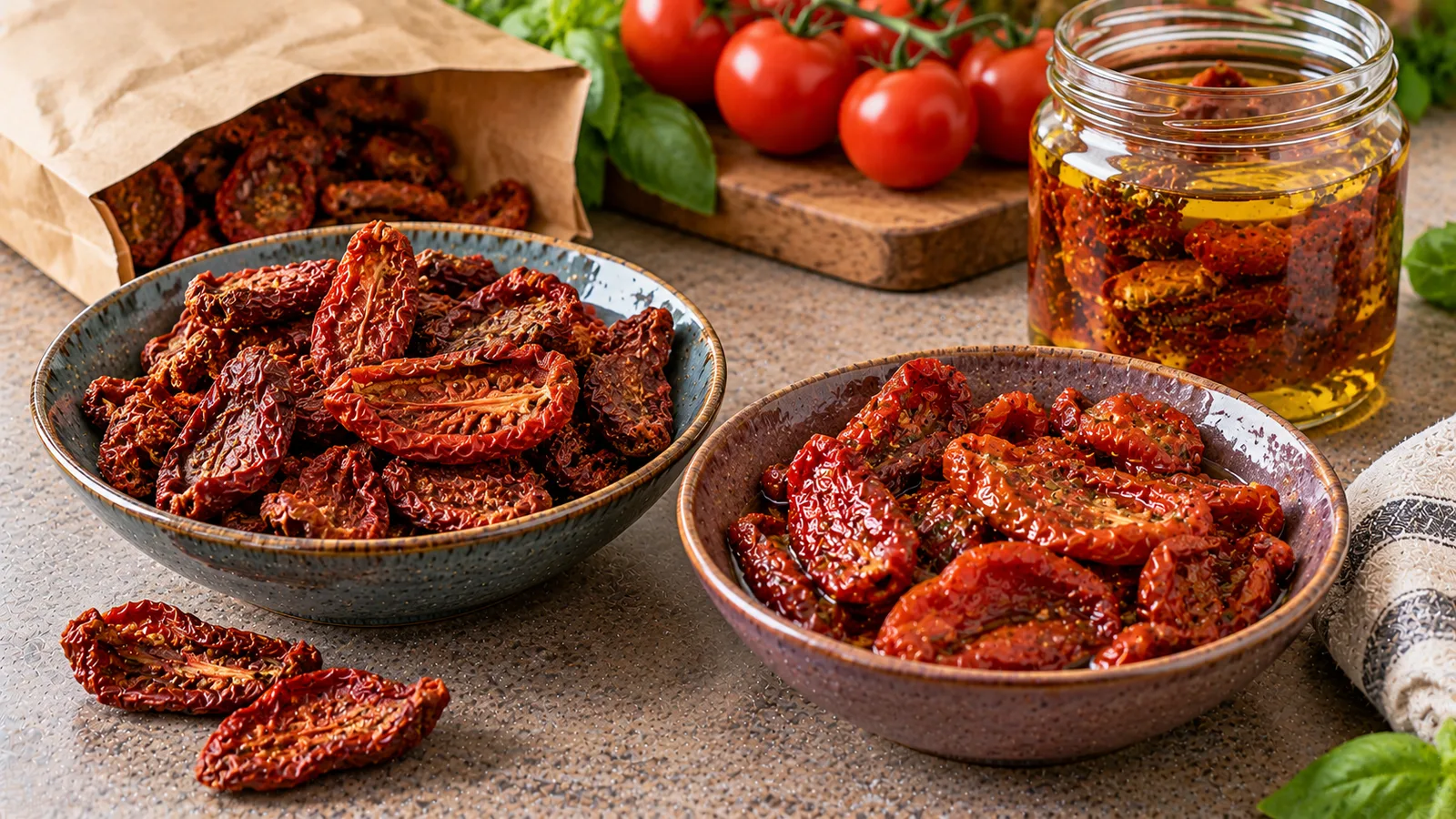
Sun-dried tomatoes taste intense because much of the original water has been removed. But “sun-dried tomatoes” can mean two quite different foods in a kitchen: leathery dry pieces sold in a bag, and soft pieces packed in a jar of oil. Their calories per 100 g are not interchangeable. To estimate a serving, first identify the form on the label and then weigh only the food actually eaten. A spoonful of loose oil needs its own calculation. This guide focuses on the food itself rather than repeating the general nutrition profile of fresh tomatoes or comparing canned tomatoes with fresh ones.
The two USDA reference foods
USDA FoodData Central SR Legacy identifies dry sun-dried tomatoes, FDC 168567, at 258 kcal per 100 g with 2.97 g fat, 14.1 g protein, 55.8 g carbohydrate and 12.3 g fibre. The separate entry sun-dried tomatoes packed in oil, drained, FDC 169384, is 213 kcal per 100 g, with 14.08 g fat, 5.06 g protein, 23.33 g carbohydrate and 5.8 g fibre. These are specific reference foods, not guaranteed values for every brand. The dry entry contains about 14.6% water, whereas the drained oil-packed entry contains about 53.8% water. That change in water concentration helps explain why the oil-packed reference can have fewer calories per 100 g despite having more fat. It does not imply that adding oil makes the original dry tomatoes lose energy.
Portions in grams, not guessed pieces
A piece is not a reliable serving unit: small fragments, thick halves and soft jar-packed strips differ in weight. For a topping, many cooks use 10–30 g; a recipe might use 50 g or more. Weigh the portion on a kitchen scale and calculate grams × 2.58 for the dry reference or grams × 2.13 for the oil-packed drained reference. For instance 20 g dry = about 52 kcal; 20 g drained = about 43 kcal. The corresponding 30 g estimates are 77 kcal and 64 kcal. These figures reflect the two referenced products, not an instruction to substitute 20 g of one for 20 g of the other in recipes. They deliver different textures, salt, water and flavour concentrations.
Reference portion estimates
| Weight | Dry tomatoes | Oil-packed drained | Difference |
|---|---|---|---|
| 5 g | 13 kcal | 11 kcal | 2 kcal |
| 10 g | 26 kcal | 21 kcal | 5 kcal |
| 20 g | 52 kcal | 43 kcal | 9 kcal |
| 30 g | 77 kcal | 64 kcal | 13 kcal |
| 50 g | 129 kcal | 107 kcal | 22 kcal |
| 100 g | 258 kcal | 213 kcal | 45 kcal |
Why the oil-packed figure may look surprisingly lower
Consider a thought experiment. A handful of dried tomatoes absorbs some water before being stored in oil. Its new weight includes water as well as tomato solids and perhaps retained oil. You cannot compare the old and new weights as if they represent identical tomato matter. For a fair nutritional comparison, match a real package's preparation state and its declared per-100-g value. Some jars contain much more absorbed oil than the USDA reference; others are brine-packed or are barely oily after draining. Their values can be lower or higher than 213 kcal. The jar's nutrition table wins over a generic database number whenever it describes the portion you are using.
Drained weight and leftover jar oil
“Drained weight” refers to the solid food after some packing liquid has been separated; it is not necessarily the total net weight shown on the front of a jar. If the jar says 280 g net and 180 g drained, the larger number includes the liquid. For a recipe using 30 g tomatoes taken from the jar and gently drained, use the drained-product reference or the corresponding label. If you pour an extra 5 g of the oil into the pan, count that separately at roughly 44 kcal using a standard 884 kcal/100 g oil assumption. Thus 30 g drained tomatoes (64 kcal) + 5 g oil (44 kcal) ≈ 108 kcal. Do not count that oil again if a product label already includes the retained oil in the weighed tomato portion.
Rehydrating dry tomatoes with water
Dried tomatoes may be soaked in hot water to soften them. Plain water adds no calories. If 20 g dry contains roughly 52 kcal, and after soaking and draining it weighs 40 g, the softened batch still starts from about 52 kcal, not 104 kcal. The energy per 100 g of the rehydrated product is now lower because the same energy is spread through a heavier, wetter batch. The exact cooked or soaked yield is variable; record the dry weight before soaking rather than multiplying the final water-filled weight by the dry entry. If soaking liquid is discarded, minor nutrient losses may occur, so this remains an approximate kitchen model.
Oil, salt and added ingredients
Oil contributes far more energy per gram than water. However, a dry tomato may also be seasoned with salt, sugar or herbs, and a jar may contain vinegar, garlic or sunflower oil. Check the ingredients rather than treating colour and texture as proof of a particular nutritional profile. The USDA dry entry lists 107 mg sodium per 100 g; the drained oil-packed reference lists 266 mg sodium per 100 g. Those numbers are not typical limits for every product; heavily salted brands can differ greatly. Where a European label states salt, it normally reflects the product's sodium expressed as salt equivalent, approximately sodium × 2.5. Calorie tracking and dietary salt tracking are separate questions.
A worked pasta example
Suppose a bowl of pasta uses 25 g dry sun-dried tomatoes. Using the dry reference, the tomato component contributes 25 × 2.58 ≈ 65 kcal. If instead you add 25 g oil-packed drained tomatoes, that component contributes 25 × 2.13 ≈ 53 kcal. Add 5 g extra jar oil to the second version and the tomato-plus-oil contribution becomes 53 + 44 = 97 kcal. These are ingredient contributions, not the calories of the entire pasta dish: pasta, cheese, vegetables and any cooking oil have to be counted separately. The oil used to coat the vegetables and the oil already in the weighed jar tomatoes must not be counted twice.
Selecting the right database entry
Before logging your meal, read the product description carefully. “Tomatoes, sun-dried” corresponds to the dry SR Legacy record 168567. “Tomatoes, sun-dried, packed in oil, drained” corresponds to 169384. A commercial jar with a precise nutrition panel may be the better entry. Never pair the dry record's 258 kcal/100 g with a weight obtained after soaking unless you deliberately convert back to the original dry mass. Likewise, a jar's “per 100 g” may refer to drained contents or to the whole product as sold; check the small print before choosing a number.
Can sun-dried tomatoes replace fresh tomatoes gram for gram?
Not sensibly for quantities or calories. Drying concentrates the solids from a larger amount of fresh tomato into a smaller mass. Fifty grams dry tomatoes have a stronger flavour than 50 g fresh tomatoes, and they contribute different energy and fibre per gram. Oil-packed strips also introduce some oil and water. In cooking, choose the amount for flavour first, and then calculate that real amount. This article does not attempt to prescribe interchangeable recipe ratios; those depend on the dish, soaking method and desired texture. A few grams in a sandwich garnish are different from a large quantity used in a pasta sauce.
How to measure your portion accurately
Set a small bowl on the scale, tare it to zero and add the tomato pieces. For oil-packed tomatoes, lift them out and allow the free oil to drain consistently before weighing. Do not press them dry one day and weigh them dripping the next if you want comparable entries. Where recipes say “two tablespoons of chopped tomatoes”, measure those tablespoons once and weigh the contents: spoon sizes and chopping change the mass. If you are splitting a dish among four people, add up the calories in the full amount used, including separately added oil, and divide by four. Explain any uncertain leftover oil rather than pretending to know its absorption to a decimal place.
For background on fresh tomatoes and typical portions, see the calorie profile of fresh tomatoes.
Buying and storing safely
Dry-packaged and commercially oil-packed products have different storage instructions. Follow the unopened and opened-package guidance printed by the manufacturer, including any refrigeration instructions. Do not assume a home-made jar of tomatoes, herbs and oil is shelf-stable simply because a factory-sealed supermarket jar can be stored before opening. Health Canada warns that improperly prepared vegetables and herbs in oil can present a botulism risk. Use a tested preservation method for home projects, keep utensils clean and discard spoiled products rather than trying to rescue them with extra cooking. This food-safety note is about storage, not a claim that properly prepared commercial tomatoes in oil are inherently unsafe.
What to remember when comparing two labels
A lower calorie figure per 100 g does not always mean one product supplies less energy in the actual dish. Compare the portion eaten, whether the weight is drained, how much oil is poured separately, and whether the label describes the same preparation state. When labels or database sources disagree, record their identities rather than averaging them. It is perfectly reasonable to use an approximate figure for a small garnish; it is less reasonable to invent precision when a recipe uses half a jar plus several tablespoons of oil. Useful tracking depends on matching the ingredient and its measured weight, not on choosing the smallest available number.