
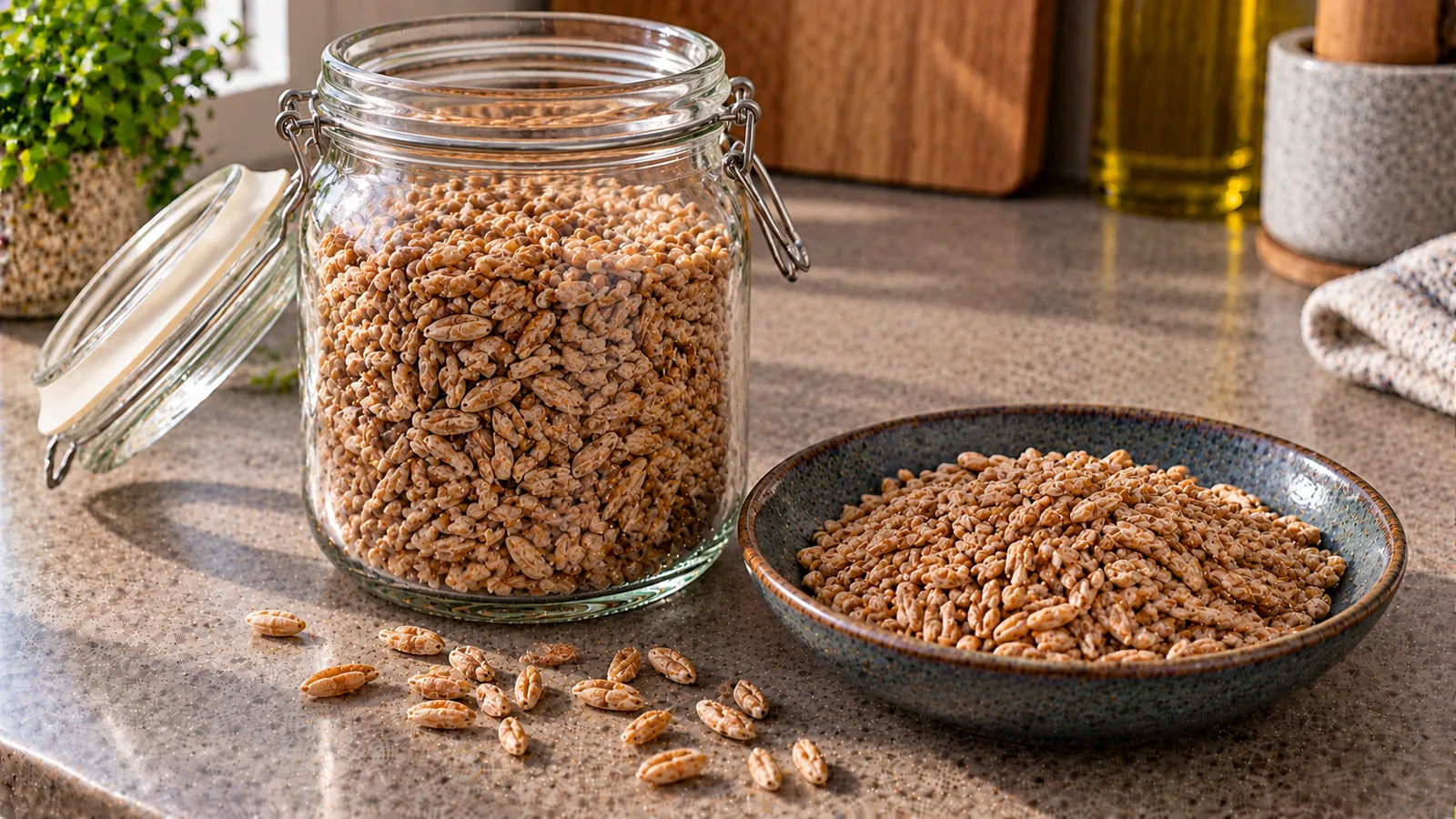
Spelt is a type of wheat, not a calorie-free alternative to ordinary grain. In the USDA FoodData Central SR Legacy reference, 100 g of uncooked spelt provides 338 kcal, while 100 g of cooked spelt provides 127 kcal. The corresponding protein figures are about 14.6 g and 5.5 g. Both descriptions refer to the edible grain in a specified state. The lower cooked figure principally reflects the water absorbed when the grain is boiled, not the disappearance of most of its food energy.
This guide is specifically about spelt wheat (Triticum aestivum subsp. spelta), called Dinkel in German and usually grand épeautre in French. It explains dry and cooked portions, whole kernels versus flour, the distinction from farro and how to count a spelt meal without mixing measurements. A package of spelt pasta, bread or flakes needs its own food entry.
Spelt calories and nutrition per 100 g
These are two USDA SR Legacy entries, not measurements of the same portion before and after cooking. All quantities are per 100 g of edible, unseasoned food. The fibre and carbohydrate definitions are those of the cited US database; a European pack may express carbohydrate and fibre using a different labelling convention.
| Spelt reference | Calories | Protein | Total fat | Carbohydrates | Fibre |
|---|---|---|---|---|---|
| Dry kernels, FDC 169745 | 338 kcal | 14.57 g | 2.43 g | 70.19 g | 10.7 g |
| Cooked grain, FDC 169746 | 127 kcal | 5.50 g | 0.85 g | 26.44 g | 3.9 g |
The primary data are USDA uncooked spelt, FDC 169745 and USDA cooked spelt, FDC 169746. They are reference profiles for plain spelt rather than values guaranteed for every cultivar or commercial product. The actual packet's nutrition panel should take precedence when you are logging that particular product.
The raw entry also reports iron, magnesium and phosphorus. Those minerals are part of why intact cereal grains can contribute nutritional variety, but their presence does not make spelt a medical treatment or mean that the calorie content is negligible. Spelt is mostly carbohydrate by weight when dry, with meaningful plant protein and fibre. It is therefore more useful to compare edible weights and meal composition than to declare the grain intrinsically slimming or fattening.
How many calories in dry spelt portions?
Measure the uncooked grain if you are building a recipe from ingredients. The following amounts use 338 kcal per 100 g, rounded to the nearest whole calorie. The 40 g and 60 g rows are example recipe amounts, not regulated serving sizes.
| Dry spelt grain | Estimated calories |
|---|---|
| 30 g | 101 kcal |
| 40 g | 135 kcal |
| 50 g | 169 kcal |
| 60 g | 203 kcal |
| 75 g | 254 kcal |
| 80 g | 270 kcal |
| 100 g | 338 kcal |
| 125 g | 423 kcal |
A 60 g dry portion contributes approximately 203 kcal and 8.7 g protein before vegetables, sauce or cooking oil. When the grain is boiled, the final bowl weighs more because it contains water. Do not carry the original 60 g into a cooked-food entry as if it were 60 g cooked; those units refer to different food states.
If a recipe serves several people, weigh the entire dry amount first, then allocate the recipe energy according to the actual proportion eaten. A small cooked bowl is not automatically one standard dry serving, especially if the mixture also includes lentils, beans or vegetables.
Calories in cooked spelt: portions after boiling
If the grain is already cooked and you only know its weight on the plate, the separate USDA cooked reference is a reasonable starting point. These numbers use 127 kcal per 100 g of plain cooked spelt without oil or sauce.
| Cooked edible spelt | Estimated calories |
|---|---|
| 50 g | 64 kcal |
| 75 g | 95 kcal |
| 100 g | 127 kcal |
| 125 g | 159 kcal |
| 150 g | 191 kcal |
| 175 g | 222 kcal |
| 200 g | 254 kcal |
| 250 g | 318 kcal |
For example, 150 g of cooked spelt contains approximately 191 kcal and 8.3 g protein using that cooked reference. A 250 g grain-heavy bowl is around 318 kcal before toppings. These are food database estimates rather than laboratory measurements of the particular spelt on your plate. Drainage, cooking time, variety and degree of processing influence moisture uptake.
A food app should not add dry and cooked calories for the same batch. If you entered the uncooked grain when planning dinner, the eventual cooked weight is useful for dividing the batch between diners, but not a second ingredient to log.
Why the dry and cooked figures differ
Dry grain contains much less water than boiled grain. During simmering, water enters the kernels and increases mass. This is why 100 g of cooked grain typically contains fewer calories than 100 g of the uncooked product. Heat has not magically removed 211 kcal from the original 100 g dry grain; the two 100 g portions contain different proportions of grain solids and water.
As a hypothetical kitchen example, start with 180 g of dry spelt: 180 × 338 ÷ 100 = 608 kcal before additions. Suppose the drained pot yields 450 g cooked grain and none is spilled or discarded. Using the initial ingredient total, each 150 g third of that pot represents approximately 203 kcal. The batch average is approximately 135 kcal per 100 g. This is close to, but not identical to, the independently measured USDA cooked entry of 127 kcal/100 g.
The difference is not an error: the cooked USDA food has its own moisture and preparation characteristics, and real simmering can involve small losses into discarded cooking liquid. The illustrated 450 g yield is not a universal conversion factor. Cooking more water into a batch reduces calories per 100 g while leaving the original recipe energy broadly attributable to the batch, subject to losses.
For accuracy, choose one coherent basis: a raw-ingredient recipe with measured finished yield, or a cooked-food database entry for a weighed cooked serving. Do not treat those methods as interchangeable down to the last calorie.
Whole spelt, pearled grain, flour, flakes and bread
Spelt can be sold as intact whole kernels, polished or partly dehulled kernels, cracked grain, flakes, semolina, flour, pasta and baked bread. The USDA profiles above refer to spelt grain. They cannot be assumed to describe a slice of sourdough, a spelt-flour pancake, a packaged crispbread or a ready-to-eat cereal.
Flour is not cooked whole grain. A whole-spelt flour can contain bran and germ, while a refined white spelt flour has a different fibre profile. A loaf combines flour with water, and may also contain oil, seeds, nuts, sweeteners or a sourdough starter. Those additions determine the baked product's nutrition alongside baking loss. If you know the exact brand and serving weight, use the packaged nutrition per 100 g instead of multiplying the weight of bread by 127 kcal.
The Whole Grains Council's description of spelt and other grains stresses checking whether the product is genuinely whole grain. A spelt label on its own does not prove that all the bran and germ are still present. For calorie tracking, state the actual product and preparation, not just the wheat species.
Is spelt the same as farro?
Not reliably. Spelt is Triticum aestivum spelta, whereas the term farro often describes emmer (Triticum turgidum dicoccum) in English-language food writing. Italian commerce also uses farro piccolo, farro medio and farro grande for different hulled wheats; farro grande may mean spelt. Consequently the word “farro” on a bag is not a precise botanical identification by itself. The Whole Grains Council reference lists spelt and farro/emmer separately.
For the separate food and its own dry/cooked references, consult our farro nutrition and serving guide. Do not silently transfer the 353 kcal dry and 178 kcal cooked CREA-based farro figures used there onto the 338/127 kcal USDA spelt entries here. Those numbers come from different datasets and labelled products, not from two names for one standardized food.
In Germany, Dinkel ordinarily means spelt. Grünkern is spelt harvested unripe and dried or roasted; its processing and moisture can change a food label. In France, grand épeautre is spelt, while petit épeautre generally refers to einkorn, another species. Read the ingredient description, particularly when comparing imported products.
Gluten, tolerance and nutritional trade-offs
Spelt belongs to the wheat family and contains gluten. It is not appropriate for someone with coeliac disease, even if it is marketed as an ancient cereal or presented as a substitute for ordinary wheat. The Celiac Disease Foundation explicitly lists spelt among gluten-containing wheat forms. Anecdotes that some people find it easier to digest are not proof that it is safe for gluten-related medical conditions.
It is possible to choose spelt for flavour, texture and recipe variety without treating it as a therapeutic food. Whole spelt contributes dietary fibre; refined products can have less. Energy intake still depends on portion, side dishes and additions. If you are comparing grain alternatives, our barley calorie guide and bulgur calorie guide have their own measurement bases and should not be substituted for spelt automatically.
How to account for oil, broth and sauces
Plain cooked spelt is one ingredient. A grain salad or pilaf may also contain oil, cheese, dressing, chickpeas, broth concentrates or nuts. If 150 g of cooked spelt is logged at 191 kcal and 10 g of olive oil is actually eaten with it, the rough meal subtotal is 281 kcal (191 + approximately 90). The same example without the oil is 191 kcal. Oil poured into a pan but left behind should not automatically be counted as eaten.
Seasoned broths can change sodium substantially without changing the basic carbohydrate density as much as oil does. Sweetened porridge may contribute extra energy from sugar, milk and dried fruit. For a homemade batch, sum the ingredients once, then divide by the edible finished portions. For a packaged spelt salad or ready meal, the manufacturer's label is usually the more suitable reference.
A labelled serving size might be smaller than the amount you ordinarily dish up. Our explanation of portion size versus serving size distinguishes these measurements and can help when a packet shows 50 g dry as one reference serving, but dinner contains more.
Practical spelt calorie-tracking checklist
Decide whether the weighed food is dry or cooked, then confirm it is spelt grain rather than flour, bread, flakes or pasta. Use 338 kcal/100 g only for the corresponding uncooked USDA reference and 127 kcal/100 g only for its cooked reference. Exclude additions from plain-grain tables, then add foods actually consumed with the dish. If you weigh a pot before and after simmering, base per-portion estimates on the recipe total and finished edible yield, not on a fixed conversion downloaded from the internet.
Finally, distinguish the species listed on the product. Dinkel, grand épeautre and spelt can point to the same wheat; the farro trade name alone cannot. This small label check prevents a more serious logging error than rounding 203 kcal to 200.
Data basis: USDA FoodData Central SR Legacy spelt, uncooked — FDC 169745 and spelt, cooked — FDC 169746. Portions and kitchen examples are rounded arithmetic from the stated references; results for individual products can vary.