
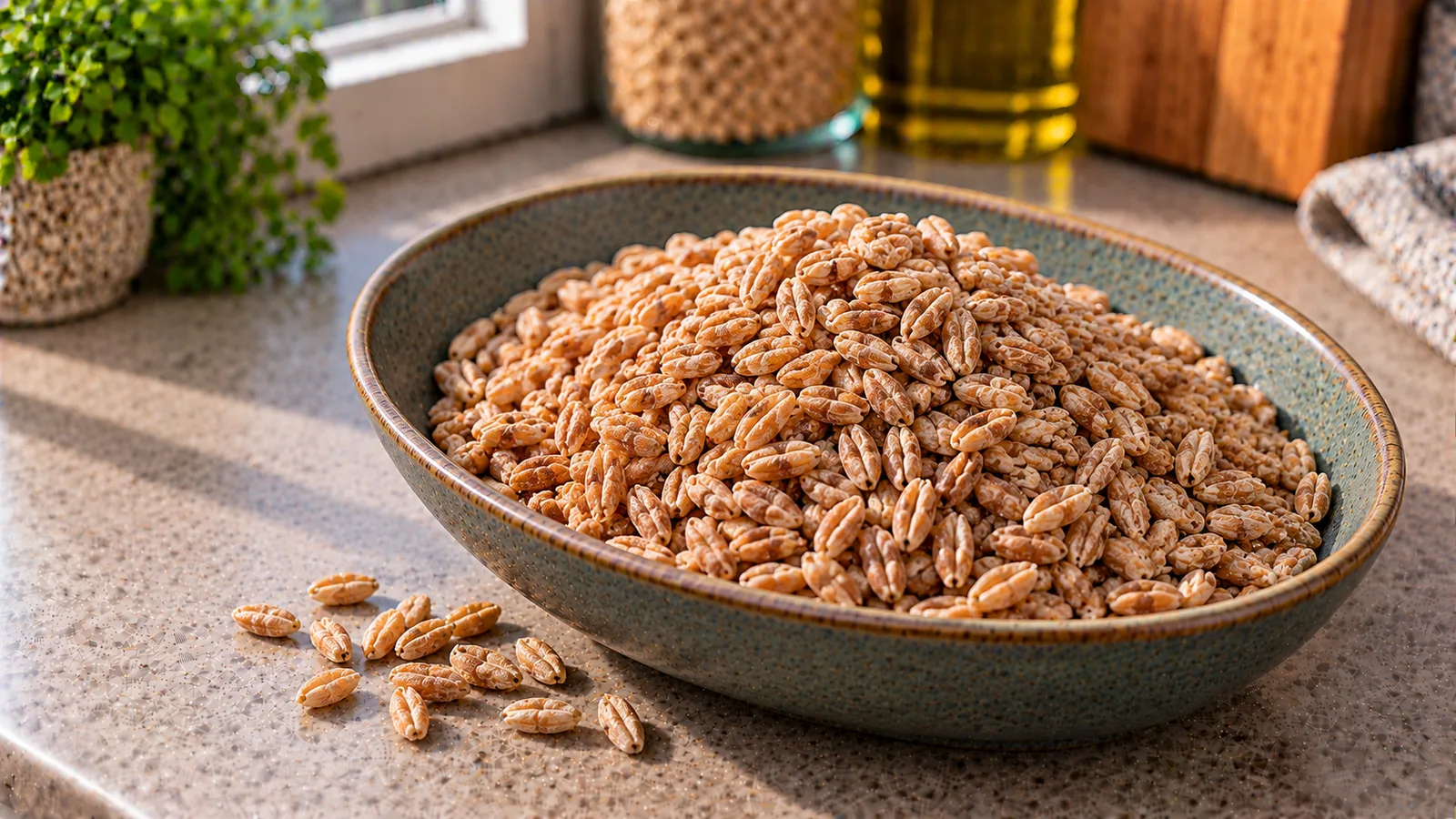
Farro is a wheat-family grain with a chewy texture, but the calories you log depend on whether you weighed the dry grains or the cooked, drained farro. The Italian CREA food-composition database reports 353 kcal per 100 g of dry pearled farro (emmer) and 178 kcal per 100 g of boiled, drained farro. These are two separately analysed food states, not the dry and cooked weights of one precisely tracked batch.
A cooked bowl may weigh more because grains absorb water. The practical first step is therefore to identify the product you bought, read whether its label describes dry or prepared grain, and weigh the edible amount in that same state. This guide covers reference nutrients, portion arithmetic, why packaged farro varies, and how to log a home-cooked pot without double-counting it.
Farro nutrition per 100 g: dry versus boiled
The table below draws on the Italian CREA food-composition entries for Triticum dicoccum, commonly called emmer. The dry record is farro perlato, crudo (database code 000020); the cooked record is farro perlato, cotto, bollito (000025), prepared in water without salt and drained. Both refer to edible grain. Carbohydrate here means available carbohydrate, the quantity shown separately from dietary fibre in the CREA database.
| CREA farro reference | Calories | Protein | Fat | Available carbohydrate | Fibre |
|---|---|---|---|---|---|
| Pearled emmer, dry | 353 kcal | 14.6 g | 2.4 g | 69.3 g | 6.5 g |
| Pearled emmer, boiled and drained | 178 kcal | 6.2 g | 1.0 g | 37.3 g | 2.1 g |
Read the CREA dry emmer record and the distinct CREA boiled emmer record. These are Italian reference data rather than USDA-branded farro measurements. Different varieties, processing, soaking, cooking times and brands can give different numbers. Neither row is a claim about the nutrition of every food sold simply as “farro”.
There are also smaller amounts of minerals such as magnesium, phosphorus and potassium. In the dry CREA entry, magnesium is 112 mg per 100 g, but a cooked serving should not be assigned the dry magnesium figure to the heavier water-filled mass. The carbohydrate figure is not the same as the weight of cooked grains, and plain farro contains little fat unless oil or another ingredient is added.
How many calories in a cooked serving of farro?
The next table uses the measured CREA cooked reference of 178 kcal per 100 g. It is suitable as an estimate if you have weighed farro after boiling and draining, with no butter, oil or other ingredients mixed in. Numbers are calculated from the published per-100-g figure and rounded to whole calories; they are not independently analysed portions.
| Cooked, drained weight | Estimated calories |
|---|---|
| 50 g | 89 kcal |
| 75 g | 134 kcal |
| 100 g | 178 kcal |
| 125 g | 223 kcal |
| 150 g | 267 kcal |
| 200 g | 356 kcal |
| 250 g | 445 kcal |
| 300 g | 534 kcal |
For example, 150 g cooked farro is approximately 267 kcal and 9.3 g protein, based on the same cooked reference. 200 g is 356 kcal before dressings or toppings. The 150-g serving is an illustrative weighed portion; restaurant portions, a soup containing farro, and a grain salad with vegetables can have different actual amounts of grain.
If your plate contains 250 g of farro salad, the entire 250 g should not automatically be entered as 250 g plain boiled farro. The salad may contain a smaller mass of grain plus tomatoes, cheese, dressing, beans or vegetables. Weigh ingredients while assembling a home recipe, or make an explicitly approximate estimate when eating out.
Calories in dry farro: weights before cooking
If you weigh grains before adding water, the dry entry is more appropriate. The following values use 353 kcal per 100 g dry farro, again as a reference for pearled emmer rather than a universal farro product label.
| Dry farro weight | Estimated calories |
|---|---|
| 40 g | 141 kcal |
| 50 g | 177 kcal |
| 60 g | 212 kcal |
| 75 g | 265 kcal |
| 80 g | 282 kcal |
| 100 g | 353 kcal |
| 125 g | 441 kcal |
| 150 g | 530 kcal |
80 g dry farro corresponds to roughly 282 kcal using the rounded dry reference, with about 11.7 g protein and 5.2 g fibre. If you cook that portion, its water-filled cooked weight will be larger, but it does not become a second food that must also be entered into your diary. The bag's nutrition label is preferable if you know the specific product and its values differ from the CREA reference.
Why the raw and cooked values cannot be directly matched
Water changes food mass without adding calories. That is why the table of dry grains looks more calorie-dense than the table of cooked grains. But another subtlety matters: the CREA raw and cooked entries come from different measured samples and reference methods. You cannot safely assume that multiplying 353 kcal by one invented dry-to-cooked factor must reproduce exactly the separate 178 kcal per 100 g cooked entry.
For home cooking, the most reproducible batch method is simple. Weigh the dry farro, calculate the recipe's grain calories from its dry label, then weigh the entire finished pot after cooking and draining. Suppose you started with 160 g dry grains: at 353 kcal per 100 g, the uncooked grain contributes about 565 kcal before other ingredients. If the finished drained batch weighs 400 g, and you eat 100 g of that same batch, you have eaten one quarter of the grain and its share is about 141 kcal on this specific raw-ingredient accounting method, assuming no meaningful energy has left with discarded cooking water.
Why is that 141 kcal different from 178 kcal for 100 g of the separate cooked reference? The measured cooked entry and your imagined 400-g yield are not the same batch. Hydration levels, product types and preparation differ. Neither answer means heat created or destroyed a precise fixed quantity of calories; the two methods answer different weighing questions. For your own batch, avoid mixing them. Use either a dry-ingredient recipe allocation or a cooked-food database estimate, and record how the method was chosen.
Farro, emmer, spelt and einkorn: check the species
“Farro” is not an internationally identical ingredient name. In Italy, farro medio commonly refers to emmer (Triticum dicoccum), while farro piccolo can mean einkorn, and farro grande can mean spelt. The Whole Grains Council grain guide explains these wheat-family grains and the different names they carry in commerce. In German stores, the translation Dinkel usually means spelt, while Emmer identifies another species; translating every pack of farro as Dinkel is not precise.
If the ingredient list says Triticum dicoccum, the Italian emmer database values above are a relevant reference. If it says Triticum spelta or Triticum monococcum, look for that species' own label rather than applying the emmer measurements automatically. Likewise, pearled/perlato grain has had portions of the outer layers removed. Whole or minimally processed grain, semi-pearled grain and fully pearled versions need not provide equal fibre per 100 g.
Packaged farro can have different nutrients
Two actual product declarations make this variability concrete. Probios Farro Perlato lists 365 kcal, 15.1 g protein and 6.8 g fibre per 100 g dry product. Monte Castello Farro Perlato lists 352 kcal, 12.5 g protein and 1.6 g fibre per 100 g of its product. These are manufacturer-reported label values, not another measurement of the CREA sample. The contrast is especially important for fibre; a generic farro entry cannot guarantee a product's exact fibre value.
Read whether the package panel describes 100 g as sold (dry), a prepared portion, or a specified number of tablespoons. Check the ingredient description and whether flavourings are included. A ready-cooked farro pouch with vegetables, oil or seasoning belongs in the diary as the labelled composite food, not automatically as plain boiled farro.
What cooking oil, pesto and toppings change
Plain farro provides carbohydrate, some protein and fibre. It is often served with olive oil, pesto, cheese or a creamy sauce; these ingredients can materially increase the energy of the finished plate. For example, 150 g of cooked, drained plain farro is about 267 kcal from the cited cooked value. Add 10 g olive oil actually consumed, estimated at 90 kcal, and the grain-plus-oil subtotal is approximately 357 kcal, excluding everything else. Oil left in the mixing bowl should not automatically be counted as eaten.
A recipe entered from dry ingredients should count each ingredient once: dry farro, oil, cooked vegetables, any cheese, and sauces. If you instead select a database record already describing farro in oil or a prepared grain salad, adding its existing oil a second time will overstate calories. For a dish where farro is only one component, it is more useful to log the amount of grain than to guess that all the food on the plate is farro.
Farro versus barley, bulgur and quinoa
Farro, barley and bulgur are distinct grains or preparations. They can all be served in similarly sized bowls, but that does not make them nutritionally identical. For an appropriate comparison, use edible grams in the same state and inspect each product's actual label. Our barley calorie reference separates dry and cooked barley, while the bulgur nutrition guide covers cracked wheat prepared differently from farro.
Quinoa is a pseudocereal rather than a wheat species, so it is not a synonym for farro. A side-by-side comparison can be useful for variety, but avoid declaring a universal “healthiest grain” from one nutrient. Cooking method, fibre retention, price, allergies and the whole meal matter. Farro can be part of varied eating patterns without being a required food.
Farro contains gluten. Emmer, spelt and einkorn are forms of wheat and are not safe gluten-free alternatives for someone with coeliac disease. The Celiac Disease Foundation lists farro and related wheat varieties among gluten sources. “Ancient grain” or “traditional grain” on a package does not overturn this. Anyone with a wheat allergy should also follow their individual medical guidance and ingredient labels.
A practical way to record farro consistently
For a quick single serving, weigh the grains after boiling and draining and choose a cooked farro entry. For cooking several portions at home, weigh dry grains first, use the actual package label, and divide the batch total by the finished edible weight or number of weighed servings. Note whether the grain is emmer, spelt or einkorn if specified, and whether it was pearled or whole. Do not substitute one species' data without checking.
Keep water weight separate from calorie intake, and add other edible ingredients only once. The Mealisa explanation of portion size versus serving size can help if a dry-pack serving on the label looks much smaller than your final cooked bowl. No single conversion ratio applies to every farro brand or cooking method.
Data basis: CREA dry pearled emmer, code 000020 and CREA boiled, drained pearled emmer, code 000025. Calculated serving calories are rounded arithmetic estimates from the stated 100-g figures. The separate at-home yield example is hypothetical and must not be mistaken for a laboratory measurement of cooked farro.