
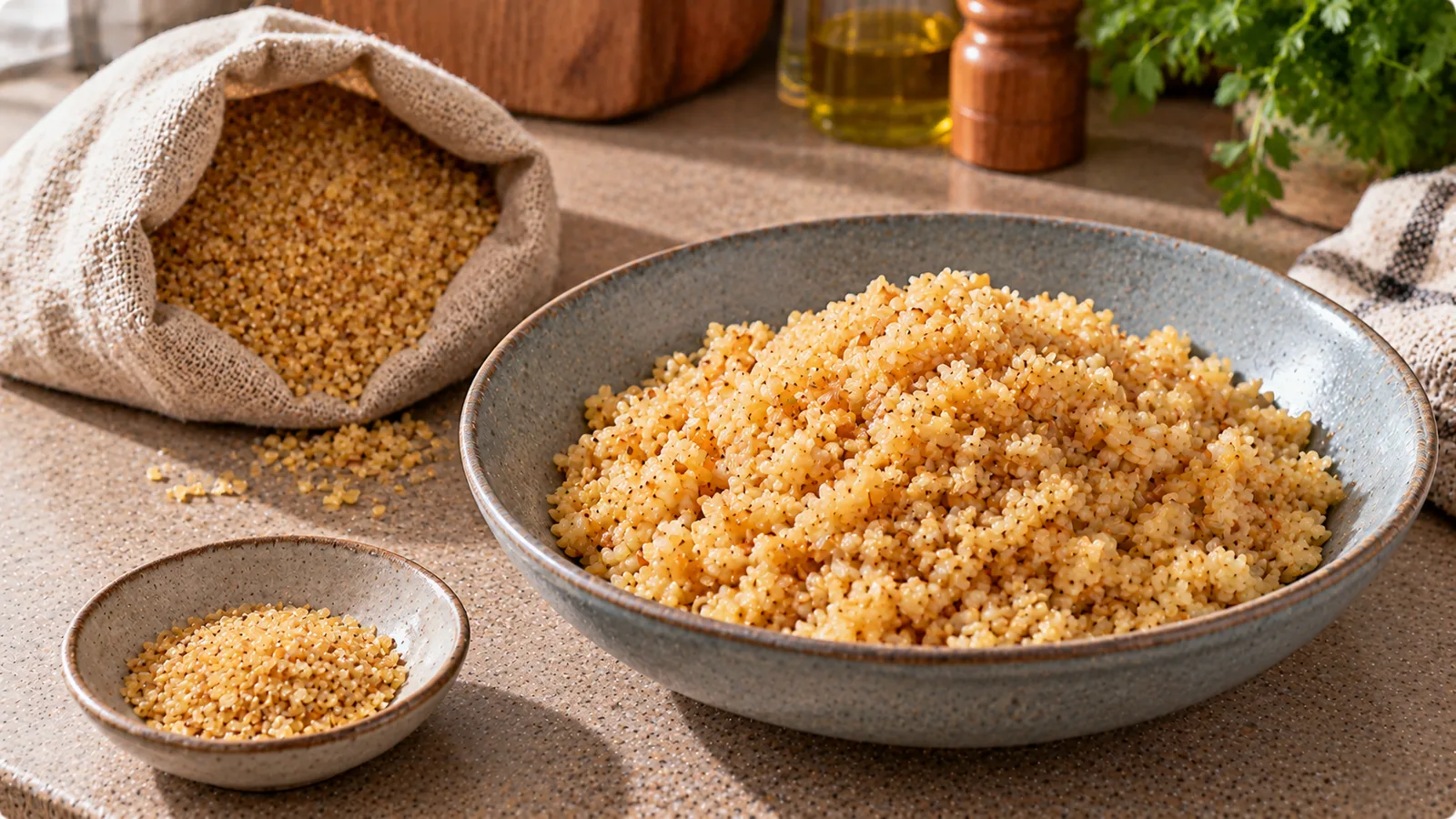
Bulgur is a wheat product made from whole wheat kernels that have been parboiled, dried and cracked. It is commonly used in salads, grain bowls, pilafs and as an alternative to rice.
For calorie tracking, the most important distinction is whether the weight refers to dry bulgur or cooked bulgur.
Dry bulgur contains approximately 342 calories per 100 grams, while a commonly used reference for plain cooked bulgur is about 83 calories per 100 grams.
The difference is mainly caused by water absorbed during cooking.
How many calories are in bulgur?
| Amount | Approximate calories |
|---|---|
| 100 g dry bulgur | 342 kcal |
| 30 g dry bulgur | 103 kcal |
| 40 g dry bulgur | 137 kcal |
| 50 g dry bulgur | 171 kcal |
| 60 g dry bulgur | 205 kcal |
| 75 g dry bulgur | 257 kcal |
| 100 g cooked bulgur | 83 kcal |
| 150 g cooked bulgur | 125 kcal |
| 200 g cooked bulgur | 166 kcal |
| 250 g cooked bulgur | 208 kcal |
These are approximate reference values for plain bulgur without oil, butter or sauce.
Different brands and cooking methods may produce different values. When using packaged bulgur, prioritize its nutrition label.
Bulgur nutrition per 100 grams
| Nutrient | Dry bulgur | Cooked bulgur |
|---|---|---|
| Calories | 342 kcal | 83 kcal |
| Protein | 12.3 g | 3.1 g |
| Total carbohydrates | 75.9 g | 18.6 g |
| Fiber | 12.5 g | 4.5 g |
| Fat | 1.3 g | 0.2 g |
| Water | Approximately 9 g | Approximately 78 g |
The carbohydrate figures above use the US total-carbohydrate convention, which includes dietary fiber.
On EU nutrition labels, carbohydrates are generally reported separately from fiber. Therefore, values from American databases and European packaging may not match directly.
The dry and cooked entries are independent food-composition references and should not be interpreted as an exact conversion of the same batch.
Why cooked bulgur has fewer calories per 100 g
Bulgur absorbs water when it is cooked or soaked.
Suppose you prepare 60 g of dry bulgur.
At 342 kcal per 100 g, the dry portion contains:
60 × 342 ÷ 100 = approximately 205 kcal.
After cooking, that portion might weigh 150–210 g, depending on the variety, water ratio and final texture.
If you add only water, the whole portion still contains approximately 205 kcal.
Its weight increases because of water, not because new nutrients have been added.
This is why dry and cooked weights should never be entered interchangeably in a nutrition app.
How much does bulgur weigh after cooking?
The yield varies with grain size, cooking method and how much water remains.
An illustrative range is:
| Dry bulgur | Possible cooked weight |
|---|---|
| 40 g | 100–140 g |
| 50 g | 125–175 g |
| 60 g | 150–210 g |
| 75 g | 190–260 g |
| 100 g | 250–350 g |
These are examples rather than guaranteed conversion factors.
Fine bulgur prepared by soaking may behave differently from coarse bulgur simmered in a saucepan.
For accurate tracking, weigh the finished batch instead of assuming a fixed multiplier.
Calculate calories using your own cooked batch
Imagine you cook 100 g of dry bulgur.
The package lists 342 kcal per 100 g.
After cooking and draining, the bulgur weighs 300 g.
The entire batch contains approximately 342 kcal.
Calories per 100 g cooked:
342 ÷ 300 × 100 = 114 kcal.
If you eat 180 g of the cooked batch:
342 × 180 ÷ 300 = approximately 205 kcal.
This method is particularly useful because it uses your actual cooking yield.
The result may differ from a generic database entry of 83 kcal per 100 g cooked.
That does not automatically mean either value is incorrect. Water content and food-composition references vary.
Is bulgur high in carbohydrates?
Bulgur is a carbohydrate-rich grain product.
Dry bulgur contains approximately 76 g total carbohydrate per 100 g using the US reporting convention.
Cooked bulgur contains much less carbohydrate per 100 g because water makes up a substantial part of its weight.
For example, 150 g of cooked bulgur provides approximately 28 g total carbohydrate using the generic cooked reference.
The amount consumed depends on the portion, not just the concentration per 100 g.
If you use EU packaging, remember that the carbohydrate value usually excludes fiber.
Does bulgur contain fiber?
Yes. Bulgur is made from wheat and retains substantial dietary fiber.
Common reference data indicate approximately 12.5 g fiber per 100 g dry bulgur and 4.5 g per 100 g cooked bulgur.
Fiber content varies by product and preparation.
Choosing whole-grain foods can contribute to overall dietary fiber intake, but bulgur should be considered within the context of the complete diet.
Vegetables, legumes, fruits, nuts and other whole grains also provide fiber.
How much protein is in bulgur?
Dry bulgur contains approximately 12 g protein per 100 g.
A 150 g portion of cooked bulgur provides approximately 4.7 g protein using the generic cooked reference.
Bulgur contributes protein, but it is not as concentrated a protein source as fish, eggs, tofu or many legumes.
For a more protein-rich meal, combine bulgur with foods such as chickpeas, lentils, beans, chicken or fish, depending on your dietary preferences.
Is bulgur gluten-free?
No.
Bulgur is made from wheat and contains gluten.
It is unsuitable for people with celiac disease and for anyone who must avoid wheat or gluten for medical reasons.
For a gluten-free alternative, consider rice, quinoa or buckwheat from an appropriate gluten-free source.
These foods have different cooking characteristics and nutritional values, so do not substitute their calorie entries directly.
Fine, medium and coarse bulgur
Bulgur is sold in different grain sizes.
Fine bulgur is often used for salads such as tabbouleh and may be prepared by soaking.
Medium and coarse bulgur are frequently used in pilafs and warm side dishes.
Grain size can influence the preparation method and water absorption.
However, the calorie content of dry plain bulgur is generally more closely related to its composition than to whether it is fine or coarse.
Check the product label when comparing brands.
Calories in common bulgur meals
The following examples use the generic reference of 83 kcal per 100 g cooked bulgur.
| Meal | Approximate calories |
|---|---|
| 150 g plain cooked bulgur | 125 kcal |
| 200 g plain cooked bulgur | 166 kcal |
| 150 g cooked bulgur + 5 g olive oil | 170 kcal |
| 200 g cooked bulgur + 10 g butter | 238 kcal |
Vegetables, meat, legumes, sauces and dressings must be counted separately.
A bulgur salad with generous olive oil may contain considerably more calories than plain cooked bulgur.
Bulgur vs rice: which has more calories?
Comparisons depend on whether the foods are dry or cooked and on their water content.
Generic cooked bulgur is often listed at approximately 83 kcal per 100 g.
Cooked white rice commonly has a higher calorie density, often around 130 kcal per 100 g, depending on the reference.
This does not mean bulgur is always the better choice.
The actual portion, preparation method, dietary preferences and nutritional needs matter more than a single calorie comparison.
For precise tracking, use the specific food entries for the products and cooking methods you use.
Bulgur vs couscous
Bulgur and couscous are both wheat-based products, but they are not identical.
Bulgur is made from parboiled, dried and cracked wheat kernels.
Conventional couscous is usually made from semolina formed into small granules.
They can differ in texture, fiber content and preparation method.
Their cooked calorie values also depend on water absorption.
Do not assume that equal cooked weights contain identical calories.
What is a normal serving of bulgur?
There is no universal serving size.
As a practical starting point, 50–75 g of dry bulgur may be suitable for an adult side dish, depending on the rest of the meal.
A smaller portion may make sense when the meal also includes bread, potatoes or other starches.
A larger portion may be appropriate when bulgur is the main carbohydrate component.
For nutrition tracking, consistency matters more than choosing a supposedly perfect serving size.
Is bulgur suitable for weight management?
Bulgur can be part of a balanced diet during weight management.
Cooked bulgur contains substantial water and provides carbohydrates and fiber.
It can be combined with vegetables and protein-rich foods to create a satisfying meal.
However, no single grain causes weight loss.
Total energy intake, portion sizes and long-term eating patterns remain important.
Added oils, dressings and sauces may substantially change the calorie content.
Common mistakes when counting bulgur calories
Logging cooked bulgur as dry.
This can greatly overestimate calories.
Logging dry bulgur as cooked.
This can substantially underestimate calories.
Using a universal cooking multiplier.
Different batches absorb different amounts of water.
Ignoring olive oil or butter.
Added fat can contribute more calories than expected.
Using a plain-bulgur entry for a complete recipe.
Pilafs and salads may contain several calorie-containing ingredients.
Confusing US total carbohydrates with EU carbohydrate values.
The two systems generally treat fiber differently.
Best way to track bulgur in an app
For a simple meal:
- Weigh the dry bulgur.
- Record the dry product and its label values.
- Include any oil, butter or other ingredients.
- Record the amount you actually eat.
For batch cooking:
- Calculate calories from all ingredients before cooking.
- Weigh the entire finished dish.
- Weigh your individual portion.
- Allocate calories proportionally to the portion weight.
This approach avoids relying on generic dry-to-cooked conversion estimates.
Sources
- USDA FoodData Central — food composition references for dry and cooked bulgur.
- EU Regulation No 1169/2011 — European nutrition labeling and allergen rules.
- FDA: Nutrition Facts Label — US nutrition labeling conventions.
The key takeaway
Plain dry bulgur contains approximately 342 kcal per 100 g, while a common reference for plain cooked bulgur is 83 kcal per 100 g.
The difference mainly reflects water absorbed during cooking.
For accurate calorie tracking, distinguish dry from cooked weights, include added ingredients and calculate portions from the actual finished batch whenever possible.