
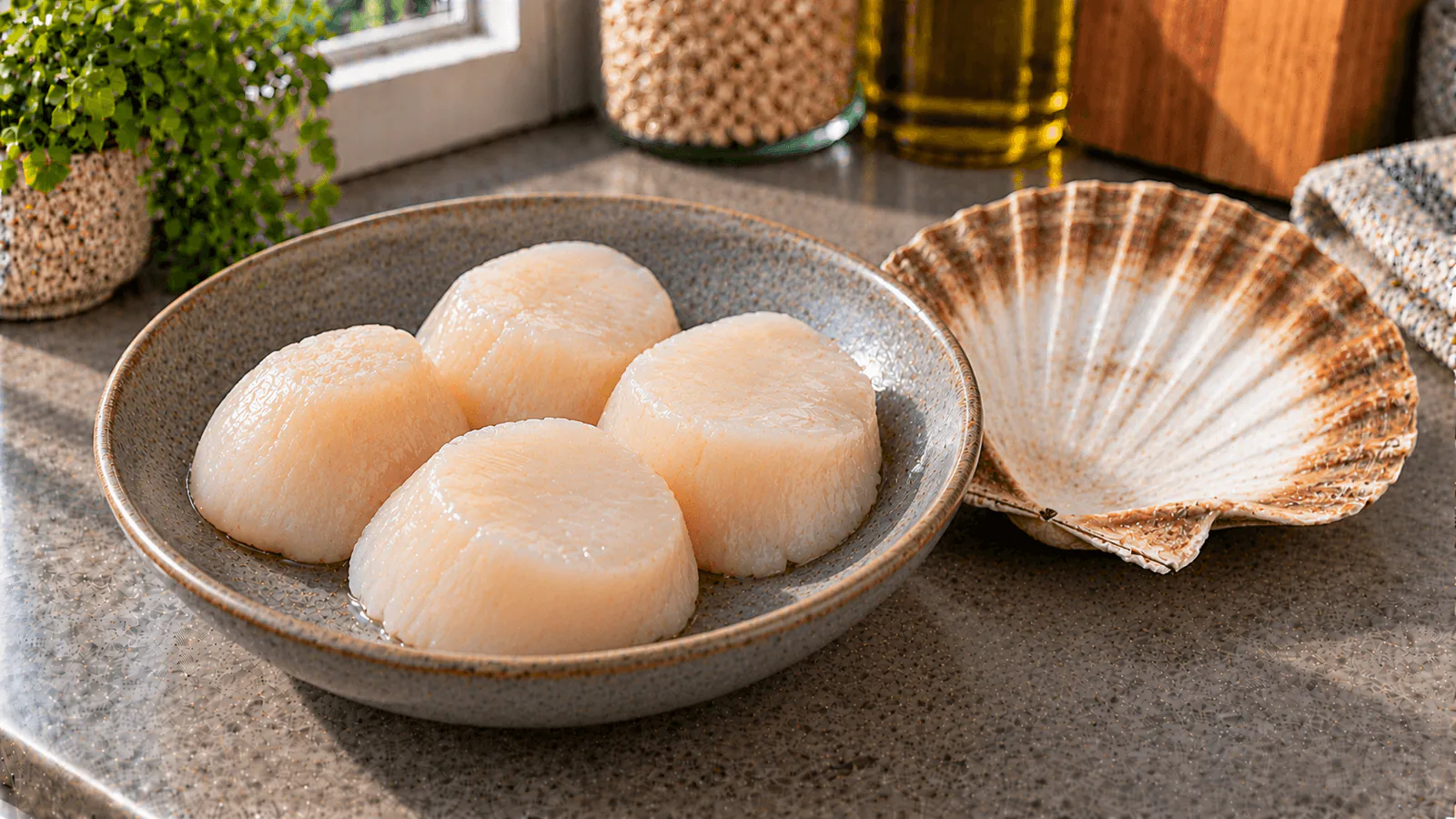
A plate of seared scallops can look light, but its calories depend on more than the number of scallops. The biggest distinctions are raw versus cooked weight, whether you are weighing the edible muscle rather than the shell, and how much butter, oil or sauce reaches the plate. Large sea scallops and small bay scallops are both sold under the same everyday name, although individual sizes vary considerably. For tracking, start with a weight in grams and an appropriate food-state reference rather than assuming that six scallops always make one serving.
How many calories are in scallops per 100 g?
The USDA FoodData Central SR Legacy entry for raw scallops, mixed species, reports 69 kcal per 100 g of edible scallop. A different USDA entry for bay and sea scallops cooked by steaming reports 111 kcal per 100 g. Both are reference values, not a guarantee for a branded frozen pack or a restaurant plate. The cooked value describes scallops without the oil used for pan-searing or a rich sauce.
| Scallops, edible portion per 100 g | Calories | Protein | Fat | Carbohydrate | Sodium |
|---|---|---|---|---|---|
| Raw, mixed species | 69 kcal | 12.10 g | 0.49 g | 3.18 g | 392 mg |
| Cooked, steamed | 111 kcal | 20.50 g | 0.84 g | 5.41 g | 667 mg |
Sources: USDA raw scallops, FDC 174220 and USDA steamed scallops, FDC 167742. Both values refer to the edible portion and are drawn from different food entries. The sodium figures also describe those entries, not a recommended salt addition or the precise composition of every scallop sold in a shop.
Why is the cooked number higher? Cooking changes moisture content and sometimes the mass left on the plate. A hundred grams of finished, steamed scallops can contain more concentrated nutrients than a hundred grams of raw scallops. That does not mean cooking spontaneously adds energy. If you weighed 150 g of raw scallops before cooking, the starting seafood still represents about 104 kcal using the raw entry. If you instead weigh 150 g of finished steamed scallops, the cooked reference gives about 167 kcal. Those are two different measured quantities, not competing estimates for one unchanged piece of food.
Scallop calories by portion size
The calculations below use edible scallop meat in the stated condition, with no added fat. They deliberately avoid a count such as “three large scallops” because size, trimming and packaging make that inconsistent. The numbers are rounded to the nearest whole kilocalorie.
| Edible scallop meat | Raw (69 kcal/100 g) | Steamed (111 kcal/100 g) |
|---|---|---|
| 25 g | 17 kcal | 28 kcal |
| 50 g | 35 kcal | 56 kcal |
| 75 g | 52 kcal | 83 kcal |
| 85 g | 59 kcal | 94 kcal |
| 100 g | 69 kcal | 111 kcal |
| 125 g | 86 kcal | 139 kcal |
| 150 g | 104 kcal | 167 kcal |
| 200 g | 138 kcal | 222 kcal |
For perspective, 85 g of steamed scallops is about 94 kcal, while 150 g provides about 167 kcal and 30.8 g protein from the cooked reference. A 25 g tasting portion and a 200 g main course clearly should not be logged as the same “one serving.” If a recipe calls for eight scallops, weigh the edible portion once before cooking; this establishes a much more useful benchmark for future meals than the count alone.
Some seafood counters use a number-per-kilogram or number-per-pound grading system. The number describes approximate size, not calories per animal. Frozen packs may also show a net weight for seafood together with ice glaze. The relevant quantity is the thawed, drained edible scallop mass, not the frozen block plus protective ice. Record what you actually ate, and note whether the weight was taken before or after cooking.
Sea scallops, bay scallops and the part you eat
“Scallop” is a broad seafood term. Sea scallops are commonly sold as thick, round white muscles that can be seared. Bay scallops are often considerably smaller and may be used in pasta, chowder or mixed dishes. Some markets sell scallops with roe attached or in a half shell; other packs contain only the white adductor muscle. Do not automatically apply the reference for ordinary scallop meat to a whole shell or a different mix of edible parts. The shell is discarded and supplies no meal calories, and roe changes the edible composition.
The published USDA entries above are useful for a generic reference, but they are not a lab test of your exact species, origin or processing method. When a product has a nutrition declaration, use that label first, especially for scallops with added water, phosphates, seasoning or a coating. Check whether values are stated per 100 g as sold, after draining or after preparation. A label may also specify whether the contents are raw, pre-cooked or breaded, and those states should not be combined.
Scallops are naturally low in total fat in the cited unseasoned references. That characteristic can be hidden by how they are served. A breaded scallop is not interchangeable with a plain steamed one; a scallop cooked in garlic butter is not interchangeable with a scallop that was briefly steamed. The additions are not nutritionally trivial simply because the underlying shellfish portion is small.
Pan-seared scallops: calculating oil, butter and sauce
A hot pan gives scallops a browned crust, but the heat itself is not an ingredient. Fat used and eaten is. If you start with 150 g raw scallop meat, the reference is approximately 104 kcal. Add 10 g olive oil, about 90 kcal, and the ingredient-level total becomes approximately 194 kcal if all that oil is eaten. If some oil remains in the pan, the true amount consumed may be lower; pretending none was eaten can underestimate the meal. Do not replace the 104-kcal raw starting weight with the calories for 150 g cooked meat unless the scallops really weighed 150 g after cooking.
An alternative example begins with the plate weight rather than the recipe weight: 150 g of already steamed scallops supplies approximately 167 kcal. With 10 g of olive oil actually consumed, the combined estimate is 257 kcal. These two worked examples use different weighing methods and are not meant to describe the same final plate. Butter contains water and has fewer calories per gram than pure oil; weigh the ingredient and use its own label or food database entry instead of counting it as olive oil.
Restaurant scallops can arrive on cauliflower purée, pea purée, risotto, creamy pasta or in a butter sauce. The plate's energy may come substantially from those other ingredients. For a home recipe, weigh the scallops, oil and starch separately, then divide the total by the number of portions eaten. For a restaurant dish, use an approximate ingredient estimate with a wider uncertainty range rather than entering “scallops” and ignoring the sauce. The most important practical error is often a forgotten tablespoon of fat, not a one-kilocalorie rounding difference in the seafood database.
Protein, carbohydrates and sodium in scallops
Scallops provide protein, and their cited fat values are relatively small. The steamed USDA entry gives 20.50 g protein per 100 g, compared with 12.10 g per 100 g for the raw entry. The comparison again reflects different water contents. At 150 g steamed edible meat, the calculated protein is 30.8 g after rounding to one decimal place. Scallops also contain some carbohydrate in these USDA entries, so the correct number is not necessarily zero merely because scallops are seafood.
Pay attention to sodium, especially if your meal includes salty sauces. The USDA reports 392 mg sodium per 100 g raw and 667 mg per 100 g steamed for the specified entries. Using the familiar European salt equivalent, 667 mg sodium corresponds to approximately 1.67 g salt (milligrams of sodium multiplied by 0.0025). This is a way to express sodium as salt equivalent, not a statement that a cook added that much table salt. Learn how these labels differ in our sodium-to-salt conversion guide.
Different scallop species and processed products may have different sodium values. Products treated with added sodium compounds or packed in brine particularly deserve a label check. A low-fat ingredient can still contribute meaningful sodium, and restaurant seasoning can increase it further. If you need a clinically restricted sodium intake, rely on the actual product declaration and individual medical advice instead of a generic average.
Buying, thawing and cooking scallops safely
Scallops are perishable shellfish. The FDA's seafood-selection and cooking advice recommends selecting scallop flesh that is clear with a pearly appearance and little or no off-odor. Avoid fishy, sour or ammonia-like smells. Refrigerate promptly; thaw frozen seafood in the refrigerator or under the agency's other controlled methods, not overnight on a kitchen counter. The FDA says cooked scallops should become firm, pearly and opaque. Safety guidance is independent of the calorie table, and a seemingly attractive nutrition number does not make raw or spoiled shellfish safe.
Scallops are mollusks and can cause allergic reactions. Anyone with a known mollusk or seafood allergy should follow their clinician's advice rather than assume all seafood categories are interchangeable. For raw or barely cooked scallop dishes, foodborne-illness risk deserves extra consideration, particularly for pregnant people, older adults and those with reduced immune defenses. Buy from regulated suppliers and follow the product's preparation directions.
How to log scallops without double counting
A consistent method matters more than extreme precision. For home cooking, weigh raw edible scallop muscle, record it against the raw entry and add ingredients consumed. For cooked leftovers, weigh finished edible meat, use the cooked entry when the preparation is reasonably similar, and add sauces separately. Never record both the raw and cooked weights as two separate seafood portions. Do not log discarded shells, protective ice glaze or cooking liquid left in the pan as food eaten.
If your plate also contains other seafood, use the appropriate ingredient entries rather than a generic “seafood” value. Our guides to shrimp calories and cod calories illustrate why species and cooking states matter. Portion labels can also differ from actual plate amounts; the distinction is explained in portion size versus serving size.
For a simple benchmark, use 69 kcal per 100 g of raw scallop meat or 111 kcal per 100 g steamed, match the number to the weight actually measured, then count any oil, butter, breading or accompaniments. Keep the meal estimate honest about uncertainty when a restaurant portion cannot be weighed. Source records: USDA raw scallops and USDA steamed scallops.