
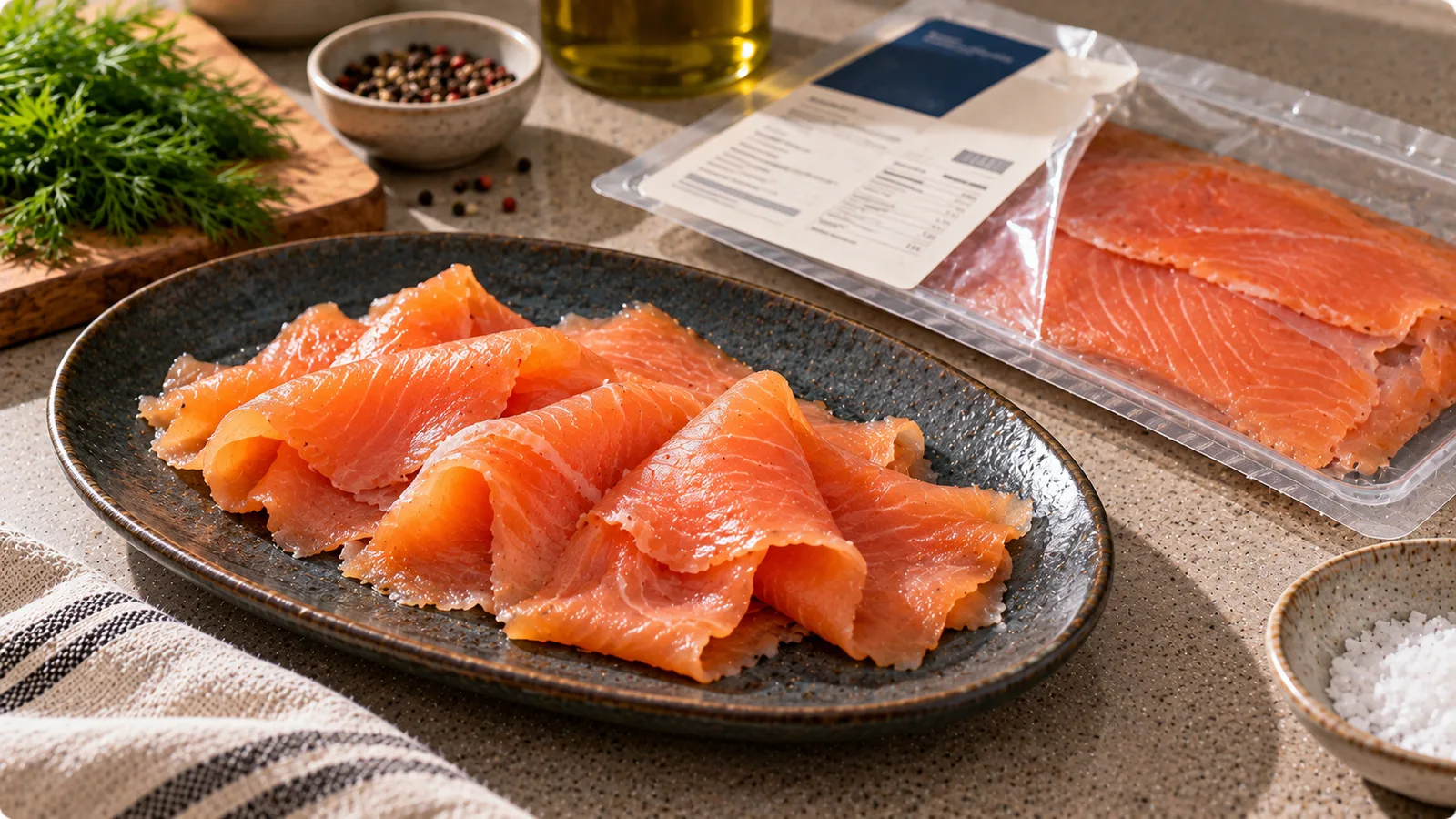
Smoked salmon is a convenient source of protein that can be eaten in sandwiches, salads, breakfasts and pasta dishes. But how many calories does it contain?
A practical starting estimate is approximately 120–200 kcal per 100 g of smoked salmon. Many cold-smoked products fall toward the lower or middle part of this range, while some hot-smoked or fattier products contain more.
The exact value depends on the salmon species, fat content, processing method and manufacturer.
For accurate tracking, use the nutrition label on your specific package whenever possible.
Smoked salmon calories by portion
The following table uses an illustrative reference value of 160 kcal per 100 g. It is not a universal value for every smoked salmon product.
| Smoked salmon portion | Estimated calories |
|---|---|
| 25 g | 40 kcal |
| 30 g | 48 kcal |
| 40 g | 64 kcal |
| 50 g | 80 kcal |
| 75 g | 120 kcal |
| 100 g | 160 kcal |
| 125 g | 200 kcal |
| 150 g | 240 kcal |
| 200 g | 320 kcal |
To calculate calories from a package, use:
Calories eaten = calories per 100 g × portion weight ÷ 100.
For example, if your smoked salmon contains 185 kcal per 100 g and you eat 60 g:
185 × 60 ÷ 100 = 111 kcal.
This calculation is more useful than assuming all smoked salmon contains exactly 160 kcal per 100 g.
Nutrition per 100 g
Smoked salmon is generally rich in protein and contains varying amounts of fat.
The figures below are broad, practical ranges rather than one standardized product specification.
| Nutrient | Approximate amount per 100 g |
|---|---|
| Energy | 120–200 kcal |
| Protein | 18–25 g |
| Total fat | 4–13 g |
| Carbohydrates | Usually 0–2 g |
| Fiber | 0 g |
| Sodium | Often 600–1,500 mg |
Some products fall outside these ranges.
Added ingredients, smoking technique, brining and the fish's original fat content can all affect the result.
Smoked salmon also provides vitamin B12 and omega-3 fatty acids, although the amounts vary.
For product-specific values, consult the label or a reliable food composition database such as USDA FoodData Central.
Cold-smoked vs hot-smoked salmon
The terms cold-smoked and hot-smoked describe processing methods, not fixed calorie categories.
Cold-smoked salmon
Cold-smoked salmon is generally cured and smoked at relatively low temperatures.
It usually has a soft, silky texture and is sold in thin slices.
It is commonly used for:
- Bagels and sandwiches.
- Breakfast toast.
- Salads.
- Canapés.
- Cold pasta dishes.
A thin slice may weigh only 15–25 g, but the weight depends on the cut and package.
Cold smoking does not reliably cook the fish to a temperature that eliminates foodborne pathogens.
Hot-smoked salmon
Hot-smoked salmon is smoked at higher temperatures and develops a firmer, flaky texture.
It is often sold as pieces or fillets rather than very thin slices.
Hot-smoked salmon can have a different calorie density because of the fish used and moisture loss during processing.
However, it is incorrect to assume that every hot-smoked product is higher in calories than every cold-smoked product.
The nutrition label matters more than the smoking method alone.
| Feature | Cold-smoked salmon | Hot-smoked salmon |
|---|---|---|
| Typical texture | Soft and silky | Firm and flaky |
| Common presentation | Thin slices | Fillet or chunks |
| Calorie content | Depends on product | Depends on product |
| Protein | Usually substantial | Usually substantial |
| Sodium | Often elevated | Often elevated |
| Food safety | Usually not fully cooked | Heat-treated, but handling and storage still matter |
Neither preparation should be treated as a single fixed nutritional value.
How much protein is in smoked salmon?
A typical 100 g serving provides approximately 18–25 g of protein.
Using 22 g protein per 100 g as an illustrative midpoint:
| Portion | Estimated protein |
|---|---|
| 30 g | 6.6 g |
| 50 g | 11 g |
| 75 g | 16.5 g |
| 100 g | 22 g |
| 150 g | 33 g |
Protein values vary between products.
For example, 40 g of smoked salmon on toast adds useful protein, but it is not the same as eating a full 150 g salmon fillet.
When evaluating a meal, count the entire portion rather than treating a few decorative slices as a large protein serving.
Fat and omega-3 fatty acids
Salmon is naturally a fatty fish.
Its fat contributes to calorie content and provides omega-3 fatty acids, including EPA and DHA.
The exact amount depends on species, farming conditions, cut and processing.
Two smoked salmon packages can have noticeably different fat contents even if they look similar.
For calorie tracking, this difference matters.
A product containing 5 g fat per 100 g will generally have a different energy density from one containing 12 g fat per 100 g.
The fat content listed on the package is therefore a useful clue when comparing products.
Smoked salmon can contribute omega-3 fatty acids to the diet, but it should not be assumed to provide an identical amount to every fresh salmon product.
Why smoked salmon can be high in sodium
Salt is commonly used during curing and smoking.
This means smoked salmon can contain considerably more sodium than fresh, unseasoned salmon.
For illustration, consider a product with 1,000 mg sodium per 100 g.
| Portion | Sodium |
|---|---|
| 30 g | 300 mg |
| 50 g | 500 mg |
| 75 g | 750 mg |
| 100 g | 1,000 mg |
| 150 g | 1,500 mg |
These figures describe a hypothetical product, not every brand.
In European markets, nutrition labels usually display salt rather than sodium.
A useful conversion is:
Salt in grams ≈ sodium in grams × 2.5.
For example, 2.5 g salt per 100 g corresponds to approximately 1,000 mg sodium per 100 g.
The World Health Organization recommends that adults consume less than 2 g sodium per day, equivalent to less than 5 g salt.
People monitoring sodium intake should check the package rather than assuming smoked salmon is nutritionally interchangeable with fresh fish.
Calories in popular smoked salmon meals
The calories in a complete meal depend on bread, spreads, oils, sauces and portion sizes.
These examples are estimates, not exact values for every recipe.
Smoked salmon on whole-grain toast
- Smoked salmon, 50 g: 80 kcal.
- Whole-grain bread, 80 g: approximately 190–210 kcal.
- Cream cheese, 30 g: approximately 65–100 kcal.
- Cucumber, 50 g: approximately 8 kcal.
Estimated total: 343–398 kcal.
The cream cheese and bread can contribute more calories than the salmon itself.
Smoked salmon bagel
- Smoked salmon, 60 g: 96 kcal.
- Plain bagel, 100 g: approximately 250–290 kcal.
- Cream cheese, 40 g: approximately 90–135 kcal.
- Tomato and onion: approximately 15 kcal.
Estimated total: 451–532 kcal.
A larger bagel or a generous spread can raise the total.
Smoked salmon salad
- Smoked salmon, 75 g: 120 kcal.
- Mixed vegetables, 200 g: approximately 50 kcal.
- Avocado, 70 g: approximately 110 kcal.
- Olive oil, 10 g: approximately 90 kcal.
Estimated total: 370 kcal.
Removing the olive oil would reduce the estimate by approximately 90 kcal, but also changes the meal's composition.
Smoked salmon pasta
- Smoked salmon, 75 g: 120 kcal.
- Dry pasta, 80 g: approximately 280–300 kcal.
- Cooking cream, 60 g: approximately 90–180 kcal, depending on fat content.
- Spinach, 100 g: approximately 20–25 kcal.
Estimated total: 510–625 kcal.
For this dish, pasta and cream are major contributors to energy.
How many slices are 50 g?
Slice weights vary.
A thin slice might weigh approximately 15–25 g, while a larger or thicker slice may weigh substantially more.
Therefore:
- Two thin slices may be around 30–50 g.
- Three slices may be around 45–75 g.
- A restaurant serving may differ from a supermarket serving.
These are only rough estimates.
The most reliable method is to weigh the portion or divide the package's net weight by the number of approximately equal slices.
For example, a 100 g package containing five similar slices averages around 20 g per slice.
Is smoked salmon good for weight management?
Smoked salmon can fit into many eating patterns because it provides protein in relatively compact portions.
However, no single food causes weight loss.
Body-weight changes depend on overall energy intake and expenditure over time.
Smoked salmon may be a convenient ingredient in a calorie-conscious meal, but its sodium content and accompanying foods still matter.
A smoked salmon salad and a large bagel with cream cheese can have very different calorie totals even when they contain the same amount of salmon.
Focus on the complete meal and your usual dietary pattern.
Food safety: who should be careful with smoked salmon?
Smoked fish requires appropriate storage and handling.
Refrigerated ready-to-eat cold-smoked fish can carry a risk of Listeria monocytogenes contamination.
People at higher risk of severe listeriosis include pregnant people, older adults and those with weakened immune systems.
For these groups, food-safety authorities may recommend avoiding refrigerated cold-smoked fish unless it is thoroughly cooked in a dish.
Shelf-stable smoked fish and fully heated dishes may be treated differently under applicable guidance.
Follow local public-health recommendations and product instructions.
The FDA's food-safety guidance for pregnant people discusses higher-risk foods and safer preparation.
Smoked salmon should also be kept refrigerated as directed, consumed within the stated period after opening and discarded if storage instructions have not been followed.
Do not assume that smoking makes fish indefinitely shelf-stable.
Smoked salmon vs fresh salmon
Fresh and smoked salmon can both provide protein and omega-3 fatty acids, but they are not identical products.
| Question | Smoked salmon | Fresh salmon |
|---|---|---|
| Calories | Vary by product and processing | Vary by species and fat content |
| Protein | High | High |
| Sodium | Often much higher | Naturally relatively low before seasoning |
| Preparation | Ready to eat in many products | Usually cooked before eating |
| Shelf life | Follow package instructions | Follow fresh-fish storage guidance |
| Convenience | Very convenient | Requires more preparation |
Fresh salmon may be a better option when minimizing added salt is a priority.
Smoked salmon may be useful when convenience and portion control are important.
Neither should be judged by calories alone.
How to log smoked salmon accurately
For a more reliable food diary:
- Check whether the package says cold-smoked or hot-smoked.
- Read the calories per 100 g.
- Weigh the portion, or estimate it from the package weight.
- Record the actual amount eaten.
- Add bread, butter, cream cheese, oil, sauces and other ingredients separately.
- Check sodium or salt if it is relevant to your dietary goals.
If the label states 175 kcal per 100 g and you eat 45 g:
175 × 45 ÷ 100 = 78.75 kcal, or approximately 79 kcal.
This is more accurate than using a generic 100 g serving for every meal.
Sources
- USDA FoodData Central — Food Composition Database
- WHO — Salt Reduction
- FDA — Food Safety for Moms to Be
- FDA — Advice About Eating Fish
The practical takeaway: smoked salmon commonly provides roughly 120–200 kcal per 100 g, but the package label is the best source for your specific product. Portion size, fat content, sodium and the rest of the meal determine how it fits into your diet.