
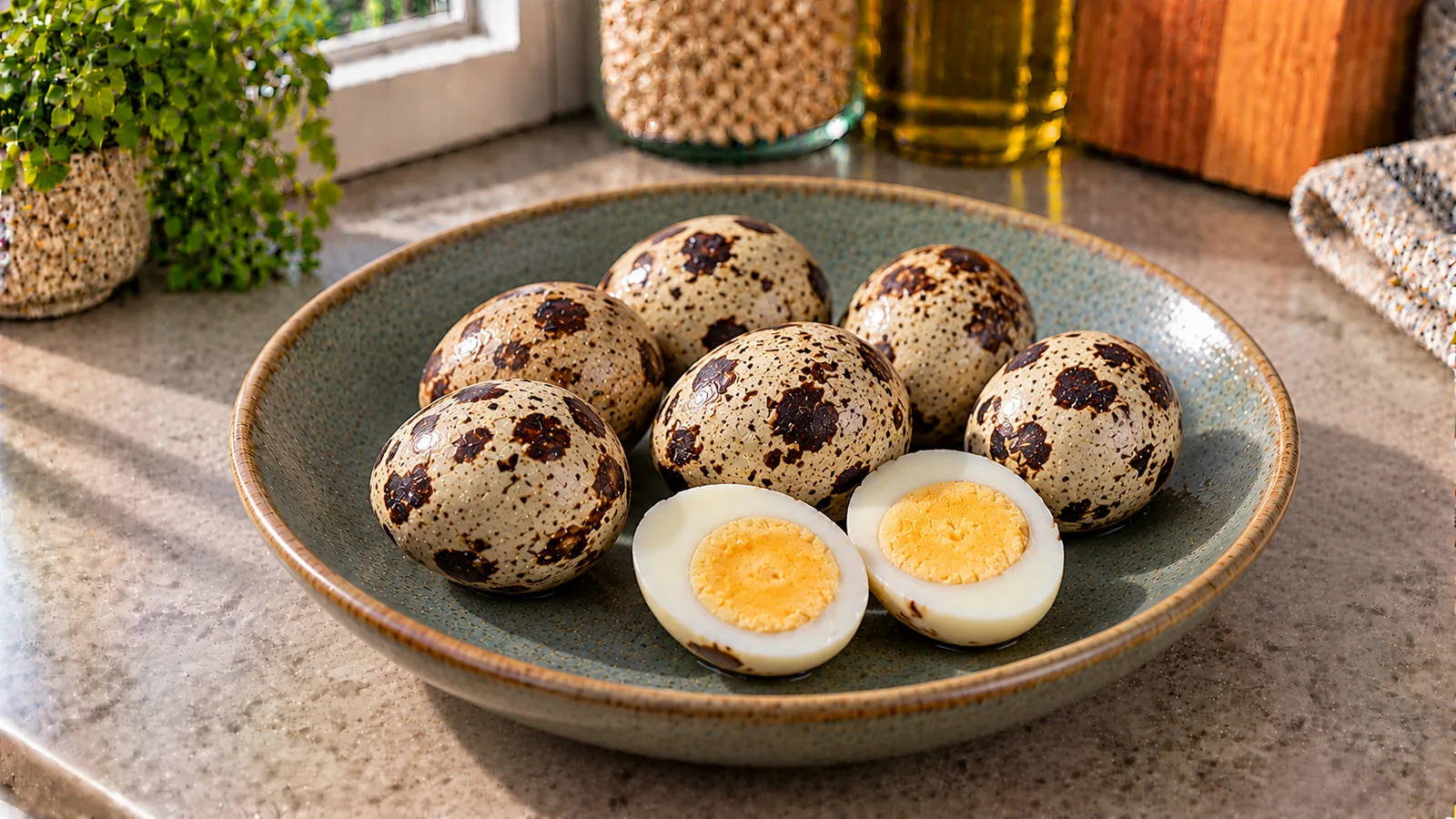
A quail egg contains about 14 calories when its edible contents weigh 9 g. USDA FoodData Central lists 158 kcal per 100 g of raw whole quail egg, along with 13.05 g protein and 11.09 g fat. The two numbers answer different questions: 158 kcal describes a fixed weight of egg, while 14 kcal describes one small reference egg without its shell. If the eggs in your carton are larger or smaller, the amount you eat changes even though the reference nutrients per 100 g do not.
This guide explains how to weigh quail eggs, estimate a plate of three, six or twelve, interpret their nutrients, and count boiled, fried and pickled versions without treating all preparations as identical. The figures are useful estimates for ordinary food logging, not laboratory measurements of your particular carton.
Quail egg nutrition per 100 g
The reference is USDA FoodData Central SR Legacy, “Egg, quail, whole, fresh, raw,” FDC 172191. It includes both yolk and white, but excludes the shell. It should not be confused with chicken eggs, quail meat or a prepared egg snack.
| Nutrient | Raw edible quail egg, per 100 g |
|---|---|
| Energy | 158 kcal |
| Protein | 13.05 g |
| Total fat | 11.09 g |
| Total carbohydrate | 0.41 g |
| Total sugars | 0.40 g |
| Fibre | 0 g |
| Water | 74.35 g |
| Sodium | 141 mg |
| Cholesterol | 844 mg |
| Vitamin B12 | 1.58 µg |
| Choline | 263.4 mg |
| Iron | 3.65 mg |
Source: USDA FoodData Central, quail eggs, FDC 172191. These are values for a reference food. Eggs can vary with the birds' feed, production conditions and individual size, and nutrient databases use different conventions for rounding numbers.
Protein is distributed between the white and yolk; much of the fat is in the yolk. Since most people eat the entire quail egg, the whole-egg entry is the appropriate starting point. The figures also show that quail eggs have very little carbohydrate. That observation does not justify calling a complete dish carbohydrate-free if bread, sauces or other ingredients are present.
Calories per egg, per five eggs and per portion
USDA gives a 9 g edible reference portion for one quail egg. That works out to 9 × 158 ÷ 100 = 14.22 kcal, usually rounded to 14 kcal per egg. Use 9 g as a reference, not as a guaranteed weight of every egg you buy.
| Edible serving | Edible weight | Calories | Protein |
|---|---|---|---|
| 1 egg | 9 g | 14 kcal | 1.2 g |
| 3 eggs | 27 g | 43 kcal | 3.5 g |
| 5 eggs | 45 g | 71 kcal | 5.9 g |
| 6 eggs | 54 g | 85 kcal | 7.0 g |
| 10 eggs | 90 g | 142 kcal | 11.7 g |
| 12 eggs | 108 g | 171 kcal | 14.1 g |
| 100 g edible egg | 100 g | 158 kcal | 13.1 g |
Every row is calculated from the same raw USDA reference and rounded independently. To estimate any other portion, use calories = edible grams × 1.58. For example, 60 g of peeled quail eggs would contribute approximately 95 kcal before oil or sauces. If you eat seven eggs weighing a total of 70 g without their shells, count approximately 111 kcal, not seven times the reference weight regardless of what the eggs actually weigh.
The distinction matters when a shop sells eggs by number, but you weigh a finished snack by grams. A plate of ten tiny eggs need not have the same edible weight as ten large ones. For consistent food records, the actual weight is better evidence than an assumed number per egg.
Does the shell count toward the serving weight?
No. Nutrition per 100 g applies to the edible white and yolk, not the whole unpeeled egg. Weigh peeled eggs when practical. If you want to record a batch of hard-boiled quail eggs, remove the shells before weighing the eggs that will be eaten. The shells add weight but do not add edible calories.
For an illustrative household check, imagine six whole eggs weigh 70 g in their shells. After boiling and peeling, the edible eggs weigh 54 g. Using the raw reference as an approximate basis gives 54 × 1.58 = about 85 kcal. The 16 g difference in this example is not a universal shell percentage: the weight of the shell and the loss during peeling vary.
If a package prints nutrition information for a precise portion, check whether it describes the drained edible product or a weight that includes brine. For plain fresh shell eggs, a reference per 100 g normally concerns edible egg. Our guide to portion size versus serving size explains why the labelled serving may differ from your meal.
Quail eggs versus chicken eggs
Quail eggs are much smaller individually, but neither type is inherently a low-calorie food simply because it comes from a different bird. A common confusion is comparing one quail egg with one chicken egg rather than comparing equal edible weights. That primarily measures the large difference in portion size.
For example, five reference quail eggs provide 45 g of edible egg and approximately 71 kcal. If you compare them with a chicken egg, weigh the chicken egg's edible part or use a correctly sized serving entry. You can find a separate breakdown in our chicken egg calorie and serving guide.
At the nutrient level, quail eggs supply protein, fat and several micronutrients. Comparisons of iron, B12 or cholesterol should use the same gram weight and the same raw-or-cooked state. A larger number per 100 g does not necessarily mean the smaller egg delivers more nutrients per piece. Nor does a marketing phrase such as “healthier than chicken eggs” substitute for a useful, portion-based comparison.
Boiled, poached or fried: what changes?
Boiling eggs in water does not introduce cooking fat. A plain hard-boiled egg of similar edible weight will therefore have approximately the same total energy from the original egg as before boiling, even though moisture changes and the nutrient value per 100 g of cooked product may differ. The table above is based on raw eggs; it is a reasonable practical estimate for a peeled boiled portion when no suitable cooked entry or product label is available. It is not presented as a separately measured USDA boiled-quail-egg record.
A fried egg is different when cooking oil or butter remains in the serving. Count the edible eggs and the fat that is actually consumed. If a pan has a large quantity of oil that is discarded afterwards, the full amount poured into the pan is not automatically eaten. Conversely, ignoring absorbed oil underestimates the dish. The olive oil calorie guide is useful when checking a label or weighing a small spoonful.
Consider an illustrative dish of six quail eggs and 5 g of oil. We approximate oil at 9 kcal per gram for a simple kitchen calculation:
| Component | Amount | Estimated calories |
|---|---|---|
| Quail eggs, edible | 54 g (6 reference eggs) | 85 kcal |
| Oil retained in the food | 5 g | 45 kcal |
| Total, before other ingredients | One dish | 130 kcal |
This is 130 kcal for the illustrated recipe, not the universal calorie count for six fried eggs. Pan size, cooking method, quantity of retained fat and additional ingredients can all change the result. Weighing a real batch and dividing by the servings eaten is better than labelling every prepared egg “14 calories” automatically.
Pickled quail eggs, sauces and ready-to-eat packs
Pickled quail eggs may be sold in brine, vinegar, seasoned liquid or a sweet marinade. Plain vinegar and salt do not add much energy, but sugar, oil or other ingredients can change the finished product's calories. Sodium can also be much higher than for an unsalted raw egg. Follow the actual label when available, including whether its weight is net or drained.
A serving of egg with mayonnaise, creamy dressing or soy-based dipping sauce cannot be recorded accurately as eggs alone. The additional condiment is part of the recipe. Similarly, a lunchbox containing eggs and vegetables may have most of its energy from bread, rice, nuts or dressing rather than from the eggs themselves.
For a concrete mixed-meal example, you can adapt our vegetable egg fried rice recipe with a weighed portion of quail egg instead of its original egg ingredient. Change the egg quantity in the recipe calculation, rather than assuming an equal number of eggs has the same weight.
Protein, cholesterol and micronutrients in context
Quail eggs contain 13.05 g protein and 11.09 g fat per 100 g in the raw USDA reference. However, a single 9 g egg provides only about 1.2 g protein. To get 12 g of protein from eggs of that size, you would need roughly 92 g edible quail egg, approximately ten reference eggs, which also contributes energy and fat. They can be part of a protein-containing meal, but their miniature size does not make an individual egg a high-protein portion.
The USDA record reports 844 mg cholesterol per 100 g, equivalent to roughly 76 mg in a 9 g egg. Cholesterol in food is not the same thing as cholesterol measured in blood; individual dietary guidance depends on the whole eating pattern and medical circumstances. Do not interpret an isolated nutrient number as a diagnosis or a reason to begin or stop treatment. For people with a specific cardiovascular condition or prescribed diet, personalised clinical advice takes priority.
The reference also lists vitamin B12, choline and iron. Those are nutrients found in real amounts, but the benefits of a varied diet cannot be inferred from a single food's ingredient list. A menu that also includes vegetables, grains, legumes and other protein sources is usually more informative than choosing foods by one micronutrient alone.
Egg safety and allergy: two practical cautions
Fresh quail eggs, like other shell eggs, should be handled as potentially contaminated by foodborne pathogens. Keep them at appropriate refrigerated temperatures, avoid cracked eggs and cross-contamination, and cook them thoroughly. The FDA's egg-safety guidance recommends cooking eggs until both the yolk and white are firm, especially relevant for higher-risk people. Raw or lightly cooked preparations require additional attention to pasteurisation and local food-safety guidance.
A quail egg is not automatically a safe substitute for someone allergic to hen eggs. Research has examined clinical cross-reactivity, and reactions to quail eggs can also occur independently. Anyone with a known egg allergy should seek advice from their allergy clinician before trying a different bird's egg. See the published clinical discussion of quail-egg cross-reactivity. These issues concern food safety and allergy rather than calories, but they matter whenever a food is being chosen as an alternative.
How to log quail eggs accurately
Start with the food state: fresh raw, plain boiled, fried with oil, or a packaged pickled product. For fresh or plain boiled eggs, use the edible weight after removing shells, and calculate from the raw USDA reference if you have no more suitable verified entry. Keep the choice consistent across days so that changes in the diary reflect food intake, not different assumptions.
For a recipe, record the number of eggs and their combined edible grams when possible; include oil, sauce and all other ingredients separately. If only the number is known, 9 g edible and 14 kcal per egg is a transparent starting estimate rather than an exact measurement. For prepared commercial foods, the producer's nutrition declaration is usually more relevant than the raw database figure.
Primary source: USDA FoodData Central, FDC 172191, Egg, quail, whole, fresh, raw. Portion calories and protein are rounded calculations from that raw reference; added oil in the recipe is illustrative and should be replaced with the quantity actually consumed.