
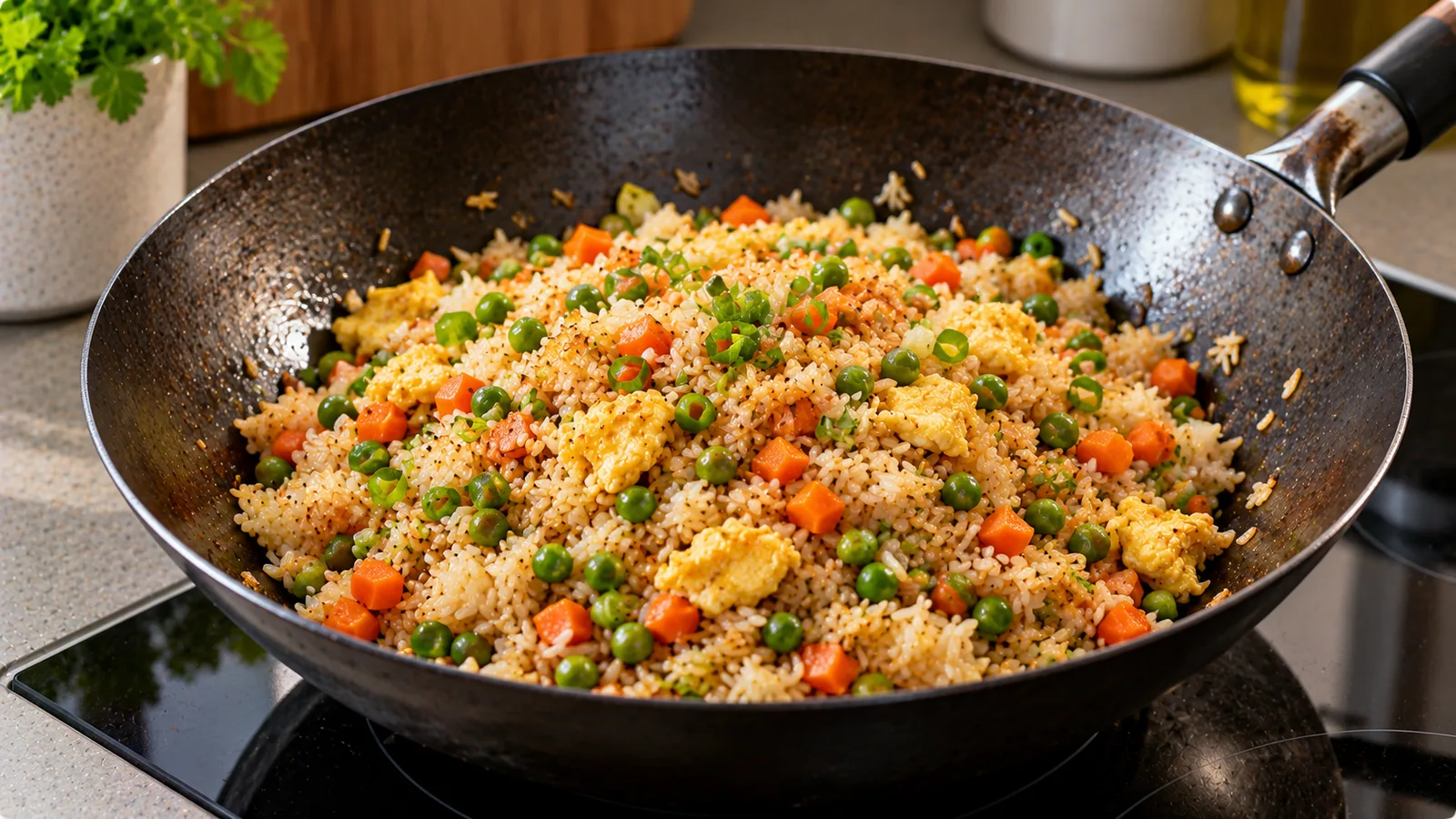
Vegetable and egg fried rice is a practical way to turn cooked rice, eggs and a handful of vegetables into a complete, satisfying meal. This version uses peas, carrots, spring onions, garlic and a modest amount of oil, with soy sauce for seasoning.
The recipe is designed for three servings and takes approximately 20 minutes of active preparation and cooking when the rice has already been cooked and safely chilled.
The most important details are the weight of the cooked rice, the amount of oil and how the rice was cooled and stored. These affect both the nutrition calculation and food safety.
Recipe at a glance
| Detail | Amount |
|---|---|
| Servings | 3 |
| Preparation | 10 minutes |
| Cooking | 10–12 minutes |
| Total active time | About 20–22 minutes |
| Cooked rice required | 450 g |
| Eggs | 3 large |
| Main vegetables | Carrot, peas, spring onions |
| Cooking method | Large frying pan or wok |
| Estimated energy | About 440 kcal per serving |
The nutrition estimate is for the recipe below, without optional toppings. It is an approximation rather than a laboratory-tested value.
Ingredients
| Ingredient | Amount |
|---|---|
| Cooked white rice, cooled | 450 g |
| Large eggs | 3, approximately 150 g without shells |
| Carrot, diced | 120 g |
| Green peas, thawed | 120 g |
| Spring onions | 60 g |
| Garlic | 10 g |
| Neutral cooking oil | 20 g |
| Reduced-sodium soy sauce | 30 g |
| Fresh ginger, finely grated | 10 g |
| Black pepper | To taste |
Optional: a little chili, lime juice or sesame seeds. Add their nutrition separately if used.
Important: The 450 g of rice refers to its cooked weight, not dry rice. Using 450 g of uncooked rice would produce a much larger recipe with substantially more calories.
What kind of rice works best?
Long-grain white rice, jasmine rice or basmati rice can all work. Rice that has cooled tends to separate more easily in the pan than freshly cooked, wet rice.
Brown rice is also suitable, although the texture and nutritional values will differ.
You can use freshly cooked rice if necessary, but it should not be wet or excessively sticky. Spread it briefly on a clean tray to release steam before frying, and do not leave it sitting at room temperature for an extended period.
If using leftover rice, follow the cooling and storage guidance later in this article.
How to make vegetable and egg fried rice
1. Prepare the ingredients
Break up any clumps of cold cooked rice with a fork.
Dice the carrot into small pieces so it cooks quickly. Slice the spring onions, separating the pale and green portions if desired.
Finely chop the garlic and grate the ginger.
Beat the eggs lightly in a bowl.
Measure the oil and soy sauce rather than pouring directly from the bottle. Small changes in oil quantity can noticeably change the final calorie estimate.
2. Cook the eggs
Heat a large nonstick frying pan or wok over medium-high heat.
Add approximately 5 g of the measured oil.
Pour in the beaten eggs and stir gently until just set.
Transfer the eggs to a clean plate.
They will return to the pan near the end, so avoid overcooking them now.
3. Cook the vegetables
Add another 10 g of oil to the pan.
Add the diced carrot and cook for approximately 3 minutes, stirring frequently.
Add the peas, pale spring onion pieces, garlic and ginger.
Cook for another 2 minutes, until the vegetables are heated through and the carrot is tender but not mushy.
If the garlic starts to brown too quickly, reduce the heat.
4. Fry the rice
Add the remaining 5 g of oil and the 450 g of cooked rice.
Spread the rice across the hot pan and let it heat briefly before stirring.
Cook for approximately 3–4 minutes, stirring and breaking up any clumps.
The rice should become thoroughly hot throughout.
Avoid adding large amounts of water, which can make the dish soft rather than lightly fried.
5. Add the seasoning and eggs
Pour in the measured soy sauce and mix thoroughly.
Return the cooked eggs to the pan.
Add the green spring onion pieces and black pepper.
Stir for another minute, ensuring the eggs and vegetables are distributed evenly and the entire dish is steaming hot.
Taste before adding any salt because soy sauce already contributes sodium.
Divide the finished fried rice into three portions.
Estimated nutrition per serving
The estimates below use representative ingredient values and assume the recipe is divided into three equal portions.
| Nutrient | Whole recipe | Per serving |
|---|---|---|
| Energy | Approximately 1,320 kcal | Approximately 440 kcal |
| Protein | Approximately 45 g | Approximately 15 g |
| Fat | Approximately 38 g | Approximately 13 g |
| Carbohydrates | Approximately 199 g | Approximately 66 g |
| Fiber | Approximately 14 g | Approximately 4.7 g |
These are approximate figures. The exact results depend on the rice variety, egg size, oil retained, vegetable products and soy sauce brand.
The ingredient quantities are the primary basis for tracking. If you use different products, recalculate using their actual labels.
Reference for representative ingredient composition: USDA FoodData Central.
Why the oil matters
This recipe uses 20 g of oil for three servings.
Oil supplies approximately 9 kcal per gram, so the measured oil contributes about 180 kcal to the whole recipe, or approximately 60 kcal per serving.
If you increase the oil from 20 g to 35 g, you add approximately 135 kcal to the whole dish.
That is around 45 additional kcal per serving.
A generous unmeasured pour can therefore change the calorie calculation even if every other ingredient stays the same.
Why cooked rice must be weighed correctly
The recipe uses 450 g of cooked rice.
Cooked rice contains absorbed water, so its weight is not interchangeable with dry rice weight.
If you prepare rice from scratch, weigh the cooked rice after cooking and use 450 g in the pan.
The amount of dry rice required depends on the variety and water absorption during cooking.
Do not assume that 150 g of dry rice always becomes exactly 450 g cooked.
How much fried rice is one serving?
The total finished weight will be lower or higher than the sum of the raw and cooked ingredient weights because some water evaporates during frying.
The starting ingredient weights total approximately 970 g, excluding pepper.
If the finished dish weighs, for example, 930 g, each of three equal servings would weigh about 310 g.
This is an illustrative yield, not a guaranteed cooked weight.
For precise food logging:
- Weigh the empty serving container.
- Weigh the complete finished dish.
- Divide the finished weight by three.
- Record the calories for one-third of the full recipe.
This is more accurate than assuming that every bowl of fried rice has the same weight.
Variations that work
With brown rice
Replace the 450 g of cooked white rice with 450 g of cooked brown rice.
Brown rice has a different texture and nutritional profile. Recalculate the recipe using the actual cooked brown rice values.
With extra vegetables
Add 100–150 g of finely chopped cabbage, mushrooms or bell pepper.
Cook vegetables that release water before adding the rice, so the finished dish does not become soggy.
With more protein
Add cooked chicken, tofu or edamame.
Make sure any added chicken is thoroughly cooked and reheated appropriately.
Additional protein ingredients change the total calories, protein and portion weight.
Without soy sauce
Use a suitable reduced-sodium or gluten-free alternative if needed.
Tamari is not automatically low in sodium, so check the label.
For a soy allergy, select a verified soy-free seasoning rather than assuming an alternative is safe.
Common texture problems
Rice becomes mushy: It may have been too wet, crowded in the pan or stirred constantly without enough heat.
Vegetables remain hard: The carrot pieces may be too large. Dice them finely and cook them before adding the rice.
Eggs become rubbery: They may have been cooked too long during the first step. Remove them as soon as they set.
The dish tastes too salty: Soy sauce quantities and sodium concentrations vary. Start with the measured amount and taste before adding more.
Rice sticks to the pan: Use a sufficiently hot pan, work in batches if necessary and avoid overloading a small skillet.
Rice safety: cooling, storage and reheating
Cooked rice requires careful handling because Bacillus cereus spores can survive cooking. If cooked rice is held under unsuitable conditions, bacteria may grow and produce toxins.
The safest approach is to cook only what you need. If saving rice for later:
- Cool cooked rice rapidly rather than leaving it at room temperature for hours.
- Transfer it into shallow containers to speed cooling.
- Refrigerate promptly.
- Follow local food-safety guidance for maximum storage time.
- Reheat thoroughly until steaming hot throughout.
- Avoid repeatedly cooling and reheating the same rice.
The UK Food Standards Agency advises cooling rice as quickly as possible, ideally within one hour, keeping it refrigerated and eating it within 24 hours if it is intended for reheating.
Source: UK Food Standards Agency — Home food fact checker.
For general leftover handling, the USDA recommends refrigerating perishable cooked foods promptly and reheating leftovers to 74°C / 165°F.
Source: USDA Food Safety and Inspection Service.
A good recipe cannot make rice safe if it was previously stored improperly. Reheating does not reliably reverse every problem caused by bacterial toxin formation.
If you do not know how long leftover rice has been unrefrigerated, do not use it.
Can vegetable egg fried rice be meal-prepped?
Yes, provided the rice is cooked, cooled, refrigerated and reheated safely.
For the simplest approach, prepare the vegetables in advance but cook the rice and eggs shortly before serving.
If preparing the entire recipe ahead of time, divide it into shallow containers and cool it rapidly.
For rice dishes, use the stricter rice-specific storage guidance rather than assuming all leftovers can be kept for the same number of days.
Freeze portions promptly if you need longer storage, following safe cooling procedures.
When reheating, heat the food thoroughly and avoid repeated reheating cycles.
Allergens and substitutions
The standard recipe contains:
- Eggs.
- Soy, from soy sauce.
- Potentially wheat/gluten, depending on the soy sauce.
Read the specific soy sauce label if you need to avoid wheat.
A gluten-free product must be verified as suitable; the name tamari alone is not a guarantee.
For an egg-free version, omit the eggs and consider tofu or another suitable protein source. The result will be a different recipe with different nutritional values.
For a soy-free version, replace the soy sauce with a verified soy-free seasoning and adjust the salt carefully.
How to make the recipe fit your calorie target
The easiest ingredients to adjust are rice and oil.
For a smaller portion, divide the same recipe into four servings rather than three. The estimated energy becomes approximately 330 kcal per serving, but each portion is smaller.
To reduce the total energy while keeping three servings, consider using 350 g cooked rice instead of 450 g, or 15 g oil instead of 20 g.
To make the meal more substantial, add a protein source or serve it with an additional side.
When modifying the recipe, calculate the nutrition from the final ingredient quantities rather than reusing the original 440 kcal estimate.
Sources and calculation notes
- USDA FoodData Central — representative ingredient nutrient composition.
- UK Food Standards Agency — cooked rice cooling, refrigeration and reheating advice.
- USDA Food Safety and Inspection Service — general safe storage and reheating guidance.
Nutrition is estimated from the listed ingredient weights, including 450 g of cooked rice and 20 g of oil. Values are rounded and may vary with actual products and preparation.