
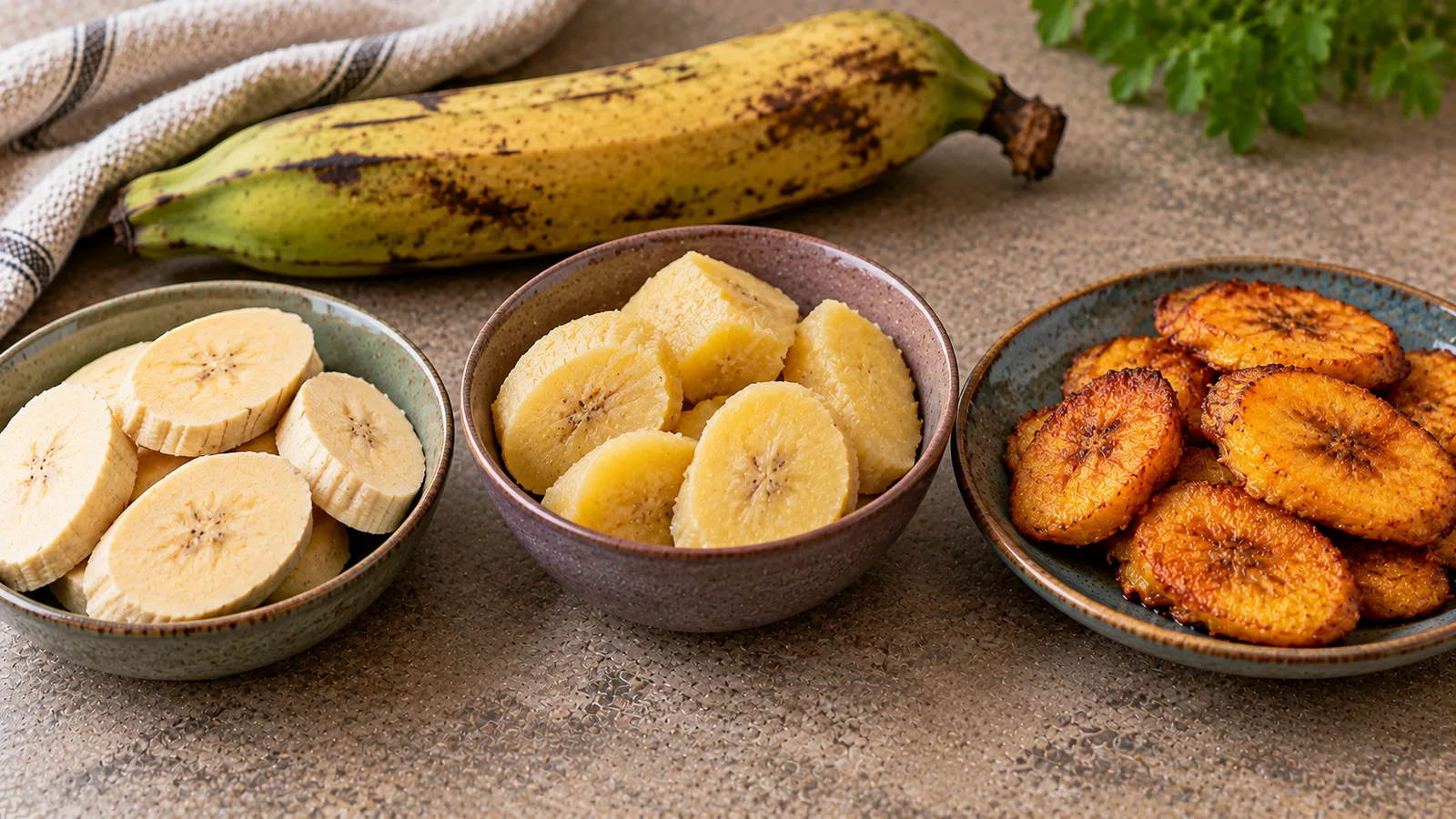
How many calories are in plantains?
Plantains, sometimes called cooking bananas, are starchy fruits commonly boiled, roasted or fried. Their energy depends on ripeness, cooking method and the weight actually eaten. Three USDA FoodData Central entries give useful reference points: 122 kcal per 100 g of raw yellow plantain (FDC 169130), 121 kcal per 100 g of boiled green plantain (FDC 168216) and 309 kcal per 100 g of fried green plantain (FDC 168199). These are three different food descriptions, not a controlled experiment using the same fruit. They should not be treated as a precise before-and-after measure of frying.
Raw, boiled and fried: comparison per 100 g
| Reference food | Energy per 100 g | What the figure represents |
|---|---|---|
| Yellow plantain, raw | 122 kcal | Peeled edible fruit; no oil |
| Green plantain, boiled | 121 kcal | Prepared green fruit; no frying oil |
| Green plantain, fried | 309 kcal | Fried green fruit, including absorbed fat |
For 100 g raw yellow plantain, the record also reports approximately 31.9 g carbohydrate, 1.3 g protein and 0.35 g fat. For 100 g fried green plantain, the separate record reports approximately 49.2 g carbohydrate, 1.5 g protein and 11.8 g fat. Do not transfer these macronutrients to an unrelated variety or package. In the USDA 'carbohydrate by difference' convention, fibre may be part of the carbohydrate total, unlike the presentation of many European labels.
Calories in 80 g, 100 g and 150 g servings
The simplest calculation is kcal per 100 g × edible serving weight ÷ 100. Always weigh the flesh, not the inedible peel. The figures below are arithmetic illustrations derived from the three separate database records, rounded to whole kilocalories.
| Weighed edible portion | Raw yellow | Boiled green | Fried green |
|---|---|---|---|
| 80 g | 98 kcal | 97 kcal | 247 kcal |
| 100 g | 122 kcal | 121 kcal | 309 kcal |
| 150 g | 183 kcal | 182 kcal | 464 kcal |
A 150 g serving of raw yellow fruit comes to 183 kcal. The same displayed weight of fried green slices corresponds to about 464 kcal in the specified USDA record. This does not mean that a particular 150 g raw plantain turns into 150 g of fried plantain: water and cooking oil change the final weight.
Why frying changes calories per 100 g
Frying introduces oil, while cooking also changes moisture. Added fat contributes energy; water contributes weight but no calories. That combination can make a cooked portion more energy-dense than its raw starting material. The USDA fried entry represents a particular composition; it cannot predict precisely how much oil your pan or deep fryer transfers into a different batch. Frying temperature, thickness, surface area and draining all matter. A darker colour is not a reliable measurement of absorbed oil.
For a transparent recipe example, start with 150 g of peeled raw yellow plantain = about 183 kcal. If you use and consume 10 g of oil = about 90 kcal, the ingredient total is about 273 kcal, before any sauce. This calculation assumes the full 10 g remains in the food; if some remains in the pan, measure the difference rather than assuming all of it was eaten. If the finished batch weighs 130 g, the same hypothetical 273 kcal would average approximately 210 kcal per 100 g of finished dish. This last number is a worked example, not a USDA fried-plantain value.
Boiling and the effect of water
Boiling does not inherently add fat. It can change how much water is in the fruit and therefore the calorie concentration per 100 g. Some solids may also pass into discarded cooking water. The 121 kcal/100 g USDA boiled-green value is suitable as a specific reference for that item, not a promise that every boiled green or ripe plantain has identical values. To track a home recipe accurately, record edible raw ingredients and the cooked batch yield. If using a database entry for the final cooked food, do not add the raw fruit calories a second time.
Green, yellow and very ripe plantains
A green plantain is firmer and usually more starch-forward; as it ripens, its taste becomes sweeter and starch and sugar proportions change. Colour, cultivar and degree of maturity affect composition. The reference here for raw fruit is yellow, whereas the boiled and fried references are green. Therefore, comparing 122, 121 and 309 kcal per 100 g illustrates three products, not solely the effect of cooking. Plantains are not interchangeable with ordinary dessert bananas for nutrient logging. Choose the matching food description whenever possible.
Peel, edible yield and the weight of one fruit
Shopping weights often include the substantial peel. A plantain weighing 250 g at the shop does not provide 250 g of edible flesh. Peel it, trim any parts you will not eat, and weigh the remaining fruit. The edible yield depends on variety, ripeness and preparation, so this article does not invent a universal peel percentage or a fixed number of calories 'per plantain'. If your peeled fruit weighs 180 g, raw yellow at 122 kcal per 100 g would provide about 220 kcal. That is a calculation from your measured 180 g, not an assumed standard fruit size.
Oil, sauces and ready-made plantain products
Tostones, patacones, maduros, packaged plantain crisps and restaurant portions can have different oil content, moisture and ingredient lists. A finished ready-made product's nutrition label is preferable to an estimate based on plain fruit. For home frying, record the oil actually used and retained; for air frying, account for any oil spray added. If served with cheese, dips or sugar, calculate these separately. Do not substitute the 309 kcal per 100 g fried-green value for every sweet ripe fried plantain, and do not treat chips as equivalent to boiled slices.
To compare the weighing method with related foods, see raw versus cooked weighing · how ordinary banana calories differ.
Which figure should you log?
For plain raw yellow plantain, use 122 kcal/100 g with the weighed edible amount; for the specifically described boiled green plantain, use 121 kcal/100 g; for fried green plantain matching the USDA entry, use 309 kcal/100 g. A 150 g weighed portion gives roughly 183, 182 or 464 kcal, respectively. Check ingredient labels and preparation details before choosing one. When calculating a homemade recipe, avoid mixing an already fried database item with separately added frying oil: that would count the oil twice.
Sources
- USDA FoodData Central: yellow plantains, raw, FDC 169130. Nutrients for edible raw yellow fruit.
- USDA FoodData Central: green plantains, boiled, FDC 168216. Distinct boiled-green preparation.
- USDA FoodData Central: green plantains, fried, FDC 168199. Fried-green composition including fat.