
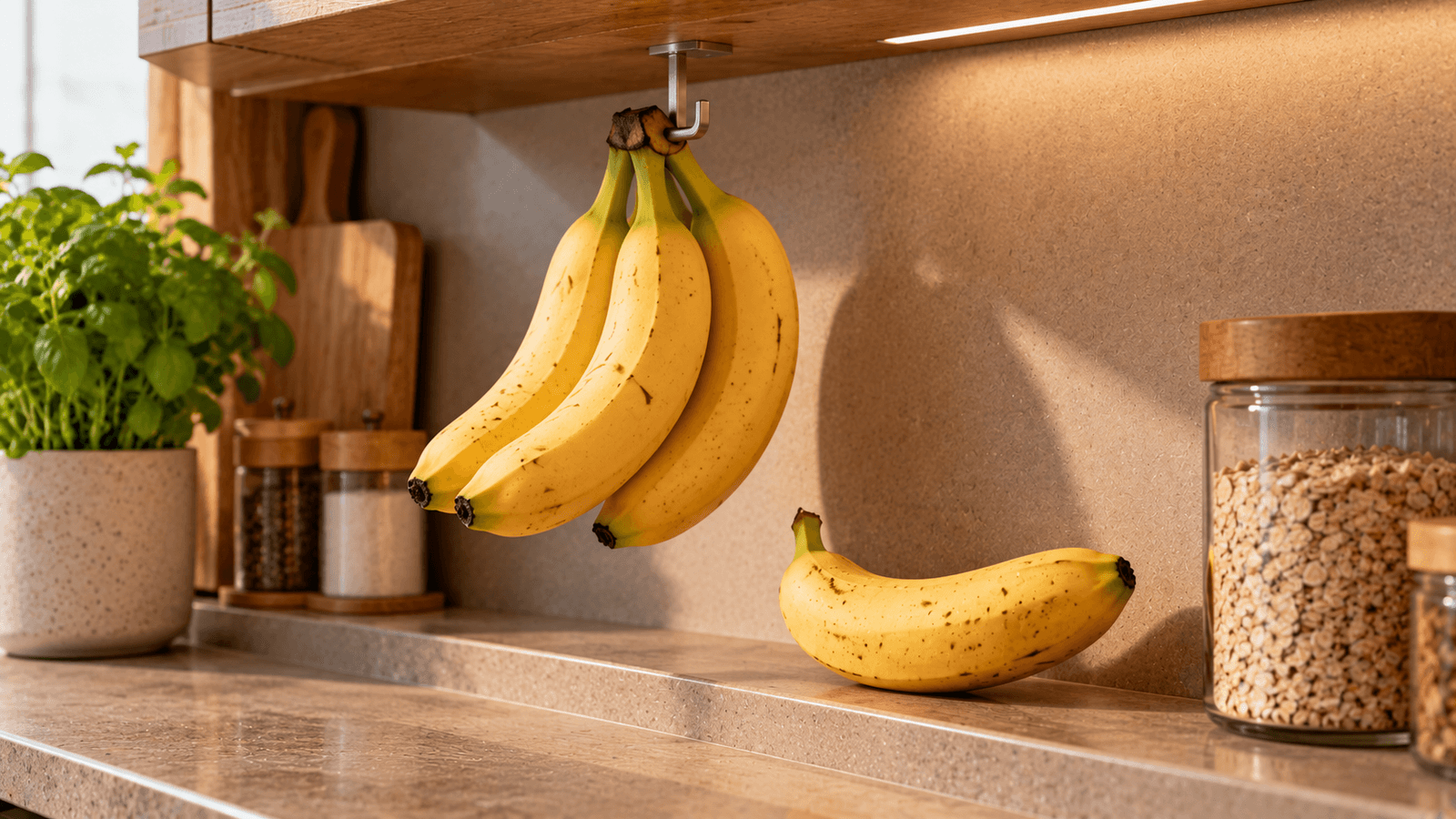
A raw banana provides roughly 90 kcal per 100 g of edible fruit.
The calories in one banana depend mainly on its edible weight. A small banana contains less fruit than a large one, so counting every banana as the same number of calories can make food tracking less accurate.
Banana calories by weight
Using about 89–90 kcal per 100 g as a practical reference:
| Edible banana weight | Approx. calories |
|---|---|
| 50 g | 45 kcal |
| 75 g | 67 kcal |
| 100 g | 89 kcal |
| 120 g | 107 kcal |
| 150 g | 134 kcal |
| 180 g | 160 kcal |
| 200 g | 178 kcal |
| 250 g | 223 kcal |
The edible weight means the banana flesh after removing the peel.
How many calories are in one banana?
Bananas vary considerably in size.
A useful example from USDA food-composition data lists a medium raw banana at about 118 g edible weight and 109 kcal.
For everyday tracking, a banana around 100–120 g of edible fruit will therefore usually be around 90–110 kcal.
Larger bananas contain more.
Small, medium and large bananas
Size labels are convenient, but weight is more precise.
As a practical estimate:
| Banana | Approx. edible weight | Approx. calories |
|---|---|---|
| Small | 80–100 g | 71–89 kcal |
| Medium | 110–125 g | 98–111 kcal |
| Large | 140–160 g | 125–142 kcal |
| Very large | 180–200 g | 160–178 kcal |
These are estimates rather than fixed values because individual bananas differ.
If calorie accuracy matters, weighing the edible fruit is more reliable than choosing a generic "one banana" entry.
How to calculate banana calories yourself
If your nutrition database gives 89 kcal per 100 g, use:
banana weight in grams × 89 ÷ 100
Example:
A peeled banana weighs 135 g.
135 × 89 ÷ 100 = 120 kcal
For a 170 g banana:
170 × 89 ÷ 100 = 151 kcal
This method works for any portion size.
Should you weigh a banana with or without the peel?
If the nutrition entry refers to edible raw banana, weigh the part you actually eat.
That normally means:
remove the peel → weigh the banana flesh → use an edible-banana nutrition entry
If you weigh the banana with its peel but log that entire weight as edible banana, the calculated calories will be too high because the peel contributes to the scale weight but is normally not eaten.
Example: whole weight vs edible weight
Suppose a banana weighs 175 g with the peel.
After peeling, the edible fruit weighs 115 g.
Using 89 kcal per 100 g:
115 × 89 ÷ 100 = 102 kcal
Using the full 175 g incorrectly:
175 × 89 ÷ 100 = 156 kcal
That is a difference of more than 50 kcal created purely by using the wrong weight basis.
What nutrients are in a banana?
Bananas are primarily a carbohydrate-rich fruit.
They contain:
- carbohydrate;
- naturally occurring sugars;
- dietary fiber;
- potassium;
- vitamin B6;
- vitamin C;
- smaller amounts of several other vitamins and minerals.
They contain relatively little fat and only a small amount of protein.
Exact nutrient values vary with the banana and the food-composition record used.
Carbohydrates in bananas
Most of a banana's calories come from carbohydrate.
That carbohydrate includes a mixture of:
- sugars;
- starch;
- fiber.
The proportions change as the fruit ripens.
This is one reason an unripe green banana and a very ripe banana do not have exactly the same carbohydrate profile even when their total energy is broadly similar.
Does ripeness change banana calories?
Ripening changes the form of carbohydrate more noticeably than it changes the total amount of energy in the fruit.
As a banana ripens, some starch is converted into sugars.
That is why a ripe banana tastes sweeter.
For ordinary calorie tracking, you generally do not need a completely different calorie entry every time the banana becomes more ripe.
Portion weight usually has a much larger practical effect on the calorie estimate.
Banana calories by portion
You do not have to eat a whole banana.
For a banana with 89 kcal per 100 g:
30 g
30 × 89 ÷ 100 = 27 kcal
60 g
60 × 89 ÷ 100 = 53 kcal
100 g
89 kcal
150 g
150 × 89 ÷ 100 = 134 kcal
This is useful when banana is added to oatmeal, yogurt, smoothies or desserts.
Half a banana
"Half a banana" is not a fixed amount because bananas vary in size.
If a whole peeled banana weighs 120 g, half is about 60 g:
60 × 89 ÷ 100 = 53 kcal
If a large peeled banana weighs 170 g, half is about 85 g:
85 × 89 ÷ 100 = 76 kcal
For repeatable tracking, weight is more useful than the fraction alone.
Banana in oatmeal
Suppose your breakfast contains:
- 50 g oats;
- 120 g banana;
- 200 ml milk.
For the banana component:
120 × 89 ÷ 100 = 107 kcal
Track the oats, milk and any other additions separately.
This keeps the banana calculation independent from the complete meal.
Banana with yogurt
Example:
- 150 g yogurt;
- 90 g banana;
- 10 g nuts.
Banana calories:
90 × 89 ÷ 100 = 80 kcal
The yogurt and nuts contribute their own calories.
The calories in "banana with yogurt" therefore depend much more on the full ingredient amounts than on the banana alone.
Banana in a smoothie
A banana does not gain calories simply because it is blended.
If 130 g of banana goes into a smoothie:
130 × 89 ÷ 100 = 116 kcal
Those banana calories remain part of the drink.
But the complete smoothie may also contain:
- milk;
- yogurt;
- juice;
- nut butter;
- oats;
- protein powder;
- honey.
For accurate tracking, count the full recipe rather than searching for a generic "banana smoothie" entry.
Frozen bananas
Freezing a banana does not inherently add calories.
If you freeze 150 g of plain banana, it still contains approximately the calories associated with that amount of banana.
The important distinction is whether anything has been added.
A frozen banana coated with chocolate or nut butter is a different food from plain frozen banana.
Dried banana is different
Dried banana should not be tracked using the same per-100-g value as fresh banana.
Removing water concentrates the food.
That means 100 g of dried banana can contain substantially more calories than 100 g of fresh banana.
Commercial dried banana products may also contain added oil or sugar.
Use the nutrition information for the specific dried product rather than a fresh-banana entry.
Banana chips are not the same as fresh banana
Banana chips can be fried or processed with additional ingredients.
Their calorie density can therefore be much higher than fresh banana.
If you eat banana chips, use the package nutrition information or a matching database entry.
Do not log their weight as raw banana.
Banana bread is not a banana calorie equivalent
The calories in banana bread come from the complete recipe.
Besides bananas, it may contain:
- flour;
- butter or oil;
- eggs;
- sugar;
- nuts;
- chocolate.
A slice of banana bread therefore cannot be estimated accurately from the calories in the banana ingredient alone.
Example: banana portion in a recipe
Suppose a recipe uses 300 g of peeled banana.
Using 89 kcal per 100 g:
300 × 89 ÷ 100 = 267 kcal from banana
If the recipe produces six equal portions:
267 ÷ 6 = 44.5 kcal of banana per portion
But the total calories per portion must also include every other ingredient.
Are bananas high in calories?
Compared with very water-rich fruits, bananas contain more calories per 100 g because they contain less water and more carbohydrate.
But whether a banana is "high calorie" depends on the comparison and portion.
A medium banana is still a relatively compact serving of fruit, and its calories can be tracked easily by weight.
For calorie tracking, the more useful question is:
How much banana did you eat?
rather than assigning the fruit a general high- or low-calorie label.
Does banana size matter?
Yes.
Consider two peeled bananas:
Banana A
95 g
95 × 89 ÷ 100 = 85 kcal
Banana B
180 g
180 × 89 ÷ 100 = 160 kcal
Both are "one banana," but the calorie difference is about 75 kcal.
This is why generic item counts are less precise than edible weight.
Common banana tracking mistakes
Logging the weight with the peel
Nutrition values for edible banana should normally be applied to edible weight.
Assuming every banana is 100 kcal
Some bananas are smaller; others are much larger.
Using a fresh-banana entry for dried banana
Water loss changes calories per 100 g.
Ignoring smoothie ingredients
Blending does not remove the calories from milk, nut butter, oats or other additions.
Logging banana chips as banana
Processed banana products can have very different calorie density.
If you cannot weigh the banana
Use a size-based estimate.
For example:
- small: roughly 70–90 kcal;
- medium: roughly 100–110 kcal;
- large: roughly 125–145 kcal.
This is less precise than weighing the edible portion, but it is often sufficient for everyday tracking.
If you buy similar bananas repeatedly, weighing a few can also give you a useful personal reference.
A simple tracking method
For the most consistent result:
- Peel the banana.
- Weigh the edible fruit.
- Choose a raw-banana database entry expressed per 100 g.
- Enter the edible weight.
- Track other ingredients separately if the banana is part of a meal or recipe.
For example:
142 g banana × 89 kcal ÷ 100 = about 126 kcal
That is usually more reliable than assuming all bananas contain the same amount.
Nutrition data sources
Reference values below are per 100 g of the specified food. Product varieties and preparation methods can differ.
- USDA FoodData Central — Bananas, raw (FDC 173944; 89 kcal/100 g).