
The calorie figure refers to what you eat
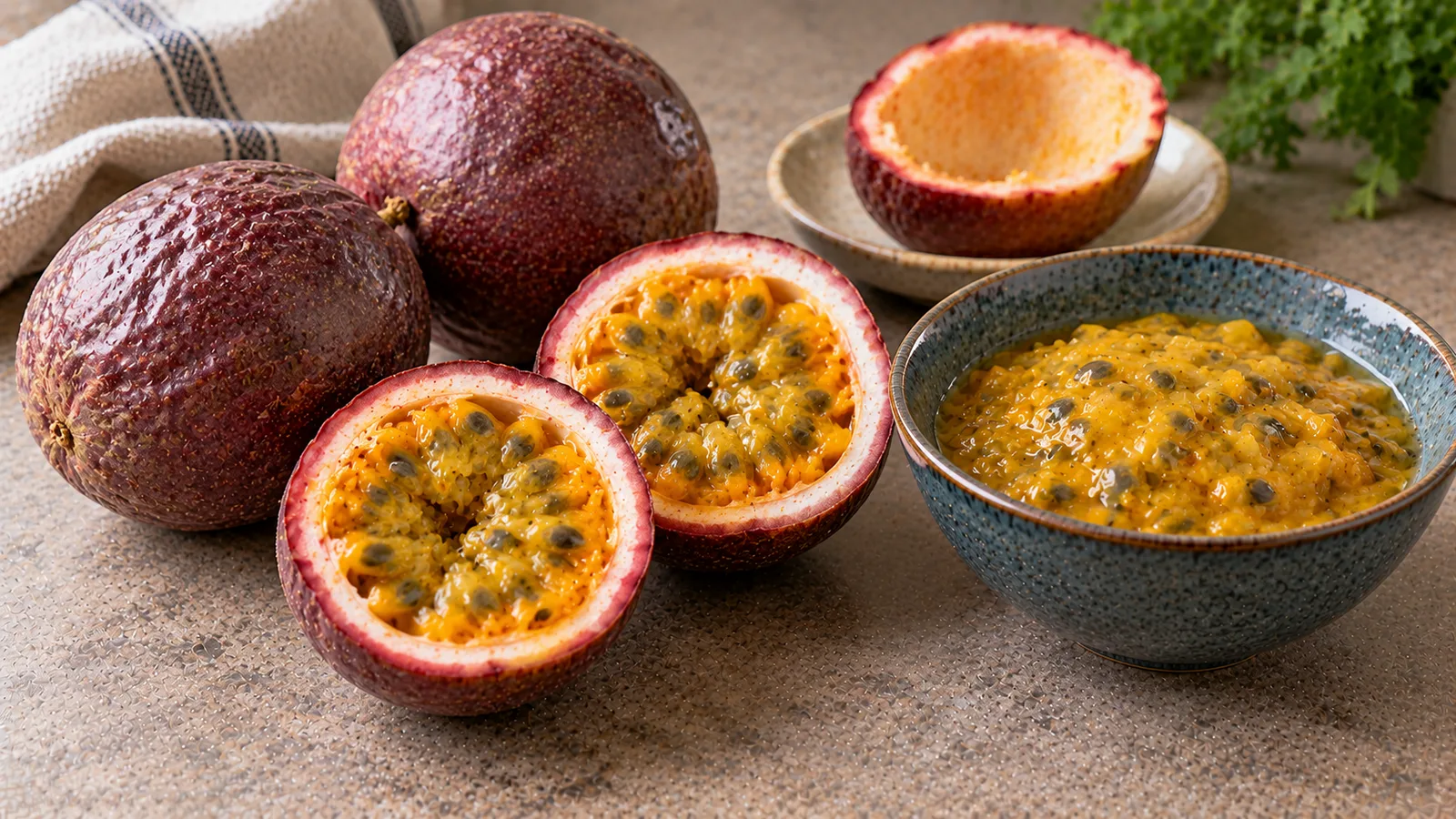
USDA FoodData Central SR Legacy describes raw purple passion fruit (granadilla) under record 169108. The entry reports 97 kcal per 100 g of the edible portion, not per 100 g of an unopened fruit. That portion is the aromatic pulp together with its edible black seeds. A thick outer rind makes a whole fruit much heavier than its contents. If you weigh the unopened passion fruit and multiply by 97 kcal, you will overestimate what you eat. The number is a database reference for one type of passion fruit; other varieties and packaged products may differ. USDA nutrient record.
One fruit is a serving estimate, not a fixed weight
A standard household measure in the Canadian Nutrient File gives 18 g of edible material for 1 fruit. At 97 kcal per 100 g, that is approximately 17 kcal per fruit. Two similarly sized reference fruits therefore contribute about 35 kcal. Real fruits can be smaller, larger, fuller or more dried out, so 18 g is not an instruction to treat every fruit identically. For a practical estimate, cut the fruit, scoop the pulp with seeds into a small bowl and weigh that portion. Measure the empty bowl first or use the tare button on the kitchen scale. Canadian portion record.
Portions and calories: a quick table
The table below scales the USDA raw-purple-fruit reference. All gram amounts describe edible pulp plus seeds, and all values are rounded to whole calories. The 18-g row is a database serving size, while 30 g, 50 g and 100 g are weighed amounts rather than assumed numbers of fruits. This difference matters when two fruits look equally large but contain different amounts of pulp. A tablespoon can also hold different amounts depending on how much juice collects with the seeds, so a scale is preferable when the calculation matters.
| Edible pulp and seeds | Approximate energy |
|---|---|
| 18 g | 17 kcal |
| 30 g | 29 kcal |
| 36 g | 35 kcal |
| 50 g | 49 kcal |
| 54 g | 52 kcal |
| 100 g | 97 kcal |
The 18-g row is the source serving size; all other rows are weighed portions.
How much of the fruit is discarded?
The Canadian portion reference lists 48% refuse for the source item, but that percentage is an observed reference characteristic, not a universal yield for every variety. The shell is normally discarded; the seeds embedded in the pulp are generally eaten. In a hypothetical batch weighing 200 g before opening, applying the reference yield of 52% would give 104 g edible fruit and roughly 101 kcal. The calculation only demonstrates how yield works. The more accurate method is to weigh the edible material directly, especially for a shopping bag of mixed sizes. Do not include the rind in the nutritional denominator or count its weight as eaten.
Pulp, juice and black seeds are not the same food
Fresh passion fruit is usually eaten by scooping out the juice-coated pulp with the seeds. The USDA figure covers that edible mixture. Straining the pulp removes a varying share of seeds, fibres and some retained juice, producing a different product. It would be misleading to claim that seedless strained juice has exactly the same calories, fibre or sugar per 100 g as whole edible passion fruit. Bottled passion-fruit drinks may contain added water, sugar, other juices and flavourings. Their ingredient list and nutrition label, not the raw-fruit reference, determine their calories. Seed removal is a preparation change, not merely a difference in how the dish looks.
Carbohydrates, fibre and sugar
Per 100 g edible passion fruit, the cited USDA record lists 23.4 g total carbohydrate, including 10.4 g dietary fibre, and 11.2 g total sugars, as well as 2.2 g protein and 0.7 g fat. These are the American database categories; on European labels, carbohydrate may be presented differently because fibre is displayed separately. Do not add fibre or sugars to the listed total carbohydrate to invent a new calorie figure. The source's 97 kcal is the reference energy value to use for this article. For a single 18-g edible serving, fibre is about 1.9 g and sugars about 2.0 g; the numbers are small because the portion is small, not because the fruit has no fibre.
A practical dessert example
Suppose you open 3 reference-size passion fruits and collect 54 g of pulp and seeds. The fruit contributes approximately 52 kcal before anything else is added. If you spoon the pulp onto plain yogurt, the finished dessert's energy equals the fruit plus the actual yogurt portion and any honey, sugar or granola. If you use 100 g of passion-fruit pulp instead, that part contributes about 97 kcal. The totals are examples, not a recommendation to eat any particular number of fruits. They demonstrate why recording each component is clearer than choosing a generic database entry for “passion-fruit dessert.”
Fresh, frozen and purée: choose the matching record
A package of unsweetened frozen passion-fruit pulp may be close to a raw-fruit preparation, but straining, pasteurisation and water content can still change its composition. Fruit purée sometimes contains sugar, concentrate or other fruit. Check whether the declared weight is the product ready to eat, the concentrated ingredient or the prepared drink after adding water. If a recipe reduces pulp over heat, the total energy of the fruit does not simply disappear when water evaporates, although calories per 100 g of the thickened product can rise. For the raw fruit, record the edible grams; for branded purée, use its specific label.
For a useful distinction, see a separate profile for pomegranate.
A simple tracking method
Choose the correct food entry for raw purple passion fruit rather than a sweetened beverage, peel or an unrelated fruit. Put a bowl on the scale, press tare, and transfer only the edible pulp and seeds. Multiply the measured grams by 0.97 to estimate kcal from the USDA reference: 30 g gives around 29 kcal, 50 g about 49 kcal and 100 g 97 kcal. If your portions vary greatly, weigh a few fruits rather than adopting 18 g forever. The nutrient values are approximations for a food category and need not describe every cultivar. For related topics, the helpful distinctions are edible weight and whether you have changed the original product.