
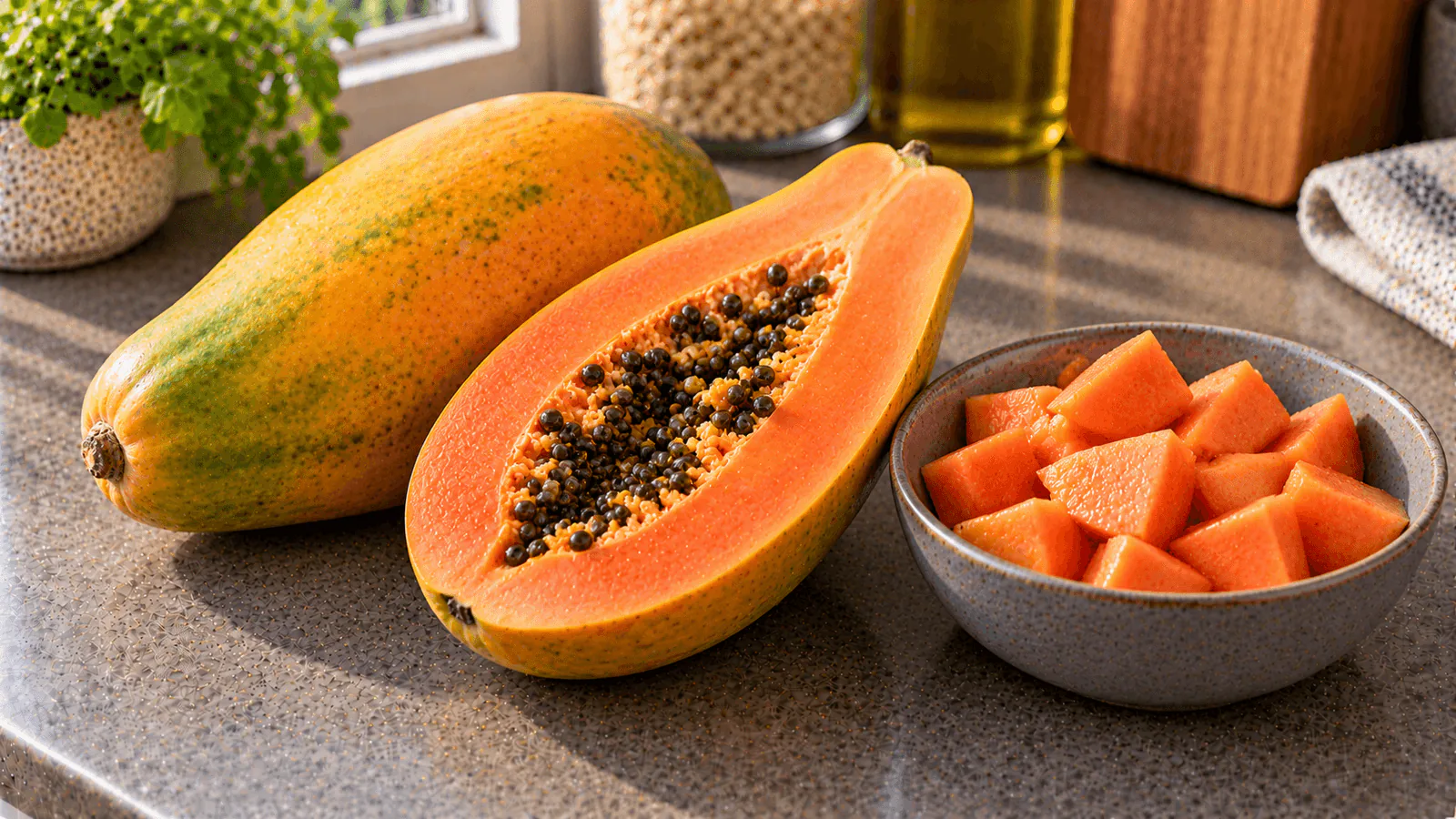
Fresh ripe papaya contains approximately 43 calories per 100 g of edible raw flesh, according to the USDA FoodData Central SR Legacy entry Papayas, raw (FDC 169926). It is a water-rich tropical fruit with naturally occurring sugars, fibre, vitamin C and carotenoids. The figure is for the flesh you eat, not the entire fruit with its thick skin and seeds.
To calculate a real portion, first identify whether the papaya is ripe and fresh, green and prepared as a savoury ingredient, dried, or packed in syrup. Those versions can have different nutritional values. This guide concentrates on plain ripe, raw papaya and shows how to include it in a complete meal calculation.
Raw papaya nutrition per 100 g
The table describes the edible part of the USDA reference food. It does not include dressing, syrup, condensed milk, dried fruit, skin or discarded seeds.
| Nutrient | Per 100 g raw papaya flesh |
|---|---|
| Calories | 43 kcal |
| Protein | 0.47 g |
| Total carbohydrate | 10.82 g |
| Total sugars | 7.82 g |
| Dietary fibre | 1.70 g |
| Fat | 0.26 g |
| Water | 88.06 g |
| Vitamin C | 60.9 mg |
| Potassium | 182 mg |
| Folate | 37 µg |
| Vitamin A | 47 µg RAE |
Source: USDA FoodData Central — Papayas, raw (FDC 169926). Individual papayas may differ in ripeness, variety and moisture. The figures are reference values, not an exact laboratory test of the fruit in your kitchen.
The USDA total-carbohydrate number includes fibre. Food labels in Europe generally report available carbohydrate separately from dietary fibre. Do not compare those figures without checking the reporting method.
Calories in common papaya portions
The following calculations use 43 kcal, 7.82 g sugars and 1.70 g fibre per 100 g of edible raw papaya. All values are rounded; they are not independently measured serving sizes.
| Raw edible weight | Calories | Natural sugars | Fibre |
|---|---|---|---|
| 75 g | 32 kcal | 5.9 g | 1.3 g |
| 100 g | 43 kcal | 7.8 g | 1.7 g |
| 145 g | 62 kcal | 11.3 g | 2.5 g |
| 150 g | 65 kcal | 11.7 g | 2.6 g |
| 200 g | 86 kcal | 15.6 g | 3.4 g |
| 250 g | 108 kcal | 19.6 g | 4.3 g |
| 300 g | 129 kcal | 23.5 g | 5.1 g |
Calories = edible papaya weight in grams × 43 ÷ 100. For instance, 180 g of papaya flesh provides about 77 kcal. This simple formula works for plain raw ripe papaya when its edible weight is known.
How many calories are in a cup of papaya?
The USDA reference serving of one cup of roughly 1-inch papaya pieces weighs about 145 g. That gives approximately 62 kcal from the fruit. It also supplies about 11.3 g natural sugars and 2.5 g fibre.
A cup is a volume, not a fixed weight. Very large cubes, finely cut pieces and loosely or tightly filled cups produce different quantities. If a recipe says one cup and precision matters, weigh the pieces after removing the skin and seeds.
A cup of papaya juice is a different product: the amount of fruit and fibre can differ, and some beverages contain water or added sugar. Do not assume the cup-of-fruit figure is the cup-of-juice figure.
Calories in one whole papaya: edible yield matters
There is no dependable calorie number for every whole papaya. A small and a large fruit may have very different edible weights, and the seed cavity and peel cannot be counted as eaten flesh.
As an illustration, imagine a whole papaya weighs 600 g. After removing the skin, seeds and discarded parts, 390 g of usable flesh remains. At 43 kcal per 100 g, the edible fruit contributes about 168 kcal. This is a worked household example, not a universal edible-yield percentage.
A larger papaya yielding 700 g of flesh would provide approximately 301 kcal. The right approach is to weigh the usable fruit instead of assigning one number based on the whole fruit's appearance. If you divide the flesh into three equal servings, divide the calculated calories by three.
Some papaya products are sold pre-cut and chilled. In that case, the label or the weight of the actual pieces may make estimation easier.
Ripe papaya versus green papaya
Ripe papaya has orange or reddish flesh and is usually eaten fresh. Green or unripe papaya is firmer and can be shredded into savoury dishes. Green papaya is not simply ripe papaya with a different colour: maturity changes starches, sugars, texture and water composition.
The USDA reference used for the nutrition table is named Papayas, raw. It should not automatically be treated as an exact record for every unripe papaya preparation. If you are logging green papaya, use a verified entry that matches the ingredient and preparation when one is available, or make clear that an estimate is approximate.
A papaya salad can include peanuts, fish sauce, lime juice, sugar, dried shrimp or other additions. The sauce and toppings have their own nutritional contributions. A 100 g figure for plain fruit cannot stand for a whole restaurant salad.
Fresh, dried, canned and blended papaya
For the purposes of food tracking, the forms below should be treated separately.
| Papaya form | What to check | Can 43 kcal/100 g be used directly? |
|---|---|---|
| Fresh ripe flesh | Edible weight after peeling and deseeding | Yes, as a raw reference estimate |
| Green papaya salad | Maturity, dressing, peanuts, added sugar | No, calculate actual ingredients |
| Dried or candied papaya | Water loss, added sugar, package label | No, use the relevant product value |
| Papaya packed in syrup | Drained weight and sweetened liquid | No, read the label |
| Unsweetened blended flesh | Fruit weight and other ingredients | Yes for the starting fruit only |
Drying removes water and usually increases energy per 100 g relative to fresh flesh. Some dried papaya is additionally sweetened. There is no reliable single calorie value for every dried or candied product, so use the packaging rather than inventing a universal comparison.
For canned papaya, look at whether the declaration is for fruit and liquid together or drained fruit. For a smoothie, track the actual ingredients; blending alone does not make fruit calories disappear or make the finished drink nutritionally identical to intact pieces.
Papaya in breakfast bowls and smoothies: a calculation
Suppose a bowl contains 200 g raw papaya (about 86 kcal), 100 g plain yogurt with a hypothetical label of 60 kcal per 100 g (60 kcal), and 15 g nuts with a hypothetical label of 600 kcal per 100 g (90 kcal). The example totals 236 kcal. If it makes two equal servings, that is 118 kcal per serving.
The yogurt and nut figures are explicitly illustrative label assumptions: actual brands and varieties differ. Use the label or a suitable verified food entry for the ingredients you eat.
In a smoothie, 150 g papaya contributes approximately 65 kcal before milk, yogurt, fruit juice, ice cream, honey or other ingredients. Ice and plain water contribute no meaningful calories, but they change the drink's volume. If the finished smoothie weighs 400 g, that does not mean it contains 400 g papaya.
Papaya can also be combined with other fresh fruit. Mealisa's guides to mango calories, pineapple calories and kiwi calories provide separate food entries. Compare the same edible weight where possible rather than comparing one large papaya with one small kiwi.
Natural sugar, fibre and vitamin C
According to the raw USDA entry, 100 g papaya provides 7.82 g naturally occurring sugars and 1.70 g dietary fibre. A 200 g portion provides about 15.6 g sugars and 3.4 g fibre. These natural sugars should not be reported as added sugar unless a recipe or manufacturer has added sweetener.
Papaya's vitamin C figure in the reference is 60.9 mg per 100 g. Vitamin C contributes to normal immune function and collagen formation. The fruit also contains carotenoids, but colour alone cannot be used to calculate a specific vitamin A intake for an individual papaya.
Papaya is not a substantial protein source. If your goal is a more balanced breakfast or snack, add another food containing protein and consider the energy and portion size of the complete meal.
Choosing, preparing and storing papaya
A ripe papaya often yields slightly under gentle pressure and may have a yellow-orange exterior; appearance depends on the cultivar. Avoid assuming that skin colour can give a precise calorie value. Wash the outside before cutting, even when the peel will be removed, to reduce the chance of transferring contamination to the flesh.
Cut the fruit on a clean board, remove the seed cavity and peel as desired, and store cut pieces under refrigeration. Follow local food-safety advice and the storage instructions on purchased ready-cut packages. See the CDC's general food safety guidance.
Some individuals can react allergically to papaya or related plant proteins. If you know you have a relevant allergy, calorie information is not a substitute for checking whether the fruit is safe for you.
Recording papaya accurately
Use the Papayas, raw USDA entry for plain ripe flesh and weigh only what you eat. Choose a separate entry for dried, sweetened or canned products. For green papaya salad, log the dressing and toppings. For homemade dishes, add the energy from every ingredient and divide by the actual servings.
The distinction between a labelled serving and your real portion is explained in our guide to portion size versus serving size. Recording edible grams consistently is more useful than memorising calories per whole fruit.
Primary source: USDA FoodData Central, SR Legacy, Papayas, raw, FDC 169926. All portion figures here are rounded calculations based on that entry.