
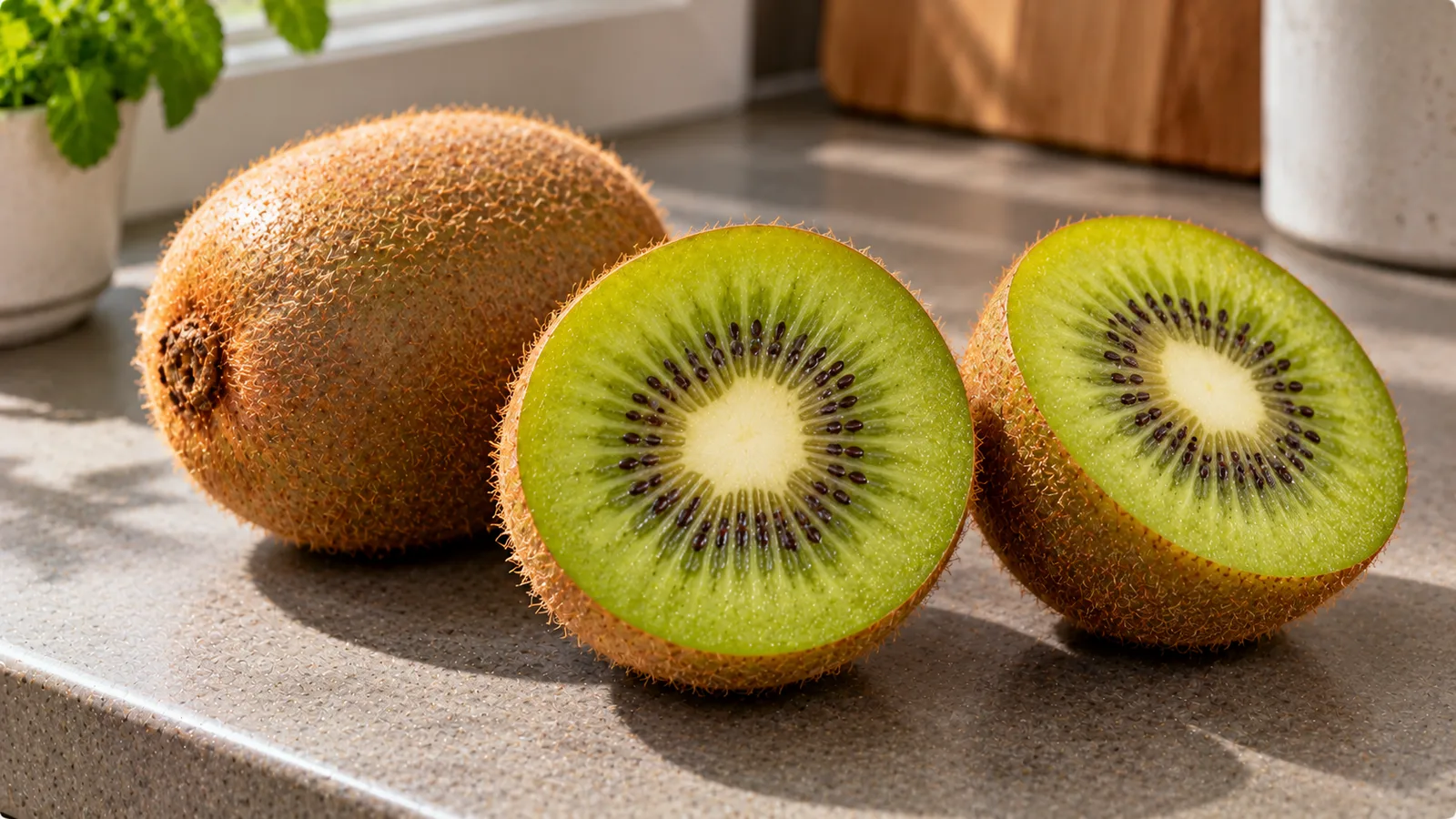
Fresh green kiwi contains approximately 61 calories per 100 g of edible fruit.
One kiwi providing 75 g of edible flesh contains approximately 46 calories. A larger portion of 100 g contains about 61 calories, while 150 g provides approximately 92 calories.
The exact amount depends on the fruit's size, variety and edible weight.
These figures describe raw green kiwifruit without added ingredients. Golden kiwi, dried kiwi, kiwi juice and sweetened products may have different nutritional values.
Kiwi calories by serving size
| Edible kiwi | Estimated calories |
|---|---|
| 25 g | 15 kcal |
| 50 g | 31 kcal |
| 60 g | 37 kcal |
| 75 g | 46 kcal |
| 100 g | 61 kcal |
| 125 g | 76 kcal |
| 150 g | 92 kcal |
| 200 g | 122 kcal |
| 250 g | 153 kcal |
The estimates use 61 kcal per 100 g and are rounded to the nearest whole calorie.
All weights refer to the edible portion. If the skin is discarded, it should not be included in the recorded weight.
Source: USDA FoodData Central.
How many calories are in one kiwi?
Kiwi fruit varies considerably in size.
A practical estimate is:
| Example | Edible weight | Calories |
|---|---|---|
| Small kiwi | 50 g | 31 kcal |
| Medium kiwi | 75 g | 46 kcal |
| Large kiwi | 100 g | 61 kcal |
| Very large kiwi | 125 g | 76 kcal |
These are illustrative serving sizes, not universal fruit-grading categories.
A kiwi sold as medium may have a different edible weight depending on its variety and the shop.
For a more accurate result, weigh the part you actually eat.
Calories in two kiwis
If each kiwi provides 75 g of edible flesh, two kiwis contain:
75 g × 2 = 150 g.
150 × 61 ÷ 100 = approximately 92 kcal.
If the two fruits are smaller or larger, the calorie total changes accordingly.
Kiwi nutrition facts
The following figures are representative values for 100 g of raw green kiwifruit.
| Nutrient | Per 100 g | Per 150 g |
|---|---|---|
| Energy | 61 kcal | 92 kcal |
| Protein | 1.1 g | 1.7 g |
| Fat | 0.5 g | 0.8 g |
| Total carbohydrate, US definition | 14.7 g | 22.1 g |
| Dietary fiber | 3.0 g | 4.5 g |
| Total sugars | 9.0 g | 13.5 g |
| Water | Approximately 83 g | Approximately 125 g |
| Vitamin C | 92.7 mg | 139.1 mg |
| Potassium | 312 mg | 468 mg |
Values are rounded and can differ between individual fruits and database entries.
Reference: USDA FoodData Central.
Why carbohydrate figures differ between countries
US food composition data generally include dietary fiber in total carbohydrate.
EU nutrition labels report carbohydrates and fiber separately, with carbohydrate referring to available carbohydrates.
Using the representative values above:
14.7 g total carbohydrate − 3.0 g fiber = approximately 11.7 g available carbohydrate per 100 g.
This is a difference in definitions, not a physical difference between fruit sold in different countries.
When comparing food databases, check whether fiber is included in the carbohydrate figure.
Reference: Regulation (EU) No 1169/2011.
How to calculate kiwi calories
For raw green kiwi, use this approximate formula:
Calories = edible weight in grams × 0.61
Examples:
- 45 g: approximately 27 kcal.
- 80 g: approximately 49 kcal.
- 110 g: approximately 67 kcal.
- 175 g: approximately 107 kcal.
- 225 g: approximately 137 kcal.
The calculation is appropriate for a representative raw green kiwi entry.
It should not automatically be used for dried kiwi, kiwi jam, sweetened fruit preparations or mixed desserts.
Green kiwi versus golden kiwi
Green and golden kiwifruit are related but nutritionally distinct varieties.
Green kiwi typically has green flesh and a tangy flavor.
Golden kiwi generally has yellow flesh and a different balance of sweetness and acidity.
Their calorie, sugar and vitamin C values can differ.
It is therefore better to choose a variety-specific entry in a nutrition database when available.
The 61 kcal per 100 g reference used in this article describes raw green kiwifruit, not every kiwi variety.
A golden kiwi should not automatically be assigned exactly the same nutritional values.
Should you weigh kiwi with or without skin?
Kiwi skin is edible for many people when the fruit is suitable for consumption and properly washed.
However, some people prefer to peel it because of its texture.
For calorie tracking, the important factor is the edible portion.
If you peel a kiwi, weigh the flesh after removing the skin.
If you eat the skin, include it in the edible weight.
The difference may be modest for one fruit, but it becomes more relevant when weighing multiple fruits or recording portions precisely.
Example with a peeled kiwi
Suppose a whole kiwi weighs 90 g.
After removing the skin and trimming the ends, 75 g remains.
Using the raw green kiwi reference:
75 × 0.61 = approximately 46 kcal.
Entering 90 g instead would give approximately 55 kcal and overestimate the consumed portion.
The actual edible yield varies, so there is no need to assume that every kiwi loses exactly the same percentage during peeling.
How much sugar is in kiwi?
A representative 100 g serving of raw green kiwi contains approximately 9 g of naturally occurring sugars.
A 75 g portion contains about 6.8 g, while 150 g provides approximately 13.5 g.
The actual amount varies by variety and ripeness.
Naturally occurring sugars in intact whole fruit are not automatically equivalent to added sugar in sweets or sugary drinks under public-health dietary guidance.
The World Health Organization distinguishes free sugars from sugars naturally present within the cellular structure of intact fruit.
Source: WHO — Healthy diet.
However, kiwi still contains carbohydrates and calories.
Its sugar content should not be confused with zero energy.
Kiwi and vitamin C
Kiwi is a notable source of vitamin C.
Representative raw green kiwi data indicate approximately 92.7 mg of vitamin C per 100 g.
A 75 g edible portion provides approximately 69.5 mg.
Vitamin C contributes to normal immune system function and helps protect cells from oxidative stress.
It also contributes to normal collagen formation.
These are established nutrient functions, not claims that eating kiwi prevents or cures infections.
The amount of vitamin C can differ by variety, storage conditions and processing.
Golden kiwi may contain different amounts from green kiwi.
References: USDA FoodData Central and EFSA.
Kiwi and dietary fiber
Raw green kiwi provides approximately 3 g of fiber per 100 g.
That means:
- 75 g kiwi: approximately 2.3 g fiber.
- 100 g kiwi: approximately 3.0 g fiber.
- 150 g kiwi: approximately 4.5 g fiber.
- 200 g kiwi: approximately 6.0 g fiber.
Dietary fiber contributes to the nutritional value of whole fruit.
The European Food Safety Authority considers 25 g of total dietary fiber per day adequate for normal laxation in adults.
A kiwi portion can contribute toward that amount, but a varied diet is needed to obtain sufficient fiber overall.
Source: EFSA — Dietary Reference Values.
Fresh kiwi versus dried kiwi
Dried kiwi contains much less water than fresh kiwi.
Consequently, its calories are more concentrated per 100 g.
Some commercially available dried kiwi products also contain added sugar.
The nutritional difference depends on the preparation and ingredients.
For dried kiwi, use the package's calorie value per 100 g and weigh the actual portion.
Do not use the fresh-kiwi figure of 61 kcal per 100 g for dried fruit.
Example of a misleading comparison
A 100 g serving of fresh kiwi contains substantial water.
A 100 g serving of dried kiwi represents a larger amount of original fruit material because much of the water has been removed.
Comparing equal weights without accounting for moisture can make dried fruit appear disproportionately calorie-dense.
The correct comparison depends on the serving actually eaten.
Kiwi versus kiwi juice
A whole kiwi and a kiwi-based drink are not nutritionally identical.
Juicing may reduce the amount of fiber retained in the final drink.
Commercial beverages may also contain other juices, added sugars or flavorings.
For accurate tracking, distinguish between:
- Whole fresh kiwi.
- Pure kiwi juice.
- Mixed fruit juice.
- Kiwi smoothie.
- Sweetened kiwi-flavored drink.
Use the product's nutrition information per 100 ml or the actual recipe.
Do not apply the raw-fruit calorie value directly to every kiwi beverage.
Kiwi in smoothies and desserts
Kiwi can be combined with yogurt, milk, other fruit, nuts or sweeteners.
Its contribution to the total calories depends on the amount used.
For example, a smoothie containing 100 g of green kiwi receives approximately 61 kcal from the kiwi.
The remaining calories depend on the other ingredients.
A smoothie containing yogurt and banana may have a very different energy value from a drink made with kiwi and water.
Likewise, kiwi served with ice cream, cream or syrup should be logged as a complete dessert rather than as plain fruit.
Is kiwi suitable for weight management?
Kiwi contains water, fiber and several micronutrients.
At approximately 61 kcal per 100 g, it can fit into many balanced eating patterns.
However, no individual fruit causes weight loss by itself.
Weight management depends on the broader pattern of energy intake, physical activity and other factors.
Kiwi may be a practical snack or an ingredient in meals, but the total portion and accompanying foods still matter.
For example, kiwi with unsweetened yogurt is different from kiwi added to a large sweetened dessert.
Neither choice can be evaluated accurately without considering the whole diet.
Kiwi food safety and allergies
Wash kiwi before cutting or eating it, even if you intend to remove the skin.
Washing helps reduce surface contamination that could otherwise be transferred during cutting.
Kiwi can also cause allergic reactions in some people.
Symptoms may include itching or swelling in the mouth, while more serious reactions are possible.
People with a known kiwi allergy should avoid the fruit and follow professional medical advice.
If a severe allergic reaction is suspected, seek emergency medical care.
General food safety guidance: FDA — Selecting and Serving Produce Safely.
How to log kiwi accurately
For fresh kiwi:
- Identify the variety when possible.
- Weigh the whole fruit if convenient.
- Peel it if you do not eat the skin.
- Weigh the edible portion.
- Select a raw kiwi entry matching the variety.
- Enter the edible weight in grams.
For two or more fruits, weigh the combined edible portions.
For dried kiwi, juice or desserts, select the appropriate processed-food entry or record the recipe ingredients.
When weighing is unavailable, a medium kiwi providing 75 g of edible fruit can be used as a rough estimate, not as an exact universal serving.
Common questions
How many calories are in 100 g of kiwi?
Approximately 61 kcal for raw green kiwi.
How many calories are in one medium kiwi?
Approximately 46 kcal if the edible portion weighs 75 g.
How many calories are in two kiwis?
Approximately 92 kcal if they provide 150 g of edible flesh combined.
How many calories are in 150 g of kiwi?
Approximately 92 kcal.
Is kiwi high in sugar?
Raw green kiwi contains approximately 9 g of naturally occurring sugars per 100 g.
Is kiwi high in vitamin C?
It provides a substantial amount of vitamin C, approximately 92.7 mg per 100 g in representative raw green kiwi data.
Does golden kiwi have the same calories?
Not necessarily. Nutrient composition differs by variety, so use a specific entry when available.
Should kiwi skin be included in the weight?
Include it only if you eat it. Otherwise, record the peeled edible portion.
Sources and calculation method
- USDA FoodData Central — representative raw green kiwi nutrition values.
- Regulation (EU) No 1169/2011 — European nutrition labeling definitions.
- EFSA — Dietary Reference Values — dietary fiber reference intake.
- WHO — Healthy diet — distinction between free sugars and naturally occurring sugars in intact fruit.
- FDA — Selecting and Serving Produce Safely — produce handling guidance.
All portion estimates use approximately 61 kcal per 100 g of edible raw green kiwi and are rounded. Individual fruit values can vary.