
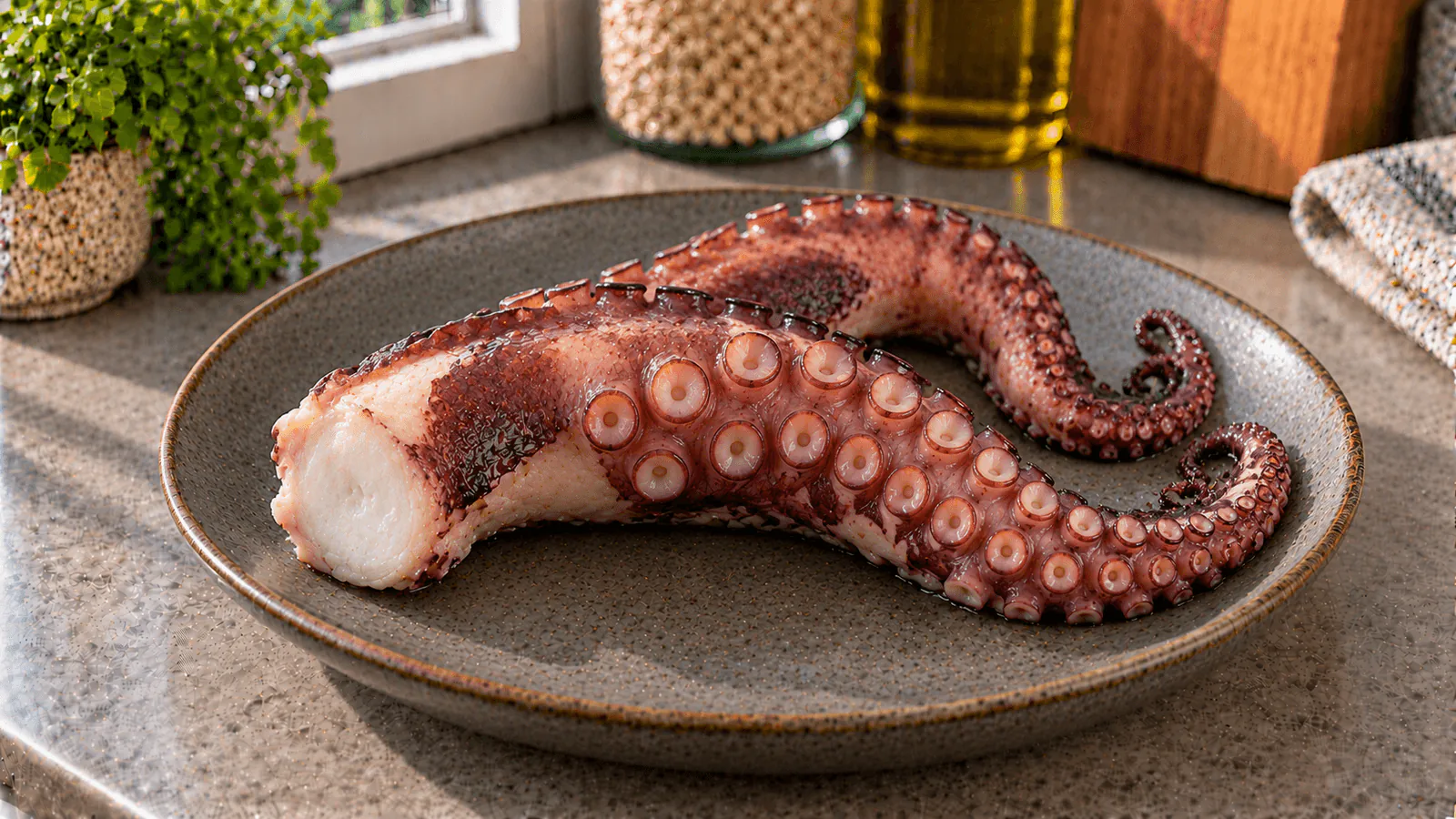
Octopus can be a lean seafood ingredient in a salad, a substantial grilled main course, or a small tapas plate with oil and potatoes. The calorie count depends on which of those meals you actually ate. Raw and cooked octopus do not have the same calories per 100 g in the USDA reference data, and the numbers on a jar of marinated octopus may be different again. For practical food tracking, identify the preparation, weigh the edible part, and count dressings separately. An estimate based only on the number of tentacles is rarely reliable.
Octopus calories and nutrition per 100 g
The USDA FoodData Central SR Legacy entry for common octopus, raw, lists 82 kcal per 100 g, while the entry for common octopus, cooked with moist heat, lists 164 kcal per 100 g. These figures describe the edible octopus itself, with no olive oil, flour coating or sauce included. They are reference foods rather than a guarantee for every species or packaged product.
| Common octopus, edible portion per 100 g | Calories | Protein | Fat | Carbohydrate | Sodium |
|---|---|---|---|---|---|
| Raw | 82 kcal | 14.91 g | 1.04 g | 2.20 g | 230 mg |
| Cooked, moist heat | 164 kcal | 29.82 g | 2.08 g | 4.40 g | 460 mg |
Sources: USDA raw common octopus, FDC 174218 and USDA cooked common octopus, FDC 174249. The entries are for different food states and should not be used interchangeably for the same weighed portion.
The cooked entry also shows a higher protein concentration: 29.82 g per 100 g, compared with 14.91 g per 100 g raw. This is not because heat manufactures protein. Moisture and the final edible weight are different after cooking, so more nutrients can fit into a fixed 100 g of finished seafood. Some cooking liquid may also be lost. It would be misleading to calculate a single batch using the raw weight first and then add the cooked reference for the same seafood.
For a simple rule: when you have a raw weight, use the raw reference; when you have a finished, cooked weight, use the cooked reference that matches the method. If the label supplies its own per-100-g figure, that product-specific figure is usually the most relevant. A chilled octopus salad containing oil and vegetables is not nutritionally identical to plain boiled octopus.
Octopus calories by serving size
The table below scales the two USDA energy values by edible weight in the stated state. All figures are rounded to the nearest whole kilocalorie. A portion weighed raw and a portion weighed after cooking are not the same measurement merely because the number of grams matches.
| Edible octopus weight | Raw (82 kcal/100 g) | Cooked, moist heat (164 kcal/100 g) |
|---|---|---|
| 25 g | 21 kcal | 41 kcal |
| 50 g | 41 kcal | 82 kcal |
| 75 g | 62 kcal | 123 kcal |
| 85 g | 70 kcal | 139 kcal |
| 100 g | 82 kcal | 164 kcal |
| 125 g | 103 kcal | 205 kcal |
| 150 g | 123 kcal | 246 kcal |
| 200 g | 164 kcal | 328 kcal |
For example, 85 g of already cooked octopus gives approximately 139 kcal, and 150 g of cooked octopus provides approximately 246 kcal and 44.7 g protein from the selected USDA entry. A 50 g tapas serving is smaller than a 200 g seafood main. Treat a menu description such as “one portion” as a label for the restaurant's serving, not as a reliable unit of mass. Our guide to portion size versus serving size explains why those two terms can lead to different numbers in a diary.
If the food is a whole octopus with the beak, internal organs or other inedible parts still present, its purchase weight is not necessarily the edible weight. Ready-cleaned octopus, cooked tentacle packs and sliced salad toppings also differ in how much draining or trimming remains. Weigh what is eaten rather than the whole package including liquid or discarded material. There is no universally dependable calories-per-tentacle figure because animal size and trimming vary.
Why boiling and grilling change the per-100-g figure
An octopus commonly shrinks in weight as it cooks. The amount depends on initial condition, size, cooking time and method. That makes energy per 100 g of finished product look greater than energy per 100 g of raw product, even without adding oil. Never interpret the 82-to-164 difference as 82 new calories created by heat. The USDA entries provide different states of food, not paired measurements for one particular octopus before and after cooking.
Suppose a recipe begins with 150 g of raw edible octopus. The raw reference gives approximately 123 kcal for that ingredient before additions. After simmering, it might weigh less; the exact yield is unknown without actually measuring it. If, instead, you place 150 g of fully cooked octopus on a scale, the cooked USDA entry gives 246 kcal. These examples do not represent one identical portion and must not be combined. If you batch-cook several portions, record the raw ingredients once, weigh the finished recipe, and allocate the recipe total by the mass or number of portions you serve.
Grilling can involve both water loss and additional fat, while braising may involve wine, tomatoes or oil. Pan-frying requires attention to how much oil remains on the seafood. A charred surface is not itself a substantial source of calories; the added fat and side dishes often matter more. In restaurant menus, “grilled octopus” may arrive with potatoes, aioli, chickpeas, bread or a generous glaze. Logging only plain octopus can miss much of the meal.
Grilled octopus with olive oil: a worked example
Start with 150 g raw edible octopus, about 123 kcal, according to the raw USDA entry. If you add 10 g of olive oil, about 90 kcal, and all that oil is eaten, the two ingredients total approximately 213 kcal before vegetables, bread or sauce. This is an ingredient-based calculation that uses the original raw seafood weight. It does not claim the final grilled seafood still weighs 150 g.
Alternatively, you might buy a ready-cooked plain tentacle and weigh 150 g after cooking, around 246 kcal under the cooked reference. Add 10 g of olive oil actually consumed, and the estimate becomes 336 kcal. The second example starts from a cooked weight. Never add both the raw and cooked octopus figures to the same plate. If some oil remains on a grill tray or in the pan, record the consumed amount as closely as feasible instead of automatically assuming either zero or all of it.
Lemon juice, parsley and herbs generally contribute much less energy at typical garnish amounts than oil or a large starch side, but a sweet glaze or rich dressing may not. Weigh ingredients for a home recipe and check actual restaurant descriptions when possible. The difference between 9 and 10 g of oil is less important than forgetting the dressing entirely.
Boiled, frozen, jarred and marinated octopus
Plain boiled or steamed octopus is the closest everyday match to the cooked, moist-heat USDA entry, provided it has no significant additions. Grilled octopus may have a different water content and may be brushed with oil. Pre-cooked vacuum-packed tentacles can have their own nutrition declaration; check whether the stated values describe drained seafood or the full product. Octopus salad in a jar may contain olive oil, brine, vegetables and seasonings. In each case, the package label supersedes a generic estimate for a different preparation.
A pack's drained weight matters if liquid is discarded. If you eat oil from a marinade by dipping bread into it, the edible energy total includes at least some of that oil. If you pour away the marinade, the actual intake can be lower, although oil adhering to the pieces still contributes. Do not divide total package calories by an arbitrary “number of pieces” when the package gives a reliable net or drained mass.
Frozen octopus is not automatically higher in calories than chilled octopus. Freezing itself does not add fat or carbohydrate. However, a glazed frozen product can show a gross frozen weight that includes ice, while a seasoned frozen dish may contain a sauce. Thaw according to package instructions, drain if appropriate, and distinguish the octopus from any extras before recording the amount eaten.
Protein, fat, sodium and the wider meal
The cited cooked octopus reference is protein-rich relative to its energy content, with 29.82 g protein and 2.08 g fat per 100 g. That can be useful in a meal, but octopus is not a magic weight-loss food. The total diet still needs energy, fibre-containing plants, appropriate fats and sufficient variety. A plate of octopus and vegetables will have a different nutritional balance from octopus with fries and mayonnaise. It is more helpful to assess the whole meal than to judge the seafood in isolation.
The raw USDA entry lists 230 mg sodium per 100 g; the cooked entry lists 460 mg per 100 g. These are composition values for the reference foods, not the sodium in every branded pack. Salted cooking water, brine, sauces or seasoning can raise the finished total. As an approximation, sodium in milligrams multiplied by 0.0025 gives salt equivalent in grams: 460 mg corresponds to about 1.15 g salt equivalent per 100 g of the cited cooked entry, before considering added salt. The distinction is explained in our sodium-to-salt conversion guide.
For meal comparisons, octopus and shrimp are different seafood ingredients with different species-specific reference values. Cod is another useful alternative, particularly if you want to compare a plain fish fillet with a prepared seafood dish. Compare each food in the same cooking state and on the same edible-weight basis; avoid a ranking that compares raw cod against octopus salad in oil and calls the calorie difference a property of the animal alone.
How to record an octopus meal accurately
At home, write down whether the weighed octopus was raw, cooked, drained or marinated. Measure the edible seafood, then add oil, potatoes, beans, bread and sauce separately. For a shared pot, use one recipe total and split that across portions rather than adding inconsistent raw and cooked weights. Keep the original product label if it provides better information than a generic database value. When eating out, estimate the octopus portion and any oil or accompaniments; an approximate but complete plate is better than a precise number for only one ingredient.
For food safety, keep raw seafood separate from ready-to-eat foods, thaw it safely and cook it thoroughly. The FDA's seafood handling guidance advises appropriate chilling, preventing cross-contamination and proper cooking. Those handling recommendations matter independently of calorie counting. If a product is intended to be cooked, do not assume marinating it in lemon juice makes it equivalent to a safely cooked food.
In short, the useful starting numbers are 82 kcal per 100 g raw octopus and 164 kcal per 100 g cooked with moist heat, always matched to the measured food state. Count oil, marinade and accompaniments separately, and use a specific package label when available. Reference records: USDA raw octopus and USDA cooked octopus.