
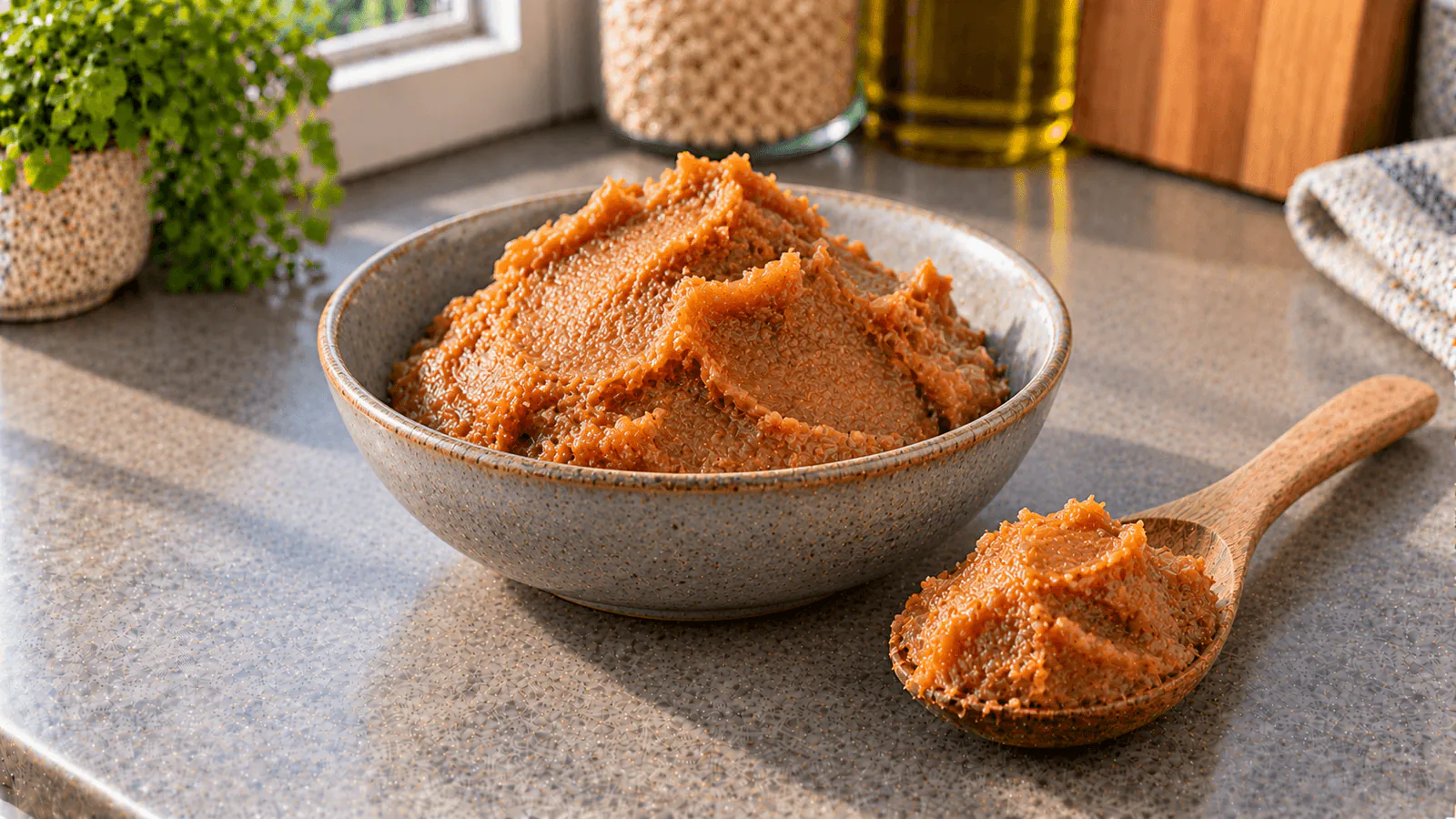
Miso is a concentrated fermented seasoning, not a food most people eat in a 100 g portion. The reference for plain miso paste is 198 kcal per 100 g. In the kitchen, the more useful numbers are 10 kcal for 5 g, 20 kcal for 10 g, 30 kcal for 15 g, and 40 kcal for 20 g. Those are calories from the paste alone, before adding tofu, oil, noodles or other ingredients. The sodium content deserves as much attention as the calorie total: ordinary miso can be very salty even when a recipe uses only one tablespoon.
A precise food diary should distinguish miso paste, a bowl of diluted miso soup and a restaurant dish described as “miso-flavored”. They are not equivalent portions. This guide focuses on paste as sold in a tub or pouch and shows how to adapt its numbers to your actual cooking.
Miso paste nutrition per 100 g
The following reference comes from USDA FoodData Central, SR Legacy, FDC 172442. It describes a generic miso product; brands and fermentation styles can differ materially. Salt equivalent is calculated from sodium, rather than being a separate measured nutrient.
| Nutrient, per 100 g paste | Amount |
|---|---|
| Energy | 198 kcal |
| Protein | 12.8 g |
| Carbohydrate | 25.4 g |
| Total fat | 6.0 g |
| Fiber | 5.4 g |
| Sugars | 6.2 g |
| Sodium | 3,728 mg |
| Salt equivalent (estimated) | 9.32 g |
The paste contains carbohydrate, protein and fat because fermentation does not remove all the nutrients from its soybeans and grains. However, calling miso a high-protein food on the strength of the 100 g panel can mislead: 15 g gives only about 1.9 g protein, not 12.8 g. Likewise, a high calorie value per 100 g does not make a small spoonful high in calories.
The sodium figure is expressed in milligrams, while many European packages display salt in grams. The two measures are related, but they must not be confused. At 3,728 mg sodium per 100 g, the calculated salt equivalent is roughly 9.32 g per 100 g of paste. This is a useful reference, not a guarantee that every supermarket brand uses exactly the same recipe.
Calories and sodium in teaspoons and tablespoons of miso
Weights are preferable to measuring by spoon volume because different pastes can be looser or denser. A 17 g tablespoon is a reference illustration, not a universal spoon weight; a lightly filled teaspoon may be closer to 5 g. The table below uses the same USDA composition for every row.
| Miso paste | Calories | Protein | Sodium |
|---|---|---|---|
| 5 g | 10 kcal | 0.6 g | 186 mg |
| 10 g | 20 kcal | 1.3 g | 373 mg |
| 15 g | 30 kcal | 1.9 g | 559 mg |
| 17 g | 34 kcal | 2.2 g | 634 mg |
| 20 g | 40 kcal | 2.6 g | 746 mg |
| 30 g | 59 kcal | 3.8 g | 1118 mg |
| 50 g | 99 kcal | 6.4 g | 1864 mg |
| 100 g | 198 kcal | 12.8 g | 3728 mg |
The arithmetic is straightforward: multiply the grams of paste by 1.98 to estimate calories, or by 37.28 for sodium in milligrams. For example, 15 g × 1.98 = 29.7, rounded to 30 kcal. The same 15 g contains about 559 mg sodium. If you spoon paste directly from a container, weighing it once or twice will tell you how your own teaspoon compares with a standard portion.
Portions also need to reflect how many people share the pot. If you dissolve 30 g miso in two equal bowls of soup, each bowl contains 15 g of paste, providing about 30 kcal and 559 mg sodium from the miso alone. Water changes the concentration per 100 g of finished soup, but not the total calories added by the miso paste. A recipe with six servings needs the total amount divided by six, even if the finished soup is thin.
Why sodium matters more than calories in many recipes
Miso is traditionally used for savoriness and salinity. It can provide a strong umami taste with a fairly small calorie addition; that does not mean it is automatically low in sodium. A 10 g serving contributes about 373 mg sodium and 20 g about 746 mg sodium before soy sauce, salted broth or packaged noodles enter the dish.
For adults in the general population, the World Health Organization sodium guidance recommends less than 2,000 mg sodium per day, equivalent to less than 5 g of salt. A 20 g miso portion on the generic USDA profile represents roughly 37% of that daily sodium reference. It is not a recommended portion or personal allowance: individual requirements and medical advice can differ.
To interpret a label, convert sodium to estimated salt by multiplying grams of sodium by 2.5. For a more detailed explanation of EU and US labels, see how to convert sodium into salt. Compare brands by the same per-100-g salt or sodium basis, then apply the number to the actual grams you will eat. A product labelled “reduced salt” may still contribute substantial sodium when used generously.
White, red and barley miso: what changes?
White or shiro miso is often milder and may contain a higher proportion of rice or other grains; red or aka miso often has a more assertive flavor and longer fermentation. Barley miso, or mugi miso, contains barley and therefore is not suitable for someone who must avoid gluten. These broad descriptions are culinary, not promises about individual products: fermentation time, ingredients, sweetness and salt levels all vary by producer.
It is risky to assign one universal calorie count to every color. A sweeter commercial paste may have more available carbohydrate, while other products contain different amounts of water, soybeans, grains and salt. The trustworthy method is to take the pack's energy and salt figures and calculate from the weighed portion. If no nutrition label is available, the USDA 198 kcal per 100 g estimate is a reasonable starting point for plain miso, with explicit uncertainty.
Most traditional miso is made with soybeans, so soy is an important allergen to look for. Miso containing wheat or barley also raises a gluten concern; rice-based miso is not necessarily certified gluten-free because recipes and manufacturing environments vary. Check ingredient lists and allergy statements rather than inferring safety from “white”, “red” or “organic” on the front label.
Miso paste versus miso soup
The ingredient is more concentrated than the dish. When a tablespoon of miso is whisked into hot water, the bowl becomes heavier but the paste's 34 kcal and 634 mg sodium remain the same. Adding a second bowl of water cannot erase sodium, even though the nutrition per 100 ml falls. Tofu, noodles, seaweed, vegetables and cooking oil contribute their own nutrients.
Consider one illustrative bowl made with 15 g miso paste, 80 g tofu and 100 g mushrooms. Suppose your tofu label lists 80 kcal per 100 g, and the mushrooms are estimated at 22 kcal per 100 g. The calculation is 30 + 64 + 22 = 116 kcal before any added oil, noodles or other ingredients. The tofu and mushroom figures here are example inputs, not universal USDA claims. If you choose another tofu, change the calculation to its label. For practical meal ideas, compare the mushroom and tofu miso soup recipe.
That bowl's sodium cannot be calculated accurately from the miso alone: tofu, stock and other seasonings may supply more. Water is not a substitute for weighing ingredients. When logging soup, start with the entire pot's ingredient quantities, sum the calories and sodium, and divide by servings; for convenience, save the finished recipe so the next bowl takes seconds to enter.
Miso compared with soy sauce and tofu
Miso and soy sauce often serve a similar salty, savory role, but they are not interchangeable gram for gram. Soy sauce is a liquid, with a different density, ingredient profile and sodium concentration. Compare nutrition on the same gram basis, or check calories in soy sauce before swapping one seasoning for another. Changing condiments can alter both flavor and sodium far more than the calorie count suggests.
In contrast, tofu is a primary ingredient rather than a small seasoning. A portion of tofu usually adds substantially more protein and calories than 10–20 g miso; the actual values depend on firmness and brand. For a fair comparison between a soup's base and its seasoning, use the separate tofu portion guide. Do not treat the combined dish as if every gram has miso's nutrition profile.
How to log miso accurately and choose a portion
First, check whether your food entry says miso paste or prepared miso soup. Second, weigh the paste before dissolving it; if that is impractical, record how many teaspoons or tablespoons you used and learn the weight of your regular spoon with a kitchen scale. Third, enter the actual product label where possible, especially for sodium. Fourth, split a family recipe by the number of servings eaten rather than by the amount of water used. Finally, remember to include added oil, sugar, broth, noodles, sauce or toppings instead of assuming they are part of the base miso entry.
A 5–15 g addition is a practical starting range for experimenting with seasoning intensity, not an instruction to consume a specific amount. Start with less, taste, and account for other sources of salt in the meal. Miso is best understood as a flavor ingredient: 15 g typically contributes around 30 kcal but can bring roughly 559 mg sodium on the generic USDA values. Those two numbers make portion decisions more informative than a headline calorie figure alone.
Sources and method: USDA FoodData Central — Miso, FDC 172442 (SR Legacy) supplies the per-100-g reference. Portion calculations use that record without pretending brand-to-brand differences disappear. The WHO sodium-reduction fact sheet provides population-level intake context; it is not individualized treatment advice.