
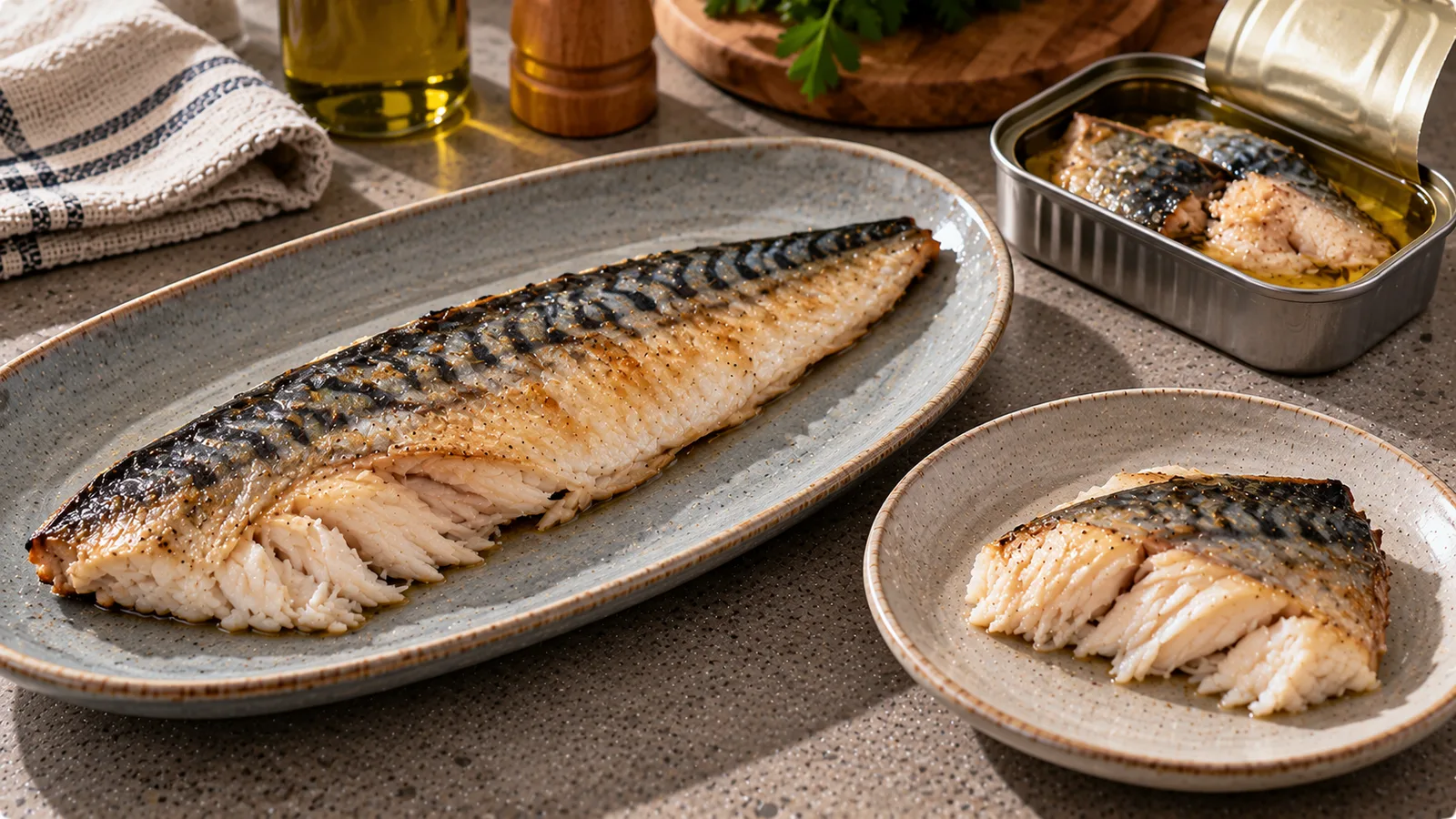
Mackerel is an oily fish, so it generally contains more calories and fat than lean white fish such as cod or haddock. It also provides substantial protein and long-chain omega-3 fatty acids.
The calorie count depends on the species, whether the fish is raw or cooked, how much water it loses during cooking and whether oil or sauce is added.
Quick answer: Atlantic mackerel provides approximately 205 kcal per 100 g raw edible portion. A 150 g raw portion contains about 308 kcal before additional cooking ingredients.
These are reference estimates for Atlantic mackerel, not universal values for every fish sold as mackerel.
Mackerel calories per 100 g
The following reference values describe raw Atlantic mackerel (Scomber scombrus), edible flesh, based on commonly reported USDA food-composition data.
| Nutrient | Per 100 g raw |
|---|---|
| Energy | 205 kcal |
| Protein | 18.6 g |
| Total fat | 13.9 g |
| Carbohydrates | 0 g |
| Saturated fat | Approximately 3.3 g |
| Omega-3 fatty acids | Present; quantity varies |
| Vitamin B12 | Present |
| Vitamin D | Present |
Reference: USDA FoodData Central.
Values are rounded. Natural variation occurs with season, species, fat content and the particular food-composition entry.
Mackerel has almost no carbohydrate in its unseasoned form. Most of its energy comes from protein and fat.
Calories by portion size
Using 205 kcal per 100 g of raw Atlantic mackerel:
| Raw edible portion | Approximate calories | Approximate protein |
|---|---|---|
| 50 g | 103 kcal | 9.3 g |
| 75 g | 154 kcal | 14.0 g |
| 100 g | 205 kcal | 18.6 g |
| 125 g | 256 kcal | 23.3 g |
| 150 g | 308 kcal | 27.9 g |
| 180 g | 369 kcal | 33.5 g |
| 200 g | 410 kcal | 37.2 g |
| 250 g | 513 kcal | 46.5 g |
These calculations assume that the listed weight is edible raw fish without bones, head or other discarded parts.
A whole fish weighing 300 g does not necessarily provide 300 g of edible flesh.
Raw, baked, smoked and canned mackerel
Preparation makes a substantial difference to calorie values per 100 g.
| Mackerel product | Typical calorie range per 100 g | Why values differ |
|---|---|---|
| Raw Atlantic mackerel | Around 205 kcal | Reference value for raw edible flesh |
| Baked or grilled mackerel, without added oil | Often around 230–280 kcal | Water loss concentrates nutrients per 100 g |
| Smoked mackerel | Often around 250–330 kcal | Moisture loss and product variation |
| Canned mackerel in water or brine, drained | Often around 150–230 kcal | Species, processing and drained composition |
| Canned mackerel in oil, drained | Often around 200–320 kcal | Retained oil and fish fat |
| Mackerel in tomato sauce | Often around 140–240 kcal | Sauce proportion, sugar and oil |
Important: These ranges are illustrative shopping estimates, not standardised laboratory values. The nutrition label on your actual product is more reliable than a general category average.
Different products may fall outside these ranges.
Why cooked mackerel can have more calories per 100 g
Cooking removes some water.
Suppose 200 g of raw mackerel contains approximately 410 kcal.
If cooking reduces its weight to 160 g without a meaningful loss of energy, the cooked fish still contains approximately 410 kcal.
Its calorie density becomes:
410 ÷ 160 × 100 = 256 kcal per 100 g cooked.
The total calories did not increase. The same energy is simply concentrated into less weight.
In practice, some fat may drip away during cooking, so the exact result depends on the method.
How much does olive oil add?
Olive oil contributes approximately 9 kcal per gram.
| Added olive oil | Additional calories |
|---|---|
| 5 g | 45 kcal |
| 10 g | 90 kcal |
| 15 g | 135 kcal |
| 20 g | 180 kcal |
If some oil remains in the pan or on the baking tray, the amount actually consumed may be lower.
For more accurate tracking, record the oil you eat rather than automatically assigning every gram used in cooking to your portion.
Atlantic mackerel versus other mackerel species
The word "mackerel" can describe several species with different nutritional profiles.
Atlantic mackerel (Scomber scombrus) is a common reference species in European food markets.
Other products may be labelled Pacific mackerel, chub mackerel, Spanish mackerel or king mackerel.
They are not nutritionally identical.
Their fat content, calorie density and mercury levels can differ.
If you want a precise food-diary entry, identify the species where possible and use the nutrition label or a species-specific food database.
Avoid assuming that every product called mackerel contains exactly 205 kcal per 100 g.
How much protein is in mackerel?
Raw Atlantic mackerel contains approximately 18.6 g protein per 100 g.
That means:
- 100 g raw: approximately 19 g protein.
- 150 g raw: approximately 28 g protein.
- 200 g raw: approximately 37 g protein.
Protein contributes to the maintenance and growth of muscle tissue and other normal body functions.
Mackerel can be a useful protein source, but it is not necessarily a low-calorie choice compared with lean fish.
For example, cod generally has considerably less fat and fewer calories per 100 g than Atlantic mackerel.
Neither is automatically better. The appropriate choice depends on the overall diet and individual needs.
Why is mackerel relatively high in fat?
Mackerel is classified as an oily fish.
Its fat content varies with species, season and feeding conditions.
The fat contributes much of the fish's calorie content.
It also provides long-chain omega-3 fatty acids, including EPA and DHA.
The European Food Safety Authority publishes dietary reference information relevant to fats and fatty acids.
Omega-3 content is not fixed at one amount for every mackerel product.
A smoked fillet, a raw Atlantic mackerel fillet and a canned product may differ substantially.
The presence of beneficial fats does not make portion size irrelevant when tracking energy intake.
Mackerel and vitamin B12
Mackerel provides vitamin B12, a nutrient involved in normal red blood cell formation and neurological function.
Fish can be an important dietary source of B12 for people who eat animal products.
Mackerel also contains other nutrients, including vitamin D and selenium, although amounts vary.
For a particular product, consult a suitable composition database or its nutrition information rather than assuming that all mackerel varieties provide identical micronutrient levels.
Is mackerel good for weight loss?
Mackerel can fit into a weight-management diet.
It provides protein and can be served with vegetables, potatoes, rice or other foods to make a satisfying meal.
However, oily fish contains more energy per 100 g than many lean fish.
Consider these simplified examples:
| Meal component | Approximate calories |
|---|---|
| 150 g raw Atlantic mackerel | 308 kcal |
| 250 g boiled potatoes | 190–220 kcal |
| 200 g steamed vegetables | 50–90 kcal |
| 10 g olive oil | 90 kcal |
| Total | Approximately 640–710 kcal |
This is a reasonable example of a substantial meal, not a prescribed weight-loss portion.
If you need a lower-energy meal, adjusting the added oil or portion size may be more useful than avoiding mackerel altogether.
Weight change depends on overall energy balance over time.
How to count mackerel calories correctly
1. Identify the product
Check whether you have fresh, frozen, smoked or canned mackerel.
For packaged fish, look at the nutrition information per 100 g.
2. Check the weight basis
Determine whether the recorded weight refers to:
- Whole fish.
- Raw edible fillet.
- Cooked edible fillet.
- Drained canned fish.
- Fish plus sauce or oil.
These are not interchangeable measurements.
3. Use the matching nutrition entry
If you weigh raw mackerel, use a raw-food entry.
If you weigh cooked mackerel, use a cooked-food entry.
Do not apply raw calories per 100 g directly to a cooked weight without accounting for cooking yield.
4. Record added ingredients
Oil, butter, breading, marinades and sauces can materially change total calories.
5. Use product labels when available
A branded smoked or canned mackerel product may differ substantially from a generic database entry.
The package label is usually the best starting point for that product.
Example: calculating a mackerel dinner
Suppose you prepare:
- 180 g raw Atlantic mackerel.
- 300 g raw potatoes.
- 200 g courgette.
- 15 g olive oil.
Using illustrative values:
| Ingredient | Approximate calories |
|---|---|
| Mackerel, 180 g | 369 kcal |
| Potatoes, 300 g | 231 kcal |
| Courgette, 200 g | 34 kcal |
| Olive oil, 15 g | 135 kcal |
| Total | 769 kcal |
If you eat the whole dish, the estimated total is about 770 kcal.
If you divide the dish into two equal servings, each contains approximately 385 kcal.
The numbers are estimates and should be adjusted for the actual products and edible amounts.
Is smoked mackerel healthy?
Smoked mackerel retains protein and fat, including omega-3 fatty acids.
However, smoked products can contain substantial amounts of salt.
Check the sodium or salt value on the package, particularly if you are trying to moderate sodium intake.
Smoking and processing can also change moisture content, so smoked mackerel often has more calories per 100 g than raw fish.
A 100 g smoked fillet should not automatically be logged using a raw Atlantic mackerel entry.
Is canned mackerel as nutritious as fresh mackerel?
Canned mackerel can be a practical and affordable source of protein.
Its nutrition depends on the species, packing liquid, sauce and drained weight.
Fish canned in water, brine, oil or tomato sauce may have very different energy values.
Some canned products include edible softened bones, which can affect calcium content.
Check whether the label reports nutrition for the drained fish or the entire contents.
For a food diary, the distinction can be important.
Mercury: does the type of mackerel matter?
Yes.
Mackerel species can differ significantly in mercury exposure.
The US Food and Drug Administration lists Atlantic mackerel among its lower-mercury "Best Choices" for fish consumption, while king mackerel is listed among fish to avoid for groups particularly vulnerable to mercury exposure.
See FDA advice about eating fish.
This distinction is important because "mackerel" is not one uniform species.
People who are pregnant, planning pregnancy, breastfeeding or choosing fish for children should follow the fish-consumption advice relevant to their country and circumstances.
For consumers in Europe, national public-health and food-safety authorities may provide more locally applicable recommendations.
Frequently asked questions
How many calories are in 100 g of mackerel?
Raw Atlantic mackerel contains approximately 205 kcal per 100 g.
Cooked, smoked and canned products can have different values.
How many calories are in 150 g of mackerel?
A 150 g raw edible portion of Atlantic mackerel contains approximately 308 kcal before added ingredients.
Is mackerel high in protein?
Yes. Raw Atlantic mackerel provides approximately 18.6 g protein per 100 g.
Is mackerel higher in calories than salmon?
It depends on the salmon species, fat content and preparation.
Both are oily fish, and their calorie values can overlap.
Use species-specific or product-specific information for a reliable comparison.
Does grilling reduce mackerel calories?
Grilling may allow some fat to drip away, but it also removes water.
Calories per 100 g cooked can therefore be higher than calories per 100 g raw.
The total calories in the edible portion depend on actual fat loss and added ingredients.
Can I eat mackerel every day?
Fish can be part of a varied diet, but species, mercury guidance, overall dietary balance and individual circumstances matter.
Varying fish and other protein sources is a practical approach.
Follow national advice for pregnancy, breastfeeding and children.
The practical takeaway
For a quick food-diary estimate, use 205 kcal and 18.6 g protein per 100 g of raw Atlantic mackerel.
For a 150 g raw fillet, that is approximately 308 kcal and 28 g protein.
For smoked, canned or cooked mackerel, use the matching product label or food-composition entry.
Always check whether the recorded weight is raw, cooked, drained or whole fish, and account for oil and sauces separately.