
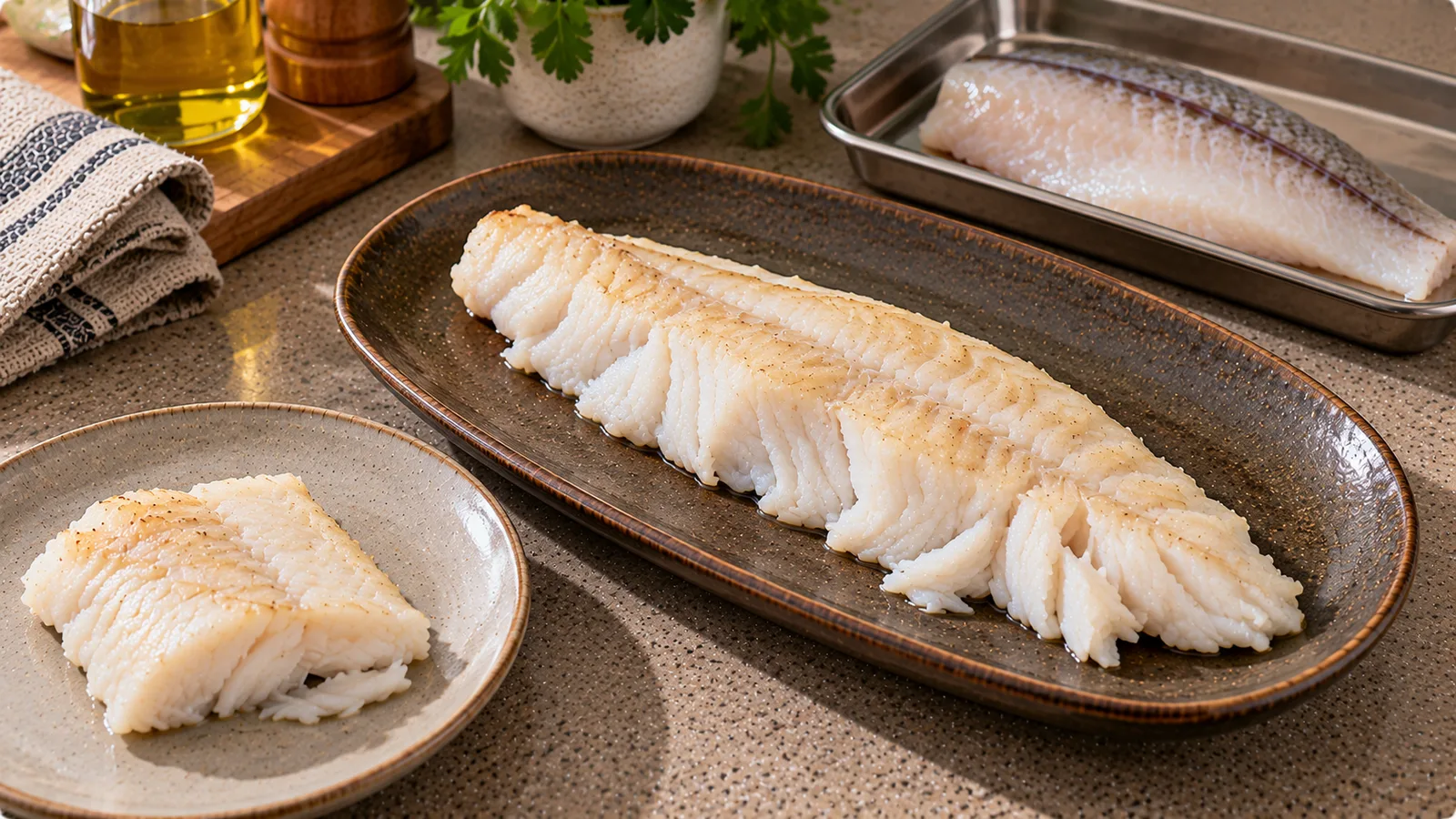
Haddock is a lean white fish that provides substantial protein with relatively little fat. It is commonly sold fresh, frozen, smoked or as part of breaded fish products.
For calorie tracking, the most important details are the portion weight, whether the fish was weighed raw or cooked, and what was added during preparation.
Plain haddock is relatively low in calories. Breaded haddock, fish cooked in butter and dishes with creamy sauces can contain considerably more energy.
How many calories are in haddock?
Raw haddock typically provides approximately 70–85 kcal per 100 g of edible fish.
A useful reference value is about 74 kcal per 100 g raw, although individual food-composition entries and products can differ.
Cooked haddock generally has a higher calorie value per 100 g because cooking removes water.
| Type of haddock | Approximate calories per 100 g | Protein per 100 g |
|---|---|---|
| Raw haddock, plain | 70–85 kcal | 16–19 g |
| Cooked haddock, without added fat | 90–120 kcal | 20–26 g |
| Smoked haddock | Varies by product and moisture | Usually protein-rich |
| Breaded haddock | Often 170–260 kcal | Depends on coating and fish content |
| Fried haddock | Depends on oil and breading | Depends on preparation |
These are indicative ranges rather than universal values.
For packaged haddock, the nutrition label is usually the best source for the exact product.
For unprocessed fish, a recognised food-composition database such as USDA FoodData Central can provide a suitable reference.
Haddock calories by portion size
The following calculations use an illustrative raw haddock value of 74 kcal per 100 g.
| Raw edible portion | Estimated calories |
|---|---|
| 75 g | 56 kcal |
| 100 g | 74 kcal |
| 125 g | 93 kcal |
| 150 g | 111 kcal |
| 175 g | 130 kcal |
| 200 g | 148 kcal |
| 250 g | 185 kcal |
| 300 g | 222 kcal |
The figures describe plain raw fish without cooking fat, breading or sauce.
A 150 g raw fillet provides approximately 111 kcal using this reference.
A 200 g raw portion provides approximately 148 kcal.
If the fish is weighed after cooking, use an appropriate cooked-food value instead.
How to calculate your own portion
Use the following formula:
Calories in your portion = calories per 100 g × portion weight in grams ÷ 100.
For example, if your haddock label states 78 kcal per 100 g and your raw fillet weighs 180 g:
78 × 180 ÷ 100 = 140.4 kcal.
You would record approximately 140 kcal for the fish itself.
Additional oil, butter or sauce should be counted separately.
Haddock nutrition per 100 g
Haddock is particularly useful as a source of protein.
A representative raw haddock profile looks approximately like this:
| Nutrient | Amount per 100 g raw |
|---|---|
| Calories | 70–85 kcal |
| Protein | 16–19 g |
| Fat | 0.3–1.0 g |
| Carbohydrates | 0 g |
| Fibre | 0 g |
The exact values vary with the reference data, water content and product.
Haddock also provides nutrients such as vitamin B12, selenium, phosphorus and iodine.
The iodine content of fish can vary considerably, so it is better to consult a specific composition source when exact micronutrient intake matters.
How much protein is in haddock?
Using 17.8 g protein per 100 g raw as an illustrative reference:
| Raw portion | Estimated protein |
|---|---|
| 100 g | 17.8 g |
| 150 g | 26.7 g |
| 200 g | 35.6 g |
| 250 g | 44.5 g |
These values are useful for meal planning.
They are not a guarantee that every haddock fillet contains precisely the same protein concentration.
Is haddock low in fat?
Yes. Plain haddock is generally considered a lean fish.
Its fat content is much lower than that of oily fish such as salmon, sardines or mackerel.
However, the fat content of a finished haddock meal depends heavily on the preparation.
Frying oil, butter, mayonnaise and cream sauces can add much more fat than the fish itself contains.
Raw versus cooked haddock calories
Raw and cooked haddock should not be compared without considering changes in water content.
When fish is baked, grilled or pan-cooked, some moisture evaporates.
The remaining fish becomes more concentrated per gram.
This explains why a cooked haddock entry can show more calories and protein per 100 g than a raw entry.
Example: a 200 g raw fillet
Suppose a 200 g raw haddock fillet contains 148 kcal.
After cooking without added fat, it weighs 160 g.
The same piece still contains approximately 148 kcal, assuming no significant energy-containing material was lost.
Its calculated calorie density is now:
148 ÷ 160 × 100 = 92.5 kcal per 100 g cooked.
The fish did not gain calories through heating.
It lost water.
Actual cooked values depend on cooking losses, species characteristics and the database method.
Which weight should you log?
If you weigh haddock before cooking, choose a raw haddock entry.
If you weigh it after cooking, choose a cooked haddock entry that matches the preparation.
Avoid applying raw values to cooked weights without adjusting for moisture loss.
Consistency matters especially when you prepare the same fish regularly.
How cooking methods change haddock calories
Plain haddock can be steamed, poached, baked, grilled or pan-fried.
The cooking method itself does not necessarily add calories.
Additional ingredients do.
| Preparation | Main calorie consideration |
|---|---|
| Steamed haddock | Usually no added fat |
| Poached haddock | Depends on poaching liquid and additions |
| Baked haddock | Oil, butter and toppings |
| Grilled haddock | Marinade and cooking fat |
| Pan-fried haddock | Amount of oil or butter consumed |
| Breaded haddock | Flour, breadcrumbs, batter and oil |
| Deep-fried haddock | Coating and absorbed frying fat |
Baked haddock
Baking a plain fillet with lemon, pepper and herbs adds very little energy if no caloric ingredients are used.
The fish may weigh less after baking because of water loss.
For a precise food diary, record its raw weight or use a suitable cooked entry.
Haddock fried in oil
Olive oil provides approximately 9 kcal per gram.
If you add 10 g oil and consume all of it, the meal gains approximately 90 kcal.
Not all oil poured into a pan necessarily ends up in the food.
The amount consumed depends on the pan, cooking process and what remains after cooking.
Haddock with butter
Butter adds calories and fat.
A fillet prepared with 15 g butter will have a higher energy content than the same fillet steamed without fat.
Use the butter's actual nutrition label for the most accurate calculation.
Breaded haddock
Breading can change the nutritional profile substantially.
The coating adds carbohydrates, and frying can add fat.
A packaged breaded haddock portion should be tracked using its own nutrition label rather than the values for plain fish.
Smoked haddock: calories and sodium
Smoked haddock is popular in soups, fish pies, breakfast dishes and creamy sauces.
Its calorie content depends on the product and how much moisture it contains.
Smoking and curing can change the weight and composition per 100 g.
For this reason, do not automatically use raw haddock values for smoked haddock.
Does smoked haddock have more calories?
Not necessarily in total.
Differences per 100 g can arise from moisture loss and the preparation process.
Some smoked products may also contain additional ingredients.
The label is the most reliable starting point.
What about salt?
Smoked and cured haddock may contain considerably more sodium than fresh plain haddock.
This is especially relevant if you monitor sodium intake.
Compare the salt information on the packaging rather than assuming all smoked fish products are equivalent.
In EU nutrition labels, salt is generally declared as a standard nutrition item.
Fresh versus frozen haddock
Freezing plain haddock does not inherently add calories.
A frozen plain fillet can have nutritional values similar to fresh haddock.
However, frozen products differ in processing.
Some contain an ice glaze, added water, seasoning or a coating.
Always distinguish between:
- Plain frozen haddock fillets.
- Seasoned frozen fish.
- Breaded haddock portions.
- Ready-made fish dishes with sauce.
These products should not share one generic nutrition entry.
Does ice glaze affect portion weight?
Some frozen fish products have a protective ice glaze.
That ice is not edible fish.
For accurate tracking, check whether the declared product weight excludes the glaze and follow the package information.
Haddock versus cod and pollock
Haddock, cod and pollock are all commonly used as lean white fish.
Their nutritional profiles can be similar, but they are not identical.
| Fish | General nutritional characteristic |
|---|---|
| Haddock | Lean, high in protein, very low in fat |
| Cod | Lean white fish with substantial protein |
| Alaska pollock | Lean white fish, commonly sold frozen |
| Salmon | Generally higher in fat and calories |
| Mackerel | Oily fish with a much higher fat content |
A fair calorie comparison should use the same basis, such as 100 g raw edible fish.
Comparing raw haddock with cooked cod can be misleading because of differences in moisture.
Also check whether any product contains added ingredients.
Calories in a complete haddock meal
The fish itself may be relatively low in calories, but the total meal includes sides and cooking fats.
Consider the following example:
| Ingredient | Quantity | Estimated calories |
|---|---|---|
| Raw haddock fillet | 180 g | 133 kcal |
| Boiled potatoes | 250 g | 190 kcal |
| Steamed green beans | 200 g | 65 kcal |
| Olive oil | 10 g | 90 kcal |
| Total | — | Approximately 478 kcal |
The numbers are illustrative and depend on the actual foods.
A creamy sauce, fried potatoes or breading would change the total.
When tracking meals, calculate all substantial ingredients rather than counting only the fish.
Example: haddock with creamy sauce
Suppose you prepare a haddock fillet with cream, butter and mashed potatoes.
The sauce and mashed potatoes may contribute more calories than the fish.
Recording only the haddock would significantly underestimate the meal.
A better approach is to enter the full recipe or each ingredient separately.
Is haddock suitable for weight management?
Haddock can fit well into a calorie-conscious eating pattern because it supplies protein with little fat.
Protein contributes to normal body functions and can help make a meal satisfying.
However, eating haddock does not automatically cause weight loss.
Long-term weight change depends on overall energy balance and individual circumstances.
A balanced meal might include haddock, vegetables, potatoes or another carbohydrate source, and a moderate amount of fat.
The overall dietary pattern matters more than choosing one particular fish.
Does haddock contain omega-3 fats?
Haddock contains some omega-3 fatty acids, but it is a lean fish.
It generally contains much less total fat than oily fish such as salmon, sardines or mackerel.
Therefore, it should not be assumed to provide the same omega-3 contribution as an equivalent portion of oily fish.
For fish-consumption advice, consult relevant national dietary recommendations.
The NHS guidance on fish and shellfish distinguishes between white and oily fish.
Haddock, mercury and food safety
Haddock is included among the lower-mercury fish choices in the FDA and EPA advice about eating fish.
Nevertheless, fish-consumption advice varies by country and population.
Pregnant people, those planning pregnancy, breastfeeding people and children should follow applicable national recommendations.
Haddock is also unsuitable for anyone with a relevant fish allergy.
Cook fish thoroughly and follow food-safety guidance for handling raw seafood.
Choosing a realistic haddock serving
The appropriate serving size depends on the meal and individual needs.
A smaller portion may be enough when fish is served with beans or other protein-rich foods.
A larger portion may make sense when haddock is the main protein source.
Using illustrative raw values of 74 kcal and 17.8 g protein per 100 g:
- 100 g haddock: approximately 74 kcal and 17.8 g protein.
- 150 g haddock: approximately 111 kcal and 26.7 g protein.
- 200 g haddock: approximately 148 kcal and 35.6 g protein.
These are planning estimates rather than exact figures for every product.
Common mistakes when tracking haddock
Confusing raw and cooked weight
Water loss changes calories per 100 g.
Match the nutrition entry to the state in which the fish was weighed.
Ignoring butter or oil
Cooking fats can add substantial energy even when the fish is lean.
Record the amount actually consumed.
Logging breaded haddock as plain fish
Breading changes calories, fat and carbohydrates.
Use the packaged product's nutrition information.
Treating smoked haddock as fresh fish
Smoked haddock may differ in moisture and salt content.
Choose a specific smoked-fish entry.
Including ice glaze in the edible portion
Protective ice is not fish flesh.
Use the appropriate net edible weight.
How to record haddock in a food diary
For consistent tracking:
- Identify the product: plain, smoked, seasoned, breaded or prepared.
- Check whether the nutrition values apply to raw or cooked fish.
- Weigh the edible portion.
- Choose the matching nutrition entry.
- Add oil, butter, sauces and side dishes.
- For homemade recipes, calculate the full batch before dividing it into portions.
If you cook several fillets together, recording the combined raw weight and dividing the completed recipe into servings is often easier than estimating each cooked piece separately.