
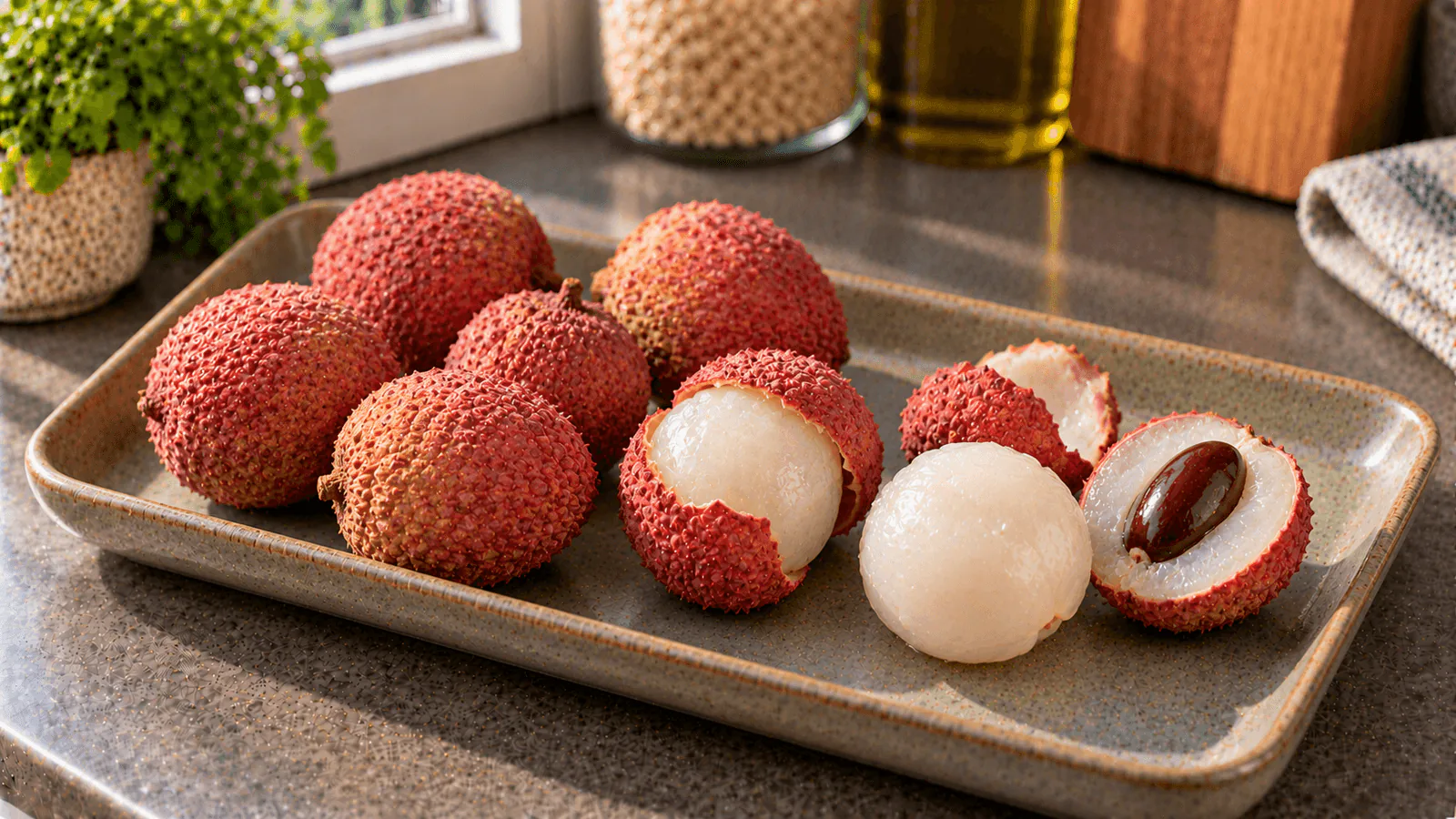
Fresh lychee provides approximately 66 calories per 100 g of edible flesh according to USDA FoodData Central. The figure does not include the tough red peel or the hard central seed. This distinction matters when a bag of whole lychees is weighed before peeling: the purchased weight is not the weight you will eat.
Lychee (also spelled litchi) is a small tropical fruit with a fragrant, sweet, juicy white interior. Its calorie and sugar content are best understood by comparing equal edible weights, rather than judging fruit by sweetness or counting whole fruit with shells and pits.
Nutrition facts for fresh lychee per 100 g
USDA's SR Legacy record Litchis, raw (FDC 169086) gives the following approximate values. They apply to the edible raw fruit, not to dried fruit, sweetened cans or juice.
| Nutrient | Per 100 g edible raw lychee |
|---|---|
| Energy | 66 kcal |
| Protein | 0.83 g |
| Carbohydrates, USDA total | 16.53 g |
| Total sugars | 15.23 g |
| Dietary fibre | 1.30 g |
| Fat | 0.44 g |
| Water | 81.76 g |
| Vitamin C | 71.5 mg |
| Potassium | 171 mg |
Source: USDA FoodData Central — Litchis, raw, FDC 169086. These are food-composition reference values; individual cultivars, ripeness and storage conditions can change the actual composition.
USDA's carbohydrate-by-difference figure includes fibre, whereas European nutrition labels generally show available carbohydrate separately from fibre. Do not compare the figures as if the calculation conventions were identical.
Calories in a small portion, bowl and cup
Using 66 kcal, 15.23 g natural sugars and 1.3 g fibre for each 100 g of peeled and pitted fresh fruit gives these calculated portions:
| Edible raw flesh | Calories | Natural sugars | Fibre |
|---|---|---|---|
| 25 g | 17 kcal | 3.8 g | 0.3 g |
| 50 g | 33 kcal | 7.6 g | 0.7 g |
| 75 g | 50 kcal | 11.4 g | 1.0 g |
| 100 g | 66 kcal | 15.2 g | 1.3 g |
| 150 g | 99 kcal | 22.8 g | 2.0 g |
| 190 g | 125 kcal | 28.9 g | 2.5 g |
Formula: calories ≈ edible grams × 0.66. For instance, 125 g of prepared lychee flesh gives roughly 83 kcal (125 × 0.66 = 82.5). Table values are rounded and represent calculations, not separate tests on each serving.
The USDA household measure of a cup of raw lychee is approximately 190 g. A bowl or household cup at home may hold a different amount depending on fruit size and how tightly it is packed. See the Mealisa explanation of portion size versus serving size for why a reference serving is not a fixed requirement.
How many calories are in one lychee?
A small lychee can have about 10 g of edible flesh, giving approximately 7 kcal at the 66 kcal/100 g reference. USDA household measures give a fruit without refuse around 9.6 g of edible flesh, but this is not the weight of every variety.
Ten small fruits with a measured total of 100 g edible flesh provide roughly 66 kcal. Ten larger lychees may provide considerably more flesh and therefore more calories. Counting fruits without accounting for size and discarded parts is less reliable than weighing the prepared serving.
The rough red shell is peeled away and the central glossy brown seed is discarded. Do not include either in the edible weight. If measuring a whole bag, weigh the remaining peels and seeds afterward and subtract that weight, or peel and pit the fruit before measuring.
Whole fruit weight versus edible yield
Suppose your kitchen scale shows 400 g of whole lychees. After removing shells and seeds, you have 240 g of flesh. The relevant calculation is 240 × 0.66 = 158 kcal, not 400 × 0.66 = 264 kcal.
The 240 g yield in this example is measured, not a universal 60% rule. Skin thickness and seed size vary. If you only know the whole-fruit weight, treat an estimated edible-yield percentage as uncertain and avoid claiming an exact calorie total.
For cooking or food tracking, the simplest approach is to put the peeled and pitted fruit into a bowl on a zeroed scale. Record that number for the portion you actually consume.
Fresh, canned and dried lychees: not the same food entry
Drying removes much of the water, concentrating energy per 100 g. USDA lists Litchis, dried as a distinct SR Legacy product with approximately 277 kcal per 100 g, rather than 66 kcal for the fresh fruit. Twenty-five grams of dried lychee therefore provides about 69 kcal (25 × 2.77 = 69.25).
Canned lychees may be packed in water, juice or light or heavy syrup. Added sugar and the amount of liquid retained determine their nutritional profile. Use the manufacturer's label and the weight actually eaten instead of assigning every can the same calorie number.
| Form | Main issue for calorie tracking | Suitable reference |
|---|---|---|
| Fresh, peeled and pitted | Edible flesh only | 66 kcal/100 g raw flesh |
| Dried lychee | Concentrated after water loss | 277 kcal/100 g dried fruit |
| Canned in water or juice | Fruit-to-liquid proportion | Specific product label |
| Canned in syrup | Added sugar, drained weight and syrup | Specific product label and serving |
| Lychee drink or dessert | Sugar, other fruit, dairy or toppings | Full recipe or package declaration |
Source for dried fruit: USDA FoodData Central — Litchis, dried, FDC 169087. The broader guide to dried versus fresh fruit explains why equal weights are often a misleading comparison.
Canned lychee: drained flesh or syrup?
A tin labelled “lychees in syrup” can show nutritional information for the product as sold, while a recipe may use only drained fruit. If the stated weight includes syrup you throw away, multiplying that weight by the labelled value can misrepresent what you consumed.
Check the label's serving definition, energy per 100 g and whether the entry describes drained solids. Record any syrup used for a drink or sauce separately when possible. A “no added sugar” description also requires the actual ingredient list; it is not a reason to ignore naturally present sugars.
When comparing brands, the most useful questions are whether sugar or sweetened liquid was added, how much drained fruit is in the container, and how big your actual serving is. Do not substitute the fresh-fruit USDA value without checking.
Natural sugar, carbohydrate and fibre
Fresh lychee has roughly 15.23 g sugar and 16.53 g USDA total carbohydrate per 100 g. The sugar naturally present in intact fruit is not automatically the same dietary situation as sugar added to a beverage or syrup. Yet the sugars still contribute to overall energy intake.
The fibre figure is approximately 1.3 g per 100 g, so lychee is not a particularly concentrated fibre source compared with many legumes or whole grains. The fruit's main nutritional attraction includes its water content and vitamin C, rather than high protein or fat.
People who count carbohydrates for a medical reason should use the convention appropriate to their treatment plan and remember that product labels and database values may express carbohydrate differently. A clinician or dietitian can help with individual carbohydrate targets.
Vitamin C and other nutrients
The USDA record reports around 71.5 mg vitamin C per 100 g. Vitamin C supports normal collagen formation and immune function. Actual amounts may vary and can decrease during storage or preparation.
The same 100 g includes about 171 mg potassium and less than 1 g protein. Lychee is not a complete source of protein or a substitute for a balanced meal. A fruit bowl can be paired with yogurt, nuts or other foods if a more substantial snack is needed.
Neither vitamin C content nor any plant compound in lychee proves that the fruit prevents or cures disease. Diet quality depends on the pattern of foods eaten over time.
Lychee desserts and drinks: a transparent recipe example
Suppose a simple blended drink contains 150 g fresh lychee flesh, 200 ml plain water and 10 g added sugar. The lychee contributes 99 kcal, water contributes none, and the added sugar contributes approximately 40 kcal, for 139 kcal total before any other ingredient.
If the sugar is omitted, the same fruit-and-water mixture contains approximately 99 kcal. Sweetened yogurt, condensed milk, tapioca pearls, ice cream and syrup must all be added to the calculation if used. Ice and water increase volume but not calories.
This illustrates why “lychee smoothie” or “lychee dessert” cannot have a single reliable calorie value: ingredients and quantities differ widely. For a different fruit base, compare the fresh values and serving guidance for mango or pineapple rather than assuming all tropical fruit is nutritionally identical.
Is lychee suitable when managing weight?
Fresh lychee can fit into a balanced eating pattern, including a calorie-conscious diet. Its sweet taste does not make it inherently forbidden, and its vitamin C does not make portions irrelevant. At 66 kcal per 100 g, 150 g edible flesh adds about 99 kcal to a day's intake.
Decide on a portion that suits your meal, remove shells and pits, and account for any syrups or desserts separately. Lychee alone contributes little protein and only modest fibre; for a more filling meal, combine it with other foods rather than treating it as a complete meal.
How to log lychee accurately
For fresh lychees, select a database entry for raw edible flesh and measure after peeling and removing the seed. Use 66 kcal per 100 g as the reference. For dried fruit, use the dried entry; for canned fruit or a packaged drink, prefer its specific label.
A simple note in your food diary—“fresh lychee, 125 g peeled flesh” versus “canned lychee in syrup, 125 g drained”—makes later comparisons more meaningful.
Sources and method
- USDA FoodData Central, SR Legacy — Litchis, raw, FDC 169086.
- USDA FoodData Central, SR Legacy — Litchis, dried, FDC 169087.
Figures are reference values per edible 100 g. Portion, single-fruit and recipe totals are clearly labelled calculations, not measured values for a particular packet or harvest.