
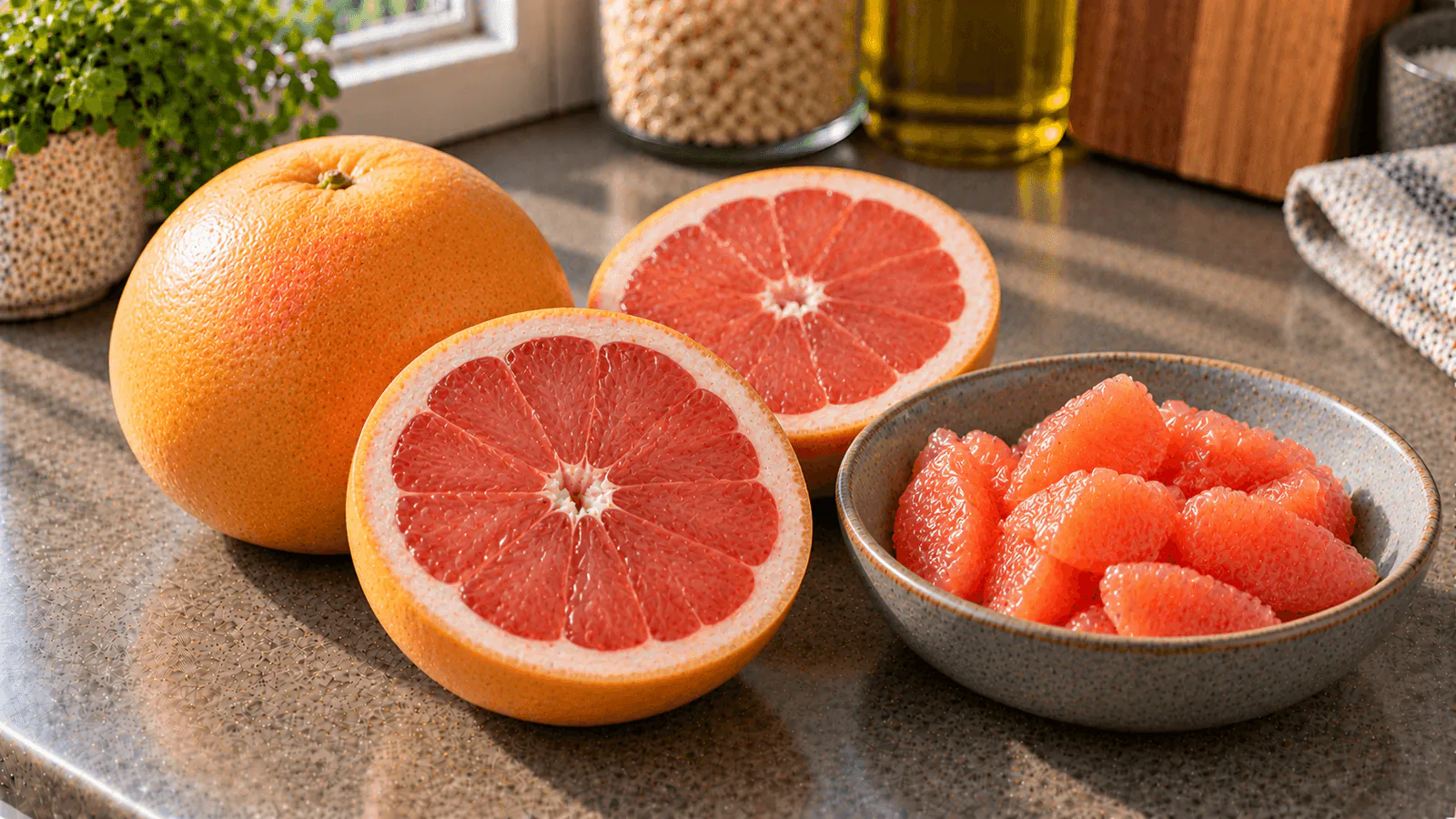
A fresh pink or red grapefruit contains about 42 calories per 100 g of edible flesh, while a white grapefruit contains around 33 calories per 100 g in the USDA FoodData Central reference records. These figures apply to raw fruit without peel, added sugar or dressing—not the weight of a whole unpeeled grapefruit or a glass of juice.
The calorie difference between varieties is real in the cited data, but the amount you actually eat matters more than the colour of the fruit. This guide shows usable serving calculations, the distinction between flesh and juice, and how grapefruit can interact with certain medicines.
Grapefruit nutrition per 100 g
The USDA's SR Legacy entries cover grapefruit, raw, pink and red, all areas (FDC 174673) and grapefruit, raw, white, all areas (FDC 174676).
| Nutrient | Pink/red, 100 g | White, 100 g |
|---|---|---|
| Energy | 42 kcal | 33 kcal |
| Protein | 0.77 g | 0.69 g |
| Total carbohydrate | 10.70 g | 8.41 g |
| Total sugars | 6.89 g | 7.31 g |
| Dietary fibre | 1.60 g | 1.10 g |
| Total fat | 0.14 g | 0.10 g |
| Water | 88.1 g | 90.5 g |
Sources: USDA pink/red grapefruit, FDC 174673 and USDA white grapefruit, FDC 174676. Values are rounded reference averages, not guarantees for any specific variety, country or harvest.
Notice that the pink/red entry has more calories and more total carbohydrate, but the white entry lists slightly more total sugars. The reported total-carbohydrate measure also includes fibre under the US convention. European food labels generally list available carbohydrates separately from fibre. Therefore do not interpret the carbohydrate and sugar columns as interchangeable.
Calories in practical portions of pink or red grapefruit
The following calculations use 42 kcal per 100 g and the corresponding USDA values for naturally occurring sugars and fibre.
| Edible flesh | Calories | Natural sugars | Fibre |
|---|---|---|---|
| 50 g | 21 kcal | 3.4 g | 0.8 g |
| 100 g | 42 kcal | 6.9 g | 1.6 g |
| 120 g | 50 kcal | 8.3 g | 1.9 g |
| 150 g | 63 kcal | 10.3 g | 2.4 g |
| 200 g | 84 kcal | 13.8 g | 3.2 g |
| 250 g | 105 kcal | 17.2 g | 4.0 g |
Calories = edible pink/red grapefruit weight in grams × 42 ÷ 100. For instance, 180 g of prepared segments contributes about 76 kcal. For the white-fleshed USDA entry, substitute 33 instead of 42: 180 g would provide about 59 kcal.
These are calculated portions, not universal sizes for a half or a whole grapefruit. Measuring the edible flesh is more reliable than counting fruit.
Half a grapefruit and one whole grapefruit
A half grapefruit can vary greatly in size. In a food diary, the purchase weight of the entire fruit is not the same as the edible weight. The thick skin, white pith and parts of the membranes may be discarded.
Suppose the flesh actually eaten from one half weighs 120 g. The pink/red reference gives about 50 kcal. If you eat 240 g edible flesh from the entire fruit, that gives about 101 kcal. These examples do not assume every grapefruit yields the same share of edible flesh.
A simple approach is to weigh the segments or spooned-out flesh after preparation. If you weigh before removing the skin, do not use the total purchase weight directly with a per-100-g edible-flesh value. When you eat some membranes with the segments, count whatever you actually consume; there is no need to make an artificial adjustment for every thin piece.
For a general explanation of household serving estimates and weighed portions, see Mealisa's portion size versus serving size guide.
Pink grapefruit, white grapefruit and juice
Pink and red grapefruit are often selected for their milder perceived flavour and colour, while white grapefruit tends to be more bitter. Sweetness, acidity and bitterness vary across fruit and ripeness; flesh colour alone cannot tell you the exact calorie or sugar content of an individual grapefruit.
Fresh edible sections also differ from squeezed juice. Juice can include much less pulp and fibre. A 200 ml glass of juice is not nutritionally equivalent to 200 g of whole fruit, and the numbers should not be copied from the fresh-fruit table.
| Grapefruit form | What to measure | Which data to use |
|---|---|---|
| Fresh pink/red flesh | Edible weight in grams | 42 kcal/100 g reference |
| Fresh white flesh | Edible weight in grams | 33 kcal/100 g reference |
| Freshly squeezed juice | Drunk volume in ml | Verified juice entry or calculated recipe |
| Packaged 100% juice | Label serving and ml | Brand-specific nutrition label |
| Sweetened grapefruit drink | Volume, added ingredients | Product label; do not use raw-fruit data |
| Segments in syrup | Drained portion and syrup eaten | Specific product label |
Juice can be refreshing, but it is easier to drink a large quantity quickly than to eat the same quantity of fruit as segments. If you choose juice for breakfast, read the label and record it as juice rather than logging a whole grapefruit.
For other citrus-food composition, compare Mealisa's orange calorie guide using matched edible weights, rather than one whole orange against one whole grapefruit.
What happens to calories when sugar is added?
Sprinkling sugar on a grapefruit changes the final calorie value. A pink grapefruit serving of 150 g contributes about 63 kcal before toppings. If you add 10 g ordinary table sugar at roughly 4 kcal per gram, the serving becomes about 103 kcal. Sugar does not disappear if the fruit is briefly grilled or warmed.
Similarly, honey, syrups, sweetened yogurt and granola can materially increase a grapefruit breakfast's energy. The exact total depends on the quantities, not whether the grapefruit itself is considered a low-calorie fruit.
Natural sugars in fresh grapefruit are not the same as sugars added in a prepared drink. The distinction is explained in Mealisa's added sugar versus total sugar guide. For packaged beverages, compare the product's sugar and calorie label; do not assume every grapefruit-flavoured drink contains only fruit.
A grapefruit breakfast: worked calculation
Consider a bowl with 150 g edible pink grapefruit, 170 g plain yogurt and 20 g oats. The fruit contributes 63 kcal. If an example yogurt label states 60 kcal per 100 g, 170 g contributes 102 kcal. If the oats used state 380 kcal per 100 g, 20 g contributes 76 kcal. The whole bowl then contributes 241 kcal, before any added sweetener or nuts.
The yogurt and oat numbers here are illustrative label assumptions, not universal nutrition values. Replace them with the exact values of your products. If you use white grapefruit in place of pink, the fruit contribution for the same 150 g would be around 50 kcal and the example total around 228 kcal.
Fibre, vitamin C and everyday nutrition
Pink/red grapefruit in the cited entry provides 1.6 g of fibre per 100 g. A 200 g edible portion therefore supplies about 3.2 g. Grapefruit also contributes vitamin C; the same pink/red USDA entry reports approximately 31 mg per 100 g. Actual levels vary with the fruit and storage.
Vitamin C supports normal immune function and collagen formation, but no particular grapefruit serving prevents or treats illness. Fresh grapefruit is not a substantial source of protein or fat, so a complete meal may also include yogurt, eggs, beans or other protein foods.
For a different fruit comparison, Mealisa has a grape nutrition and portion guide. Equal edible weights are the fairest basis for comparisons, not a handful of grapes versus a whole grapefruit.
Important: grapefruit and certain medicines
Grapefruit and grapefruit juice can interact with some prescription and over-the-counter medicines. Depending on the medicine, grapefruit may increase drug exposure and side-effect risks or reduce how much medicine is absorbed. It does not interact with every medicine in a broad category, and the effect may vary between people.
The US Food and Drug Administration gives examples involving certain statins, blood-pressure medicines, medicines used after organ transplantation and other drugs. Read the patient information leaflet and ask your pharmacist or prescribing clinician before eating grapefruit or drinking its juice if you take any medicine that may interact. Do not attempt to make the interaction safe by spacing the food and medicine a few hours apart without professional advice.
See FDA: Grapefruit Juice and Some Drugs Don't Mix. This section is a safety reminder, not a list of every medicine or an instruction to stop treatment.
How to log grapefruit accurately
For fresh pink or red grapefruit, use 42 kcal per 100 g of edible flesh; for white grapefruit, the cited reference is 33 kcal per 100 g. Weigh the parts actually eaten and make sure the database entry matches the form used.
Record juice, syrup-packed segments and sweetened dishes as separate foods. Add any sugar, yogurt, sauces or other toppings. For homemade recipes, total the calories of the ingredients and divide by the portions actually served.
Data sources and interpretation
- USDA FoodData Central: pink/red grapefruit, SR Legacy FDC 174673
- USDA FoodData Central: white grapefruit, SR Legacy FDC 174676
- US FDA: grapefruit and medication interactions
Figures are reference values and rounded calculations. The fresh-fruit tables do not describe commercial juices, preserved fruit, every cultivar or any specific drug interaction.