
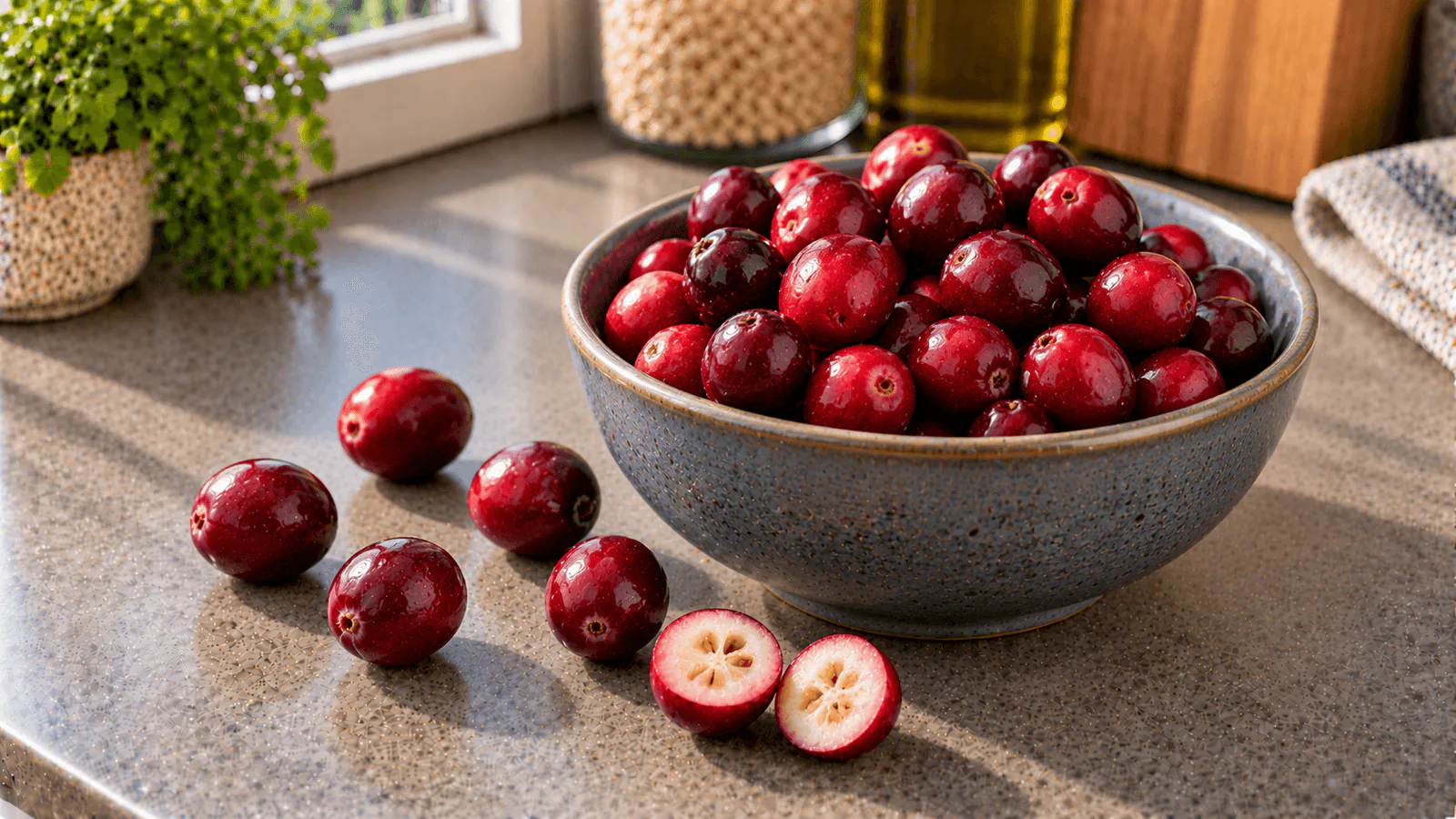
Fresh raw cranberries contain approximately 46 calories per 100 g of edible berries, according to USDA FoodData Central (SR Legacy, FDC 171722). That is very different from sweetened dried cranberries, which have approximately 308 calories per 100 g in the separate USDA reference (FDC 171723). The distinction matters: a cranberry's calories depend on its form and any added sugar, not just the word cranberry on a package.
Cranberries are notably tart, so many people encounter them in dried snack mixes, juice drinks and cooked sauces rather than eating a bowl of raw berries. This guide explains the raw-fruit numbers, weighed portions, the role of sugar and how to log the foods you actually eat.
Cranberry nutrition per 100 g: fresh fruit
The reference below is for raw whole cranberries, without sweeteners or other ingredients. It is an average food-composition entry, not a measurement of a particular bag of berries.
| Nutrient | Per 100 g raw cranberries |
|---|---|
| Calories | 46 kcal |
| Protein | 0.46 g |
| Total carbohydrate, USDA method | 11.97 g |
| Naturally occurring sugars | 4.27 g |
| Dietary fibre | 3.60 g |
| Fat | 0.13 g |
| Water | 87.32 g |
| Potassium | 80 mg |
| Vitamin C | 14.0 mg |
Source: USDA FoodData Central — Cranberries, raw, FDC 171722.
USDA reports total carbohydrate by difference, which includes fibre. European nutrition labels commonly list available carbohydrates separately from fibre. To compare labels fairly, make sure the carbohydrate definitions match.
The 46 kcal value is for edible raw berries and should not be copied into an entry for dried sweetened fruit, cranberry sauce, cordial or juice cocktail. Even different unsweetened cranberry products can have different concentrations because their water content varies.
Calories in cranberry portions
The table uses the USDA raw-fruit reference of 46 kcal, 4.27 g naturally occurring sugar and 3.60 g fibre per 100 g. Values are rounded calculations, not separate laboratory measurements. USDA's reference cup of whole raw cranberries is around 100 g; a cup of chopped berries is approximately 110 g.
| Edible raw serving | Calories | Natural sugars | Fibre |
|---|---|---|---|
| 25 g | 12 kcal | 1.1 g | 0.9 g |
| 50 g | 23 kcal | 2.1 g | 1.8 g |
| 75 g | 35 kcal | 3.2 g | 2.7 g |
| 100 g (reference cup, whole) | 46 kcal | 4.3 g | 3.6 g |
| 110 g (reference cup, chopped) | 51 kcal | 4.7 g | 4.0 g |
| 150 g | 69 kcal | 6.4 g | 5.4 g |
| 200 g | 92 kcal | 8.5 g | 7.2 g |
For any weighed raw serving, calories = edible weight in grams × 0.46. A 180 g serving contains approximately 83 kcal (180 × 0.46 = 82.8). A measuring cup, however, can hold a different mass depending on whether the berries are whole, chopped or packed down.
Our guide to portion size versus serving size explains why a reference cup and a person's actual serving may differ. For the best food log, record the edible mass rather than relying only on household measures.
How many calories are in one cranberry?
There is no universal calorie number per berry. Wild and cultivated cranberries, different grades and different individual berries vary in size. A calculation for one berry is possible only if its weight is known.
For illustration, a raw berry weighing 2 g would contribute about 0.9 kcal. Ten berries with a combined edible mass of 25 g would provide about 12 kcal. Those numbers demonstrate the weight calculation; they are not standard weights for a single cranberry or ten berries.
A kitchen scale works better for larger quantities. Weigh the berries after discarding any stems and spoiled pieces that will not be eaten. Rinsing and draining them does not add calories, although remaining surface water can slightly affect a precise weigh-in.
Fresh cranberries versus sweetened dried cranberries
A particularly important distinction is the supermarket bag labelled dried cranberries. Many are sweetened because untreated cranberries are strongly tart. The USDA entry Cranberries, dried, sweetened (FDC 171723) lists around 308 kcal, 82.8 g total carbohydrate, 72.6 g sugars and 5.3 g fibre per 100 g. The raw entry lists 46 kcal, 11.97 g total carbohydrate and 4.27 g sugars.
Source: USDA FoodData Central — Cranberries, dried, sweetened, FDC 171723.
The increase per 100 g is not simply proof that drying creates calories. Water is removed, concentrating what remains; sweetened products can also contain substantial added sugar. Products vary, so check the ingredient list and nutrition label before treating these USDA figures as your specific brand's values.
A 30 g portion of the USDA sweetened dried product has about 92 kcal, calculated from 30 × 3.08. A 40 g reference quarter-cup has about 123 kcal. Both servings are smaller by weight than 100 g of fresh berries, yet they can contain more energy because their formulation and concentration differ.
For comparison, see Mealisa's separate guide to dried apricots; the method is the same: compare the actual edible grams and check whether sugar or other ingredients have been added.
Are cranberry juice and cranberry juice cocktail the same?
No. A pure unsweetened cranberry juice, a blended 100% juice and a cranberry juice cocktail can have very different ingredients and nutrient profiles. A cranberry-flavoured drink may contain added sugar, concentrated juice from other fruits or sweeteners. The name on the front is not enough to calculate the calories.
Look at the complete product name, the volume consumed, calories per 100 ml and the sugars declaration. Also check the ingredient list for added sugar or other juices. No added sugar does not mean no naturally occurring sugar. The distinction is discussed in our article on added sugar versus total sugar.
Juice is also not equivalent to whole berries in terms of fibre. A drink strained free of pulp generally supplies less of the whole fruit's structural fibre. For a home-made drink, include the grams of fruit and all sweeteners, then divide the total by the volume or servings you actually consume.
A spoonful of cranberry concentrate should not be logged as if it were the same volume of ready-to-drink juice.
Cranberry sauce: count the complete recipe
An unsweetened sauce made from berries and water differs from a sweetened holiday sauce. Cooking can evaporate water, changing calories per 100 g of finished sauce, but it does not create energy on its own.
Take a transparent example: 250 g raw cranberries plus 40 g table sugar, cooked with water. The berries contain about 115 kcal (250 × 0.46); the sugar contributes approximately 160 kcal at 4 kcal per gram. The starting recipe therefore contains roughly 275 kcal, before any other ingredients.
If all of the sauce is eaten in five equal servings, that is about 55 kcal per serving. The result is conditional: discarded liquid, straining, extra ingredients or unequal portions will alter what each person actually eats. There is no single correct calorie number for cranberry sauce.
If you measure a cooled finished sauce by grams, also measure the finished total weight; that allows you to calculate an energy value per 100 g for your recipe. A jar from a store should instead be recorded from its own label.
A breakfast example with raw cranberries
Suppose you use 100 g raw cranberries, 170 g plain yoghurt and 15 g rolled oats in a bowl. The fruit provides approximately 46 kcal. If the yoghurt label lists 70 kcal per 100 g, the yoghurt contributes 119 kcal. If the oats label lists 380 kcal per 100 g, 15 g provides 57 kcal. This illustrative bowl therefore contains about 222 kcal before toppings.
The yoghurt and oat values are clearly stated examples, not universal nutrition figures. Choose the values on your own products. If the berries taste too tart and you add honey, syrup or sugar, count those additions separately.
Frozen unsweetened cranberries can be used in a cooked topping; frozen berries with added syrup should be treated as a different product. The complete meal matters more than the apparent calories of one ingredient.
Fibre, acidity and practical use
The USDA raw-cranberry entry contains 3.6 g fibre and around 14 mg vitamin C per 100 g. Both values describe raw fruit and should not be copied directly to all processed drinks or sauces. Cooking, dilution and processing may change the amount per serving.
Cranberries taste tart largely because of their organic acids. Tartness alone is not a reliable measurement of sugar content or calories, especially in manufactured foods where sweetness and acidity can be adjusted independently.
Cranberry products are sometimes associated with urinary-health claims. Food-composition data do not demonstrate that ordinary cranberry juice, sauce or berries treat an existing infection. Anyone with symptoms requiring medical care should not substitute food for appropriate treatment.
For everyday eating, raw cranberries can be cooked with other fruit or added in small amounts to dishes. Their role in a balanced diet depends on the other ingredients, not on a claimed special effect.
How to log cranberries accurately
Select cranberries, raw for fresh whole berries eaten without additions and enter the edible grams. Choose cranberries, dried, sweetened for a product matching that description only when the packaging does not offer better data; use the actual label for other dried varieties.
Use recipe totals for homemade sauce and product-specific values for juice, drinks and preserves. If a recipe contains fresh blueberries alongside cranberries, weigh each ingredient and calculate them separately.
Sources and limits
- USDA FoodData Central — Cranberries, raw (SR Legacy 171722).
- USDA FoodData Central — Cranberries, dried, sweetened (SR Legacy 171723).
Numbers are population reference values for particular food states. Serving-table values and recipes are calculations from those references and clearly stated example label values, not claims about every product.