
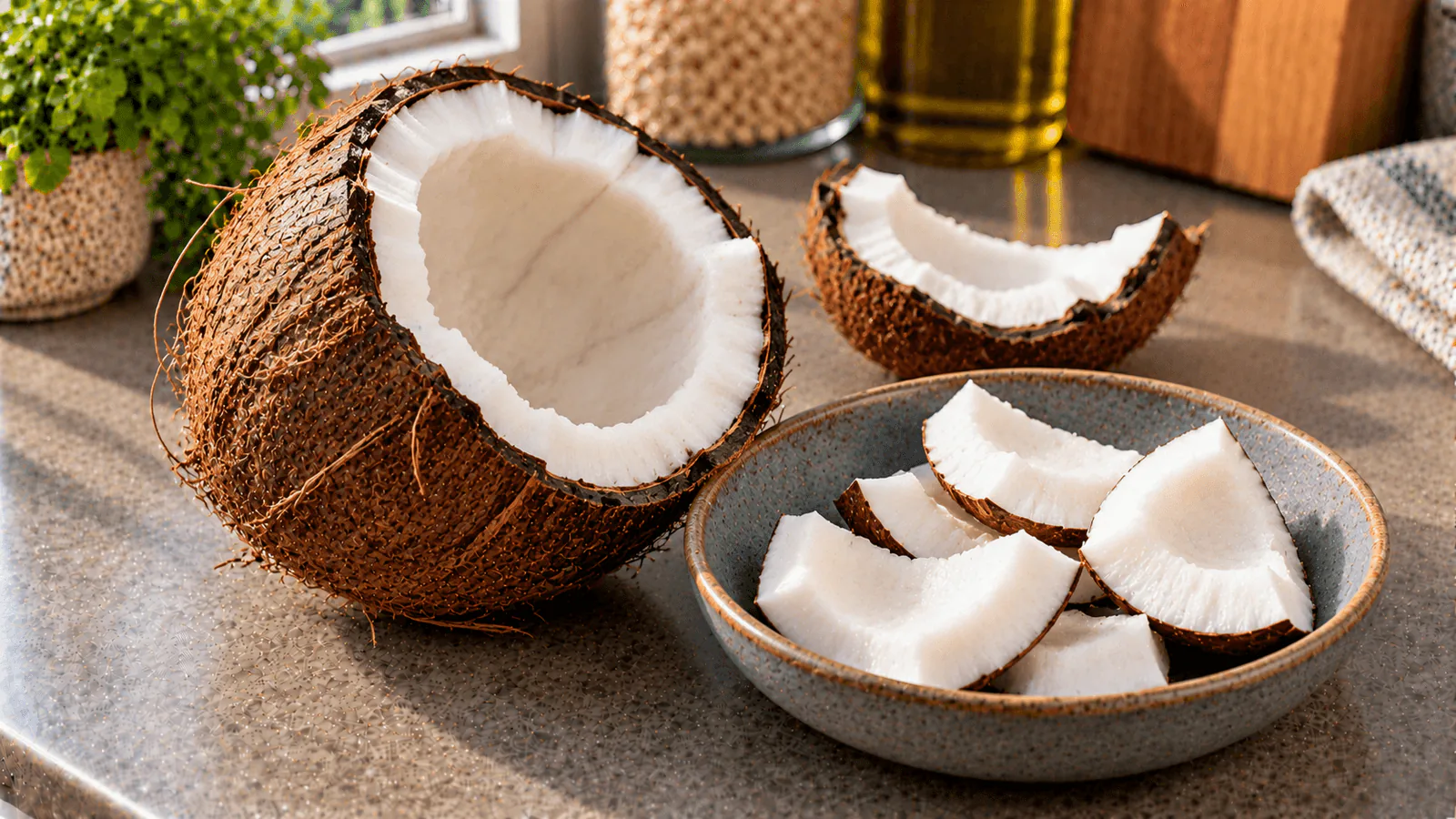
Fresh coconut meat contains about 354 calories per 100 g of edible flesh, according to USDA FoodData Central (SR Legacy, FDC 170169). It is much more energy-dense than most fresh fruits because it contains substantial fat rather than mainly water. The same database reports 660 calories per 100 g of dried, unsweetened desiccated coconut (FDC 170170). Fresh flesh and dried flakes therefore need different entries in a food diary.
Here, coconut meat means the firm white edible flesh inside a mature coconut. The hard shell and discarded husk are not included in the reference weight. Coconut water, canned coconut milk, coconut cream and coconut oil are different products with different serving conventions. This article focuses on the flesh, its realistic portions, and how processing changes the numbers.
Nutrition in 100 g of raw coconut meat
The USDA entry Nuts, coconut meat, raw describes the edible white flesh of a mature coconut, without sugar, oil or other ingredients. The figures are reference averages, not measurements of every coconut.
| Nutrient | Per 100 g raw meat |
|---|---|
| Calories | 354 kcal |
| Protein | 3.33 g |
| Total fat | 33.50 g |
| Saturated fat | 29.70 g |
| Total carbohydrate (USDA method) | 15.20 g |
| Natural sugars | 6.23 g |
| Dietary fibre | 9.00 g |
| Water | 47.00 g |
| Potassium | 356 mg |
Source: USDA FoodData Central — coconut meat, raw, FDC 170169.
Fat supplies much of the energy in coconut meat; the 33.5 g of fat includes approximately 29.7 g saturated fatty acids. Coconut also contributes fibre, but its fat composition still matters when deciding how often and how much to eat. The USDA carbohydrate-by-difference figure includes fibre, whereas European nutrition labels normally display available carbohydrate separately from fibre. Those figures should not be compared without checking the convention.
Calories in everyday portions of fresh coconut
The table multiplies 354 kcal, 33.5 g fat and 9 g fibre per 100 g by the edible raw weight. All entries are rounded calculations; the serving masses are examples rather than guaranteed weights of coconut pieces.
| Edible raw flesh | Calories | Fat | Fibre |
|---|---|---|---|
| 10 g | 35 kcal | 3.4 g | 0.9 g |
| 20 g | 71 kcal | 6.7 g | 1.8 g |
| 25 g | 89 kcal | 8.4 g | 2.3 g |
| 30 g | 106 kcal | 10.1 g | 2.7 g |
| 50 g | 177 kcal | 16.8 g | 4.5 g |
| 75 g | 266 kcal | 25.1 g | 6.8 g |
| 100 g | 354 kcal | 33.5 g | 9.0 g |
Calories = edible fresh coconut flesh in grams × 3.54. A 40 g portion provides approximately 142 kcal. The same piece can look larger or smaller depending on thickness, so weighing matters more than counting strips or cubes. See our guide to portion size versus serving size for the difference between a reference portion and the quantity eaten.
The brown thin skin attached to white coconut flesh can be eaten, but the thick woody shell cannot. Weigh only the portion you eat. If a recipe says "one coconut," its edible yield is not standardized: shell thickness, maturity, water content and waste vary too much to use one universal number.
Fresh flesh versus dried unsweetened coconut
Drying removes much of the water. USDA's separate entry Nuts, coconut meat, dried (desiccated), not sweetened reports 660 kcal, 64.5 g fat, 57.2 g saturated fat, 23.6 g total carbohydrate and 16.3 g fibre per 100 g. These are figures for unsweetened dried coconut, not for shredded coconut mixed with sugar or chocolate.
Source: USDA FoodData Central — dried unsweetened coconut, FDC 170170.
A 20 g serving of unsweetened dried coconut supplies approximately 132 kcal, compared with 71 kcal from 20 g fresh flesh. A 30 g dried serving supplies approximately 198 kcal. The dried reference has less water and correspondingly more fat and fibre per 100 g; that does not mean the drying process manufactures energy.
Sweetened coconut flakes, toasted flakes coated in syrup, or packaged coconut snacks can differ substantially. Product labels should take priority when their ingredients and moisture content do not match either USDA reference. For recipes, a tablespoon measure can be misleading because long flakes, fine desiccated coconut and large chips fill the spoon differently.
Coconut meat, coconut milk and coconut water are different
Fresh coconut flesh is a solid food. Coconut water is the naturally occurring liquid inside the fruit; it is not the same as a pressed coconut-milk beverage. Coconut milk is commonly made by combining coconut flesh with water and extracting the liquid; canned full-fat milk, lighter cooking milk and carton beverages are not interchangeable.
Coconut cream is generally a richer product, and coconut oil is predominantly fat. None should automatically inherit the 354 kcal figure for raw flesh. When using coconut milk in a curry, use the package's calories per 100 ml or 100 g and record how much of the can you used.
Our separate article on calories in coconut milk covers that product's serving sizes. Keeping these foods in different diary entries avoids a common mistake: adding a generic "coconut" item to a recipe when the ingredient was actually coconut milk, water or oil.
Fat and saturated fat: what the numbers mean
Raw coconut's USDA profile shows approximately 33.5 g total fat and 29.7 g saturated fat per 100 g. That is a high proportion of saturated fat, even though coconut is plant-derived. A plant origin does not automatically mean that most of its fat is unsaturated.
The World Health Organization's healthy-diet guidance recommends limiting saturated fatty acids and replacing some with unsaturated fats where appropriate. Coconut flesh can be part of a varied diet, but it should not be described as a food that automatically improves heart health simply because it contains medium-chain fatty acids or comes from a tropical fruit.
For a fuller explanation, read saturated versus unsaturated fat. If you monitor saturated fat, multiplying the raw reference by portion size is useful: 30 g coconut meat contains about 8.9 g saturated fat (29.7 × 0.30). This is a calculated estimate, not a medical recommendation for how much coconut an individual should eat.
What if you toast or cook coconut?
Toasting raw or dried coconut can change water content and weight. Toasting without added ingredients does not create extra calories in the original batch, but the finished food can have more calories per 100 g if it loses water.
When roasting coconut strips with oil, count the added oil separately. If you caramelize coconut with sugar or syrup, include the amount actually consumed. A recipe that starts with 50 g fresh flesh has roughly 177 kcal from coconut before any additions; a finished 50 g toasted product cannot be assumed to have the same composition as 50 g raw flesh.
If measuring a whole batch, record the raw edible coconut and other ingredients first, then portion the result. Where a specific packaged toasted product is used, its label is more accurate than a generic raw entry.
Example: coconut in a breakfast bowl
Consider an illustrative bowl of 30 g fresh coconut, 170 g plain yoghurt and 80 g berries. The coconut contributes about 106 kcal. Suppose the yoghurt label states 60 kcal per 100 g, adding 102 kcal, and the berries used are recorded at 50 kcal per 100 g, adding 40 kcal. The total is approximately 248 kcal before any honey, seeds or other toppings.
Those yoghurt and berry values are explicitly sample label assumptions, not universal values. A thicker high-fat yoghurt, a flavoured product or another fruit can change the total. If adding granola, weigh it separately: a visually small handful may add more energy than expected. Coconut flakes can also be used as a garnish rather than the main ingredient.
For a smaller coconut topping, 10 g fresh flesh provides about 35 kcal; 10 g dried unsweetened coconut provides about 66 kcal. The visible amount alone does not tell you which reference to choose.
Buying and storing coconut flesh
A whole mature coconut offers flesh plus liquid, surrounded by inedible shell and husk. Packages of fresh prepared strips may have a different moisture level from naturally dried products. Verify whether a label says fresh, dehydrated, desiccated, roasted or sweetened.
Store freshly cut coconut according to safe refrigeration practices and any seller instructions, rather than assuming shelf life from a dry product. Discard flesh showing mould, off odour or obvious spoilage. Packaged dried coconut should be kept as directed and protected from moisture. These practical differences matter for shopping and batch preparation, though storage does not change the arithmetic of the nutrients you actually eat.
Recording coconut correctly
Choose coconut meat, raw for weighed fresh mature flesh and multiply grams by 3.54 kcal. Choose dried desiccated coconut, unsweetened when that really is the ingredient; otherwise follow the product label. For a coconut curry or drink, select the actual milk or beverage instead of solid flesh. Track discarded shell separately from edible yield and include oils and added sugar used in cooking.
Sources and limitations
- USDA FoodData Central — coconut meat, raw (SR Legacy 170169).
- USDA FoodData Central — coconut meat, dried, unsweetened (SR Legacy 170170).
- WHO — Healthy diet.
The nutrition tables use USDA reference values for specific food states. Portions and recipes are arithmetic examples; coconut variety, moisture, handling and commercial formulations can change real-world results.