
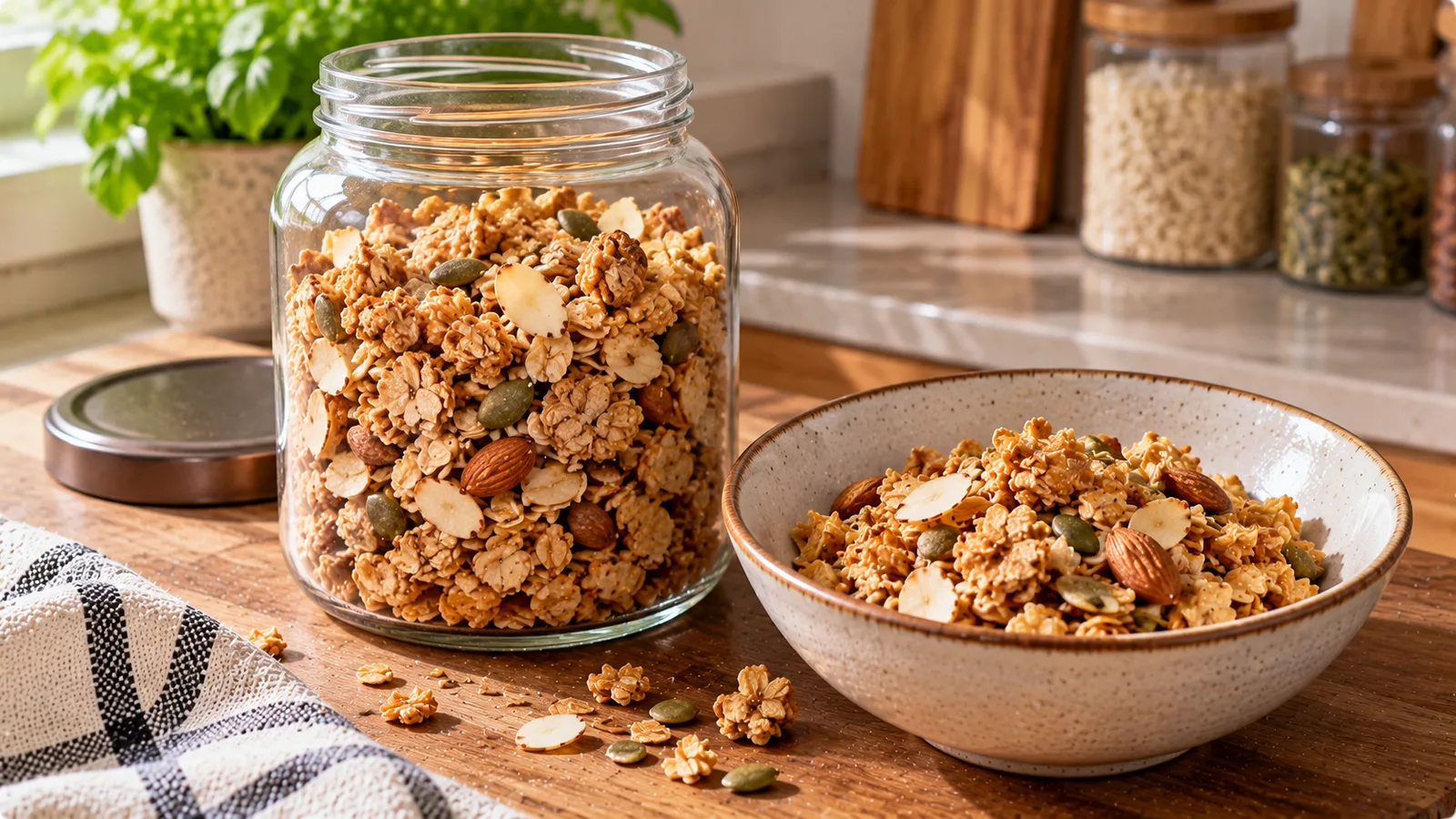
Granola is often marketed as a convenient breakfast or snack, but its calorie content can be surprisingly concentrated. A small bowl may contain rolled oats, nuts, seeds, oil, syrup and dried fruit. These ingredients contribute different amounts of energy, and the final calorie value depends on their proportions.
For a practical estimate, many conventional granolas fall somewhere around 400–500 kcal per 100 g. This is a broad reference range rather than a universal nutritional value. Products with substantial amounts of nuts, chocolate or added fats may fall outside it.
The most accurate figure for packaged granola is the energy value on its nutrition label. For homemade granola, calculate calories from the actual ingredients and the finished batch weight.
How many calories are in granola?
The table below uses an illustrative granola containing 450 kcal per 100 g.
| Granola portion | Estimated calories |
|---|---|
| 20 g | 90 kcal |
| 30 g | 135 kcal |
| 40 g | 180 kcal |
| 50 g | 225 kcal |
| 60 g | 270 kcal |
| 75 g | 338 kcal |
| 100 g | 450 kcal |
These are calculated examples, not laboratory measurements or averages from a specific database.
If your granola contains 420 kcal per 100 g, a 40 g serving provides 168 kcal. If it contains 490 kcal per 100 g, the same portion provides 196 kcal.
The difference becomes more significant when granola is eaten regularly or combined with several toppings.
What counts as a serving of granola?
Granola serving sizes are not standardized across brands. One package may suggest 30 g, another 40 g or 50 g.
A serving printed on a label is a reference quantity, not a recommendation that everyone should eat exactly that amount.
For example, with a product containing 450 kcal per 100 g:
- 30 g provides approximately 135 kcal.
- 40 g provides approximately 180 kcal.
- 50 g provides approximately 225 kcal.
- 80 g provides approximately 360 kcal.
The easiest way to determine your actual serving is to weigh the granola before adding milk or yogurt.
A visual estimate based on a bowl can be inaccurate because granola clusters, nuts and dried fruit differ in size and density.
Why is granola relatively calorie-dense?
Granola is usually made from a mixture of cereal grains and energy-rich additions.
Rolled oats
Oats provide carbohydrates, some protein, fat and fiber. Dry rolled oats commonly contain roughly 370–390 kcal per 100 g, depending on the product and database.
Oats form the base of many granola recipes, but they are not the only source of calories.
Nuts and seeds
Almonds, walnuts, sunflower seeds and pumpkin seeds contain substantial amounts of fat.
Fat provides approximately 9 kcal per gram, compared with approximately 4 kcal per gram for digestible carbohydrate or protein.
Nuts and seeds can contribute useful nutrients, but they also increase the energy density of a mixture.
Oil and other fats
Many granola recipes include oil to help the ingredients roast and form clusters.
Even a modest quantity can noticeably increase the total calories because oil is almost entirely fat.
Sugar, honey and syrup
Sweeteners add energy and affect the taste and texture of granola.
Honey, maple syrup and other syrups are not calorie-free alternatives to sugar. Their energy content differs because of water and sugar composition, but all can contribute calories.
Chocolate and dried fruit
Chocolate adds energy from fat and sugar. Dried fruit adds carbohydrates and natural sugars in a relatively concentrated form.
Neither ingredient has a single fixed effect on the final calorie value: the amount used matters.
Granola calories compared with other breakfast foods
These broad ranges illustrate why it is useful to compare products by weight rather than by bowl size.
| Food, dry unless stated otherwise | Approximate kcal per 100 g |
|---|---|
| Plain rolled oats | 370–390 |
| Unsweetened traditional muesli | 350–410 |
| Conventional granola | 400–500 |
| Nut-rich granola | Often toward the upper end or above the conventional range |
The ranges overlap. Some muesli products contain large amounts of nuts and dried fruit, while some granolas use less oil or sugar.
The label is therefore more reliable than the product category alone.
Granola and oatmeal are also not equivalent in prepared weight. Oatmeal cooked with water absorbs liquid, so 100 g of prepared porridge typically contains fewer calories than 100 g of dry oats.
That difference largely reflects water content rather than the disappearance of calories.
Calories in granola with milk or yogurt
Granola is rarely eaten completely on its own. Milk, yogurt, fruit and nut butter can substantially change the total energy of the meal.
Consider this illustrative breakfast:
| Ingredient | Quantity | Estimated calories |
|---|---|---|
| Granola at 450 kcal/100 g | 50 g | 225 |
| Plain yogurt at 65 kcal/100 g | 150 g | 98 |
| Blueberries at 57 kcal/100 g | 80 g | 46 |
| Total | 369 kcal |
Actual values vary by product.
Using a high-fat yogurt, adding nut butter or increasing the granola portion will change the result. Choosing a different yogurt or reducing the granola amount will change it in the other direction.
For accurate tracking, enter each ingredient separately or save the complete combination as a recipe.
How to calculate granola calories from a label
The calculation is straightforward:
Calories in your portion = calories per 100 g × portion weight ÷ 100.
Example:
A package lists 468 kcal per 100 g.
You weigh out 45 g.
468 × 45 ÷ 100 = 210.6 kcal.
Rounded to the nearest whole calorie, that is approximately 211 kcal.
The same method works for protein, fat, carbohydrates and fiber when the relevant per-100-g values are available.
Always check whether the label describes the dry product or a prepared serving with milk. Mixing these reference quantities can produce incorrect results.
Homemade granola: calculate the whole batch
Homemade granola can vary even more than commercial products because ingredient proportions are entirely flexible.
Consider a simplified example:
| Ingredient | Amount | Illustrative energy |
|---|---|---|
| Rolled oats | 250 g | 950 kcal |
| Almonds | 70 g | 406 kcal |
| Pumpkin seeds | 40 g | 224 kcal |
| Oil | 30 g | 270 kcal |
| Honey | 60 g | 182 kcal |
| Total | 450 g before baking | 2,032 kcal |
These figures are illustrative and should be replaced by the values for your actual ingredients.
Suppose the finished granola weighs 420 g after baking.
2,032 ÷ 420 × 100 = approximately 484 kcal per 100 g finished granola.
The finished product is more calorie-dense per 100 g than the original mixture because some water has been lost during baking.
That does not mean baking created extra calories.
The calculation assumes no meaningful ingredient losses. If some mixture remains on the baking tray or ingredients are discarded, adjust the batch calculation as appropriate.
Does low-sugar granola have fewer calories?
Not necessarily.
Reducing added sugar may reduce the energy content if the replacement ingredients contribute less energy.
However, a granola marketed as low in sugar may contain more nuts, seeds or fat. Its total calories can therefore remain similar to those of a sweeter product.
Check the energy value per 100 g rather than assuming that a lower sugar figure automatically means fewer calories.
The same applies to terms such as natural, organic, high-protein or gluten-free. These claims do not independently determine energy density.
Can granola fit into a weight-loss diet?
Yes. Granola can be included in an eating pattern designed to reduce energy intake, but portion size matters because it is relatively energy-dense.
There is no universal portion that works for everyone.
A practical approach is to decide how much granola you want, weigh it, and combine it with other foods according to your needs.
For example, a smaller amount of granola can provide texture in a larger bowl of plain yogurt and fruit.
This is not inherently superior to a larger portion. It is simply one way to adjust the energy content of the meal.
Weight management depends on the overall dietary pattern over time rather than on whether a particular food is included or excluded.
Granola and protein: what should you check?
Granola contains some protein from oats, nuts and seeds, but the amount differs between recipes.
Products marketed as high-protein may include added protein ingredients or different proportions of nuts and seeds.
Do not assume that a higher-protein product has fewer calories.
Compare both protein and energy per 100 g, then calculate the values for the portion you actually eat.
If you eat granola with yogurt, milk or another protein-containing food, remember to include that component when evaluating the complete meal.
Frequently asked questions
How many calories are in 30 g of granola?
At 450 kcal per 100 g, 30 g contains approximately 135 kcal. A different product may provide more or less.
How many calories are in 50 g of granola?
At 450 kcal per 100 g, 50 g provides approximately 225 kcal.
Is granola higher in calories than oats?
Many granolas contain more calories per 100 g than plain oats because they include nuts, oils and sweeteners. The ranges overlap, so compare the actual products.
Is homemade granola lower in calories?
Not automatically. Homemade granola may contain substantial amounts of oil, nuts and sweeteners. Calculate the ingredients and finished batch weight.
Does baking reduce the calories in granola?
Baking can reduce water content and change the weight. It does not simply remove the calories from the ingredients. Any meaningful ingredient losses should be accounted for separately.
Is granola with yogurt a balanced breakfast?
It can be part of a varied breakfast. The nutritional profile depends on the granola, yogurt, fruit, quantities and the rest of your diet.
Sources and reference data
- USDA FoodData Central — food composition data for oats, nuts, seeds and granola products.
- UK CoFID food composition data — reference nutrient values for foods.
- EU Regulation No 1169/2011 — requirements for nutrition information on packaged foods.
Key takeaway
A useful starting estimate for conventional granola is approximately 400–500 kcal per 100 g, but the actual figure depends on the product or recipe.
For packaged granola, use the nutrition label. For homemade granola, total the ingredient calories and divide by the finished weight.
Above all, measure the portion you actually eat rather than assuming that every bowl or package serving contains the same number of calories.