
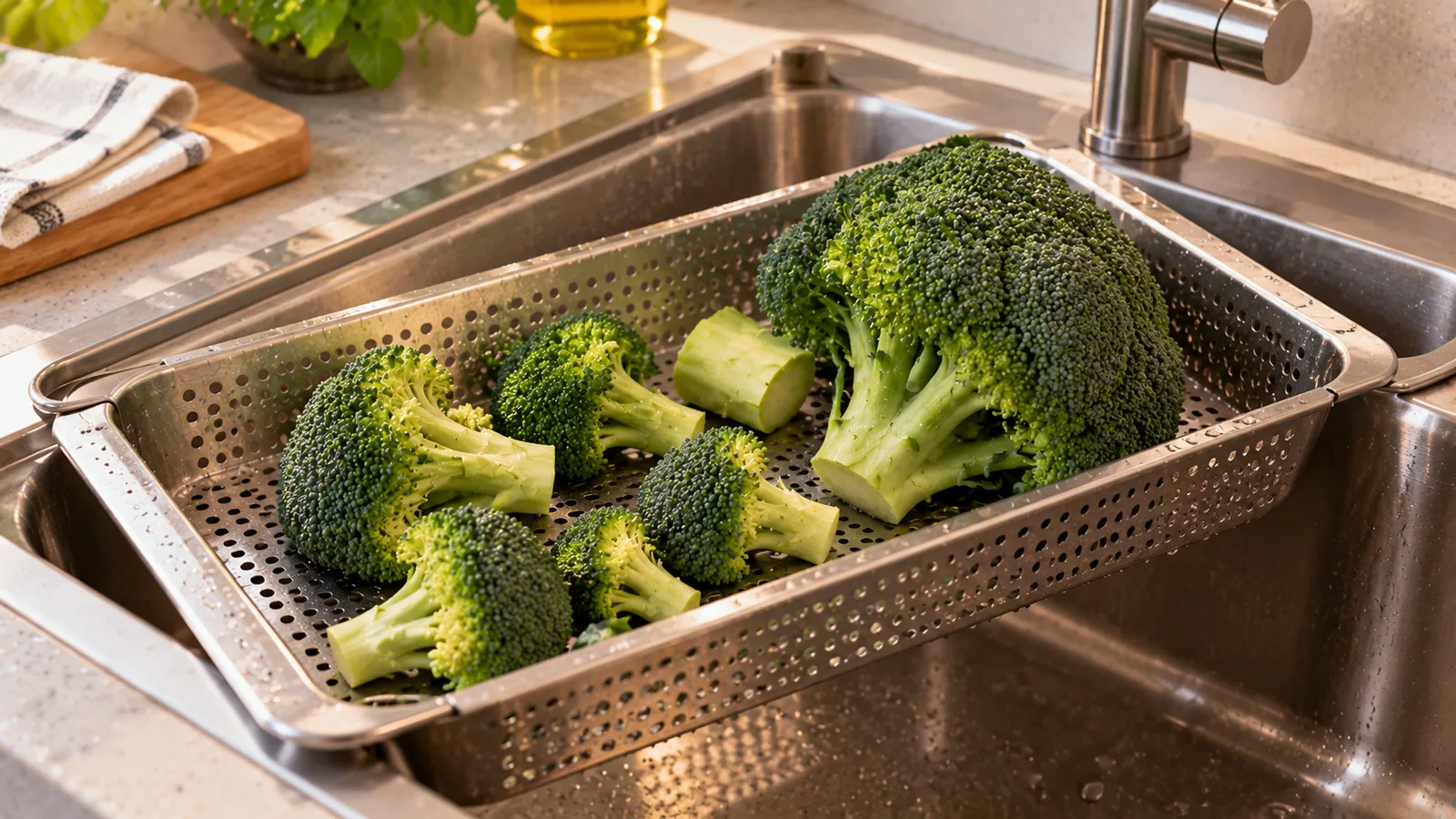
Broccoli is a low-calorie vegetable with a high water content, fiber and a useful range of micronutrients.
A practical reference for raw broccoli is approximately 34 kcal per 100 g.
That means even relatively large portions usually contribute modest amounts of energy before oils, cheese, sauces or other ingredients are added.
Broccoli calories at a glance
Using approximately 34 kcal per 100 g of raw broccoli:
| Broccoli | Approx. calories |
|---|---|
| 50 g | 17 kcal |
| 75 g | 26 kcal |
| 100 g | 34 kcal |
| 150 g | 51 kcal |
| 200 g | 68 kcal |
| 250 g | 85 kcal |
| 300 g | 102 kcal |
These values are practical estimates. Exact values can vary slightly by variety, database and preparation.
How to calculate broccoli calories from weight
If your nutrition entry lists 34 kcal per 100 g:
Calories = weight in grams × 34 ÷ 100
For 180 g:
180 × 34 ÷ 100 = 61.2 kcal
So 180 g of raw broccoli contains approximately 61 kcal using this reference.
This weight-based method is usually more reliable than estimating by the number of florets.
Nutrition in broccoli per 100 g
A typical reference for 100 g of raw broccoli is approximately:
| Nutrient | Approx. amount |
|---|---|
| Energy | 34 kcal |
| Protein | 2.8 g |
| Carbohydrate | 6.6 g |
| Fiber | 2.6 g |
| Fat | 0.4 g |
Broccoli also provides micronutrients including vitamin C, vitamin K, folate and potassium.
Exact nutrient values vary between databases and individual vegetables.
Why is broccoli relatively low in calories?
Broccoli contains a large proportion of water and relatively little fat.
This gives it a low energy density compared with foods such as:
- oils;
- nuts;
- cheese;
- many snack foods;
- some sauces.
A physically substantial portion of broccoli can therefore contain relatively few calories.
That does not mean broccoli has “negative calories.” Digestion uses energy, but broccoli still contributes energy to your diet.
What does 100 g of broccoli look like?
Visual size varies because broccoli florets are irregular.
A compact collection of small florets can weigh differently from a loosely filled bowl of large florets.
For this reason, visual descriptions such as:
- one handful;
- five florets;
- one bowl;
- half a head
are useful only as rough estimates.
If calorie accuracy matters, grams are more consistent.
How many calories are in 200 g of broccoli?
Using 34 kcal per 100 g:
200 × 34 ÷ 100 = 68 kcal
A 200 g raw portion therefore contains approximately 68 kcal before additional ingredients are included.
If you roast that broccoli with oil, the final dish will contain the calories from both the broccoli and the oil.
Raw vs cooked broccoli
Cooking can change broccoli's weight, mainly because water can be lost or gained depending on the method.
This means that calories per 100 g can differ between raw and cooked database entries even when no energy-containing ingredient has been added.
For example, broccoli that loses water during cooking may become lighter while retaining most of its original energy.
The most important tracking rule is therefore:
Match the state you weighed with the state in the nutrition entry.
If you weigh broccoli raw, use a raw broccoli entry.
If you weigh it cooked, use an appropriate cooked entry.
For a detailed explanation, see Raw vs Cooked Food Weight: How to Track Calories Correctly.
Steamed broccoli
Steaming does not require added fat.
The broccoli itself remains a relatively low-calorie food.
However, its final weight can differ from its raw weight.
If you weigh it after steaming, use a steamed or cooked reference where possible.
If you weighed the raw amount before cooking, you can track that original raw amount instead.
Boiled broccoli
Boiling can alter water content.
Again, the important point is not to compare the cooked weight directly with a raw per-100-g value unless you know what you are doing.
If 250 g of raw broccoli is cooked and the entire batch is eaten, you can simply track the original 250 g raw amount.
If only part of the cooked batch is eaten, a cooked-weight method or recipe-based calculation can be more practical.
Roasted broccoli
Roasted broccoli is often more calorie-dense as a finished dish because oil is commonly added.
Suppose you roast:
- 300 g broccoli;
- 15 g olive oil.
Using 34 kcal per 100 g:
Broccoli:
300 × 34 ÷ 100 = 102 kcal
The oil must then be added separately using its nutrition value.
The total dish is not simply 102 kcal because the cooking oil contributes additional energy.
Air-fried broccoli
An air fryer does not automatically make broccoli calorie-free or high-calorie.
The important question is what was added.
Broccoli air-fried without energy-containing additions remains close to the calories of the broccoli itself, allowing for weight changes from water loss.
Broccoli coated with oil, cheese or sauce must include those ingredients.
Broccoli with cheese sauce
Broccoli itself may contribute relatively few calories, while the sauce can substantially change the meal.
A cheese sauce may contain ingredients such as:
- cheese;
- milk;
- cream;
- butter;
- flour.
Track the broccoli and sauce separately when possible.
The same principle applies to creamy dips and casseroles.
Broccoli with butter or oil
Small additions can matter more than the vegetable itself.
For example, a large serving of broccoli may contain fewer calories than the oil used to cook or dress it.
This is not a reason to avoid fat.
It is simply a reason to track added fats separately when calorie accuracy matters.
Frozen broccoli vs fresh broccoli
Plain frozen broccoli and fresh broccoli are nutritionally similar enough for everyday meal planning, but product-specific values can differ.
Frozen products may also include:
- sauces;
- seasoning;
- cheese;
- butter;
- other vegetables.
For plain frozen broccoli, use the package nutrition information when available.
For a prepared frozen broccoli product, do not assume the calories are identical to plain broccoli.
Broccoli florets vs stems
Both florets and stems are edible.
The stem is sometimes discarded even though it can be peeled and cooked.
If you weigh the portion you actually eat, there is no need to estimate discarded material.
If you weigh an entire head before trimming, remember that some parts may not end up in the meal.
How many calories are in a whole head of broccoli?
There is no useful single answer because heads vary greatly in size.
One head might provide a few hundred grams of edible broccoli, while another may be much larger or smaller.
Instead of logging “one head,” weigh the edible portion.
For example:
Edible broccoli = 420 g
420 × 34 ÷ 100 = 142.8 kcal
So 420 g would contain approximately 143 kcal using the raw reference.
Broccoli can add volume to meals
Because broccoli has low energy density, it can increase the physical size of meals without adding a large number of calories.
For example, it can be added to:
- pasta;
- rice bowls;
- stir-fries;
- soups;
- omelets;
- casseroles;
- roasted vegetable meals.
The calorie impact of the final meal still depends on all ingredients.
A large vegetable portion does not cancel the calories from oils, sauces, cheese or other foods.
Broccoli and weight loss
No individual vegetable causes weight loss.
Broccoli can be useful in meals intended for weight management because it provides substantial food volume for relatively little energy.
But weight loss still depends on the broader pattern of energy intake over time.
A meal containing broccoli can be low or high in calories depending on what else is included.
Compare:
Meal A
Broccoli + grilled protein + potatoes
with:
Meal B
Broccoli + large amount of oil + cheese sauce + additional toppings.
Both contain broccoli, but their total calorie content can be very different.
Is broccoli filling?
Broccoli provides water, fiber and physical volume.
These characteristics can contribute to the overall satisfaction of a meal.
However, broccoli alone is not necessarily a complete or sufficiently filling meal.
Combining it with a protein source and other foods can create a more substantial dinner or lunch.
Example: building a meal around broccoli
A simple meal might contain:
- broccoli;
- chicken, tofu, fish, eggs or legumes;
- potatoes, rice or another carbohydrate source;
- a measured amount of sauce or fat.
Instead of trying to make the entire meal as low-calorie as possible, build a meal that is nutritionally useful and appropriate for your overall intake.
Common broccoli tracking mistakes
Using raw nutrition data for cooked weight
Cooking changes water content and therefore can change weight.
Match the nutrition entry to the state you weighed.
Forgetting cooking oil
Roasted or fried broccoli may contain significant added oil.
Logging a prepared frozen product as plain broccoli
Check whether the product contains sauce, cheese, butter or other additions.
Estimating large portions by florets
Floret size varies too much for precise tracking.
Counting the entire purchased head as eaten
Trimmed or discarded parts should not automatically be counted as consumed.
Do you need to weigh broccoli?
Not always.
Because plain broccoli is relatively low in calories, small estimation errors usually have less impact than similar errors with calorie-dense foods such as oil or nuts.
If your goal is general meal awareness, a visual estimate may be sufficient.
If you want more precise tracking, weigh the portion.
Precision is especially useful when you are calculating an entire recipe or dividing a cooked batch into several servings.
Tracking broccoli in mixed dishes
When broccoli appears in a mixed recipe, you have two main options.
Track ingredients separately
Useful for a simple stir-fry or bowl.
For example:
- broccoli;
- chicken;
- rice;
- oil;
- sauce.
Calculate the whole recipe
Useful for casseroles, soups or large batch dishes.
Add the calories from all ingredients, determine the final number of portions and divide the total accordingly.
This is usually more accurate than trying to estimate the broccoli separately after everything has been mixed.
Portion estimation without a scale
If you cannot weigh broccoli, use a rough visual estimate and avoid false precision.
You can estimate based on:
- fraction of the package;
- fraction of the cooked batch;
- approximate bowl volume;
- a familiar serving you have weighed previously.
If you frequently eat broccoli, weighing your usual portion a few times can make future visual estimates easier.
How to log broccoli in Mealisa
A practical workflow is:
- identify whether the broccoli is raw, steamed, boiled, roasted or part of a recipe;
- use the measured weight when available;
- match the nutrition entry to the state in which it was weighed;
- add oils, sauces, cheese and other ingredients separately;
- use package data for prepared frozen products;
- calculate the whole recipe when broccoli is part of a complex mixed dish.
This avoids treating every form of broccoli as nutritionally identical.
Quick reference
Using approximately 34 kcal per 100 g of raw broccoli:
- 50 g ≈ 17 kcal
- 75 g ≈ 26 kcal
- 100 g ≈ 34 kcal
- 150 g ≈ 51 kcal
- 200 g ≈ 68 kcal
- 250 g ≈ 85 kcal
- 300 g ≈ 102 kcal
The broccoli itself is relatively low in calories. In many prepared dishes, the larger calorie differences come from oils, cheese, sauces and other ingredients.
Nutrition data sources
Reference values below are per 100 g of the specified food. Product varieties and preparation methods can differ.
- USDA FoodData Central — Broccoli, raw (FDC 170379; 34 kcal/100 g).