
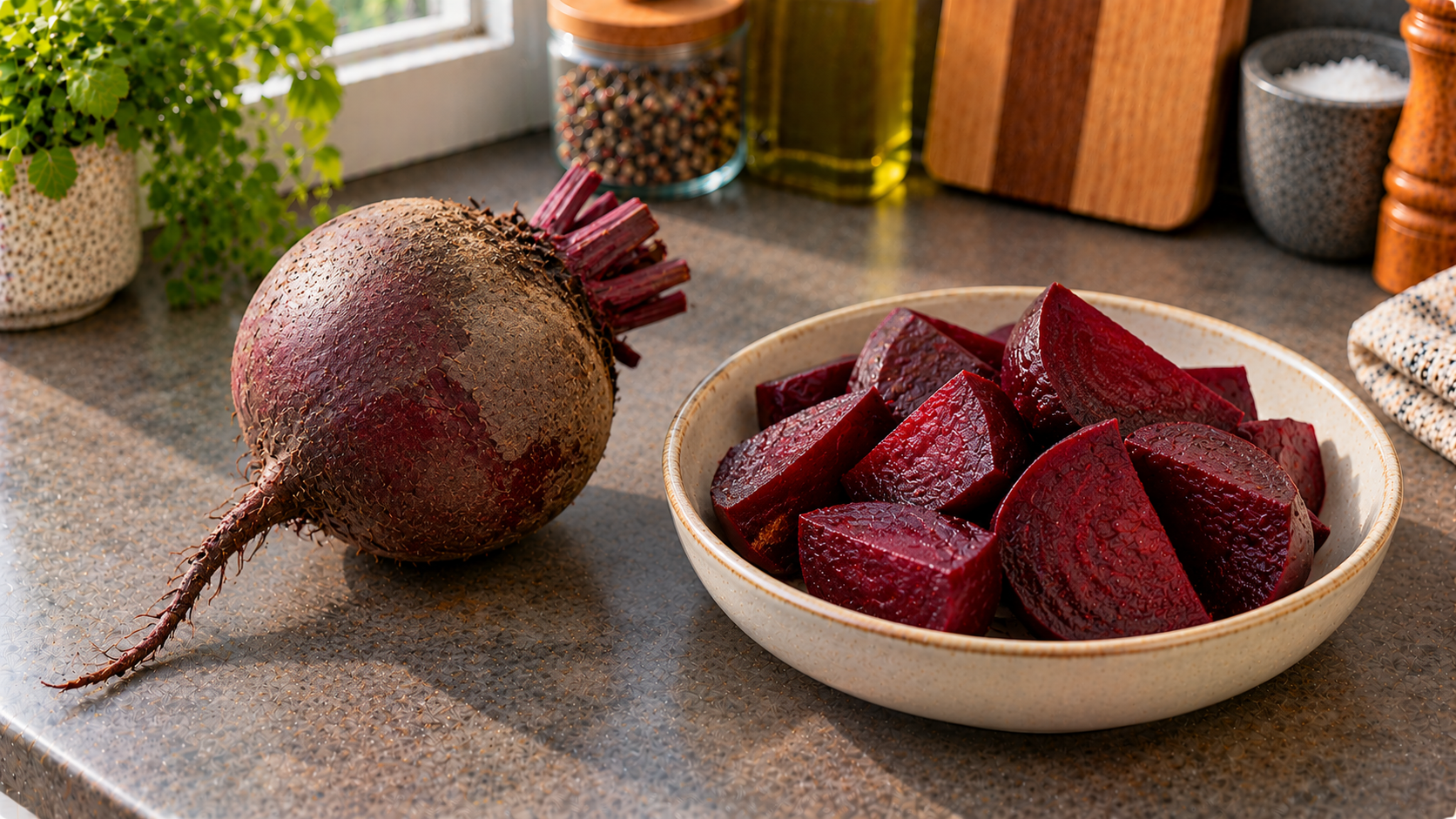
Beetroot contains approximately 43 calories per 100 g raw or 44 calories per 100 g boiled and drained, according to USDA FoodData Central. It provides carbohydrates, dietary fibre and folate while remaining relatively low in calories.
The amount in a real meal depends on the edible weight and preparation. Plain beetroot, roasted beetroot with oil, pickled beetroot and beetroot salad with dressing should not all be assigned the same calorie value.
Beetroot nutrition: raw versus boiled
The following values come from USDA SR Legacy entries for raw beetroot (FDC 169145) and boiled, drained beetroot (FDC 169146).
| Nutrient per 100 g | Raw beetroot | Boiled beetroot |
|---|---|---|
| Calories | 43 kcal | 44 kcal |
| Protein | 1.61 g | 1.68 g |
| Carbohydrates | 9.56 g | 9.96 g |
| Total sugars | 6.76 g | 7.96 g |
| Fibre | 2.8 g | 2.0 g |
| Fat | 0.17 g | 0.18 g |
Sources: USDA raw beetroot and USDA boiled beetroot.
These figures describe edible beet roots without added oil or sauce. The raw and boiled records represent different food states, not measurements demonstrating that cooking adds calories.
Differences in water content, cooking losses and food samples can affect per-100-g values.
Calories in common beetroot portions
The following calculations use the reference value of 44 kcal per 100 g boiled beetroot.
| Cooked edible portion | Calories | Protein | Fibre |
|---|---|---|---|
| 50 g | 22 kcal | 0.8 g | 1.0 g |
| 100 g | 44 kcal | 1.7 g | 2.0 g |
| 150 g | 66 kcal | 2.5 g | 3.0 g |
| 200 g | 88 kcal | 3.4 g | 4.0 g |
| 250 g | 110 kcal | 4.2 g | 5.0 g |
These are rounded calculations from USDA data, not individual laboratory measurements of each serving.
Calories = cooked edible weight in grams × 44 ÷ 100.
For example, 180 g boiled beetroot provides approximately 79 kcal before dressing or added fat.
For raw beetroot, use 43 kcal per 100 g instead.
How many calories are in one beet?
The calorie count of a whole beet depends on its size and how much remains after trimming and peeling.
A raw beet with 80 g of edible flesh contains approximately 34 kcal. A larger beet with 150 g edible flesh contains approximately 65 kcal.
These are weight-based examples, not universal small- and large-beet sizes.
For accurate food tracking, remove discarded parts, weigh the edible portion and match the weight to the appropriate raw or cooked entry.
Do not use the entire purchased weight when the leaves, roots, damaged pieces or peel will not be eaten.
Raw, boiled and roasted beetroot
Raw beetroot can be grated into salads or thinly sliced. Boiled beetroot is softer and is often used in salads, soups and side dishes.
A complete dish includes dressing, cheese and other ingredients, as illustrated by the roasted beetroot and feta salad recipe.
Roasting creates a different texture and may reduce water content. This can change the calories per 100 g finished food even if no additional calories are added to the original beetroot.
Oil is a separate issue.
For example, 200 g boiled beetroot contains approximately 88 kcal. If 10 g olive oil is added and consumed completely, the combined total is roughly 178 kcal.
That example illustrates an actual ingredient calculation. It is not an average nutrition value for all roasted beetroot.
Use the finished weight for cooked-food entries, and record any oil or other ingredients separately.
Pickled beetroot and packaged products
Pickled beetroot may contain vinegar, salt and sometimes added sugar.
Some products are relatively close to plain beetroot in calories, while sweetened products can be higher. The nutrition label is more useful than assuming every pickled product has 44 kcal per 100 g.
Check whether label values refer to the drained product or the full jar contents.
Ready-made beetroot salad may include oil, mayonnaise, nuts, cheese or other calorie-dense ingredients.
Beetroot juice should also be recorded separately: its composition and fibre content differ from the whole vegetable. The calories from a glass cannot automatically be estimated using the weight of fresh beetroot.
Carbohydrates, natural sugars and fibre
Raw beetroot contains approximately 9.56 g total carbohydrate and 6.76 g sugar per 100 g in the USDA reference entry.
The sugars are naturally present in the vegetable. This does not make plain beetroot equivalent to a drink or dessert containing added sugar.
Raw beetroot also provides about 2.8 g dietary fibre per 100 g. The boiled reference reports about 2.0 g.
Fibre contributes to digestive health and can help make meals satisfying, especially alongside other vegetables, protein and whole grains.
If you track carbohydrates, distinguish total carbohydrate from fibre and use the conventions appropriate to your nutrition database or food label.
Folate, potassium and dietary value
Beetroot contains folate and potassium. For example, the USDA raw-beetroot entry reports approximately 109 µg folate and 325 mg potassium per 100 g.
These nutrients contribute to normal physiological functions, but beetroot is not a substitute for an overall varied diet.
The vegetable also contains naturally occurring nitrates. Research on beetroot and exercise frequently uses beetroot juice or concentrated products with measured nitrate doses; results should not be assumed for an ordinary portion of cooked beetroot.
Beetroot has a modest protein content. A complete main meal should generally include another appropriate protein source.
Is beetroot useful for weight management?
Plain beetroot has a relatively low energy density and can contribute volume, colour and fibre to meals.
It does not cause weight loss by itself. The overall diet, portions and energy balance are more important.
A practical meal might combine beetroot, lentils, leafy vegetables and a measured amount of olive oil.
Count each ingredient instead of assigning the whole dish the calorie value of plain beetroot.
Practical answers for food tracking
Use 43 kcal per 100 g for the specified raw USDA entry, and 44 kcal per 100 g for the specified boiled entry.
For roasted, packaged, sweetened or pickled products, choose a matching entry or the manufacturer's label.
When cooking a recipe for several people, calculate the ingredients before cooking, then divide the finished recipe into actual portions.
Sources
- USDA FoodData Central — Beets, raw, FDC 169145.
- USDA FoodData Central — Beets, cooked, boiled, drained, FDC 169146.
Portion and recipe figures are calculated from these references. Actual nutrient values vary by preparation, product and edible weight.