
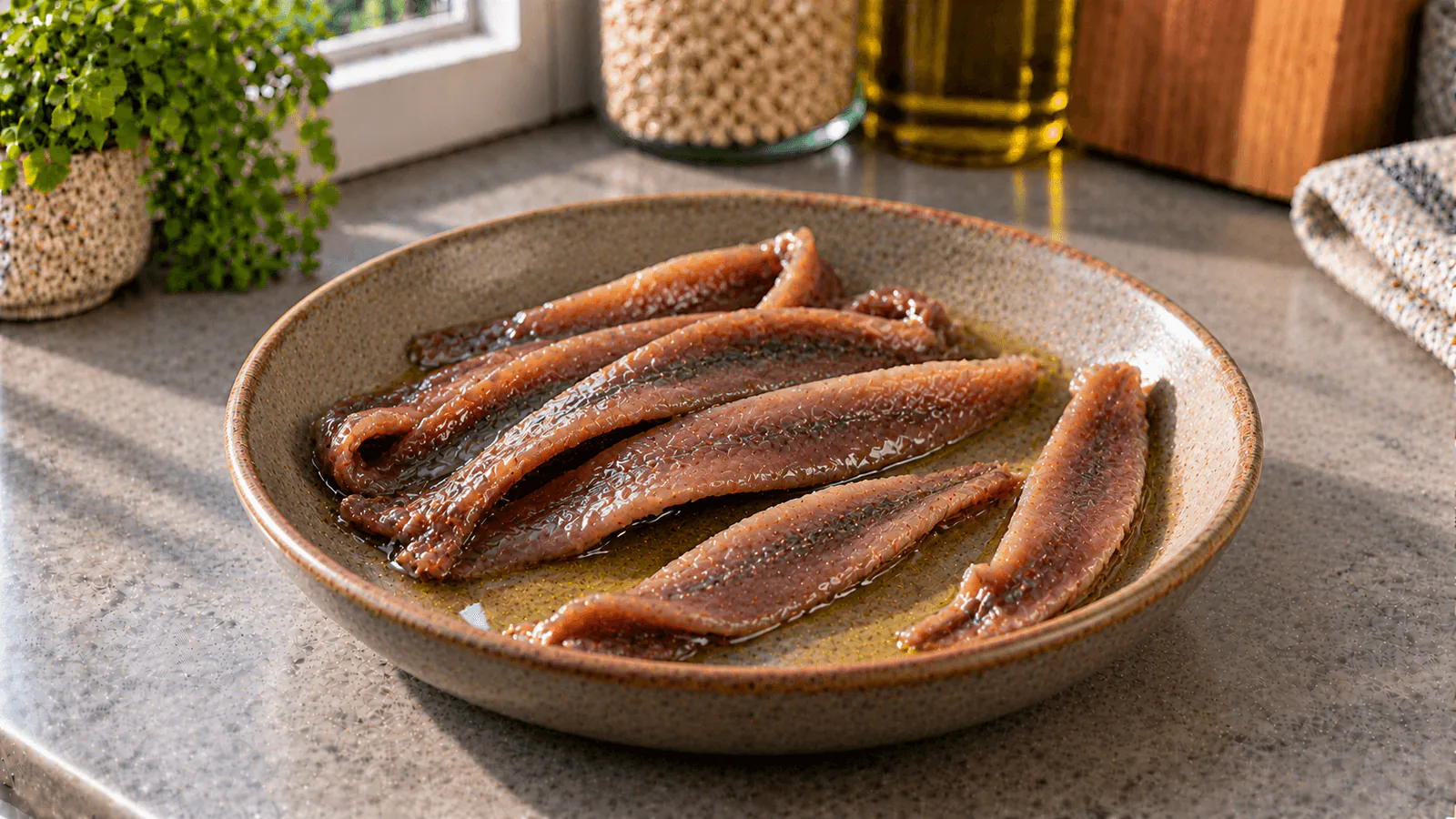
Anchovies are small fish, but their calories depend heavily on what you actually buy. Fresh European anchovies and the intensely salty fillets packed in oil are not nutritionally interchangeable. A few preserved fillets can make a sauce taste rich without adding many calories, while the sodium in the same small quantity deserves more attention than its energy. The useful starting point is to identify the product, record the edible weight, and use a nutrition entry for that exact preparation.
How many calories are in anchovies?
USDA FoodData Central lists 131 kcal per 100 g for raw European anchovy (Engraulis encrasicolus), compared with 210 kcal per 100 g for European anchovy canned in oil, drained solids. The second entry is for the fish after excess packing oil has been removed; it is not the calorie value of a jar including every drop of oil. Both values describe 100 g of edible food, not a fixed number of individual fish or fillets.
| USDA reference per 100 g | Calories | Protein | Fat | Sodium |
|---|---|---|---|---|
| European anchovy, raw | 131 kcal | 20.35 g | 4.84 g | 104 mg |
| European anchovy, canned in oil, drained | 210 kcal | 28.89 g | 9.71 g | 3668 mg |
Sources: USDA raw anchovy, FDC 174182 and USDA canned anchovy, FDC 174183. These SR Legacy entries describe two particular foods, not the complete range of cured anchovies, white vinegar-marinated anchovies, anchovy paste or branded products. They provide a transparent reference for calculations; the nutrition label on your own package takes precedence when it differs.
The larger number for the oil-packed fish does not mean that oil alone adds 79 kcal to every 100 g of anchovy. The product also has a different water content because of processing and curing, and its composition is reported per 100 g of the finished food. Protein rises from about 20 g to nearly 29 g per 100 g in these two specific database entries, partly because the products contain different proportions of water. That is why comparing equal weights is useful, but calling them identical servings is misleading.
Calories in 5, 10, 15, 20 and 30 g of anchovies
Preserved anchovies are commonly used by the fillet, not as a large fish dinner. Weights differ among brands and packing styles, so an individual fillet is not a reliable universal unit. A kitchen scale is more informative than an assumed fillet count. These values are calculated directly from the two USDA per-100-g references and rounded to the nearest whole calorie.
| Edible quantity | Fresh, raw (131 kcal/100 g) | Canned in oil, drained (210 kcal/100 g) |
|---|---|---|
| 5 g | 7 kcal | 11 kcal |
| 10 g | 13 kcal | 21 kcal |
| 15 g | 20 kcal | 32 kcal |
| 20 g | 26 kcal | 42 kcal |
| 30 g | 39 kcal | 63 kcal |
| 50 g | 66 kcal | 105 kcal |
| 85 g | 111 kcal | 179 kcal |
| 100 g | 131 kcal | 210 kcal |
For instance, 15 g of drained canned anchovies provide about 32 kcal. If the same recipe contains 5 g of added olive oil, that oil contributes approximately 45 kcal, bringing these two ingredients to roughly 77 kcal before adding pasta, vegetables or other components. This calculation counts the oil deliberately added and consumed; it does not automatically count all the liquid left in the original anchovy jar. If oil is left behind in a pan or bowl, the true amount eaten is less certain.
You may see an individual fillet described as weighing only a few grams, but there are thin, thick, whole and split fillets. A five-fillet topping could therefore represent quite different weights depending on the pack. For repeat recipes, drain the fish as you normally do, weigh one batch of fillets, and use that average for the same product next time. If your tracking app allows a custom food, save the nutrition label along with the exact drained serving.
Fresh, salt-cured, oil-packed and white anchovies are different products
Fresh anchovies are small silvery fish sometimes grilled, baked or fried whole. The 131 kcal/100 g raw reference applies to their edible portion before cooking. Heat can reduce their mass through water loss; added batter, flour and frying fat can also contribute energy. It is incorrect to weigh cooked fish and apply a raw-food value without considering that change. For a homemade meal, weighing the edible fish raw and recording separately any oil or coating is often the most reproducible option.
Salt-cured anchovies may be sold in tins or jars, with or without oil. Salt draws out water and strongly changes the flavour and sodium content. The USDA oil-packed drained entry is a useful example of a preserved anchovy but does not stand for every manufacturer or curing duration. Read the product label, particularly when the fish is packed in oil, sunflower oil, olive oil or a seasoned sauce. The edible drained weight and the entire jar's net weight are different measurements.
White anchovies in vinegar, often called boquerones, are commonly marinated with vinegar, herbs or oil rather than cured in the same way as brown anchovy fillets. Their declared calories and salt can be quite different. A sweet marinade may also add sugar. Some products use a label for the complete fish-and-liquid mixture; others refer to drained solids. Match your weighed serving to the label's definition instead of transferring the USDA figure automatically.
Anchovy paste, meanwhile, is a concentrated condiment. Its recipe may include anchovies, salt, oil, spices and occasionally other ingredients. A tablespoon of paste is not necessarily equal to a tablespoon of plain anchovy meat. Use the paste's own per-100-g values multiplied by the quantity squeezed from the tube. The same principle applies to prepared Caesar dressings, olive tapenade and sauces containing anchovies: count the complete recipe, not just the fish.
Sodium is the bigger difference in a small preserved serving
The raw European anchovy reference contains 104 mg sodium per 100 g. The canned-in-oil, drained USDA entry reports 3668 mg sodium per 100 g, approximately 9.17 g salt equivalent using the common calculation sodium × 2.5. This is a consequence of the preserved product described by that dataset, not a claim about all fresh seafood or every jar on a store shelf.
With this preserved reference, 10 g contains about 367 mg sodium, equivalent to approximately 0.92 g salt. A 15 g portion contains about 550 mg sodium, or around 1.38 g salt equivalent; 20 g contains about 734 mg sodium, corresponding to 1.84 g salt equivalent. That can be nutritionally relevant even though the 15 g serving has only 32 kcal. When a recipe contains anchovies, capers, olives or Parmesan, other salty ingredients can add to the meal's total.
In Germany and France, packaged food labels usually list salt in grams; American references frequently list sodium in milligrams. These are different ways of expressing related information, not two ingredients to add together. Our sodium-to-salt conversion guide shows how to compare the units. If you have been advised to limit sodium, rely on your specific product's label and your clinician's individual guidance rather than assuming that draining or rinsing achieves a precise reduction.
Do anchovies contain protein and omega-3 fats?
Yes. In the raw USDA entry, 100 g provides about 20.35 g protein, while 100 g of the preserved, drained entry supplies approximately 28.89 g. These numbers relate to the foods as weighed, not to an intrinsic change in protein quality. Because a normal anchovy topping may weigh just 10–20 g, its contribution to total daily protein is modest even though the per-100-g concentration looks high. For example, 20 g of the drained product contains roughly 5.8 g protein by proportional calculation.
Anchovies also provide marine omega-3 fatty acids and various minerals. The details vary with species, season and preservation; the mere presence of omega-3 does not turn a salted jar into a low-sodium food. If you want a larger serving of oily fish instead of a small seasoning, compare the practical portion sizes in our sardine calorie guide and mackerel nutrition guide. A 20 g anchovy pizza topping and a 150 g mackerel main course are serving different culinary purposes.
The FDA/EPA place anchovies among their “Best Choices” of fish regarding mercury. This does not mean mercury is completely absent, nor does it override advice about fish allergy, safe storage or high sodium in preserved fillets. The FDA fish guidance recommends variety and gives additional serving advice for pregnancy, breastfeeding and children. Prepared raw or marinated seafood also requires appropriate handling; being a lower-mercury fish does not make every uncooked preparation automatically safe for everyone.
How to log anchovies in pizza, pasta and salad
For pizza, first decide whether you are recording a prepared slice with a known nutrition label or building the recipe ingredient by ingredient. If it is a homemade pizza, include the dough, cheese, sauce, anchovies and any finishing oil separately. A 15 g serving of drained anchovies is about 32 kcal by this USDA reference; it does not account for mozzarella, a generous oil drizzle or extra olives. For takeaway pizza, the amount of fish cannot usually be inferred precisely from a photo.
In pasta, anchovies often melt into warm oil with garlic and tomatoes. That changes their appearance, not the energy of the quantity originally added. Use the amount placed in the pan and separately count the oil actually consumed. If you prepare four portions from 40 g of drained anchovies, the fish contributes about 84 kcal to the entire pan, or 21 kcal per equal portion, before other ingredients. Divide the full recipe by the actual portions served, not by an assumed number of individual fillets.
In a salad, the most important distinction may be the dressing. A few anchovy pieces mixed into lettuce and tomatoes contribute relatively few calories. A creamy bottled dressing can dominate the total, even if its label advertises anchovies. Record the full dressing amount. When choosing between preserved anchovies and another canned fish, our tuna calorie guide explains why water-packed, oil-packed and drained weights must not be combined indiscriminately.
For a simple food log, keep three pieces of information: the product description, the edible grams, and the nutrition values for the same state. Weigh the fish after draining if you select the drained USDA entry. Keep any separately eaten oil in the recipe. A raw anchovy reference is for fresh fish, not a shortcut for salt-cured fillets. Neither a low calorie count nor a high protein percentage compensates for missing information about salt and added fat.
Practical conclusion: fresh European anchovies contain about 131 kcal/100 g in USDA SR Legacy; preserved European anchovies canned in oil and drained contain 210 kcal/100 g in the corresponding entry. In a typical 15 g preserved topping, that is about 32 kcal, but also about 550 mg sodium based on the cited reference. Use the specific label where available. Underlying datasets: USDA raw European anchovies and USDA oil-packed drained anchovies.