
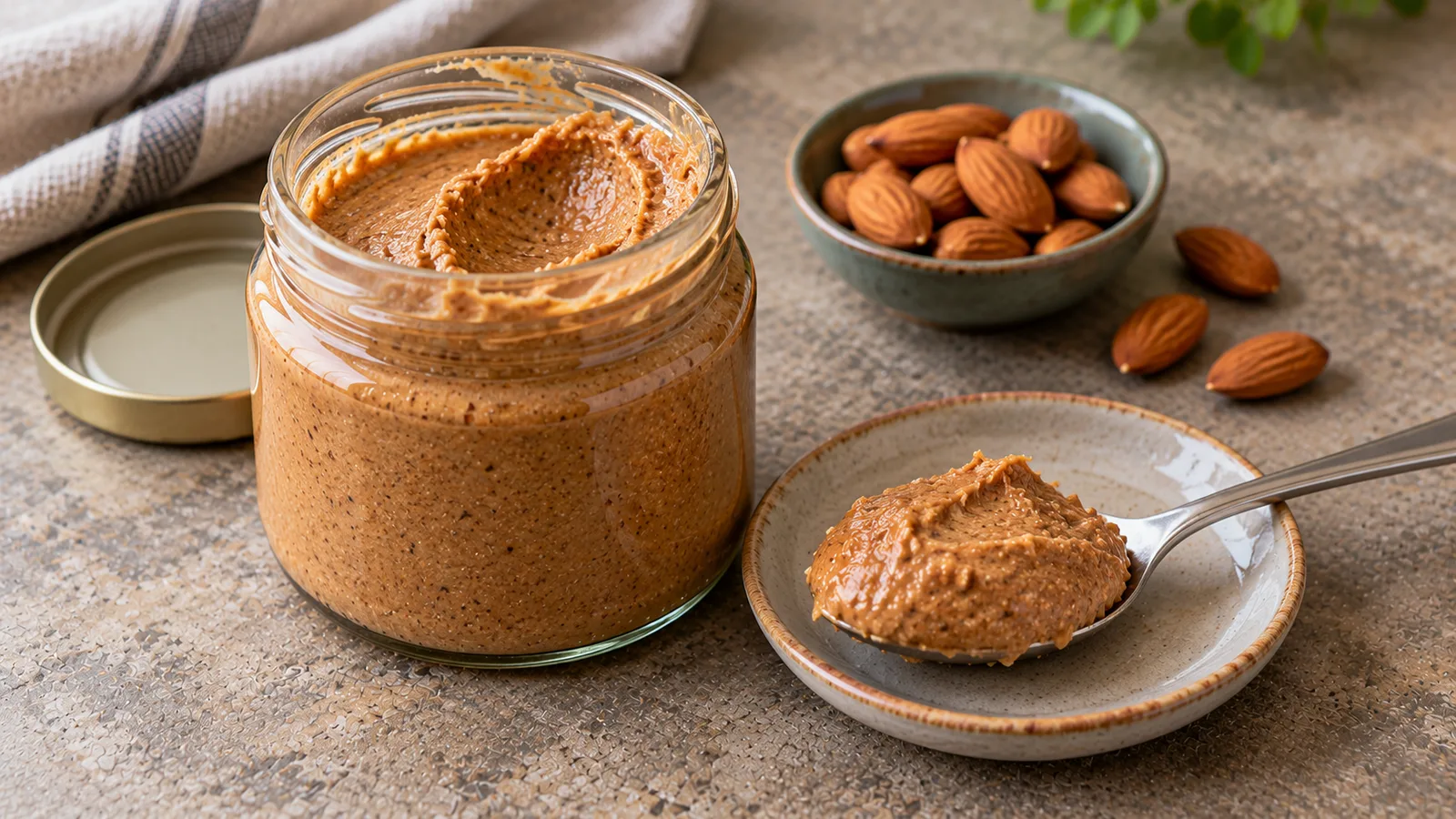
Almond butter calories at a glance
Plain almond butter without added salt contains 614 kcal per 100 g in the USDA SR Legacy reference (FDC 168588). A reference tablespoon weighing 16 g provides approximately 98 kcal. The number is not a universal promise for every spoon or every brand: the amount you scoop and the ingredient list both matter. This guide concentrates on almond butter itself, not dairy butter, almond flour, a whole almond serving, or a sandwich containing other ingredients. We use one clearly identified food record for the calculations, then explain when to replace it with a package label.
Portions and calories by weight
The simplest calculation is grams eaten × 614 ÷ 100. A kitchen scale lets you track a small spread with much less uncertainty than a rounded or heaped spoon. The figures below are rounded to the nearest whole kcal; calculation uses the unrounded 614 kcal per 100 g reference. A tablespoon is treated as 16 g only for the reference row. Spoon shape and technique may produce a very different actual serving.
| Weighed almond butter | kcal |
|---|---|
| 8 g | 49 kcal |
| 10 g | 61 kcal |
| 15 g | 92 kcal |
| 16 g | 98 kcal |
| 20 g | 123 kcal |
| 25 g | 154 kcal |
| 30 g | 184 kcal |
| 32 g | 196 kcal |
| 40 g | 246 kcal |
| 100 g | 614 kcal |
What a tablespoon really means
A tablespoon is a volume utensil, while this nutrition estimate needs a mass. In the USDA serving reference, 1 tablespoon = 16 g, giving 98.24 kcal, displayed as 98 kcal. If your light spread weighs 10 g, it contains about 61 kcal; a generous 25 g spoonful gives about 154 kcal. Two reference tablespoons total 32 g and 196 kcal. A spoonful straight from a jar may be dome-shaped, runny or packed; none is automatically 16 g. Weigh the spoon once for your own routine, or weigh the jar before and after use.
Nutrition: 100 g versus a 16 g serving
The reference food has about 21 g protein, 55.5 g fat, 18.8 g carbohydrate by difference and 10.3 g dietary fibre per 100 g. At 16 g, those amounts become approximately 3.4 g protein, 8.9 g fat, 3.0 g carbohydrate by difference and 1.6 g fibre. The USDA carbohydrate-by-difference figure includes fibre; carbohydrate on a European nutrition label is generally shown separately from fibre. Do not compare those carbohydrate numbers directly as if they used the same definition. The fat content largely explains why a thin spread contributes noticeable energy.
Choosing a comparable supermarket product
Check the ingredient list before using the reference. A jar marked 100% almonds is often the closest practical match, although varieties and roasting can still change the label. Salted almond butter may be similarly energy-dense but has a different sodium profile. Versions with sugar, added oil, cocoa, honey or other ingredients need their own values, copied from the actual package. Smooth and crunchy textures do not provide a reliable calorie rule on their own. If a label specifies 630 kcal per 100 g, a 20 g spread contains 126 kcal, not the 123 kcal calculated from the reference. Do not average a labelled product with the USDA example.
Three everyday calculations
For toast topped with 20 g almond butter, calculate 20 × 614 ÷ 100 = 122.8 kcal, about 123 kcal from the spread alone; add the bread separately. For porridge with 15 g stirred in, the butter contributes 92.1 kcal, around 92 kcal, before oats, milk or fruit. For a snack of 30 g eaten from the jar, the almond butter alone adds 184.2 kcal, around 184 kcal. If you pour a 200 g jar into a recipe, its reference contribution is 1,228 kcal. Divide by the number of actual portions only after including the rest of the recipe and any losses.
How to log the spread accurately
For a quick entry, search for almond butter without added ingredients, enter the actual weight in grams, and check whether the app expects raw ingredients or a prepared food. If you spread butter on two slices, record the total grams applied, not two automatic tablespoons. One straightforward method is to place an empty bowl on the scale, tare, add the portion and read the weight. Another is to weigh the jar before and after spreading and record the difference. Scraping the spoon into a hot dish does not remove its calories. If some paste remains on the utensil, the amount truly eaten may be smaller than the amount originally scooped.
Does homemade almond butter change the number?
Grinding plain almonds into a paste changes their form but does not remove the energy of the nuts. The final calories depend on which almonds you used, whether you roasted them, any water loss and whether you added oil, sugar or other ingredients. For a home batch, total the calories of weighed ingredients, measure the finished batch weight and calculate per 100 g. A hypothetical batch made with 300 g of a labelled ingredient at 600 kcal per 100 g begins with 1,800 kcal from that ingredient; if the final edible batch weighs 290 g, its calculated density is about 621 kcal per 100 g, before additions. These are illustrative recipe numbers, not another USDA entry.
Almond butter, peanut butter and dairy butter are different foods
Almond butter means ground almonds, not the dairy product usually called butter. Peanut butter is ground peanuts and can have different nutrition and ingredients. Almond flour is dried ground almond material, sometimes defatted; it should not inherit the same entry. Do not insert a generic nut-butter value into several unrelated products. A comparison of brands should use the same 100 g basis and then the weight you truly eat. When the purpose is choosing a meal rather than looking up this ingredient, consider the rest of the plate as well.
For related but distinct questions, see peanut butter calories · almond flour calories · dairy butter calories.
Practical label checks and storage
Use the jar's energy per 100 g as the first number, then note whether its stated tablespoon is 15 g, 16 g or another weight. Calories expressed per serving can be rounded differently from the 100 g figure. If oil has separated, stir thoroughly according to the package directions before portioning; taking mostly surface oil first makes a spoonful unrepresentative. Almond butter contains tree nuts and is unsuitable for someone allergic to almonds. Follow the producer's storage directions and use-by or best-before information rather than guessing one storage life for every jar. Store-brand price or origin is not a calorie measurement.
Sources
The primary food-composition reference is USDA FoodData Central, almond butter, plain without salt, SR Legacy FDC 168588. The record summary with the FDC number reproduces the 614 kcal, 21 g protein, 55.5 g fat, 18.8 g carbohydrate-by-difference and 10.3 g fibre reference. Individual product labels take precedence for a specific commercial jar. All spoon and recipe figures here are calculations from stated weights, not measurements of every brand.