
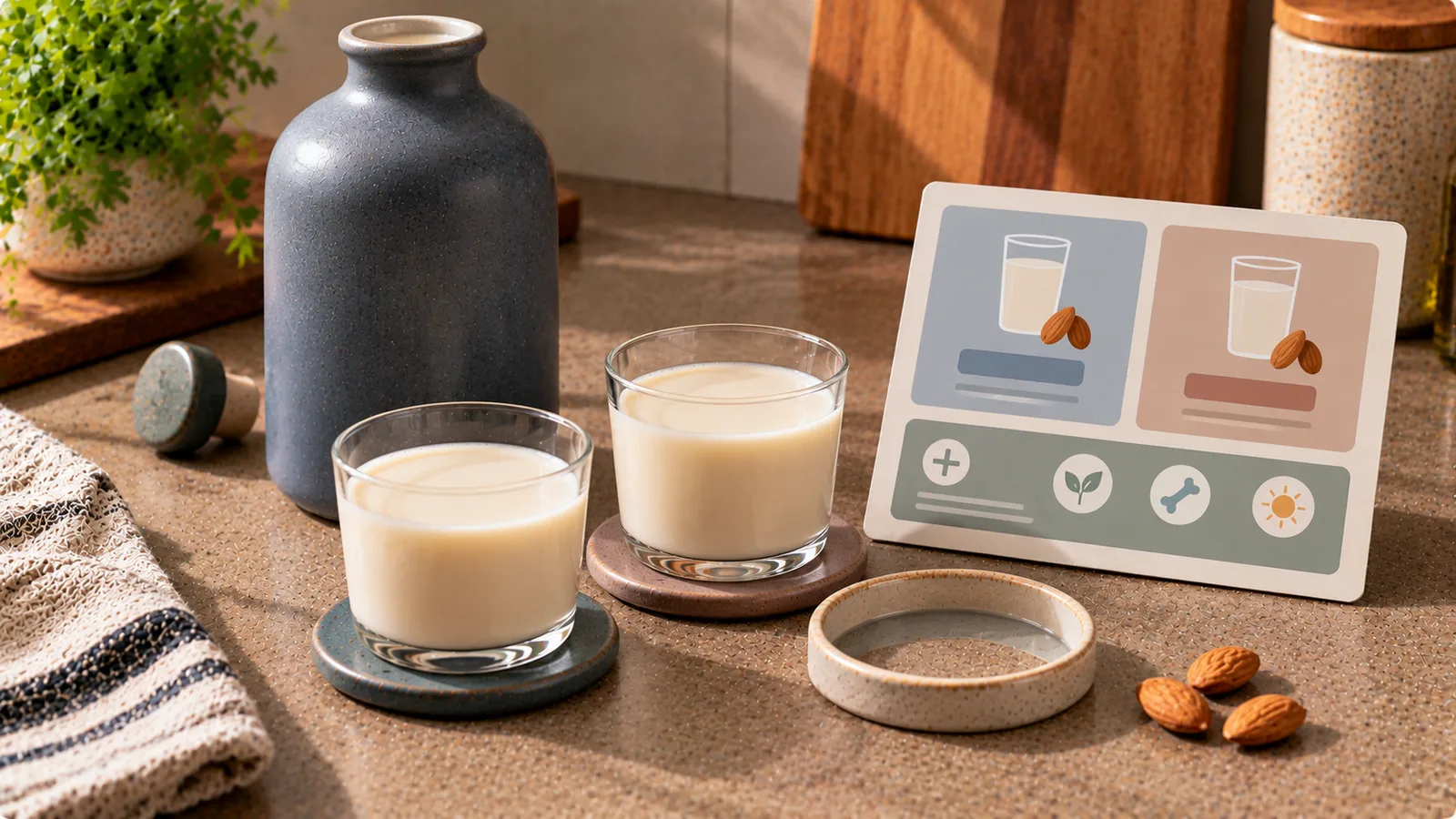
Almond milk can be relatively low in calories, particularly when it is unsweetened, but the exact number varies considerably between products.
Added sugar, almond concentration, added oils and flavorings can all change the nutrition profile.
For an unsweetened almond drink, a practical representative range is approximately:
13–30 kcal per 100 ml
That means a 250 ml glass may contain roughly:
33–75 kcal
Some products fall outside this range, so the package label remains the best source for a specific product.
Almond milk calories at a glance
A useful general comparison is:
| Type | Approximate calories per 100 ml | Approximate calories per 250 ml |
|---|---|---|
| Unsweetened almond milk | 13–30 kcal | 33–75 kcal |
| Sweetened almond milk | 30–50 kcal | 75–125 kcal |
| Flavored almond milk | 35–60+ kcal | 88–150+ kcal |
| Barista-style almond drink | 30–60+ kcal | 75–150+ kcal |
These are broad ranges rather than fixed values.
Always use the nutrition label when tracking a specific brand.
How many calories are in unsweetened almond milk?
Unsweetened almond milk is usually the lowest-calorie version.
Many commercial products provide around:
13–30 kcal per 100 ml
For example, if your carton lists:
15 kcal per 100 ml
then:
- 100 ml = 15 kcal;
- 200 ml = 30 kcal;
- 250 ml = 38 kcal;
- 300 ml = 45 kcal;
- 500 ml = 75 kcal.
The calculation is:
calories per 100 ml × amount consumed ÷ 100
For 250 ml:
15 × 250 ÷ 100 = 37.5 kcal
which can be rounded to approximately 38 kcal.
Calories in a glass of almond milk
There is no universal glass size.
A small glass may contain 150–200 ml, while a larger glass can hold 300 ml or more.
Using an almond drink with 20 kcal per 100 ml:
| Amount | Calories |
|---|---|
| 100 ml | 20 kcal |
| 150 ml | 30 kcal |
| 200 ml | 40 kcal |
| 250 ml | 50 kcal |
| 300 ml | 60 kcal |
| 400 ml | 80 kcal |
| 500 ml | 100 kcal |
For accurate tracking, measuring the volume is more reliable than entering a generic "glass."
Why is almond milk often low in calories?
Commercial almond milk is usually not equivalent to eating a large quantity of whole almonds in liquid form.
Many products contain a substantial proportion of water and a relatively modest amount of almonds.
Whole almonds are energy-dense because they contain significant fat.
When a drink contains only a small amount of almond material diluted with water, the resulting beverage can contain far fewer calories per 100 ml.
This is why comparing almond milk directly with the calories in whole almonds can be misleading.
Typical macros in unsweetened almond milk
The exact composition depends on the product, but an unsweetened almond drink may provide approximately per 100 ml:
- 0.4–1.0 g protein;
- 0–1.5 g carbohydrate;
- 1.0–2.0 g fat;
- 13–30 kcal.
Some products contain more almonds and therefore more fat, protein and calories.
Others are more diluted.
Almond milk is usually not a high-protein drink
One important nutritional difference between almond milk and dairy milk or soy milk is protein.
Many almond drinks contain less than:
1 g protein per 100 ml
A 250 ml glass may therefore provide only around:
1–2.5 g protein
depending on the product.
By comparison, dairy milk and many soy drinks usually provide substantially more protein.
This does not make almond milk inherently better or worse; it simply means the drinks are not nutritionally interchangeable.
Unsweetened vs sweetened almond milk
The word "unsweetened" matters.
Unsweetened products generally contain little or no added sugar.
Sweetened almond drinks may contain added sugar, syrups or other carbohydrate sources.
Suppose:
Unsweetened version:
15 kcal per 100 ml
Sweetened version:
40 kcal per 100 ml
For a 250 ml serving:
Unsweetened:
15 × 2.5 = 37.5 kcal
Sweetened:
40 × 2.5 = 100 kcal
The difference is:
about 62 kcal per glass
If several servings are consumed during the day, that difference becomes more significant.
Flavored almond milk
Vanilla, chocolate and other flavored almond drinks can have very different calorie values.
Flavor itself does not necessarily add many calories, but flavored products are often sweetened.
Chocolate almond milk, for example, may contain:
- added sugar;
- cocoa;
- stabilizers;
- flavorings.
Check both:
calories per 100 ml
and:
sugars per 100 ml
rather than assuming every almond drink has the same nutritional profile.
Barista almond drinks
Barista-style almond drinks are formulated to foam and behave better in coffee.
To improve texture and stability, manufacturers may use:
- more fat;
- added vegetable oil;
- different almond concentrations;
- stabilizers or emulsifiers.
As a result, barista versions can contain more calories than a basic unsweetened almond drink.
For example:
Standard unsweetened almond milk:
15 kcal per 100 ml
Barista almond drink:
45 kcal per 100 ml
A 300 ml latte using mostly almond drink could therefore contain approximately:
135 kcal from the almond drink alone
before sugar, syrup or other additions.
Almond milk in coffee
A small splash contributes relatively few calories.
If almond milk contains 20 kcal per 100 ml:
- 20 ml = 4 kcal;
- 30 ml = 6 kcal;
- 50 ml = 10 kcal;
- 100 ml = 20 kcal.
But a latte or large milk-based coffee can use 200–350 ml.
That makes the exact product more important.
A 300 ml drink made with almond milk at 15 kcal per 100 ml contributes about:
45 kcal
The same volume at 45 kcal per 100 ml contributes:
135 kcal
before any sweeteners.
Added sugar can change the total quickly
Sugar provides approximately:
4 kcal per gram
If a sweetened almond drink contains 5 g more sugar per 100 ml than an unsweetened version, that difference represents approximately:
20 kcal per 100 ml
Across 250 ml:
12.5 g additional sugar
corresponds to approximately:
50 kcal
This helps explain why sweetened versions can differ substantially from unsweetened ones.
Added oil also matters
Some almond drinks include vegetable oil to improve texture.
Fat provides approximately:
9 kcal per gram
Even a small increase in fat can therefore affect the calorie value.
If one product contains 1 g fat per 100 ml and another contains 3 g, part of the calorie difference may come from the additional fat rather than sugar.
The nutrition label shows the combined result.
Fortified almond milk
Many commercial almond drinks are fortified with nutrients such as:
- calcium;
- vitamin D;
- vitamin B12;
- vitamin E.
Fortification can make the micronutrient profile very different from the amount naturally present in almonds.
The presence of added vitamins or minerals usually has little effect on calories.
However, fortification levels vary between products and countries.
Check the label rather than assuming every almond drink contains the same nutrients.
Shake the carton when instructed
Some fortified nutrients can settle during storage.
If the package says to shake well before use, following that instruction can help redistribute the contents.
This is especially relevant when using a fortified plant drink regularly.
Almond milk vs dairy milk
The calorie comparison depends on the type of dairy milk.
As a broad illustration per 100 ml:
| Drink | Approximate calories |
|---|---|
| Unsweetened almond milk | 13–30 kcal |
| Low-fat dairy milk | 40–50 kcal |
| Whole dairy milk | 60–70 kcal |
However, calories are only one difference.
Dairy milk generally contains considerably more protein than most almond drinks.
The micronutrient profiles also differ unless the almond drink is fortified.
Almond milk vs soy milk
Unsweetened soy milk commonly contains more calories than very low-calorie almond milk, but it also usually provides substantially more protein.
A broad comparison per 100 ml might look like:
| Drink | Calories | Protein |
|---|---|---|
| Unsweetened almond milk | 13–30 kcal | ~0.4–1 g |
| Unsweetened soy milk | ~30–45 kcal | ~3–4 g |
Actual values vary by brand.
The appropriate choice depends on what you want from the drink rather than calories alone.
Almond milk vs oat milk
Oat milk often contains more carbohydrate and calories than unsweetened almond milk.
A typical oat drink may provide roughly:
40–60 kcal per 100 ml
although products vary widely.
Unsweetened almond drinks can be considerably lower.
Again, oat and almond drinks differ in texture, carbohydrate, protein and formulation, so calorie content is only one comparison point.
Does homemade almond milk have the same calories?
Not necessarily.
Homemade almond milk can vary dramatically because the almond-to-water ratio is not standardized.
A recipe made with:
50 g almonds per liter
will differ from one made with:
150 g almonds per liter
Straining also removes some almond solids.
Without measuring ingredients and estimating how much material remains in the final drink, it is difficult to assign one reliable calorie value to homemade almond milk.
A commercial label value should not automatically be applied to a concentrated homemade recipe.
Does straining reduce calories?
When homemade almond milk is strained, some almond solids remain in the pulp.
Those solids contain:
- fat;
- protein;
- carbohydrate;
- fiber.
Therefore, not all of the calories from the starting almonds necessarily end up in the liquid.
The exact proportion is difficult to know without laboratory analysis or a carefully controlled recipe.
For practical tracking, a consistent recipe estimate is usually more useful than assuming all almond calories transfer into the drink.
Almond percentage can help explain differences
Some packages state the percentage of almonds used.
A product with a higher almond percentage may contain more almond-derived fat and protein, although formulation still matters.
Two products with the same almond percentage can still differ because one may contain added sugar or oil.
Use almond percentage as context, not as a substitute for the nutrition table.
Calories in almond milk on cereal
If you pour 150 ml of unsweetened almond milk containing 20 kcal per 100 ml over cereal:
20 × 1.5 = 30 kcal
If you use 250 ml:
20 × 2.5 = 50 kcal
The cereal itself will usually contribute far more calories than the almond milk, but both should be included when tracking the complete meal.
Almond milk in oatmeal
Suppose oatmeal is prepared with:
250 ml almond milk
at:
18 kcal per 100 ml
The almond milk contributes:
18 × 2.5 = 45 kcal
If you also add oats, nuts, fruit or nut butter, those ingredients should be calculated separately.
Almond milk in smoothies
Smoothies can use substantial amounts of liquid.
For 300 ml almond milk:
At 15 kcal per 100 ml:
45 kcal
At 40 kcal per 100 ml:
120 kcal
This is another reason to check whether the product is unsweetened or sweetened.
Fruit, nut butter, oats and protein powder often contribute much more energy than the liquid, but the drink base still matters.
Almond milk in cooking
Almond milk can be used in:
- sauces;
- soups;
- pancakes;
- baking;
- porridge.
When the entire amount is consumed in the final dish, count the amount originally added.
For example, a sauce made with:
400 ml almond milk at 20 kcal per 100 ml
contains:
80 kcal from the almond milk
in the complete recipe.
If the sauce makes four equal servings:
80 ÷ 4 = 20 kcal
from almond milk per serving.
Heating does not create calories
Heating almond milk may evaporate some water.
This can make the remaining liquid more concentrated by weight, but it does not create additional calories.
If 500 ml of almond milk contains 100 kcal before heating, the total remains approximately 100 kcal after some water evaporates, assuming none of the milk is discarded.
The calories per 100 g of the reduced liquid can increase because the final weight is lower.
Milliliters vs grams
Nutrition labels for almond milk commonly provide values per:
100 ml
rather than per 100 g.
For ordinary household tracking, using the labeled volume is usually simplest.
If you weigh almond milk in grams, its density is close enough to water that grams and milliliters may be similar for rough estimates, but they are not formally identical.
For the most accurate calculation, use the unit printed on the package.
Calories in 1 cup of almond milk
Cup size depends on the measurement system.
A US cup is approximately:
240 ml
If almond milk contains 20 kcal per 100 ml:
20 × 2.4 = 48 kcal
So one US cup would contain approximately:
48 kcal
At 15 kcal per 100 ml:
15 × 2.4 = 36 kcal
At 40 kcal per 100 ml:
40 × 2.4 = 96 kcal
The product itself matters more than the word "cup."
What if the package lists calories per serving?
Suppose the label states:
30 kcal per 200 ml
You drink 300 ml.
First calculate the multiplier:
300 ÷ 200 = 1.5
Then:
30 × 1.5 = 45 kcal
This method works for any labeled serving size.
How to calculate calories from the label
If the carton gives:
22 kcal per 100 ml
and you use:
180 ml
calculate:
22 × 180 ÷ 100 = 39.6 kcal
So the portion contains approximately:
40 kcal
For 350 ml:
22 × 350 ÷ 100 = 77 kcal
Using the exact package value is more reliable than selecting a generic almond milk entry when brands differ significantly.
Why database entries may disagree
Food-tracking databases may contain multiple almond milk entries with values such as:
- 13 kcal per 100 ml;
- 20 kcal per 100 ml;
- 35 kcal per 100 ml;
- 50 kcal per 100 ml.
These entries may all be valid for different products.
Before selecting one, check:
- sweetened or unsweetened;
- flavor;
- barista or standard;
- calories per 100 ml;
- fat;
- carbohydrate;
- protein.
Matching the actual carton is more important than finding a universal value.
Does "no added sugar" mean zero calories?
No.
An almond drink with no added sugar can still contain calories from:
- almonds;
- fat;
- naturally present carbohydrate;
- added oil.
"No added sugar" describes sugar addition, not total energy.
Likewise, "unsweetened" does not mean calorie-free.
Is almond milk calorie-free?
No.
Even very low-calorie almond drinks contain some energy.
A product with 13 kcal per 100 ml provides:
32.5 kcal in 250 ml
and:
65 kcal in 500 ml
Small amounts may contribute little to a day's total, but the drink is not literally free of calories.
How to log almond milk accurately
A simple tracking process is:
- identify the exact almond drink;
- check whether it is unsweetened, sweetened, flavored or barista-style;
- read calories per 100 ml or per labeled serving;
- measure the amount used;
- calculate the calories for that amount;
- include syrups, sugar or other additions separately.
For coffee, cereal and recipes, logging the actual milliliters is usually more reliable than choosing a generic serving.
Practical reference
For a typical unsweetened commercial almond drink, remembering:
about 13–30 kcal per 100 ml
is a useful starting range.
But almond milk is a category rather than one standardized food.
A sweetened, flavored or barista product can contain two, three or even more times the calories of a very low-calorie unsweetened version.
For accurate tracking, the carton in your refrigerator is more useful than a universal almond milk number.
Nutrition data sources and product differences
The records below describe only the named foods, fat levels and preparation states. USDA figures are per 100 g; manufacturer figures retain their stated unit. These sources do not independently prove every approximate figure in the article.
The 13–30 kcal per 100 ml range is an illustrative guide for unsweetened almond drinks, not a guaranteed range for every product. Alpro organic unsweetened almond drink is labeled 29 kcal per 100 ml.
USDA FoodData Central (search by FDC ID):
- FDC 2257045 — Almond milk, unsweetened, plain, refrigerated (19.33 kcal/100 g)
- FDC 1999631 — Almond milk, unsweetened, plain, shelf stable (14.56 kcal/100 g)
Examples from manufacturer labels (product-specific, checked 16 October 2026):
- Alpro Bio Mandeldrink ohne Zucker — 29 kcal/100 ml.