
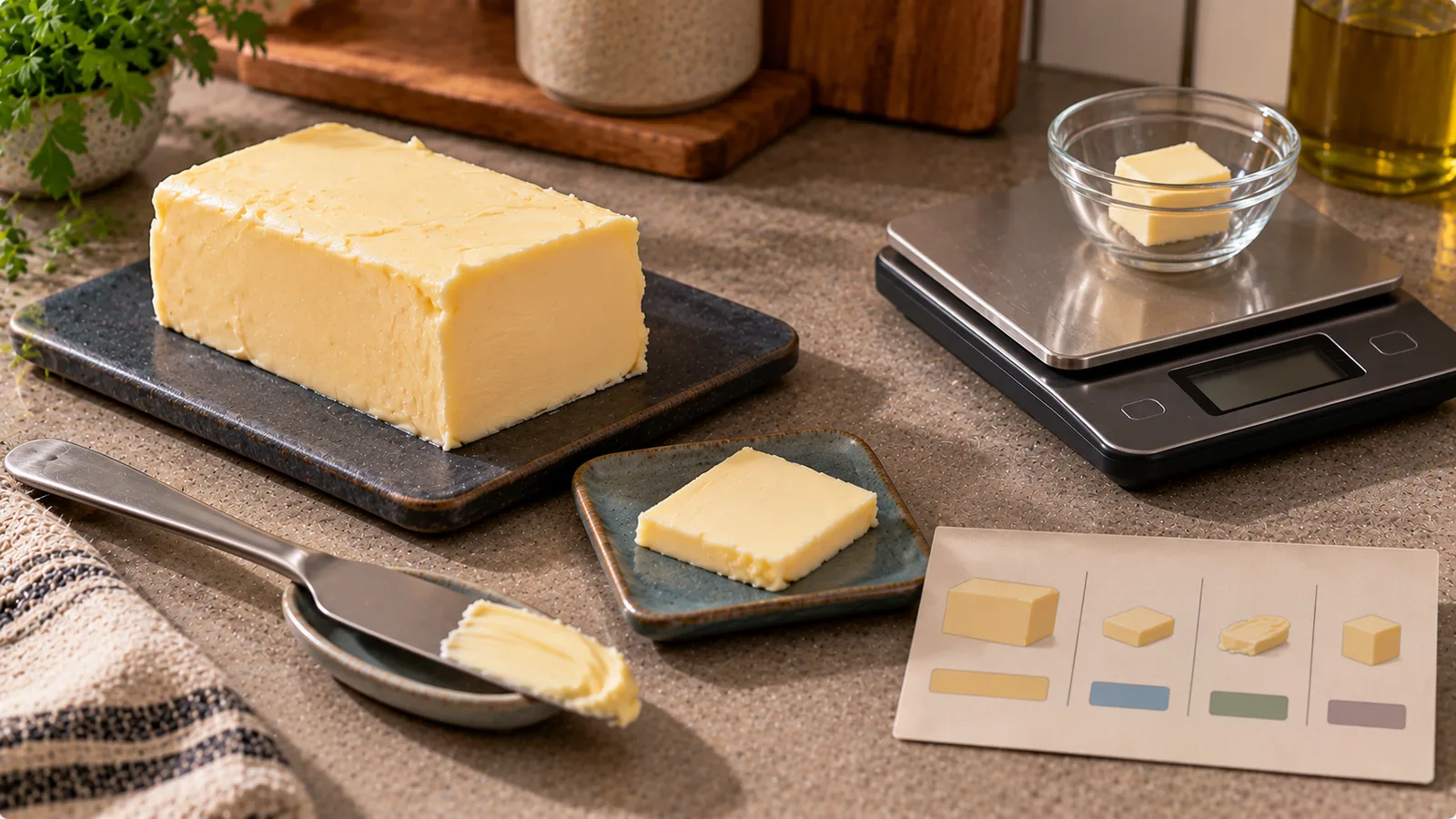
Butter is an energy-dense food because most of its calories come from fat.
A typical butter contains roughly 710–750 kcal per 100 g, although the exact value depends on the product, its fat percentage, water content and whether other ingredients have been added.
For everyday tracking, the amount you use usually matters more than small differences between brands.
How many calories are in butter?
A useful representative value for regular butter is about:
720 kcal per 100 g
Using that value, common portions provide approximately:
| Butter amount | Approximate calories |
|---|---|
| 5 g | 36 kcal |
| 10 g | 72 kcal |
| 15 g | 108 kcal |
| 20 g | 144 kcal |
| 25 g | 180 kcal |
| 30 g | 216 kcal |
| 50 g | 360 kcal |
| 100 g | 720 kcal |
These are estimates. Use the nutrition label of your butter when you need the most accurate value.
Calories in 10 g of butter
If butter contains 720 kcal per 100 g:
720 × 10 ÷ 100 = 72 kcal
So a 10 g portion contains about:
72 kcal
Ten grams is a relatively small amount visually, but because butter is mostly fat, it still contributes a noticeable amount of energy.
Calories in 5 g of butter
Using the same example:
720 × 5 ÷ 100 = 36 kcal
Five grams of butter therefore provides about:
36 kcal
This can be close to a thin amount spread over one slice of bread, although actual spreading amounts vary considerably.
Calories in 20 g of butter
Calculation:
720 × 20 ÷ 100 = 144 kcal
So 20 g provides approximately:
144 kcal
This amount may be reached easily when butter is used both for cooking and as a spread.
Calories in a tablespoon of butter
Tablespoon weights are not perfectly consistent.
A commonly used reference for one tablespoon of butter is around 14 g.
At 720 kcal per 100 g:
720 × 14 ÷ 100 = 100.8 kcal
That is approximately:
101 kcal per 14 g tablespoon
Depending on how the tablespoon is measured and the exact butter, the real amount can differ.
For food tracking, weighing butter in grams is more reliable than estimating it with a spoon.
Calories in a teaspoon of butter
A teaspoon of butter is often estimated at around 5 g.
At 720 kcal per 100 g:
720 × 5 ÷ 100 = 36 kcal
So one 5 g teaspoon contains approximately:
36 kcal
Again, a rounded or heavily filled teaspoon can weigh more.
Nutrition in butter per 100 g
The exact nutrition depends on the product, but regular butter is typically dominated by fat.
A representative 100 g portion may contain approximately:
| Nutrient | Typical amount |
|---|---|
| Energy | 710–750 kcal |
| Fat | 80–83 g |
| Saturated fat | about 50–55 g |
| Carbohydrate | usually under 1 g |
| Sugars | usually under 1 g |
| Protein | usually under 1 g |
Butter also naturally contains fat-soluble nutrients, but its main nutritional contribution in ordinary portions is dietary fat and energy.
Always use the package label for the exact product.
Why butter contains so many calories
Fat provides approximately:
9 kcal per gram
Protein and carbohydrate each provide approximately:
4 kcal per gram
Because butter is usually around 80% or more fat, its energy density is high.
For example, if a butter contains 82 g fat per 100 g, fat alone accounts for roughly:
82 × 9 = 738 kcal
The final declared energy value can differ slightly because food-label calculations use the complete composition and applicable calculation rules.
Butter is not 100% fat
Butter is highly concentrated in fat, but regular butter is not pure fat.
It also contains water and small amounts of milk solids.
This is one reason why butter can contain fewer calories per 100 g than a cooking oil that is essentially 100% fat.
A typical oil may provide close to 900 kcal per 100 g, while butter is commonly closer to the low-to-mid 700s.
Salted versus unsalted butter calories
Salted and unsalted butter usually have similar calorie values when their fat contents are similar.
Salt adds essentially no calories.
The more meaningful nutritional difference is sodium or salt content.
For example, two products might both contain around 720 kcal per 100 g even though one is salted and the other is unsalted.
Check the package rather than assuming a meaningful calorie difference.
Butter versus spreadable butter
A product sold as spreadable butter may not have the same composition as traditional butter.
Some spreadable products combine butter with:
- vegetable oil;
- additional water;
- other ingredients.
As a result, calorie density can be higher or lower depending on the formulation.
Do not automatically use the nutrition value for ordinary butter when logging a butter spread.
Use the exact label.
Butter versus reduced-fat spread
Reduced-fat spreads can contain substantially more water and less fat than butter.
For example:
Regular butter:
720 kcal per 100 g
Reduced-fat spread:
400 kcal per 100 g
A 10 g serving would provide:
Regular butter:
72 kcal
Reduced-fat spread:
40 kcal
The exact difference depends on the products being compared.
A product that looks and is used like butter is not necessarily nutritionally equivalent to butter.
Portion size makes a large difference
Because butter is energy-dense, small differences in portion weight can noticeably change calories.
At 720 kcal per 100 g:
5 g = 36 kcal
10 g = 72 kcal
15 g = 108 kcal
20 g = 144 kcal
The difference between 5 g and 20 g is only 15 g of food, but it represents:
108 kcal
This is why estimating butter by sight can produce larger tracking errors than estimating the same weight difference in a low-calorie vegetable.
How much butter is actually on bread?
There is no universal amount.
A very thin spread might use around 5 g.
A more generous spread might use 10 g or more.
If your butter contains 720 kcal per 100 g:
5 g = 36 kcal
8 g = 58 kcal
10 g = 72 kcal
15 g = 108 kcal
If you regularly track food, weighing the butter once or twice can help you learn what your normal portion looks like.
You do not necessarily need to weigh it forever.
Example: butter on two slices of bread
Suppose you use 8 g of butter on each slice.
Total butter:
8 + 8 = 16 g
Calories:
720 × 16 ÷ 100 = 115.2 kcal
The butter contributes approximately:
115 kcal
The bread calories would be added separately.
How to calculate calories for any butter portion
Use:
Calories = calories per 100 g × portion in grams ÷ 100
For example, the label says:
744 kcal per 100 g
You use:
12 g
Calculation:
744 × 12 ÷ 100 = 89.28 kcal
Your portion contains about:
89 kcal
This method is more accurate than relying on a generic butter entry.
Butter used for frying
Butter added to a frying pan can be easy to overlook because it becomes part of the cooking process rather than remaining visible as a separate ingredient.
Suppose you add 15 g of butter.
At 720 kcal per 100 g:
720 × 15 ÷ 100 = 108 kcal
If the entire amount is effectively incorporated into the meal, those calories belong to the recipe.
However, not every gram of cooking fat necessarily ends up in the food. Some can remain in the pan or cooking vessel.
For ordinary home tracking, false precision is rarely useful.
A practical approach is to record the amount added unless you have a reliable reason to use another estimate.
Example: scrambled eggs cooked in butter
Suppose you cook eggs using 10 g of butter.
Butter:
72 kcal
If the eggs themselves provide 210 kcal, the combined total before any other ingredients is:
210 + 72 = 282 kcal
Ignoring the butter would underestimate the meal by about 72 kcal in this example.
Butter in mashed potatoes
Butter can contribute significantly to the energy content of a large homemade recipe.
Suppose a pot of mashed potatoes contains:
- 1,000 g potatoes;
- 50 g butter;
- other ingredients.
If the butter contains 720 kcal per 100 g:
720 × 50 ÷ 100 = 360 kcal
The butter contributes about:
360 kcal to the entire batch
If the finished batch is divided into five equal portions, the butter contributes an average of:
360 ÷ 5 = 72 kcal per portion
The other ingredients must be calculated separately.
Butter in baking
When butter is used in cakes, cookies or pastry, calculate it as part of the full recipe rather than trying to estimate butter in each finished piece independently.
Example:
A recipe contains 150 g butter.
At 720 kcal per 100 g:
720 × 150 ÷ 100 = 1,080 kcal
The butter contributes approximately:
1,080 kcal to the whole recipe
If the recipe produces 12 equal servings, the butter component averages:
1,080 ÷ 12 = 90 kcal per serving
This does not mean each serving contains only 90 kcal. Flour, sugar, eggs and other ingredients must also be included.
Does melted butter have more calories?
Melting butter does not create calories.
If you melt 20 g of butter and consume the same 20 g, its energy content is essentially unchanged.
What can cause confusion is volume.
Melted butter is easier to measure by volume differently than a solid piece, and water can be lost during prolonged heating.
For accurate recipe tracking, use the weight of the butter added rather than assuming that a tablespoon of melted butter and a visually estimated tablespoon of solid butter are identical.
Does cooking butter remove calories?
Heating butter does not make its energy disappear.
Water can evaporate, and milk solids can brown.
If some butter remains in the pan or is discarded, not all of the original amount is necessarily eaten.
But simply heating or melting butter is not a method of removing its calories.
Calories in butter by common portion
Using 720 kcal per 100 g as a representative value:
| Portion | Calories |
|---|---|
| 3 g | 22 kcal |
| 5 g | 36 kcal |
| 7 g | 50 kcal |
| 10 g | 72 kcal |
| 12 g | 86 kcal |
| 14 g | 101 kcal |
| 15 g | 108 kcal |
| 20 g | 144 kcal |
| 25 g | 180 kcal |
| 30 g | 216 kcal |
| 40 g | 288 kcal |
| 50 g | 360 kcal |
The table is useful for estimation, but the package value should take priority for a specific butter.
What about European butter?
Many European butters contain around 82% milk fat, although products vary.
A higher fat percentage generally means slightly greater energy density if other factors are similar.
For example, one butter might contain 717 kcal per 100 g while another contains 744 kcal.
For a 10 g serving, that difference is:
717 kcal product:
71.7 kcal
744 kcal product:
74.4 kcal
Difference:
2.7 kcal
For a small serving, the difference between these two products is minor compared with the effect of using 5 g versus 15 g.
What matters most when tracking butter?
For most people tracking ordinary meals, the priorities are:
- use the nutrition value from the actual product when available;
- record the amount in grams when practical;
- include butter used as a cooking ingredient;
- avoid assuming all butter-like spreads have the same calories;
- focus on realistic portion estimates rather than false precision.
Because butter is calorie-dense, portion size matters.
But there is no need to treat a difference of one gram as nutritionally dramatic.
Quick reference
If your butter contains approximately 720 kcal per 100 g:
- 5 g = about 36 kcal
- 10 g = about 72 kcal
- 15 g = about 108 kcal
- 20 g = about 144 kcal
- 30 g = about 216 kcal
- 50 g = about 360 kcal
For the most accurate result, replace 720 with the calorie value printed on your butter and calculate using the amount you actually eat.
Nutrition data sources
Reference values below are per 100 g of the specified food. Product varieties and preparation methods can differ.
- USDA FoodData Central — Butter, salted (FDC 173410; 717 kcal/100 g).
- USDA FoodData Central — Butter, without salt (FDC 173430; 717 kcal/100 g).