
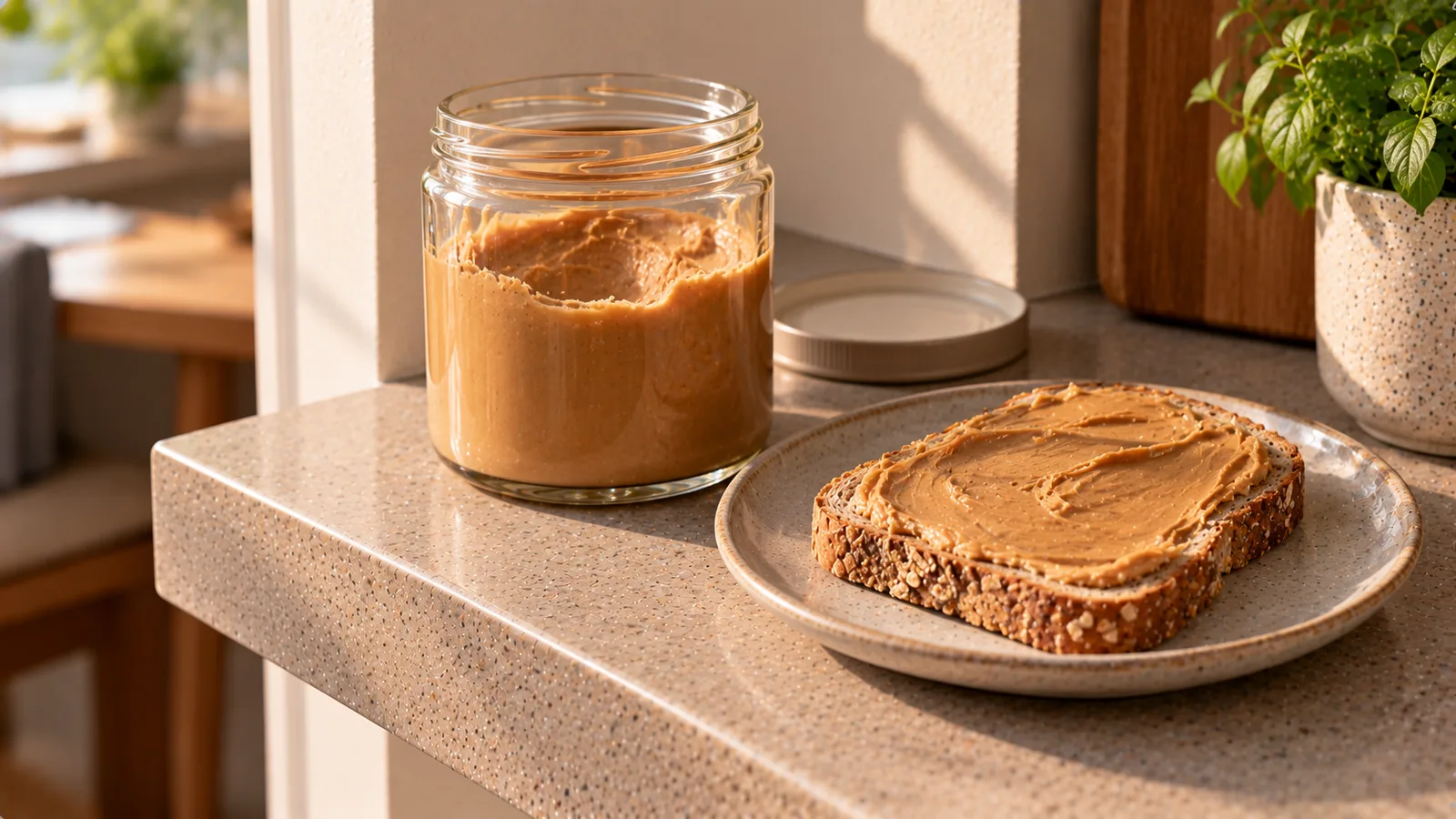
Peanut butter is calorie-dense because peanuts naturally contain a substantial amount of fat. At the same time, peanut butter provides protein, some fiber and several micronutrients.
The exact nutrition depends on the product. Some peanut butters contain only peanuts, while others include salt, sugar, oils or other ingredients.
For tracking, the most reliable approach is to use the label of the peanut butter you actually eat and measure the portion in grams when possible.
Peanut butter calories at a glance
As a practical reference, smooth peanut butter typically provides around 590 kcal per 100 g, although products vary.
Using 590 kcal per 100 g:
| Amount | Approx. calories |
|---|---|
| 5 g | 30 kcal |
| 10 g | 59 kcal |
| 15 g | 89 kcal |
| 20 g | 118 kcal |
| 25 g | 148 kcal |
| 30 g | 177 kcal |
| 32 g | 189 kcal |
| 40 g | 236 kcal |
| 50 g | 295 kcal |
| 100 g | 590 kcal |
These are reference values rather than universal numbers.
If your jar says 610 kcal per 100 g, use 610. If it says 575 kcal, use 575.
Typical nutrition per 100 g
A typical smooth peanut butter may provide approximately:
| Nutrient | Per 100 g |
|---|---|
| Calories | ~590 kcal |
| Protein | ~24–25 g |
| Fat | ~49–50 g |
| Carbohydrates | ~20–22 g |
| Fiber | ~6–8 g |
The exact carbohydrate, sugar, fiber and fat values can differ substantially between products and labeling systems.
Check the package for the most relevant numbers.
How many calories are in one tablespoon of peanut butter?
This depends on how much the tablespoon actually weighs.
A tablespoon is a volume measure. Peanut butter can be level, rounded or heaped, so two visually similar spoonfuls may contain different amounts.
If one measured tablespoon weighs 16 g and the peanut butter contains 590 kcal per 100 g:
16 × 590 ÷ 100 = about 94 kcal
If a larger spoonful weighs 25 g:
25 × 590 ÷ 100 = about 148 kcal
The difference is more than 50 kcal even though both portions might casually be described as “one spoonful.”
For accurate tracking, grams are more useful than spoon descriptions.
What about two tablespoons?
Many peanut butter labels use a serving close to 2 tablespoons, often around 30–32 g depending on the product and market.
At 590 kcal per 100 g:
30 g = about 177 kcal
32 g = about 189 kcal
Do not assume every manufacturer's two-tablespoon serving has exactly the same weight.
Read the gram amount printed next to the serving size.
Calories by gram portion
The simplest calculation is:
grams eaten × calories per 100 g ÷ 100
Suppose your peanut butter contains 598 kcal per 100 g and you eat 22 g:
22 × 598 ÷ 100 = 131.6 kcal
You would log approximately 132 kcal.
The same method works for protein, fat and carbohydrates.
If the product contains 25 g protein per 100 g:
22 × 25 ÷ 100 = 5.5 g protein
Why weighing peanut butter is useful
Peanut butter is difficult to estimate visually.
A thin layer on bread may be 10–15 g. A thick layer can easily be twice that amount.
Because peanut butter contains roughly 6 kcal per gram, relatively small differences in weight can affect the calorie estimate.
For example:
- 15 g ≈ 89 kcal
- 25 g ≈ 148 kcal
- 35 g ≈ 207 kcal
The difference between 15 g and 35 g is about 118 kcal.
A kitchen scale can remove much of this uncertainty.
An easy way to weigh peanut butter
You do not have to scrape peanut butter into a separate bowl.
One practical method is:
- place the jar on the scale;
- tare the scale to zero;
- remove the peanut butter you intend to eat;
- read the negative number.
If the scale shows −23 g, you used 23 g.
At 590 kcal per 100 g:
23 × 590 ÷ 100 = about 136 kcal
This method also includes peanut butter that ends up on the knife or spoon if it was removed from the jar.
Natural peanut butter vs regular peanut butter
“Natural” peanut butter commonly contains peanuts as the main or only ingredient, sometimes with salt.
Other peanut butters may contain ingredients such as:
- sugar;
- vegetable oils;
- stabilizers;
- salt.
It is tempting to assume that added sugar or oil always makes the calorie difference very large, but this is not necessarily true.
Peanuts themselves are already high in fat and calories. Two products with different ingredient lists can therefore still have similar calories per 100 g.
Compare the actual labels rather than predicting calories from the front-of-pack wording.
Crunchy vs smooth peanut butter
Crunchy and smooth peanut butter can have very similar calorie values.
The presence of peanut pieces does not automatically create a meaningful calorie difference because both products are primarily made from peanuts.
However, recipes and added ingredients differ by brand.
If you switch from smooth to crunchy peanut butter, use the nutrition label for the new product rather than assuming the values are identical.
Added sugar
Some peanut butter contains added sugar.
Added sugar can change the carbohydrate and sugar values, but the total calorie difference depends on the complete formulation.
A product with no added sugar is not automatically low-calorie because most peanut butter calories come from the peanuts themselves.
If your goal is accurate tracking, compare:
- calories per 100 g;
- serving weight;
- protein;
- fat;
- carbohydrate;
- sugars;
- ingredient list.
This gives a more complete picture than focusing on a single claim.
Added oils
Some products contain added vegetable oils.
The amount and type vary.
Because oil is energy-dense, added oil can affect the nutrition profile, but again, the final calorie value should be taken from the label rather than estimated from the ingredient list alone.
Products marketed as “100% peanuts” and products with added oils should be treated as separate foods when their labels differ.
Peanut butter powder is different
Powdered peanut products are not nutritionally equivalent to ordinary peanut butter.
Much of the fat may be removed during processing, substantially changing calories and macros per 100 g.
Do not use a standard peanut butter database entry for peanut powder.
Likewise, do not use the nutrition of dry powder for prepared peanut butter unless the product instructions and database entry specifically match what you consumed.
Peanut butter and whole peanuts are separate foods
Peanut butter is made from peanuts, but it should still have its own tracking entry.
Whole peanuts and peanut butter can differ in:
- processing;
- added ingredients;
- serving format;
- product-specific nutrition.
If you eat 20 g of peanut butter, log 20 g of the appropriate peanut butter rather than trying to convert it into a number of whole peanuts.
For whole peanuts, see Calories in Peanuts: Nutrition, Portions and Common Serving Sizes.
Peanut butter on toast
When tracking peanut butter toast, record the components separately.
For example:
- bread: 90 kcal;
- peanut butter, 20 g at 590 kcal/100 g: 118 kcal.
Total:
90 + 118 = 208 kcal
If you also add jam, honey, banana or another topping, include that separately.
This is more reliable than selecting a generic “peanut butter toast” entry whose portion may not match yours.
Peanut butter in oatmeal
Suppose you add 18 g of peanut butter to oatmeal.
At 590 kcal per 100 g:
18 × 590 ÷ 100 = about 106 kcal
If you instead add 30 g:
30 × 590 ÷ 100 = 177 kcal
The visual difference in a bowl may not look dramatic after the peanut butter melts into the oats, so weighing it before mixing is useful.
Peanut butter in smoothies
Peanut butter can be difficult to estimate after it has been blended into a drink.
Measure it before blending.
If a smoothie contains:
- 250 ml milk;
- banana;
- 25 g peanut butter;
- other ingredients;
log each ingredient using its own amount.
At 590 kcal per 100 g, the 25 g peanut butter contributes approximately 148 kcal.
Do not use the finished smoothie volume to estimate how much peanut butter it contains.
Homemade peanut butter
For homemade peanut butter, calculate nutrition from the ingredients used.
If you blend only peanuts, start with the nutrition of the actual weight of peanuts.
If you add oil, honey, sugar or other ingredients, include them in the recipe.
Then determine the finished recipe weight.
For example, if the entire batch contains 2,400 kcal and the finished peanut butter weighs 410 g:
2,400 ÷ 410 = 5.85 kcal per gram
or approximately:
585 kcal per 100 g
If you eat 24 g:
24 × 5.85 = about 140 kcal
This method accounts for your actual recipe rather than assuming it matches a commercial product.
Does separation change the calories?
Natural peanut butter can separate, with oil rising to the top.
The jar's nutrition information generally assumes the product is consumed as intended.
If you stir the oil back into the peanut butter, use the label normally.
If you deliberately pour away a substantial amount of separated oil, the final composition is no longer exactly the same as the labeled product. The calorie and fat content may be lower, but the precise change is difficult to determine without measuring what was removed.
For normal tracking, mix the product as instructed and use the label.
Serving size is not a recommendation
A serving size printed on a label is a reference quantity for nutrition information. It does not mean everyone needs to eat exactly that amount.
Your portion may be smaller or larger depending on the meal and your overall diet.
If the label says 30 g per serving but you eat 12 g, track 12 g.
If you eat 45 g, track 45 g.
The amount actually consumed is what matters for calculating nutrition.
Quick reference
Using approximately 590 kcal per 100 g:
- 10 g: ~59 kcal
- 15 g: ~89 kcal
- 20 g: ~118 kcal
- 25 g: ~148 kcal
- 30 g: ~177 kcal
- 32 g: ~189 kcal
- 40 g: ~236 kcal
- 50 g: ~295 kcal
- 100 g: ~590 kcal
Because peanut butter formulations vary, use these numbers as a practical reference rather than a replacement for the label.
For accurate tracking, match the correct product and weigh the amount you actually eat.