
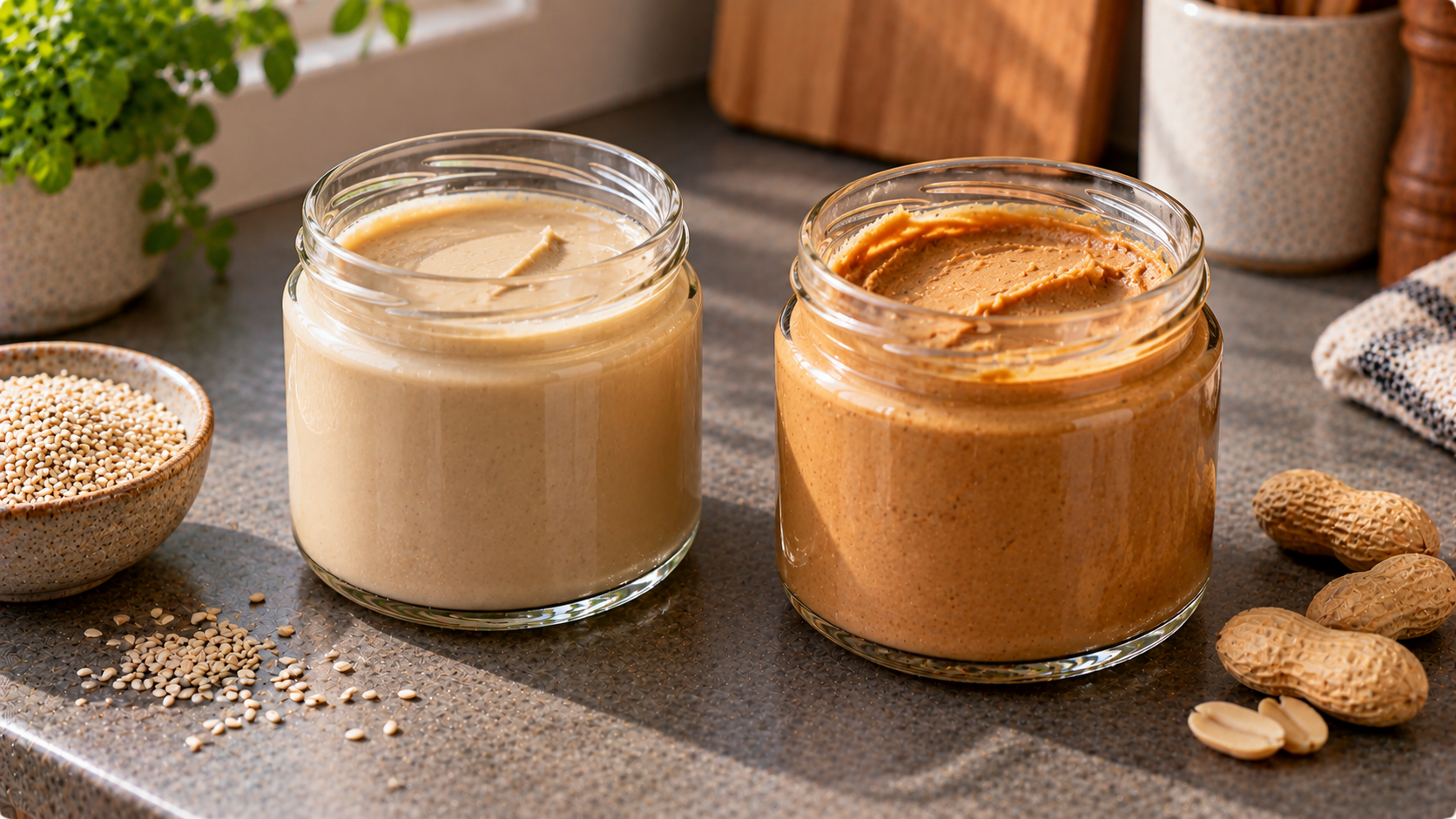
Tahini and peanut butter are both concentrated seed or legume pastes, but they bring different flavours, nutrients and allergens to a meal. Tahini is ground sesame; peanut butter is ground peanuts. Neither is automatically healthier. Comparing equal weights, ingredient lists and the role each plays in your meal gives a more useful answer than treating either as a superfood.
If you need a rich, savoury dressing or a sesame flavour, tahini is often the more practical choice. If you want a familiar spread with more protein per spoonful, unsweetened peanut butter often has an advantage. Both are energy-dense, mostly because of their fat content. Choosing a portion deliberately matters more than a small difference in calories per 100 g.
Tahini vs peanut butter: the essential differences
| Question | Tahini | Peanut butter |
|---|---|---|
| Main ingredient | Ground sesame seeds | Ground peanuts (a legume) |
| Typical flavour | Toasted, earthy, slightly bitter | Roasted, nutty, sometimes sweet or salty |
| Typical texture | Pourable to thick; oil may separate | Smooth or crunchy; usually spreadable |
| Protein | Moderate | Usually higher per equal weight |
| Key nutritional features | Mostly unsaturated fats; variable calcium and iron | Mostly unsaturated fats; protein, niacin and magnesium |
| Allergen | Sesame | Peanut |
| Common uses | Hummus, sauces, dressings, halva | Toast, porridge, satay-style sauces, baking |
These are category-level tendencies, not promises for every jar. Sesame may be hulled or unhulled; peanuts may be blended with sugar, salt or other oils. Check what you are actually buying.
Nutrition per 100 g: a fair comparison
The following numbers are rounded illustrative reference ranges, not a single laboratory result or an exact label for a particular brand. They broadly reflect plain sesame paste and peanut-only butter; processing, seed type and databases cause differences.
| Nutrient per 100 g | Plain tahini, illustrative | Peanut-only butter, illustrative |
|---|---|---|
| Energy | 570–650 kcal | 580–640 kcal |
| Protein | 15–22 g | 24–30 g |
| Total fat | 50–60 g | 48–55 g |
| Saturated fat | 7–10 g | 8–11 g |
| Carbohydrate | Depends on total-vs-available carbohydrate definition | Depends on total-vs-available carbohydrate definition |
| Fibre | Roughly 5–10 g, variety dependent | Roughly 5–9 g |
| Sodium/salt | Low if nothing added | Low if nothing added; salted jars vary |
The two foods are more alike in energy than many product marketing claims suggest. Peanut butter generally supplies more protein by weight, but neither should be measured against lean, protein-rich foods as a primary protein source. Both also contribute meaningful calories from fat.
Do not combine carbohydrate figures from different national labelling systems without checking definitions. US labels use total carbohydrate, which includes fibre; EU labels commonly report available carbohydrate separately from fibre. A seemingly large transatlantic difference may be partly a reporting difference, not a product difference.
Compare the amount you actually eat
A heaped tablespoon varies with thickness and the utensil, so weighing is best when accuracy matters. For everyday planning, compare the same 15 g, 30 g or 45 g amount of each product, not one teaspoon of tahini against two tablespoons of peanut butter.
For a weighed serving rather than an imprecise spoonful, consult the separate calorie guides for tahini and peanut butter.
| Portion | Approximate calories for either plain paste | Practical role |
|---|---|---|
| 15 g | 85–100 kcal | Thin dressing or small topping |
| 30 g | 170–195 kcal | Substantial spread or sauce base |
| 45 g | 255–295 kcal | Generous addition to a meal |
These are computed ranges from the illustrative per-100-g figures, rounded for readability. The exact numbers are on the package. For instance, if your tahini label says 610 kcal per 100 g, a weighed 20 g serving gives 122 kcal (610 × 20 ÷ 100). If peanut butter says 600 kcal per 100 g, 20 g gives 120 kcal. A two-kilocalorie difference is not a meaningful basis for the decision.
Which has more protein?
For a plain product with 18 g protein per 100 g, 30 g tahini supplies 5.4 g protein. A peanut butter containing 27 g per 100 g supplies 8.1 g in the same serving. That is a difference of 2.7 g, useful to know but modest compared with protein from an entire meal.
If your breakfast includes 200 g skyr or fortified soy yoghurt, oats and fruit, the spread may be only one contributor to its protein. If you are replacing an animal protein at lunch, adding tahini alone does not make the meal protein-equivalent. Beans, tofu, dairy or another substantial protein source may still be needed. Tahini with chickpeas creates a practical combination in hummus, but the finished hummus is diluted with water, lemon and other ingredients, so it has different nutrition per 100 g than pure tahini.
Protein quality also depends on amino-acid composition, digestibility and overall dietary variety. No single spoonful provides everything your body needs. Someone targeting a higher-protein meal may prefer peanut butter in a small topping, yet still benefit more from increasing the main protein ingredient.
Fat quality matters more than the calories gap
Both spreads are rich in unsaturated fatty acids. Peanut butter usually contains a substantial monounsaturated share, while sesame paste contains both monounsaturated and polyunsaturated fats. Both have saturated fat as well, and the amounts differ by product.
Neither paste is a replacement for a balanced mix of foods. Olive or rapeseed oil, nuts, seeds and fish can play different roles in an overall eating pattern. Replacing a spread high in saturated fat with either unsweetened paste may shift the fatty-acid profile, but the amount and what is displaced matter. Adding a generous portion on top of an unchanged meal simply increases energy intake.
A layer 5 g thicker than you intended adds around 30 kcal. Across several meals this becomes noticeable even though there is nothing wrong with the food itself. For weight management, use the flavour and satisfaction you get per portion as the deciding factor.
Calcium, iron, magnesium and other micronutrients
Tahini is often promoted for calcium, but there is no single dependable calcium number for all tahini. Sesame hulls contain a substantial share of the seed's calcium; whether seeds are hulled, their processing and the analysis method change the final content. Unhulled sesame pastes may show much higher calcium values than hulled versions. Read reliable product data or a matched food-composition entry before asserting a gram-for-gram advantage.
Tahini can contribute iron, copper and other minerals. The presence of a mineral does not mean all of it is absorbed: phytates and meal composition influence mineral bioavailability. Pairing plant foods with vitamin-C-rich vegetables can help support non-haem iron absorption, but tahini should not be treated as a guaranteed solution for iron deficiency.
Peanut butter contributes magnesium, niacin and vitamin E; quantities again vary by product. A food label does not have to list every mineral in every country. If calcium or iron is a priority, compare numbers from the same trustworthy database or from manufacturer information rather than assuming one paste is always superior.
Ingredients: plain is not the same as flavoured
For the simplest comparison, choose tahini listing only sesame seeds and peanut butter listing only peanuts. A little added salt does not automatically make a product unsuitable, but it changes the comparison. Some peanut butters include sugar, syrups, palm oil or hydrogenated fats; some tahini sauces are already mixed with oil, salt and lemon. The nutrition of a prepared sauce can be much lower per 100 g than straight sesame paste because it contains water, while sodium may be higher.
Check four parts of the label: the ingredients list, the nutrition table per 100 g, the stated serving and the allergen declaration. Sugar that appears in a peanut-butter ingredient list is different from naturally occurring small amounts of sugars in peanuts. In the EU, salt on the nutrition panel is not the same unit as sodium in many US databases. Salt-equivalent is approximately sodium × 2.5; always keep the units straight.
Oil separation in a single-ingredient jar is normal. Stir with a clean utensil, close the lid and follow storage instructions. Never assume that a 'natural' spread is allergen-free or safer for someone with a food allergy.
Taste and texture: substitutions that actually work
Tahini tends to be bitter-earthy and becomes a creamy emulsion when whisked gradually with water and acid. That makes it ideal for lemon-garlic dressing, roasted vegetables and hummus. Peanut butter has a sweeter roasted flavour even without sugar; it thickens sauces and works well with lime, ginger, chilli or soy sauce. Each can be used in smoothies or baking, but the flavour and mouthfeel will change.
For a tahini dressing, whisk 20 g tahini with lemon juice, water added slowly and a little garlic. Depending on how much water you add, the dressing may have a quarter or less of the calories per 100 g of the original paste; the calories in the full mixture still include all 20 g of tahini. To log a portion accurately, record the tahini amount plus any added oil or sweetener and divide by the portions served.
For a peanut sauce, mix 20 g unsweetened peanut butter with hot water, lime, ginger and a measured quantity of soy sauce. This can coat vegetables or noodles without needing a large serving of paste. The soy sauce, not the peanuts, may dominate the final sodium content.
Replacing tahini 1:1 with peanut butter in hummus creates a different peanut-flavoured dip, not a nutritionally identical classic hummus. Likewise replacing peanut butter in a baked recipe may affect bitterness, thickness and moisture. Test small recipe changes before scaling up.
Allergy safety is a separate decision
Sesame and peanuts are distinct major allergens, and a person allergic to one cannot assume the other is safe without individual medical advice. Cross-contact can occur during processing and in kitchens. For severe allergy, read the full current label every time, consider precautionary statements and follow the person's allergy care plan. Do not conduct home taste tests to check tolerance.
US regulations have required sesame to be identified as a major allergen on applicable packaged foods since January 2023; peanuts were already a major allergen. EU rules also require declaration of sesame and peanuts among specified allergens. A product marketed as vegan, organic or high-protein can still contain either. Restaurant sauces, hummus, baked goods and desserts are common places to ask about hidden ingredients.
Cost per serving: calculate instead of guessing
A jar's shelf price is less useful than price per 100 g and price for the amount you use. Imagine, for calculation only, 300 g tahini for €3.30 and 350 g peanut butter for €2.80. The tahini costs €1.10 per 100 g, or €0.33 for 30 g. The peanut butter costs €0.80 per 100 g, or €0.24 for 30 g. These are fictional prices, not a current supermarket survey.
For protein specifically, divide serving price by the grams of protein in that serving. However, buying a high-fat paste primarily to obtain inexpensive protein often makes less sense than choosing beans, quark, skyr, tofu or eggs, depending on preferences and restrictions. With tahini, you may value the distinctive flavour and usefulness across several meals more than cost per protein gram.
Home-made versions have different economics. Toasted sesame seeds and peanuts can be ground into pastes with suitable equipment, but accounting for ingredient prices, equipment time, storage and yield avoids false savings claims. For both foods, store as directed on the package and discard if mould or an unusual rancid smell develops.
Which one should you choose?
| Your priority | More practical starting point | Important qualification |
|---|---|---|
| More protein in the same spoonful | Plain peanut butter | Compare actual labels; still calorie-dense |
| Sesame flavour and pourable dressing | Tahini | Dilute with water, not extra oil, when appropriate |
| Familiar toast or porridge topping | Peanut butter | Look for unsweetened if you want control over sugar |
| Hummus and Middle Eastern-style sauces | Tahini | The finished dip differs from pure paste |
| Avoid peanut allergen | Not peanut butter | Tahini is only an option if sesame is safe for that person |
| Avoid sesame allergen | Not tahini | Peanut butter is only an option if peanuts are safe |
| Track calories accurately | Either, weighed | Use per-100-g package figures |
The useful answer is contextual: neither product automatically wins for nutrition. Both can fit into balanced meals, with peanut butter usually offering more protein per equal portion and tahini offering distinctive sesame flavour and potentially valuable minerals depending on its processing. Pick a paste with an ingredient list you understand, weigh realistic portions and judge it by the entire meal rather than its reputation.
Sources and data notes
- USDA FoodData Central — reference nutrient profiles; select an entry matching actual ingredients and processing.
- FDA: sesame as a major food allergen — allergen-labelling requirements in the US.
- European Commission: food information and nutrition labelling — EU nutrition label framework.
- EU Regulation 1169/2011, Annex II — sesame and peanuts among allergens that must be declared.
Illustrative nutrition ranges, portion calculations and sample prices are educational examples, not audited product values or current retail quotes. Check the label of the product you buy.