
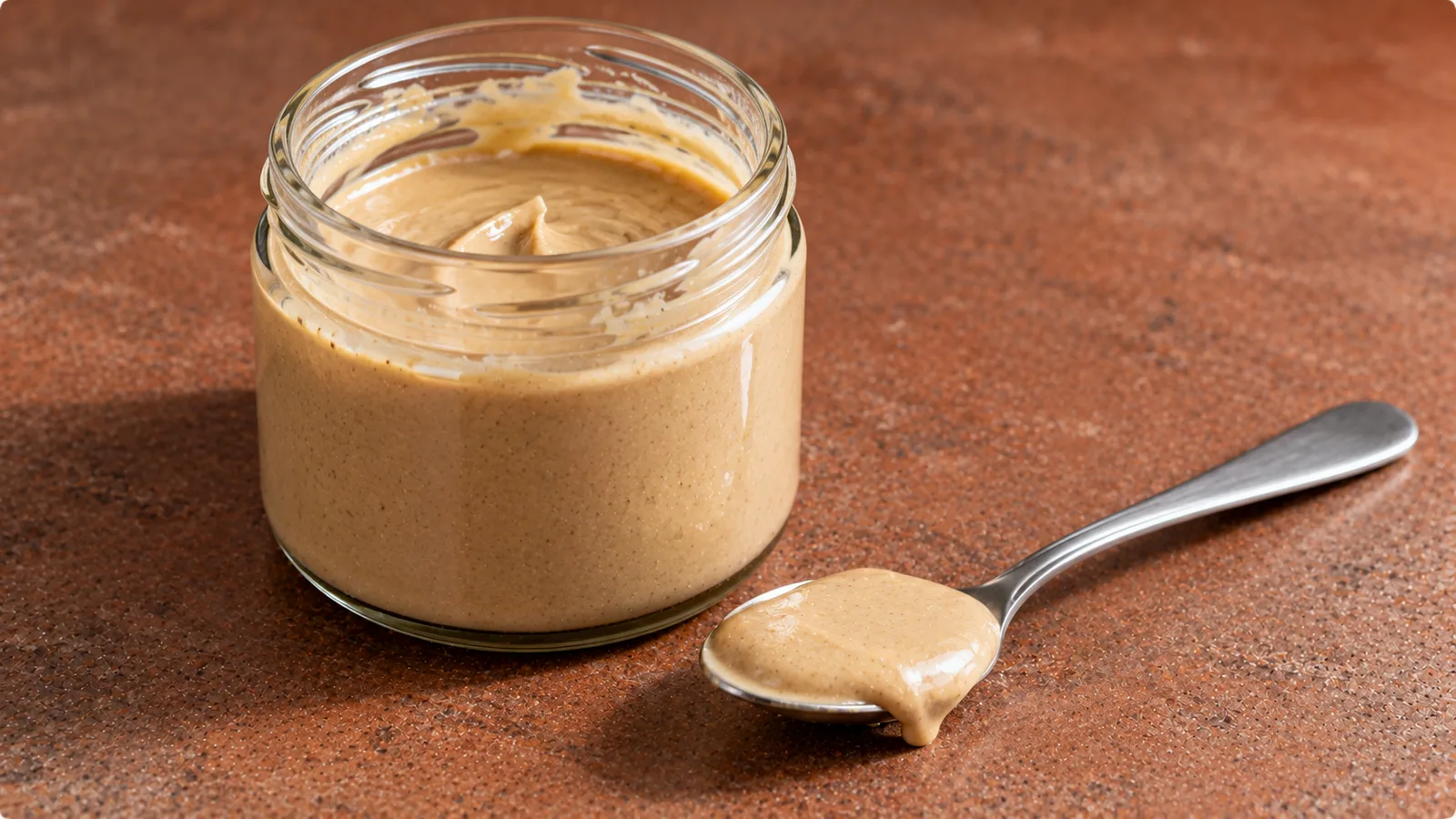
Tahini is a paste made from ground sesame seeds. It is used in hummus, salad dressings, sauces, dips and many Middle Eastern and Mediterranean dishes.
Because sesame seeds naturally contain substantial amounts of fat, tahini is energy-dense. A relatively small serving can contribute a noticeable amount of calories.
For plain tahini made entirely from sesame seeds, a practical reference is approximately 595 calories per 100 g.
The exact value varies by product, sesame variety and manufacturing method. Always use the nutrition label when calculating a specific brand.
How many calories are in tahini?
| Tahini quantity | Approximate calories |
|---|---|
| 5 g | 30 kcal |
| 10 g | 60 kcal |
| 15 g | 89 kcal |
| 20 g | 119 kcal |
| 25 g | 149 kcal |
| 30 g | 179 kcal |
| 40 g | 238 kcal |
| 50 g | 298 kcal |
| 100 g | 595 kcal |
These estimates use 595 kcal per 100 g and are rounded to the nearest whole calorie.
The calculation is:
Calories = tahini weight in grams × 5.95
For example, a 25 g portion provides approximately:
25 × 5.95 = 149 kcal
This is a useful estimate for plain sesame tahini, not a guarantee for every commercial product.
Calories in one teaspoon of tahini
A level teaspoon of tahini is often estimated at approximately 5 g.
At that weight:
5 × 5.95 = 30 kcal
However, tahini is thick and can cling to the spoon. A heaped teaspoon may contain substantially more than 5 g.
The actual quantity depends on the spoon, whether the paste has been stirred and how full the spoon is.
For precise tracking, weigh the tahini rather than assuming every teaspoon has the same mass.
A teaspoon measurement is most useful when a rough estimate is sufficient.
Calories in one tablespoon of tahini
A tablespoon is frequently estimated at approximately 15 g.
That corresponds to:
15 × 5.95 = 89 kcal
Some nutrition databases and product labels use a tablespoon portion closer to 15–16 g.
A generously filled tablespoon can weigh considerably more.
For example:
| Actual tablespoon weight | Approximate calories |
|---|---|
| 12 g | 71 kcal |
| 15 g | 89 kcal |
| 18 g | 107 kcal |
| 20 g | 119 kcal |
| 25 g | 149 kcal |
This variation explains why two people can record different calorie amounts while both describe their serving as one tablespoon.
If you regularly use tahini in sauces or breakfast bowls, weighing a typical spoonful once can improve your future estimates.
Tahini nutrition per 100 g
Plain sesame tahini provides mostly fat, along with protein and carbohydrates.
The following values are approximate reference figures for a typical unsweetened sesame paste.
| Nutrient | Approximate amount per 100 g |
|---|---|
| Energy | 595 kcal |
| Protein | 17 g |
| Total fat | 54 g |
| Carbohydrates | 21 g |
| Fiber | 9 g |
Carbohydrate declarations vary between countries.
US nutrition data generally include dietary fiber within total carbohydrates. European nutrition labels usually list available carbohydrates separately from fiber.
Consequently, carbohydrate values from US and European sources should not always be compared directly.
Fat, protein and carbohydrate composition also varies with sesame seed type and processing.
These numbers describe a representative product, not a laboratory analysis of every jar.
Reference: USDA FoodData Central.
Nutrition in a 15 g serving
For a practical serving of 15 g, the approximate values are:
| Nutrient | Amount |
|---|---|
| Calories | 89 kcal |
| Protein | 2.6 g |
| Fat | 8.1 g |
| Total carbohydrates, US definition | 3.2 g |
| Fiber | 1.4 g |
Tahini contributes some protein, but it is primarily a fat-rich food rather than a concentrated protein source.
For example, a 15 g serving supplies only a few grams of protein despite providing nearly 90 calories.
This does not make tahini a poor food choice. It simply means that its nutritional role differs from foods such as beans, yogurt or lean meat.
Why is tahini high in calories?
Sesame seeds contain substantial natural oil.
Fat provides approximately 9 kcal per gram, compared with approximately 4 kcal per gram for protein and digestible carbohydrates.
Tahini retains much of the fat naturally present in sesame seeds.
Grinding the seeds changes their texture but does not remove most of their energy.
That is why a small quantity of tahini can contain more calories than a much larger volume of watery vegetables.
Energy density is not the same as nutritional quality.
Tahini also supplies unsaturated fats and minerals, but portion size remains relevant when tracking calorie intake.
Does tahini contain healthy fats?
Most of the fat in sesame seeds is unsaturated, including monounsaturated and polyunsaturated fatty acids.
These fats can fit within a balanced dietary pattern.
However, the presence of unsaturated fats does not cancel the calories.
A 30 g serving of tahini still provides approximately 179 kcal, regardless of whether those fats are considered nutritionally useful.
For meal planning, it is more helpful to consider both fat quality and total quantity.
Tahini can replace or complement other fat sources in a recipe rather than always being added on top of them.
Is tahini a good source of protein?
Tahini contains protein, but it is not especially protein-dense relative to its calories.
Using the approximate reference values:
100 g tahini provides about 17 g protein and 595 kcal.
A realistic 15 g portion provides approximately 2.6 g protein.
If your main goal is to increase protein intake, tahini is better treated as a complementary ingredient than as the principal protein source.
For example, tahini can add flavor and texture to a meal containing chickpeas, lentils, tofu or other protein-containing foods.
The protein contribution from the whole meal matters more than the tahini alone.
Minerals in tahini
Sesame seeds can provide minerals such as calcium, iron, magnesium, phosphorus and zinc.
The amounts in tahini vary substantially depending on whether the sesame seeds are hulled or unhulled.
Products made from unhulled sesame may contain more calcium than some hulled products.
However, mineral content and mineral absorption are not the same thing.
Sesame contains compounds such as phytates that can influence mineral bioavailability.
For this reason, avoid assuming that a spoonful of tahini supplies a fixed percentage of daily mineral requirements.
Use product-specific information where available, and assess mineral intake across the whole diet.
Hulled versus unhulled tahini
Tahini can be made from hulled or unhulled sesame seeds.
Hulled tahini generally has a lighter color and a milder taste.
Unhulled tahini often has a stronger, sometimes more bitter flavor.
Removing the hull changes some aspects of the mineral and fiber composition.
However, both types remain calorie-dense sesame pastes.
Do not assume that unhulled tahini is dramatically lower in calories.
For calorie tracking, the specific product label is more useful than the hull designation alone.
Tahini versus sesame seeds
Tahini and sesame seeds come from the same ingredient, but their physical forms differ.
Whole sesame seeds require chewing and may pass through digestion differently from finely ground sesame paste.
Tahini is easier to spread, mix into sauces and consume in relatively large quantities.
That can make portion size less obvious.
Both sesame seeds and tahini are energy-dense.
When comparing them, use the actual weight rather than comparing a spoonful of paste with a spoonful of whole seeds.
The two spoonfuls may not weigh the same.
Tahini versus peanut butter
Tahini and unsweetened peanut butter are both concentrated spreads.
Their calorie values are often in a broadly similar range, although individual products vary.
| Product | Typical calorie range per 100 g |
|---|---|
| Plain tahini | Approximately 570–650 kcal |
| Unsweetened peanut butter | Approximately 580–650 kcal |
These ranges are illustrative, not specifications for every brand.
Peanut butter generally provides more protein than plain tahini, while the mineral profiles differ.
Neither product is automatically better for weight management.
The amount eaten, other ingredients and the overall meal are more important than a small difference in calories per 100 g.
Tahini versus hummus
Tahini and hummus are frequently confused when comparing calories.
Tahini is primarily ground sesame paste.
Hummus usually contains cooked chickpeas, tahini, water or lemon juice, and other seasonings.
Because hummus contains ingredients with more water and less fat than pure tahini, it often has fewer calories per 100 g.
However, hummus recipes vary greatly in the amount of tahini and oil added.
A homemade hummus with generous quantities of tahini and olive oil may be much more calorie-dense than a lighter commercial version.
Compare the finished products using their actual recipes or labels.
Do not use the calorie value of pure tahini to log a portion of hummus.
Calories in tahini sauce
Tahini sauce is not necessarily the same as pure tahini.
Many sauces combine tahini with water, lemon juice, garlic and salt.
Adding water changes the calories per 100 g of finished sauce, even though the total calories from the original tahini remain.
For example, consider a sauce containing:
- 30 g plain tahini.
- 30 g water.
- 10 g lemon juice.
- Garlic and seasonings.
The tahini contributes approximately:
30 × 5.95 = 179 kcal
Water contributes no calories.
Lemon juice and garlic contribute a small additional amount.
The finished sauce weighs more than the original 30 g of tahini, so its calories per 100 g are lower.
However, eating the entire sauce still means consuming the calories from all 30 g of tahini.
This distinction matters when tracking dips and dressings.
Example: calculate a homemade dressing
Suppose you make a dressing with:
| Ingredient | Amount | Approximate calories |
|---|---|---|
| Tahini | 40 g | 238 kcal |
| Lemon juice | 20 g | 4 kcal |
| Water | 40 g | 0 kcal |
| Garlic | 5 g | 7 kcal |
The total is approximately 249 kcal.
The ingredient weight is approximately 105 g before any losses.
If you divide the dressing into three equal portions:
249 ÷ 3 = 83 kcal per portion
The calculation is approximate because product composition and preparation vary.
If you use only one portion, record one-third of the dressing rather than all 40 g of tahini.
If the sauce is shared unequally, weigh or estimate the actual amount consumed.
How much tahini should you use in a meal?
There is no universal serving size that is ideal for everyone.
A small quantity may provide enough flavor and creaminess.
For practical cooking:
| Tahini amount | Possible use | Approximate calories |
|---|---|---|
| 5 g | Small flavor addition | 30 kcal |
| 10 g | Light sauce ingredient | 60 kcal |
| 15 g | Moderate spoonful | 89 kcal |
| 25 g | Generous sauce portion | 149 kcal |
| 40 g | Large contribution to a dressing | 238 kcal |
These are cooking examples, not medical or dietary prescriptions.
The suitable amount depends on the recipe, the rest of the meal, personal preferences and energy needs.
When tahini replaces some oil or another spread, consider the complete recipe rather than treating the tahini as an isolated addition.
Is tahini suitable for weight loss?
Tahini can fit into an eating pattern intended for weight loss.
Weight management depends on overall energy intake over time, not on avoiding one particular ingredient.
Because tahini is calorie-dense, portions can matter.
For example, adding 30 g instead of 15 g contributes approximately 89 additional calories.
That difference may be relevant if it happens frequently and is not accounted for elsewhere.
At the same time, a measured serving can make vegetables, legumes or whole-grain dishes more enjoyable.
The useful question is not whether tahini is permitted, but how its quantity fits into the meal and daily energy intake.
Does roasting change tahini calories?
Sesame seeds may be roasted before grinding.
Roasting changes flavor, aroma and moisture content.
Because moisture changes can affect calorie concentration per 100 g, roasted and unroasted products may have somewhat different nutrition values.
However, roasting does not transform tahini into a low-calorie ingredient.
Use the manufacturer's nutrition information whenever possible.
Avoid applying a fixed calorie reduction or increase based only on the word "roasted."
Does oil separation change the calories?
Natural tahini often separates during storage.
Oil rises to the top while thicker sesame solids settle below.
This is normal for many products.
If you scoop mostly separated oil from the surface, the nutritional composition of that spoonful may differ from a thoroughly mixed serving.
For more consistent portions, stir the tahini well before measuring.
Oil separation does not mean that calories have disappeared or been created.
It simply means the components are temporarily distributed unevenly.
Does tahini contain added sugar?
Plain tahini typically contains ground sesame seeds and may contain no added sugar.
However, products sold as sesame spreads, sweet tahini creams or flavored pastes may contain sugar, additional oils or other ingredients.
These products can have different nutritional values.
Read the ingredient list and nutrition label.
Do not automatically apply the values for pure sesame tahini to sweetened sesame spreads.
The same caution applies to tahini-based dressings and ready-made sauces.
Sesame allergy and tahini
Tahini is made from sesame and is not suitable for people with sesame allergy.
Sesame can cause serious allergic reactions in susceptible individuals.
Diluting tahini in a sauce does not remove sesame allergens.
In the European Union, sesame seeds and products made from them are among the allergens that must be declared when used as ingredients under applicable food-information rules.
People with sesame allergy should check ingredient lists and take appropriate precautions regarding cross-contact.
Reference: EU Regulation 1169/2011.
How to record tahini accurately
For a food diary or nutrition application:
- Identify whether the product is plain tahini or a prepared sauce.
- Stir the jar if the oil has separated.
- Weigh the amount used in grams when practical.
- Use the specific product's calorie value per 100 g.
- Record only the portion actually consumed.
- For homemade sauces, include every calorie-containing ingredient.
For example, if a label lists 610 kcal per 100 g and you eat 18 g:
18 × 610 ÷ 100 = 110 kcal
That product-specific calculation is more accurate than using the generic 595 kcal reference.
The practical takeaway
Plain tahini contains approximately 595 kcal per 100 g, or about 89 kcal in a 15 g serving.
It contributes mostly fat, along with some protein, fiber and minerals.
The most important distinction is between pure tahini and diluted tahini sauces, which can have very different calories per 100 g.
For accurate meal planning, measure the actual quantity, check the product label and consider tahini as part of the complete dish rather than judging it by calories alone.