
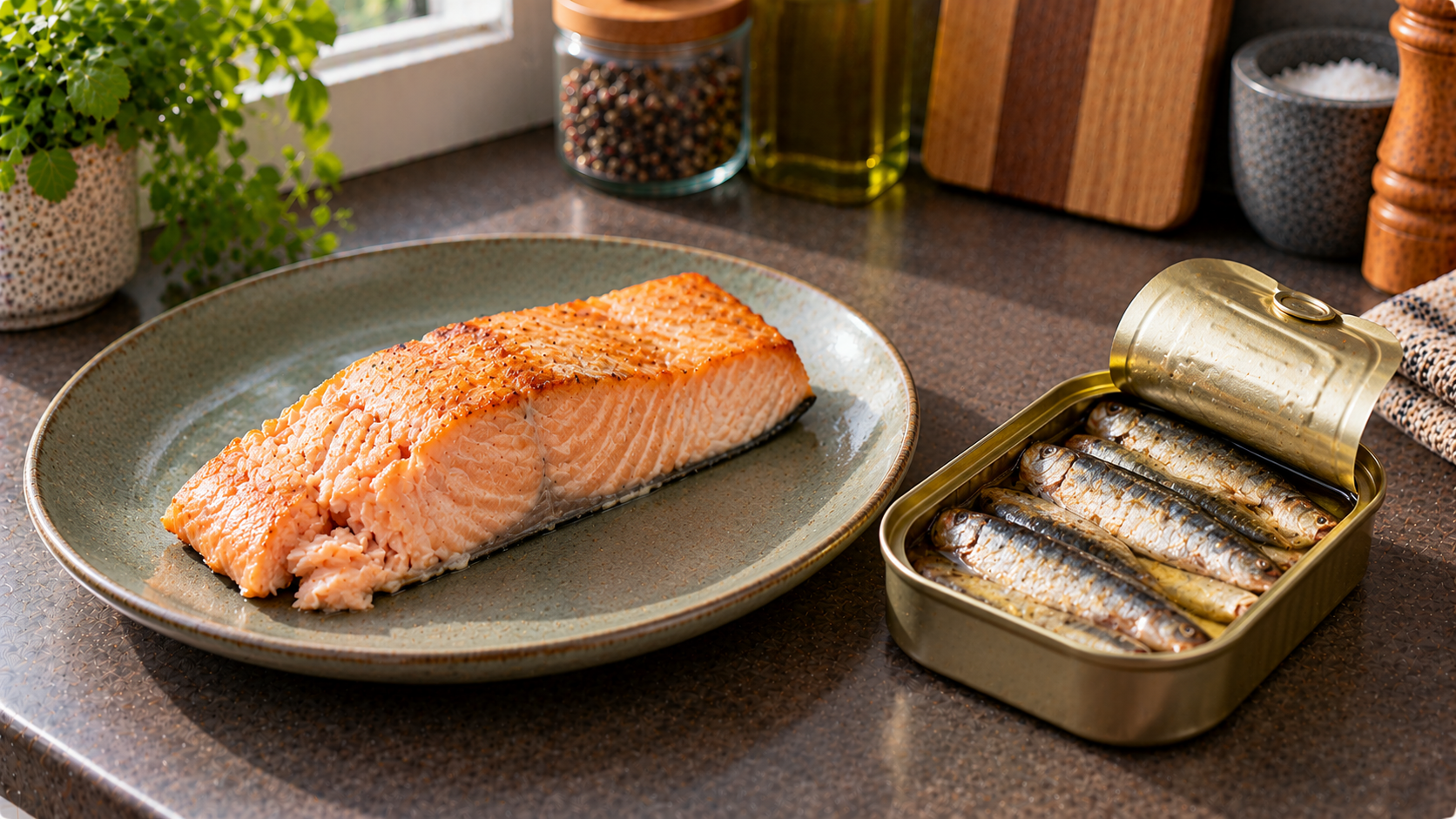
Salmon and sardines are both oily fish that supply protein, omega-3 fatty acids and valuable micronutrients. Neither is universally healthier. Salmon is convenient as a fresh or frozen fillet, whereas canned sardines can be an economical, ready-to-eat choice. Sardines eaten with their soft bones can also provide substantially more calcium than boneless salmon.
The fairest comparison uses the edible portion of each product and distinguishes raw salmon, cooked salmon and canned sardines drained of their packing liquid. Comparing 100 g of raw salmon with 100 g of sardines including oil from the tin can lead to misleading conclusions.
Salmon vs sardines at a glance
| Feature | Salmon | Sardines | Practical meaning |
|---|---|---|---|
| Protein | High | High | Both can anchor a protein-rich meal |
| Omega-3 EPA and DHA | Rich source | Rich source | Exact amounts vary by species and product |
| Calories | Vary by species and farming conditions | Vary by packing medium and drained weight | Compare matched edible portions |
| Calcium | Relatively modest in boneless fillets | Can be high when edible bones are included | Bones make a major difference |
| Vitamin D | Can be a useful source | Can be a useful source | Amounts vary |
| Vitamin B12 | Present | Often substantial | Check exact food-composition entries |
| Sodium | Plain fillets may be relatively low | Canned products may have added salt | Compare labels |
| Preparation | Usually requires cooking | Often ready to eat | Convenience matters |
| Price | Varies by species, cut and retailer | Often economical in tins | Compare cost per edible portion |
Bottom line: Choose salmon when you want a fillet for a cooked meal, and sardines when you want convenient fish, potentially useful calcium from edible bones and a shelf-stable pantry option. Both can contribute to a nutritious diet.
Calories and protein: compare the same food state
Salmon is not a single nutritionally identical product. Atlantic, sockeye and other salmon species vary in fat content. Wild and farmed products may also differ.
The packing liquid and edible portion can change the numbers for canned fish; see the sardine calories and portions guide for that distinction.
Sardines sold in water, tomato sauce or oil have different nutritional profiles. Draining oil changes the actual amount of added fat consumed, but it does not automatically remove every trace of it.
For an accurate comparison:
- Identify the salmon species and whether it is raw or cooked.
- Identify whether the sardines are canned in water, tomato sauce or oil.
- Check whether the label refers to total contents or drained product.
- Compare the protein, fat and calories per 100 g of edible fish.
- Calculate the amount you will actually eat.
Do not assume that all salmon contains more calories than all sardines, or vice versa. The exact products determine the result.
For verified nutrient values, consult USDA FoodData Central and select food entries that match the preparation method and edible components.
What does a 120 g or 150 g portion provide?
Suppose an illustrative salmon product declares 20 g protein and 200 kcal per 100 g edible portion, while an illustrative drained sardine product declares 24 g protein and 190 kcal per 100 g.
These figures are hypothetical label examples, not measured averages or claims about specific brands.
| Edible portion | Salmon protein | Salmon calories | Sardine protein | Sardine calories |
|---|---|---|---|---|
| 100 g | 20 g | 200 kcal | 24 g | 190 kcal |
| 120 g | 24 g | 240 kcal | 28.8 g | 228 kcal |
| 150 g | 30 g | 300 kcal | 36 g | 285 kcal |
| 200 g | 40 g | 400 kcal | 48 g | 380 kcal |
The calculation is:
Serving nutrient = amount per 100 g × edible serving weight ÷ 100.
A 120 g tin of sardines may not contain 120 g of drained fish. If the packaging lists a drained weight of 90 g, use 90 g with nutrient values that describe drained sardines.
Likewise, a salmon fillet weighed before cooking should not automatically be calculated using values per 100 g of cooked salmon. Water loss changes the weight and concentration of nutrients.
Omega-3: which fish provides more?
Both fish supply long-chain omega-3 fatty acids, especially EPA and DHA. These are distinct from the plant omega-3 fatty acid ALA.
Both options contribute marine EPA and DHA; the overview of omega-3 food sources explains how these differ from plant ALA.
Salmon and sardines can each make meaningful contributions to dietary EPA and DHA, but neither has a guaranteed advantage across every product.
Amounts vary with salmon species, feed, natural diet, processing and the particular sardine product. The amount of oil in a tin is not a reliable measure of the fish's EPA and DHA content.
Look for product-specific EPA and DHA information where available, or consult an appropriately matched food-composition database.
Omega-3 content is one reason fish is included in healthy dietary patterns, but higher omega-3 content alone does not make an individual product the best choice for everybody.
If you rarely eat fish, including a variety of lower-mercury oily fish may be more practical than trying to identify a single nutritional winner.
Calcium: why sardine bones matter
This is one of the clearest practical differences.
A boneless salmon fillet generally contains much less calcium than canned sardines eaten with their softened bones. The bones are edible in appropriately prepared canned products and are an important source of calcium.
However, boneless sardines cannot be assumed to provide the same calcium advantage.
Before using sardines specifically for calcium, check whether the product contains edible bones and compare the stated calcium amount or a matching database entry.
Salmon canned with edible bones is a different product from a boneless salmon fillet and may also provide substantial calcium.
The meaningful comparison is therefore boneless salmon versus sardines with bones, not merely salmon versus sardines as species.
Vitamin D, B12, selenium and other nutrients
Both fish can supply vitamin B12, selenium and vitamin D, although the amounts depend on the species, preparation and product.
Sardines are often particularly useful for vitamin B12 and calcium when bones are present. Salmon can be an important vitamin D source, but values vary considerably between different salmon entries.
It would be misleading to promise that one fish always contains more of every vitamin or mineral.
When a specific nutrient matters, compare the actual product data. A broad nutritional ranking cannot replace matching serving sizes and food descriptions.
Both fish contain no meaningful dietary fibre. Combine them with vegetables, beans, potatoes or whole grains to make a more varied meal.
Sodium and canned packing liquids
Plain salmon and canned sardines may differ notably in sodium content.
Salt may be added to canned sardines for flavour and preservation. Products in tomato sauce, seasoned oil or brine may contain more sodium than unsalted fish.
Some canned salmon products also contain added salt, so packaging format alone does not determine sodium content.
For EU labels, look at the salt value per 100 g. On US labels, sodium is normally reported separately.
Compare labels on an equivalent weight basis and consider how much packing liquid or sauce you actually consume.
If reducing salt is a priority, choose a product with a lower declared salt or sodium content instead of assuming all sardines are high in salt.
Mercury: are salmon and sardines good choices?
Both salmon and sardines are listed in the US FDA/EPA Best Choices category for lower-mercury fish.
This makes them useful options within a varied fish-eating pattern, including for people who need to be especially careful about mercury exposure.
The FDA/EPA fish advice recommends that adults who are pregnant, might become pregnant or are breastfeeding choose two to three servings per week from the Best Choices category, using a four-ounce serving.
National guidance, individual circumstances and preparation requirements may differ. Follow applicable local recommendations.
Fish species, origin and local contamination advisories also matter, especially for fish caught recreationally.
Cooking cannot reliably remove mercury already present in fish tissue.
The key is to choose appropriate lower-mercury species and vary the fish eaten, rather than rely on one species every day.
Cost: compare edible fish, not just the package
Sardines may be cheaper per package, but the correct comparison uses drained edible weight.
Consider a hypothetical shopping example:
| Measure | Salmon | Canned sardines |
|---|---|---|
| Package price | €5.00 | €1.80 |
| Edible weight used | 250 g | 90 g |
| Cost per 100 g edible | €2.00 | €2.00 |
| Protein per 100 g edible (example) | 20 g | 24 g |
| Cost per 30 g protein | €3.00 | €2.50 |
These are illustrative arithmetic examples, not current German or French supermarket prices.
Calculate edible-weight cost as:
Cost per 100 g edible = package price ÷ edible grams × 100.
Then, if protein value is central to your decision:
Cost per 30 g protein = cost per 100 g edible ÷ protein per 100 g × 30.
For salmon with skin, bones or other discarded components, use the amount you will actually eat. For canned sardines, check the drained weight and whether bones and skin are eaten.
A larger salmon pack may become economical if you use or freeze all of it safely.
Which fish works better in different meals?
| Meal | Practical choice | Why |
|---|---|---|
| Oven-baked dinner | Salmon fillet | Easy to serve as a main protein |
| Quick toast or sandwich | Sardines | Ready-to-eat convenience |
| Salad with beans | Either | Protein with fibre-rich ingredients |
| Rice or potato bowl | Either | Works with vegetables and grains |
| Pasta with tomato sauce | Sardines | Easy to break into the sauce |
| Grilled fillet | Salmon | Whole-muscle texture |
| Emergency pantry meal | Canned sardines | Shelf-stable before opening |
| Calcium-focused meal | Sardines with edible bones | Bones contribute calcium |
Salmon is useful where the recipe depends on the texture of a large fillet. Sardines are convenient when preparation time, storage space or budget matters.
Neither fish supplies vegetables, grains or fibre on its own, so the rest of the plate remains important.
Food safety and storage
For raw salmon cooked at home, the USDA FSIS safe temperature chart specifies a minimum internal temperature of 63°C / 145°F for fish.
Follow applicable local food-safety guidance and use a food thermometer where appropriate.
Commercially canned sardines are typically heat-processed and ready to eat before opening. Inspect packaging integrity and follow manufacturer storage instructions.
After opening a tin, refrigerate unused fish promptly in an appropriate covered food-safe container and follow the label's instructions for use.
Keep raw fish separate from ready-to-eat foods, avoid cross-contamination and maintain a suitable cold chain.
Pregnant people and other vulnerable groups should also follow local advice about raw, smoked and refrigerated ready-to-eat fish products. The safety of a canned shelf-stable product should not be generalized to every smoked or raw salmon preparation.
Which should you choose?
Choose salmon when you prefer a substantial fillet, want flexibility for roasting or grilling, or have access to a well-priced suitable product.
Choose sardines when you need a convenient pantry protein, want calcium from edible bones or find an attractive price per edible serving.
For omega-3 and general protein intake, both can be valuable. Evaluate calories, salt, portion size and actual product composition instead of making a universal claim that one fish is healthier.
Sources and calculation notes
- USDA FoodData Central — food-specific nutrient composition, edible portions and preparation differences.
- FDA/EPA Advice About Eating Fish — lower-mercury fish categories and advice for pregnancy and children.
- USDA FSIS Safe Temperature Chart — recommended fish cooking temperature.
All worked prices and illustrative nutrition-label values are hypothetical. Use the exact product label or correctly matched food-composition entry for real-life tracking.