
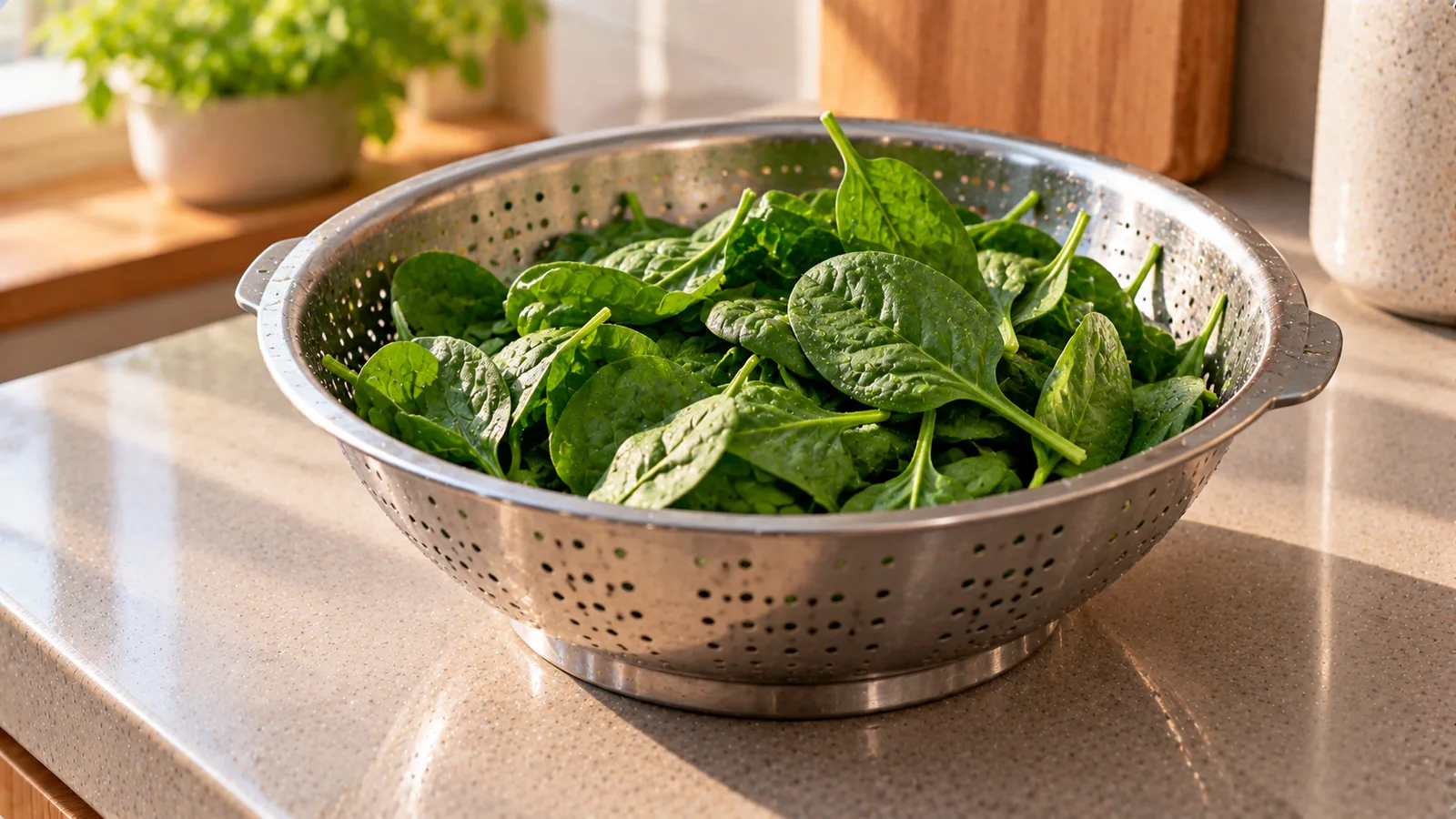
Spinach is a low-calorie leafy vegetable, but its portion size can be surprisingly confusing because fresh leaves lose a large amount of volume during cooking.
As a practical reference, raw spinach contains about 23 kcal per 100 g. Cooked spinach can show a different value per 100 g because cooking changes its water content and weight.
Spinach nutrition per 100 g
A typical 100 g portion of raw spinach provides approximately:
| Nutrient | Approx. amount |
|---|---|
| Calories | ~23 kcal |
| Protein | ~2.9 g |
| Carbohydrates | ~3.6 g |
| Fat | ~0.4 g |
| Fiber | ~2.2 g |
Spinach also provides micronutrients, but exact nutrient values vary by product, growing conditions and preparation.
Calories in common raw spinach portions
Using approximately 23 kcal per 100 g:
| Raw spinach | Approx. calories |
|---|---|
| 25 g | 6 kcal |
| 50 g | 12 kcal |
| 75 g | 17 kcal |
| 100 g | 23 kcal |
| 150 g | 35 kcal |
| 200 g | 46 kcal |
| 250 g | 58 kcal |
For any weighed amount:
grams × calories per 100 g ÷ 100
For example:
180 g × 23 ÷ 100 ≈ 41 kcal
Why a large bowl of spinach can contain few calories
Fresh spinach leaves contain a large amount of water and take up considerable space.
This means a visually large bowl may still weigh relatively little.
For example, 100 g of raw spinach can look like a substantial volume while containing only around 23 kcal before dressing, oil, cheese or other ingredients are added.
For tracking purposes, the weight is more useful than judging the portion by volume.
How many calories are in one cup of raw spinach?
A cup of loose raw spinach is a very light serving and may weigh only around 25–35 g depending on how tightly the leaves are packed.
If one cup weighs 30 g:
30 × 23 ÷ 100 ≈ 7 kcal
Two cups at the same density would weigh approximately 60 g:
60 × 23 ÷ 100 ≈ 14 kcal
Cup measurements should therefore be treated as estimates.
Raw versus cooked spinach
Spinach shrinks dramatically during cooking because water leaves the leaves and their structure collapses.
Suppose you start with:
300 g raw spinach
At 23 kcal per 100 g:
300 × 23 ÷ 100 = 69 kcal
After cooking without added fat, the spinach might weigh much less.
The whole batch still contains approximately the same 69 kcal from the spinach itself.
As a result, cooked spinach can contain more calories per 100 g than raw spinach simply because there is less water in the final weight.
Match the food state to the database entry
A common tracking mistake is to weigh cooked spinach and select a raw-spinach entry.
A better rule is:
- weighed raw → use a raw entry;
- weighed cooked → use a cooked entry;
- packaged product → use the package information when possible.
This avoids trying to use a universal raw-to-cooked conversion, which can be inaccurate because water loss varies.
Tracking spinach before cooking
If you cook one portion yourself, weighing the spinach before cooking is straightforward.
Example:
Raw spinach: 250 g
Reference: 23 kcal per 100 g
Calories:
250 × 23 ÷ 100 ≈ 58 kcal
If you cook it without calorie-containing ingredients, the spinach itself still contributes approximately 58 kcal even after it shrinks.
Tracking a cooked batch
For meal prep, calculate the total raw spinach first and then weigh the finished batch.
Example:
Raw spinach: 600 g
Calories:
600 × 23 ÷ 100 = 138 kcal
Suppose the finished cooked spinach weighs 240 g.
Calories per cooked gram:
138 ÷ 240 = 0.575 kcal
A 100 g cooked portion from this batch contains:
100 × 0.575 ≈ 58 kcal
A 150 g portion contains:
150 × 0.575 ≈ 86 kcal
This calculation reflects the actual water loss in your batch.
Protein in spinach
Raw spinach provides approximately 2.9 g protein per 100 g.
Using that reference:
| Raw spinach | Approx. protein |
|---|---|
| 50 g | 1.5 g |
| 100 g | 2.9 g |
| 150 g | 4.4 g |
| 200 g | 5.8 g |
Spinach contributes some protein, but its low calorie density does not make it a concentrated protein source.
Carbohydrates and fiber
Raw spinach contains relatively little carbohydrate.
At approximately 3.6 g total carbohydrate and 2.2 g fiber per 100 g, a 200 g raw portion provides roughly:
- 7.2 g total carbohydrate;
- 4.4 g fiber.
Nutrition labels can display carbohydrate and fiber differently depending on regional labeling rules, so package values may not look identical across countries.
Fresh spinach
Fresh spinach is often sold loose or in bags.
If the package contains plain spinach without dressing or other ingredients, the calorie value should remain low.
For the most accurate portion:
- place a bowl on the scale;
- tare the scale;
- add the spinach;
- record the gram weight.
This is more reliable than estimating handfuls.
Baby spinach
Baby spinach is harvested at an earlier stage than larger mature spinach leaves.
Its calorie density is similarly low.
There is usually no practical reason to treat a small difference between generic spinach and baby spinach as a major calorie difference unless the package provides specific nutrition data.
Frozen spinach
Plain frozen spinach can be convenient because it is already compact.
Its nutrition per 100 g may differ from fresh raw spinach because of processing, blanching and water content.
Use the package value when available.
Also check whether the label refers to:
- frozen product;
- prepared product;
- drained product.
Frozen spinach portions
A 100 g block of frozen spinach should not automatically be assigned the raw-spinach value.
If the package states, for example, 25 kcal per 100 g, use that product-specific figure.
For 180 g:
180 × 25 ÷ 100 = 45 kcal
The package value is more relevant than forcing a generic raw reference onto the product.
Canned spinach
Canned spinach can have different water and sodium content from fresh spinach.
If it is drained before eating, use a value corresponding to drained spinach when available.
As with other packaged vegetables, the label should take priority over a generic estimate.
Boiled spinach
Boiling spinach in plain water does not add calories.
However, the water content of the spinach can change, so calories per 100 g of the finished product may differ from the raw value.
If you know how much raw spinach you used, calculating from the starting amount can be easier.
Steamed spinach
Steaming also changes the weight and volume without adding calories by itself.
Any butter, oil or sauce added afterward should be counted separately.
Sautéed spinach
Sautéed spinach can contain considerably more calories than plain spinach because cooking fat is often added.
Suppose you use:
- 300 g raw spinach;
- 15 g olive oil.
Spinach:
300 × 23 ÷ 100 = 69 kcal
Olive oil at approximately 884 kcal per 100 g:
15 × 884 ÷ 100 ≈ 133 kcal
Total:
69 + 133 = approximately 202 kcal
In this example, the oil contributes almost twice as many calories as the spinach.
Spinach with butter
Suppose you cook:
- 250 g raw spinach;
- 10 g butter.
Spinach:
250 × 23 ÷ 100 ≈ 58 kcal
Butter at approximately 717 kcal per 100 g:
10 × 717 ÷ 100 ≈ 72 kcal
Total:
58 + 72 = approximately 130 kcal
Even a modest amount of butter can therefore contribute more calories than the spinach itself.
Creamed spinach
Creamed spinach is a different food from plain cooked spinach.
Recipes may contain:
- cream;
- milk;
- butter;
- flour;
- cheese;
- oil.
The final calorie count depends on the complete recipe.
Do not weigh a serving of creamed spinach and apply a plain-spinach calorie value to the entire portion.
Spinach with cheese
Cheese can substantially change the energy and macro profile of a spinach dish.
For example, spinach with feta, mozzarella or Parmesan should be tracked as separate ingredients or as a complete recipe.
The same applies to spinach-and-cheese fillings in pastries, pasta or casseroles.
Spinach salad
A bowl of raw spinach may contribute very few calories, but a spinach salad can be much more energy-dense.
Common additions include:
- olive oil;
- dressing;
- nuts;
- seeds;
- cheese;
- avocado;
- dried fruit;
- croutons.
Suppose a salad contains 100 g spinach and 20 g olive oil.
Spinach:
100 × 23 ÷ 100 = 23 kcal
Oil:
20 × 884 ÷ 100 ≈ 177 kcal
Before counting any other ingredients, the salad already contains approximately:
23 + 177 = 200 kcal
The dressing can therefore matter far more than the spinach.
Spinach in smoothies
When spinach is blended into a smoothie, blending itself does not meaningfully increase its calories.
If you add 50 g raw spinach:
50 × 23 ÷ 100 ≈ 12 kcal
The larger calorie contribution often comes from ingredients such as:
- milk;
- yogurt;
- fruit;
- nut butter;
- oats;
- protein powder.
Track the complete smoothie rather than judging it by the spinach content.
Spinach in an omelet
Suppose an omelet contains 80 g raw spinach.
Spinach contributes:
80 × 23 ÷ 100 ≈ 18 kcal
Eggs, cheese and cooking fat are separate components.
This makes it easier to understand which ingredients contribute most of the meal's calories.
Spinach in pasta
A pasta dish containing spinach should not be tracked as spinach alone.
The major calorie sources may include:
- pasta;
- olive oil;
- cream;
- cheese;
- meat;
- sauce.
For a homemade dish, calculate each ingredient or save the complete recipe.
Spinach in a curry
Spinach-based curries can vary from relatively light dishes to recipes containing substantial oil, cream, coconut milk or cheese.
The calorie value of plain spinach therefore tells you very little about the complete curry.
Use the recipe ingredients or product-specific nutrition information.
Does cooking destroy the calories in spinach?
Cooking does not remove a meaningful amount of the spinach's energy simply because the leaves shrink.
The dramatic reduction in volume is mostly related to water and structure.
This is why 300 g of raw spinach can become a relatively small cooked serving while retaining roughly the same total calories from the spinach.
Is spinach high in protein for its calories?
Spinach provides some protein relative to its very low calorie content, but this can be misleading when comparing foods.
A 100 g portion has only around 3 g protein.
To obtain large amounts of protein from spinach alone, you would need a very large quantity.
It is more useful to view spinach as a vegetable that contributes some protein rather than as a primary protein food.
Is spinach low in calories?
Plain spinach is low in calorie density.
Using the raw reference:
- 50 g → ~12 kcal
- 100 g → ~23 kcal
- 200 g → ~46 kcal
- 300 g → ~69 kcal
The final dish can nevertheless become much more calorie-dense when fats, cheese, cream or other ingredients are added.
Example: complete side dish
Suppose you prepare:
- 400 g raw spinach;
- 12 g olive oil;
- garlic and seasonings.
Spinach:
400 × 23 ÷ 100 = 92 kcal
Oil:
12 × 884 ÷ 100 ≈ 106 kcal
Total:
92 + 106 = approximately 198 kcal
If the finished dish is divided into three equal portions:
198 ÷ 3 ≈ 66 kcal per portion
This is more accurate than using a generic value for “cooked spinach with oil.”
Restaurant spinach
Restaurant spinach may be cooked with oil, butter, cream or cheese even when those ingredients are not obvious.
If nutrition information is unavailable, estimate the spinach and added fats separately when practical.
A plain raw-spinach reference can underestimate a prepared restaurant side dish.
Package-label example
Suppose a frozen spinach package states:
- 28 kcal per 100 g;
- 3.1 g protein;
- 2.0 g carbohydrate;
- 0.6 g fat.
You eat 180 g.
Calories:
180 × 28 ÷ 100 ≈ 50 kcal
Protein:
180 × 3.1 ÷ 100 ≈ 5.6 g
Carbohydrate:
180 × 2.0 ÷ 100 = 3.6 g
Fat:
180 × 0.6 ÷ 100 ≈ 1.1 g
For that product, these values are more relevant than a generic raw-spinach reference.
Common tracking mistakes
Spinach is often logged inaccurately when people:
- estimate large handfuls instead of weighing them;
- weigh cooked spinach but select a raw entry;
- assume shrinking during cooking means calories disappeared;
- forget oil or butter used during cooking;
- log creamed spinach as plain spinach;
- ignore dressing, nuts or cheese in a spinach salad;
- use a fresh-spinach value for a packaged frozen product without checking the label;
- apply the spinach value to the full weight of a mixed dish.
Quick reference
For raw spinach at approximately 23 kcal per 100 g:
- 25 g: ~6 kcal
- 50 g: ~12 kcal
- 75 g: ~17 kcal
- 100 g: ~23 kcal
- 150 g: ~35 kcal
- 200 g: ~46 kcal
- 250 g: ~58 kcal
- 300 g: ~69 kcal
The most important distinction is between the spinach itself and the complete prepared dish.
For accurate tracking, match the database entry to the state in which you weighed the spinach and include oil, butter, cream, cheese, dressing and other calorie-containing ingredients separately.