
Oat Bran vs Oatmeal: Fiber, Portions and Price
What is being compared?
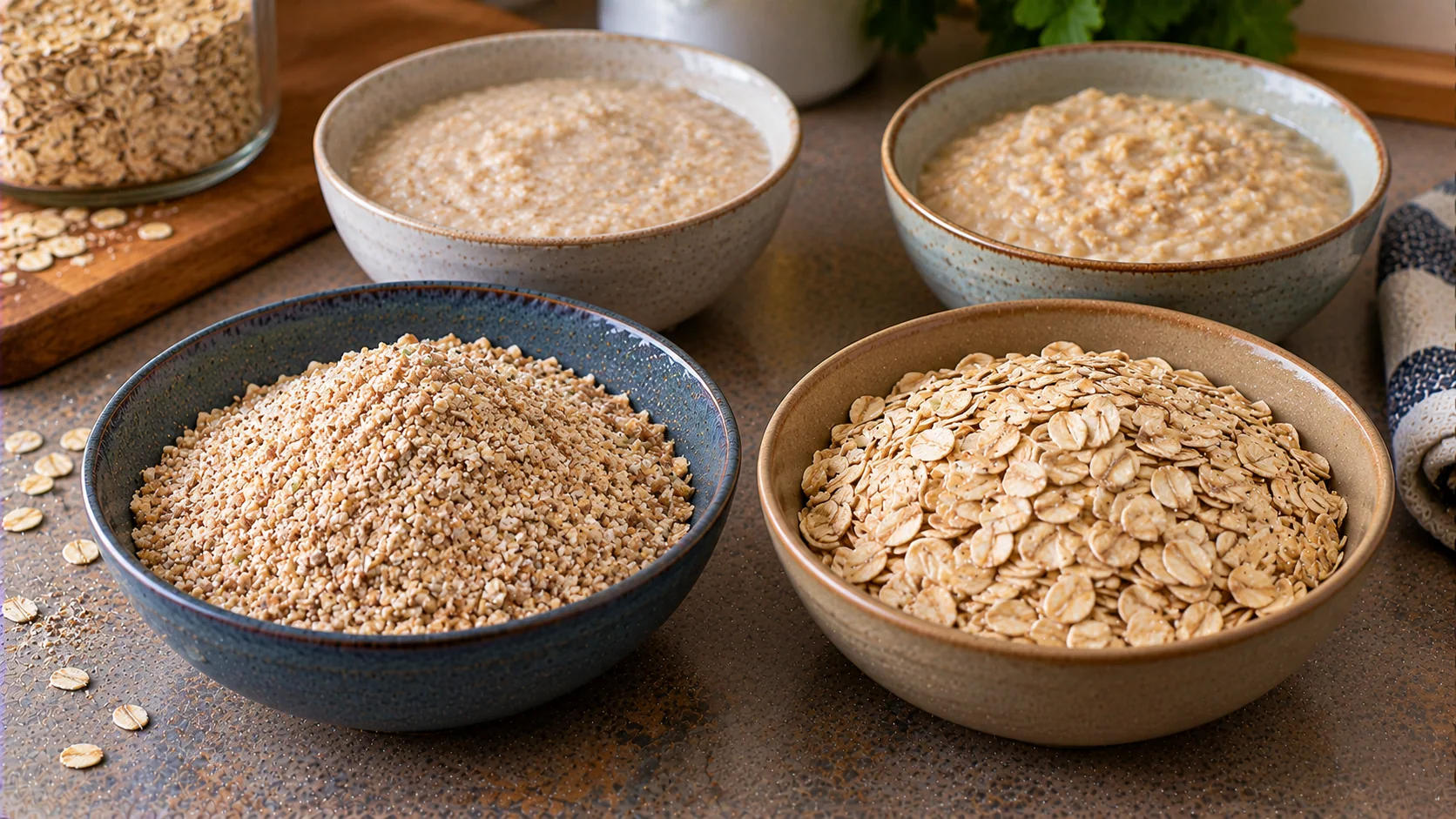
Oat bran is the fibre-rich outer layer separated during oat milling, while oatmeal here means plain rolled oats, not a sugary instant-flavour sachet or a prepared porridge containing milk. Both start as oats but differ in particle size, texture and typical serving amount. Do not confuse oat bran with a ready-to-eat bran breakfast cereal; those may contain sugar, wheat or salt. The most reproducible comparison starts with the product dry, before water or milk is added. This article compares fibre concentration and practical cost, rather than claiming either food independently treats a disease.
Fibre and protein per 100 g dry
One manufacturer lists its plain rolled oats at 9.0 g fibre, 11 g protein and 374 kcal per 100 g dry; see the Quaker product label. A USDA legacy reference for raw oat bran reports 15.4 g fibre, 17.3 g protein and 246 kcal per 100 g; explore the corresponding record using FoodData Central. These figures are from different references and measurement conventions. They are illustrative, not guaranteed values for every European product. Use the nutrition panel of the actual bags when comparing brands. The unusual energy difference particularly should not be interpreted as proof that every oat-bran product is substantially lower in calories: labelling systems and sources can differ.
| Comparison | Rolled oats | Raw oat bran |
|---|---|---|
| Fibre / 100 g dry | 9.0 g | 15.4 g |
| Protein / 100 g dry | 11.0 g | 17.3 g |
| Energy / 100 g dry | 374 kcal | 246 kcal |
Realistic bowl sizes and cooked weights
Water changes weight, not the amount of fibre originally in the dry cereal. Take a 40 g dry rolled-oat portion cooked with 160 g water: the bowl weighs about 200 g before evaporation and additions. For a separate comparison, take 30 g dry oat bran with 170 g water: around 200 g before evaporation. These are two different dry serving sizes, not a strict gram-for-gram comparison. Actual porridge thickness and water loss vary. Milk, berries, yoghurt, sugar and toppings add their own nutrients and cost, so exclude them from the baseline calculation.
How much fibre does each bowl provide?
Using the reference values above, 40 × 9/100 gives 3.60 g fibre in 40 g rolled oats. For bran, 30 × 15.4/100 gives 4.62 g fibre in 30 g bran. A 40 g bran serving would provide 6.16 g on the same reference basis. Cooking with plain water does not multiply these quantities; it dilutes fibre per 100 g of the prepared bowl. The distinction matters because an apparently impressive figure per 100 g dry is not the same as fibre eaten at breakfast. Values rounded to two decimal places are calculated examples only.
| Comparison | Rolled oats | Raw oat bran |
|---|---|---|
| Example dry portion | 40 g | 30 g |
| Fibre in example portion | 3.60 g | 4.62 g |
Compare the price fairly
The price of a package alone is a poor comparison if weights differ. Illustrative scenario: a 500 g bag of oat bran costs €2.50, or €0.50 per 100 g dry; a 1,000 g bag of rolled oats costs €2.00, or €0.20 per 100 g. Thus 30 g bran costs €0.15, and 40 g oats €0.08. On these assumed prices, €0.15/4.62 gives €0.0325 per gram of fibre, compared with €0.08/3.60 = €0.0222 for oats. Rolled oats are cheaper per fibre gram in this scenario, despite the lower fibre concentration. This is not a claim about current supermarket shelf prices.
| Comparison | Rolled oats | Raw oat bran |
|---|---|---|
| Assumed pack | 1,000 g / €2.00 | 500 g / €2.50 |
| Cost per example portion | €0.08 | €0.15 |
| Cost per g fibre | €0.0222 | €0.0325 |
Cooking and texture
Rolled oats generally retain visible flakes and soften into a creamy porridge after several minutes of gentle cooking. Fine bran hydrates more quickly and thickens a liquid without the same flake structure. For a basic bowl, simmer 40 g flakes with around 160–200 ml water as directed by the pack; for bran, stir 30 g into roughly 170–200 ml and heat gently until fully hydrated. Adjust liquid gradually rather than expecting identical texture. Neither of these is a validated medical diet. Those with coeliac disease need an explicitly gluten-free certified oat product because cross-contact with wheat or barley can occur.
Nutrition claims and limitations
Fibre figures can differ with cultivar, processing, testing and the rules used to express dietary fibre. In the EU the nutrition panel usually reports fibre separately from carbohydrate. An oat beta-glucan health claim, where permitted, has specific conditions; it should not be inferred from any bran bowl without confirming the relevant quantity and compliant wording. Always distinguish total oat fibre from beta-glucan specifically. In addition, an oat product with a high fibre number is not automatically low in added sugar if it is flavoured.
Choosing between the two
Choose rolled oats if you want inexpensive, familiar porridge flakes or a firmer texture in overnight oats. Choose bran if you prefer a smaller dry portion with more fibre in the reference comparison or if you want to thicken porridge and baking mixtures. Both can fit a balanced diet; increase fibre gradually and drink enough fluid if your usual intake is low. For the wider background on oats, read nutrition and portion sizes for oats, and for daily fibre planning consult other practical fibre calculations.
Sources
- USDA FoodData Central — raw oat-bran reference; confirm the ingredient and state.
- Quaker Traditional Rolled Oats — pack label for rolled oats.