
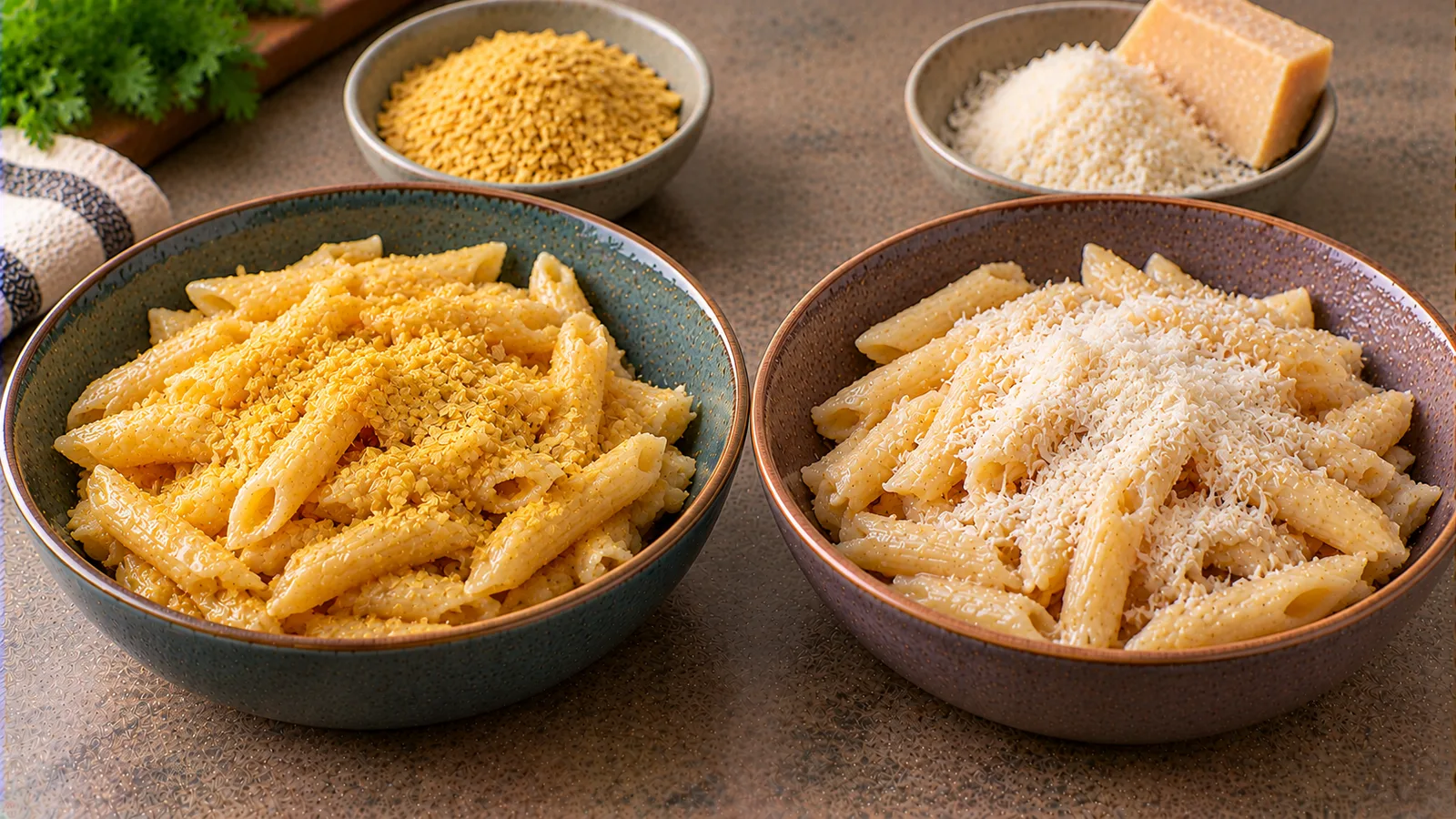
Nutritional yeast and Parmesan can both finish a bowl of pasta with a savoury taste. But a comparison based on vague claims that one is “more protein-rich” or “lower in salt” can be wrong: nutritional-yeast products differ substantially, and pasta toppings are normally used in small quantities. The useful question is what 10 g of the specific product actually adds to your plate.
In this worked comparison, VITAM Hefeflocken Klassik, a 100% yeast-flake product, supplies 4.81 g protein and 0.02 g salt per 10 g. The published average for Parmigiano Reggiano supplies 3.24 g protein and 0.16 g salt per 10 g. This result belongs to these references, not to every yeast seasoning. One dmBio wheat-based yeast-flake blend lists 0.50 g salt in the same 10 g—more, not less, than Parmesan.
Nutritional yeast vs Parmesan: a 10 g topping
| Label value | VITAM yeast flakes | Parmigiano Reggiano |
|---|---|---|
| Basis | 10 g topping | 10 g topping |
| Protein | 4.81 g | 3.24 g |
| Salt | 0.02 g | 0.16 g |
| Energy | 34.1 kcal | 40.2 kcal |
| Fat | 0.64 g | 2.97 g |
| Saturated fat | 0.12 g | 1.96 g |
| Dairy ingredient | No | Milk |
| Naturally suitable for vegans | Yes, per listed ingredients | No |
These numbers come from the VITAM Hefeflocken Klassik nutrition panel and the Parmigiano Reggiano Consortium's average composition, both stated per 100 g and divided by ten. Energy and nutrients are topping-only: they exclude the pasta, sauce, oil, meat or vegetables. The cheese figures describe the protected Parmigiano Reggiano product; a generic grated hard-cheese blend may be different.
Why this comparison uses the same 10 g
Comparing 100 g of dry yeast flakes with 100 g of hard cheese is mathematically simple but not very helpful for dinner. Most people do not add 100 g of either ingredient to one plate. We therefore start with 10 g weighed on kitchen scales as an illustrative pasta topping, not a declared standard serving or a taste-equivalence claim. Dry yeast flakes and fluffy grated cheese have different densities; a tablespoon can weigh different amounts. Use grams rather than matching spoonfuls or volume.
For reference, the calculation is label value per 100 g × 10 ÷ 100. Thus VITAM protein = 48.1 × 0.1 = 4.81 g, while Parmesan protein = 32.4 × 0.1 = 3.24 g. For salt, 0.2 × 0.1 = 0.02 g for VITAM, against 1.6 × 0.1 = 0.16 g for Parmesan. The differences are 1.57 g more protein and 0.14 g less salt in the particular VITAM example. That is modest in the context of a whole lunch, and sauce salt may contribute much more.
For a bigger 15 g topping, multiply each 100 g value by 0.15. The VITAM example gives 7.22 g protein and 0.03 g salt (7.215 g protein before rounding); Parmesan gives 4.86 g protein and 0.24 g salt. These are topping calculations, not changes in the nutrients already in the cooked pasta.
Different nutritional yeasts do not have one nutrition label
Here is the important counterexample. The dmBio yeast flakes on a wheat basis are not the same formula as the VITAM flakes. The dmBio product lists 65% yeast autolysate, 30% wheat flour and 5% sea salt. Its nutrition label lists 25 g protein and 5 g salt per 100 g, compared with 48.1 g protein and 0.2 g salt per 100 g for VITAM. The ingredient composition matters; marketing words such as “yeast flakes” do not guarantee a specific salt or protein level.
| Product, weighed topping | Protein per 10 g | Salt per 10 g | What to check |
|---|---|---|---|
| VITAM Hefeflocken Klassik | 4.81 g | 0.02 g | 100% yeast-flake ingredient |
| dmBio wheat-based yeast flakes | 2.50 g | 0.50 g | Wheat and 5% added sea salt |
| Parmigiano Reggiano reference | 3.24 g | 0.16 g | Milk and animal rennet |
In this counterexample, 10 g dmBio provides 0.34 g more salt than 10 g Parmesan. A person trying to limit salt should read the exact packet instead of assuming every plant-based topping is low in salt. The dmBio product also contains wheat/gluten, whereas the VITAM product description lists yeast flakes produced from molasses as its sole ingredient. Allergy and cross-contact statements must be checked on the actual pack, not inferred from the brand alone.
Protein matters, but the whole pasta meal matters more
Neither topping should be the main protein strategy for a meal. A plate containing 75 g dry pasta plus vegetables and sauce has its own protein contribution, and the 10 g topping adds only the amounts shown. For an illustrative 20 g protein target for the meal, the topping alone does not come close: 4.81 g with the specific yeast or 3.24 g with Parmesan is an addition, not the whole goal. The protein content of the pasta depends on variety and brand. Our comparison protein pasta versus lentil pasta focuses on protein pasta versus lentil pasta on a separately defined protein-cost basis; do not transfer those product-specific prices to this topping.
If you want an actual higher-protein plate, check the cooked meal as a whole and consider beans, lentils, tofu, fish, meat or another appropriate protein food in the sauce. Simply adding two or three times as much topping may produce too strong a flavour or too much salt, particularly with the wheat-based seasoning example.
Salt: check grams, not vague front-of-pack messages
EU prepacked-food labels normally present salt and protein per 100 g, with any per-portion panel given in addition. That lets shoppers calculate a common weight; see the EU nutrition declaration guidance. The term “salt” on European nutrition panels is not interchangeable with a separately stated sodium figure in milligrams. Our guide sodium versus salt on nutrition labels explains how to convert sodium to salt when the label uses a different system.
For this example, VITAM has 0.02 g salt and Parmesan 0.16 g per 10 g. That does not prove a meaningful difference in total dietary salt without considering the sauce, cooking water and other foods. A store-bought pesto or jarred sauce may contribute additional salt; do not ignore it while focusing on the garnish. If you need a specific salt restriction for medical reasons, use your individual dietary advice and check complete meals.
EU authorised nutrition claims such as “low salt” or “high protein” are subject to defined conditions. An ingredient having a relatively low salt number compared with another ingredient is not, by itself, proof that a packaged product legally qualifies for a specific claim. Refer to the European Commission's nutrition-claims conditions rather than inventing an unverified badge.
Does nutritional yeast provide vitamin B12?
Do not count vitamin B12 unless the exact package confirms fortification and a numeric B12 amount. Yeast-flake products can be unfortified or fortified. The VITAM product page used for our protein-and-salt calculation lists multiple B vitamins but does not declare a vitamin B12 value in its displayed panel. That omission does not support assigning it a B12 quantity. The cheese source provides separate nutrient information, but this article does not assume a matched B12 comparison because the yeast evidence is incomplete.
If you are choosing a yeast product specifically for B12, find vitamin B12 / cobalamin in the ingredients or nutrition table and look for a declared amount per 100 g and ideally per serving. “Contains B vitamins” is insufficient. The NHS vegan-diet advice explicitly names B12-fortified yeast flakes as a possible dietary source, not all yeast flakes.
For someone following a vegan diet, the German Nutrition Society (DGE) recommends regular, reliable B12 supplementation and appropriate follow-up rather than trusting unverified plant foods to cover needs. A pasta sprinkle is not an adequate substitute for that guidance. The broader article vitamin B12 and vegan eating addresses how to evaluate reliable B12 sources without confusing vitamin labelling with the protein comparison here.
Taste, texture and cooking use
Parmesan contributes a strong matured-cheese aroma, fat and a granular texture. It can be finely grated over hot pasta or folded through sauce. The reference Parmesan is made from milk, salt and animal rennet, so it is neither dairy-free nor suitable for a strict vegan diet. A lactose-related claim does not cancel the presence of milk protein, which matters to people with a milk allergy.
Nutritional yeast adds a savoury, nutty, sometimes cheese-like flavour, but it is not melted cheese. Sprinkle it over the plated pasta or stir it into the finished sauce; it may thicken wet sauce slightly. Some flakes contain flour, added salt or vitamins; texture and flavour differ with formula. For a dairy-free meal, read all ingredient and cross-contact statements, including those of the sauce and pasta toppings. If gluten avoidance is necessary, the wheat-based dmBio example is unsuitable.
Try a small side-by-side taste test: prepare one common batch of pasta, split it into two plates, add 10 g weighed VITAM flakes to the first and 10 g grated Parmigiano Reggiano to the second, and keep sauce, pasta weight and added salt constant. These are equal weights, not a claim that the flavours are equally strong. Taste before adding extra salt. Repeat with your own brand only after recalculating from its label.
A practical label-reading checklist
- Name the actual product. Is it pure yeast flakes, a yeast-and-wheat seasoning, or a flavoured cheese alternative? For cheese, is it genuine Parmigiano Reggiano or a generic grated blend?
- Weigh the amount you use. Choose 5 g, 10 g or 15 g and calculate from per-100-g figures; do not assume a tablespoon always weighs 10 g.
- Compare protein in grams. Divide per-100-g protein by ten for 10 g. The example yields 4.81 g, 2.50 g or 3.24 g depending on the product.
- Compare salt in grams. The three example values for 10 g are 0.02 g, 0.50 g and 0.16 g; their order differs from a generic “vegan versus cheese” assumption.
- Verify allergens and B12. Milk matters for Parmesan; wheat matters for some yeast blends. B12 must be explicitly declared if you intend to count it.
- Count the whole dish. Sauces, pasta and added seasoning can change the protein and total salt much more than the garnish.
Sources and calculation notes
- VITAM Hefeflocken Klassik — product ingredients and nutrition: 100% yeast flakes, per 100 g 48.1 g protein, 0.2 g salt, 341 kcal, 6.4 g fat and 1.2 g saturates.
- Parmigiano Reggiano Consortium — nutritional characteristics: mean per 100 g 32.4 g protein, 1.6 g salt, 402 kcal, 29.7 g fat and 19.6 g saturates.
- dmBio wheat-based yeast-flake label: 25 g protein, 5 g salt per 100 g; includes wheat flour and added sea salt.
- Your Europe — nutrition declaration and European Commission — nutrition claims: comparable per-100-g labels and conditions for regulated claims.
- NHS vegan diet and DGE vegan nutrition FAQs: B12 fortification and vegan B12 supply precautions.
Method: per-10-g values are published per-100-g manufacturer or consortium figures multiplied by 0.10. The 15 g figures multiply by 0.15. All values are product-specific averages rounded for reading, not laboratory tests of a prepared meal. No current prices are claimed, and no B12 number is imputed to unlabelled yeast.