
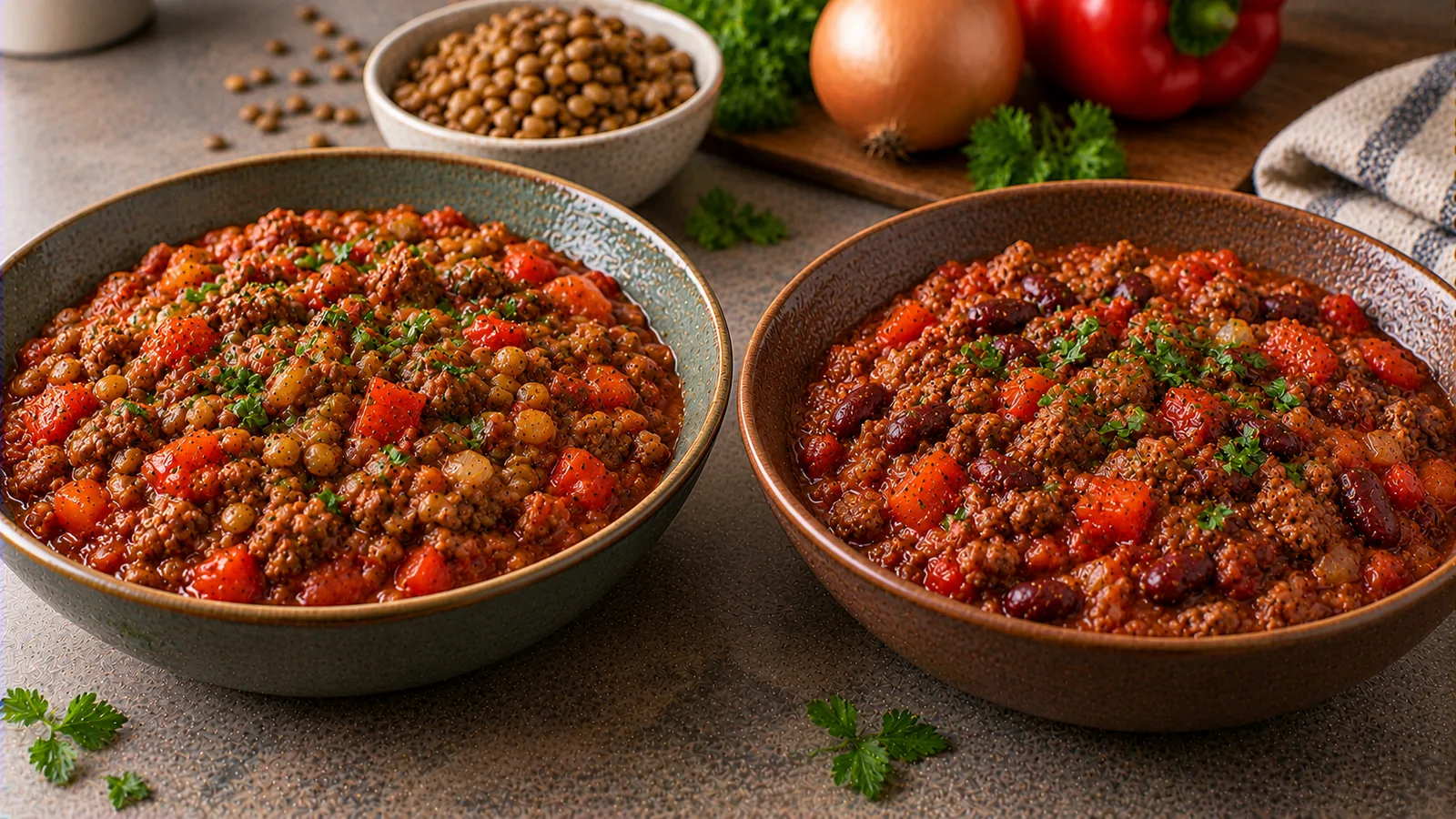
Replacing some minced beef with drained lentils can lower the ingredient cost of chili, but it also changes the protein count. The useful question is not whether lentils and beef are interchangeable gram for gram. It is what happens when you cook two complete pots of chili, divide each into four servings, and use the same vegetables, tomato sauce and seasonings. This comparison does that, distinguishing protein supplied by the beef and lentils from the additional, brand-dependent protein in the vegetables.
We compare 600 g raw lean minced beef in the beef-only pot with 300 g of the same raw beef plus 300 g drained, ready-to-eat brown lentils in the hybrid. Both versions have 600 g of principal protein ingredients, the same sauce and four bowls. They are equivalent in recipe structure and pre-cooking main-ingredient weight, not in protein, calories, cooked weight or satiety. Moisture loss and simmering affect final mass, so do not pretend every cooked bowl weighs exactly the same.
Two complete chili recipes: ingredients for four servings
| Ingredient, measured before cooking | Beef-only chili | Beef-and-lentil chili |
|---|---|---|
| Lean minced beef, raw | 600 g | 300 g |
| Brown lentils, canned and thoroughly drained | 0 g | 300 g |
| Plain tomato passata | 800 g | 800 g |
| Onion, prepared | 200 g | 200 g |
| Bell pepper, prepared | 200 g | 200 g |
| Cooking oil | 20 mL | 20 mL |
| Chili powder, cumin, paprika, garlic and salt | About 12 g total | About 12 g total |
| Servings | 4 | 4 |
The shared ingredients keep flavor and vegetable volume roughly comparable. The seasonings are a flexible blend, not a medical sodium target: salt is to taste and the actual salt per bowl cannot be estimated from a generic 12 g mixed spice line. If seasoning with a salty premix or adding stock, inspect its label. Both recipes are chili, not a raw-meat versus cooked-legume laboratory trial. No rice, tortilla, cheese or sour cream is included in the cost or protein totals below.
Method: cook each pot separately
- Prepare: Drain and briefly rinse the canned lentils, weigh 300 g after draining. Dice the 200 g onion and 200 g pepper. Have 800 g passata ready. The lentil tin lists 240 g drained content per 400 g total fill, so 300 g requires opening two tins; keep the remaining drained 180 g for another meal.
- Brown the beef: Heat 20 mL oil in a pan or heavy pot, add the 600 g or 300 g of raw beef and break it up. Cook thoroughly, without leaving raw clumps; separate utensils that have contacted raw mince.
- Build the shared sauce: Add the onion and pepper, soften them, then mix in passata and spices. Stir and simmer gently for about 15–20 minutes, adjusting heat and splashes of water to stop sticking. Cooking time is approximate; food safety is governed by actual thorough heating, not the clock alone.
- Finish: In the hybrid pot, stir in 300 g drained lentils during the last 5–10 minutes to heat them through; do not cook them from dry. The beef-only pot needs no lentils. Keep the sauce in the meal: draining away large amounts of beef liquid would change the nutrient balance.
- Serve: Divide each finished pot into four portions. For an exact per-100 g cooked analysis, weigh the finished pot and then a serving; the calculations here allocate ingredient totals by four, irrespective of moisture loss.
The German Federal Institute for Risk Assessment (BfR) advises heating food throughout to at least 70 °C for two minutes, including ground meat, and avoiding cross-contamination. A thermometer is preferable to judging by color alone. Cool leftovers promptly in shallow containers; refrigerate and eat within two to three days, or freeze portions for later.
Protein per bowl: what the labels actually establish
The REWE lean minced-beef example declares 20 g protein, 130 kcal, 5.6 g fat and 2 g saturated fat per 100 g raw meat. This is one specific product profile, not a guaranteed value for all ground beef. The dmBio brown-lentil label gives 7.7 g protein, 96 kcal, 4.6 g fiber and 0.35 g salt per 100 g and 240 g drained weight for the tin. The comparison uses these declarations applied to measured ingredients before simmering.
| Counted nutritional component | Beef-only pot | Hybrid pot |
|---|---|---|
| Protein from raw beef | 600 × 20 / 100 = 120.0 g | 300 × 20 / 100 = 60.0 g |
| Protein from drained lentils | 0 g | 300 × 7.7 / 100 = 23.1 g |
| Protein from these two ingredients, whole pot | 120.0 g | 83.1 g |
| Protein from these ingredients, per 1 of 4 bowls | 30.0 g | 20.8 g (20.775 unrounded) |
| Fiber from lentils per bowl | 0 g | 3.45 g |
| Beef-derived saturated fat per bowl | 3.0 g | 1.5 g |
The difference is 9.2 g protein per bowl (9.225 g before rounding). Passata, onion and pepper contribute more protein and fiber, but they are held constant between recipes and not numerically counted because their chosen retail labels have not been specified. Therefore 30.0 g and 20.8 g are protein-source subtotals, not exact full-meal protein. Oil contains no meaningful protein; changing toppings or adding a grain will change the plate further.
These inputs do not justify calculating protein per 100 g of finished chili: the final simmered weight is unknown. Losing water concentrates protein per 100 g cooked chili without creating protein. Some solids may adhere to the pot or be discarded. Divide an intact pot evenly for the four-bowl estimate, or weigh and recalculate your individual portion.
Energy, fat, fiber and texture are not equivalent
For the two featured protein ingredients alone, raw beef supplies 780 kcal in the beef-only pot. In the hybrid, the beef supplies 390 kcal and the lentils 288 kcal, giving 678 kcal in the combined protein ingredients. The difference is 102 kcal across four portions, or 25.5 kcal per bowl, before passata, vegetables, oil and any sides. This is not a claim that the complete hybrid dinner is low-calorie: a larger oil pour or rice side can easily exceed that gap.
The beef source contributes 33.6 g fat in the beef-only pot and 16.8 g in the hybrid; lentils add roughly 1.2 g fat to the hybrid. Shared oil adds fat to both. The lentil component alone adds 13.8 g fiber to the hybrid pot, or 3.45 g per portion. Tomatoes, onion and pepper add still more fiber to each pot. Beef contributes essentially none. The hybrid is likely to be thicker and more textured: the cooked lentils thicken the tomato sauce and give a softer bite than the meat-only version. If you prefer a smoother sauce, crush some lentils with a spoon; do not puree the entire pot unless that texture is desired.
Cost of used ingredients: an explicit example, not a store quote
The 500 g beef pack for €6.49, 500 g passata for €0.89, 1 kg onions for €1.49, 500 g pepper for €2.49 and 1 L oil for €3.49 are illustrative assumptions, not offers seen at REWE or another shop. A €0.20 allowance covers spices used. The beef nutrition numbers are from a real REWE listing for a different package size; the hypothetical 500 g pack price must not be attributed to REWE. For lentils the sample uses €1.15 per 240 g drained tin, a price displayed on the cited dm product page when checked; confirm locally before purchasing. Cost allocation values used below are indicative, with rounding at the end.
| Ingredient used in four servings | Beef-only: cost used | Hybrid: cost used |
|---|---|---|
| Lean beef (€6.49 / 500 g) | 600 g = €7.79 | 300 g = €3.89 |
| Canned lentils (€1.15 / 240 g drained) | €0.00 | 300 g = €1.44 |
| Passata (800 g of €0.89 / 500 g) | €1.42 | €1.42 |
| Onion (200 g of €1.49 / kg) | €0.30 | €0.30 |
| Pepper (200 g of €2.49 / 500 g) | €1.00 | €1.00 |
| Oil (20 mL of €3.49 / L) | €0.07 | €0.07 |
| Seasoning used, allowance | €0.20 | €0.20 |
| Total for four servings | €10.78 | €8.32 |
| Cost per bowl | €2.69 | €2.08 |
With those particular example inputs, the hybrid reduces the cost of ingredients used by €2.46 per pot, or €0.61 per portion, while reducing the protein contributed by beef and lentils by about 9.2 g per portion. That is a trade-off, not proof that the cheaper bowl has the same protein. Both bowls may be appropriate meals, depending on sides and the rest of the day's protein intake.
Checkout totals are different from ingredient-use totals
To cook from an empty pantry with the hypothetical package sizes, the beef-only version needs two 500 g beef packs and no lentils. The hybrid needs one beef pack and two 240 g-drained tins of lentils. For the shared recipe, assume purchase of two 500 g passata packs, one 1 kg onion bag, one 500 g pepper pack, one 1 L oil bottle and one €1.19 spice jar. These are an artificial shopping basket, not a verified shop inventory.
- Beef-only checkout: €23.42, including €12.98 beef and €10.44 for the common full packages.
- Hybrid checkout: €19.23, including €6.49 beef, €2.30 lentils and the same €10.44 for common full packages.
Why is the difference in checkout €4.19, not €2.46? Because leftover inventory differs: the beef-only cook has 400 g uncooked beef from the packs, whereas the hybrid cook has 200 g uncooked beef and 180 g drained lentils left, plus shared vegetable, passata, oil and seasoning stocks. Respect refrigerated raw beef use-by information and freeze unused mince promptly if needed; do not save opened mince for days. Opened lentils also require refrigeration and timely use. These leftovers are goods, not money refunded at checkout. To compare spending over several weeks, count how much you actually use and throw away, not just the first receipt.
How to preserve protein when replacing beef
You can replace 300 g raw beef with 300 g drained lentils and obtain the cheaper hybrid described, but that is not protein-neutral. If maintaining the original 120.0 g protein subtotal is the goal, an extra protein source must be calculated from its own label. For illustration, another approximately 479 g drained lentils would contribute 36.9 g protein, replacing the difference across the full pot; this would substantially increase portion mass, fiber and food cost, and need additional tins. That is neither a one-for-one nor necessarily a practical solution.
A smaller substitution (for example, swap 150 g raw beef for 150 g drained lentils in the same four-serving formula) reduces beef protein by 30.0 g, adds 11.55 g lentil protein, and yields a loss of 18.45 g per pot, about 4.6 g per bowl. It also adds 6.9 g lentil fiber per pot. This gentler ratio may preserve a meat-forward taste while reducing some of the cost. For a general lean-versus-fattier-mince selection, see the difference between ground beef and ground turkey fat percentages; it addresses a separate decision from the cost and protein of a complete pot.
Who should pick which pot?
Choose beef-only if you specifically want more protein from the chili itself, prefer a meat-centered texture and the price fits your budget. Choose the hybrid if you want to stretch beef across more portions, add a legume source of fiber and keep the basic chili format. Neither is a magic health food. According to the German Nutrition Society (DGE), people who eat meat should generally keep meat and processed meats to no more than 300 g per week within its dietary pattern recommendations; those guidelines are not a diagnosis or an individual prescription. A hybrid portion here contains 75 g raw beef; a beef-only portion uses 150 g raw beef. The figures are raw recipe allocations and should not be confused with a clinical dietary prescription or a finished cooked serving weight.
Sources and calculation boundaries
- REWE: lean minced beef nutrition label — per 100 g raw meat; the illustrative 500 g price is not a quote from this listing.
- dmBio: canned brown lentils — 240 g drained per tin and the stated nutrient declaration; price subject to change.
- BfR: household food hygiene — heat thoroughly and cool leftovers safely.
- DGE: meat and processed-meat guidance — dietary context rather than a claim about the health effect of this specific recipe.
The protein subtotals omit common vegetables, prices are a dated or hypothetical German example, and nutritional calculations use raw beef and drained ready-cooked lentils, not an imaginary 100 g cooked-chili label. This keeps the comparison reproducible when packages or prices change.