
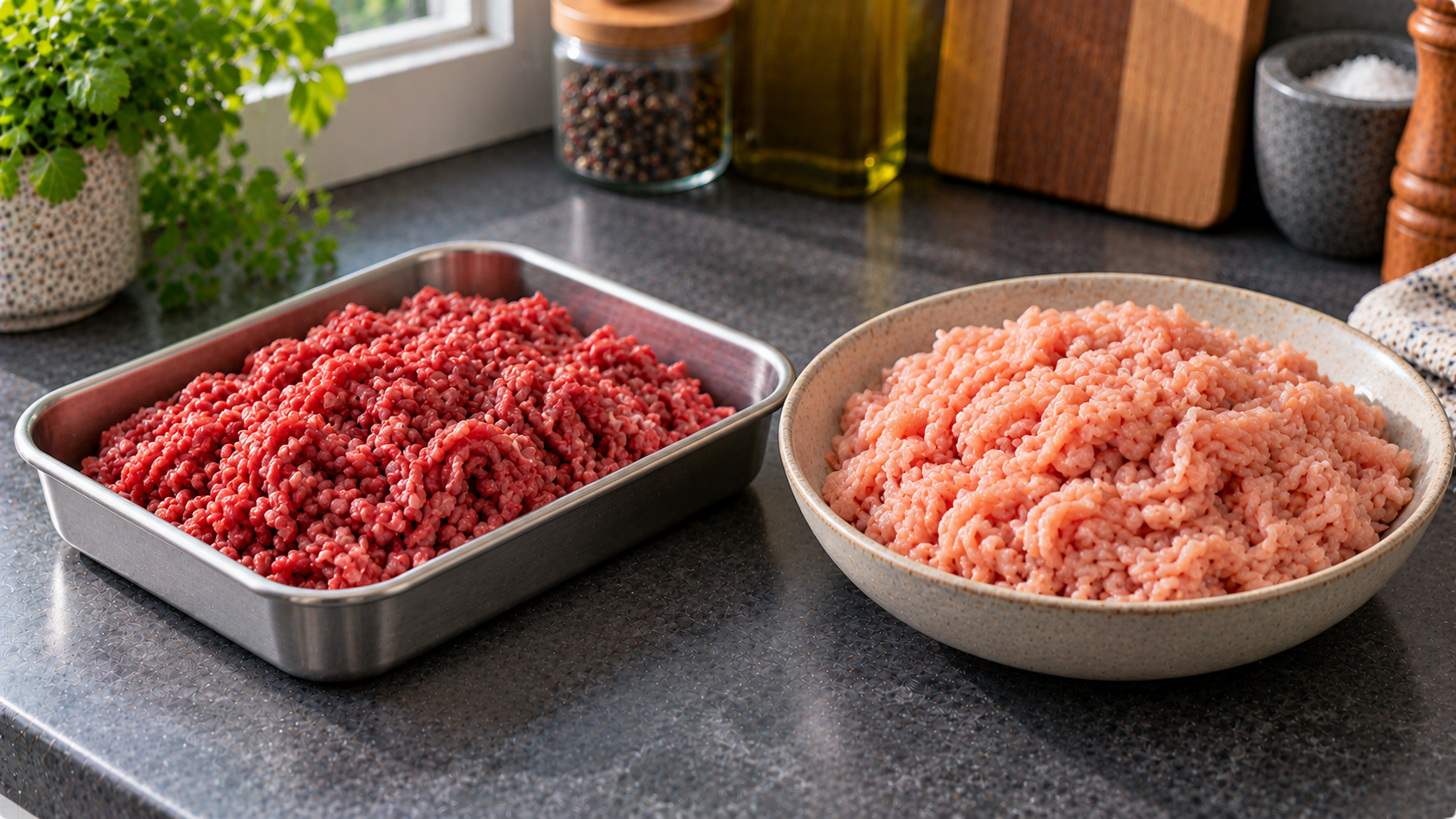
Ground beef and ground turkey can both provide substantial protein, but neither has a fixed nutritional advantage. The most important variable is the fat percentage of the actual product. A lean ground beef product may contain less fat than regular ground turkey, while extra-lean turkey can be substantially leaner than higher-fat beef.
If you are choosing between them for burgers, meatballs, pasta sauce, meal preparation or calorie tracking, compare the labels at the same weight and in the same raw or cooked condition. The species alone is not enough to predict calories, saturated fat or final portion size.
Ground beef vs ground turkey: the key differences
| Feature | Ground beef | Ground turkey | What to check |
|---|---|---|---|
| Protein | Generally high | Generally high | Grams per 100 g |
| Total fat | Depends on the lean-to-fat ratio | Depends on the cut and formulation | Actual grams of fat |
| Saturated fat | Often higher in comparable products | Often lower, but not always | Saturated fat on the label |
| Calories | Strongly affected by fat content | Strongly affected by fat content | Calories per 100 g |
| Iron and zinc | Typically useful sources | Generally contains both | Exact food database entry |
| Vitamin B12 | Typically a useful source | Also provides B12 | Specific food composition |
| Taste | Richer, characteristic beef flavour | Milder flavour | Recipe and seasoning |
| Cooking | Browning and fat rendering | Can dry out when very lean | Temperature and added ingredients |
| Price | Varies by leanness and retailer | Varies by product and retailer | Price per edible portion |
The practical answer: Compare lean ground beef with lean ground turkey, not a 5% fat beef product with a 15% fat turkey product. If two products have similar fat, calories and protein, their nutritional differences may be smaller than the effects of oil, cheese, sauce and portion size.
Fat percentage determines much of the calorie difference
Fat supplies approximately 9 kcal per gram, compared with approximately 4 kcal per gram for protein. Therefore, a difference of 10 g of fat per 100 g of meat can contribute roughly 90 kcal before considering variations in protein, moisture and other components.
The following values are deliberately hypothetical product-label examples, not verified averages for every brand:
| Example raw product | Protein per 100 g | Fat per 100 g | Illustrative energy |
|---|---|---|---|
| Extra-lean beef mince | 22 g | 5 g | About 133 kcal from protein and fat |
| Regular beef mince | 18 g | 15 g | About 207 kcal from protein and fat |
| Lean turkey mince | 21 g | 7 g | About 147 kcal from protein and fat |
| Higher-fat turkey mince | 18 g | 15 g | About 207 kcal from protein and fat |
These energy figures use the simplified calculation of protein × 4 plus fat × 9. They are not an exact prediction of legally declared food-label energy, which can differ due to calculation methods and other components.
Notice that the extra-lean beef example is lower in calculated energy than the higher-fat turkey example. This illustrates why statements such as "turkey always has fewer calories" are unreliable.
Use the nutrition facts of your own product. For a database comparison, select the exact fat percentage, meat composition and raw or cooked entry rather than a generic listing for beef or turkey.
For more detailed ingredient entries, see ground beef and ground turkey. Their serving figures are useful only when the declared fat content and raw or cooked state match the meat you are weighing.
What changes in a 150 g or 200 g portion?
A food label normally provides values per 100 g. Your serving may be substantially larger, particularly when cooking a burger or preparing meat for two people.
Suppose one product lists 22 g protein and 5 g fat per 100 g raw, while another lists 21 g protein and 7 g fat per 100 g raw.
| Raw serving | Product A: protein | Product A: fat | Product B: protein | Product B: fat |
|---|---|---|---|---|
| 100 g | 22 g | 5 g | 21 g | 7 g |
| 150 g | 33 g | 7.5 g | 31.5 g | 10.5 g |
| 200 g | 44 g | 10 g | 42 g | 14 g |
| 250 g | 55 g | 12.5 g | 52.5 g | 17.5 g |
These are mathematical illustrations, not measurements of specific supermarket products.
For a 200 g serving, Product A contains 2 g more protein and 4 g less fat. Whether that difference matters depends on your broader daily intake, energy needs and meal composition.
The standard formula is:
Nutrient in serving = nutrient per 100 g × serving weight ÷ 100.
Do not automatically apply raw-food values to a separately weighed cooked serving.
Raw weight and cooked weight must not be mixed
Ground meat loses moisture during cooking and may also lose fat into the pan. Consequently, 200 g of raw mince may finish at a considerably lower weight.
Imagine cooking 200 g of raw mince and obtaining 150 g of cooked meat. The cooked food weighs less, so protein per 100 g of finished product may appear higher because the water content has fallen.
However, the cooking process does not create additional protein. Some nutrients and fat may be lost in the cooking juices or discarded drippings.
There are two consistent tracking methods:
- Weigh the meat raw and use a nutrition entry for that same raw product. Record the oil, sauce and other ingredients separately.
- Weigh the finished food and use an appropriate cooked-food entry with comparable fat content and cooking conditions.
Avoid combining the raw weight of one product with cooked values from another. For prepared meals, calculating the complete recipe and dividing by the actual number of servings is often more useful than estimating from an isolated cooked meat weight.
Protein: does turkey outperform beef?
Both ground beef and ground turkey can supply high-quality complete protein containing essential amino acids. Neither species automatically provides a meaningful muscle-building advantage when the serving delivers a similar amount of protein.
For example, a 150 g raw portion containing 21 g protein per 100 g supplies 31.5 g protein before accounting for any cooking losses. Another product containing 22 g protein per 100 g supplies 33 g.
A difference of 1.5 g protein in the raw portion is generally less important than your overall daily protein intake, meal pattern, energy intake and resistance-training routine.
Protein concentration may appear higher per 100 g in cooked mince because moisture has been removed. Compare products on equivalent preparation bases before interpreting this as an advantage.
If your priority is protein per calorie, compare actual labels. The useful calculation is:
Protein per 100 kcal = protein grams per 100 g ÷ calories per 100 g × 100.
A higher figure indicates that a product delivers more protein for the same stated energy amount. It does not, by itself, establish that the product is a healthier overall food.
Saturated fat and heart-health considerations
Total fat and saturated fat are related but different measurements. Two ground-meat products may contain the same total fat while supplying different amounts of saturated and unsaturated fatty acids.
Beef products often have a higher proportion of saturated fat than comparable turkey products, but recipes, cuts and formulations vary. Some turkey mince includes skin or darker meat, and some beef products are extremely lean.
If reducing saturated fat is a priority, compare the saturated-fat line on the package rather than relying on the animal species. The broader dietary pattern also matters, particularly the types of fats used elsewhere in your meals.
The World Health Organization recommends limiting saturated fatty acids to no more than 10% of total energy intake for adults, with replacement by unsaturated fats where appropriate. See the WHO healthy diet guidance.
Using a lower-fat mince can reduce the energy and fat of a meat-based meal, but adding large amounts of butter, cream or cheese may outweigh that difference.
Iron, zinc, vitamin B12 and other micronutrients
Ground beef can contribute iron, zinc and vitamin B12. Turkey also contains these nutrients, but the quantities depend on the type of meat and its composition.
Beef is often particularly useful for heme iron and zinc intake. Nevertheless, a universally correct micronutrient ranking cannot be assigned without comparing the specific products and their composition data.
If you want exact nutritional values, consult USDA FoodData Central and select matching entries rather than comparing raw beef mince against cooked turkey mince.
Neither ground beef nor turkey supplies dietary fibre. Vegetables, lentils, beans and whole grains make important contributions to fibre intake and can improve the overall nutrient profile of a meal.
Which meat is better for weight management?
Either meat can fit into a calorie-controlled diet. Weight management depends on your overall energy balance over time, not merely whether a product is labelled beef or turkey.
A genuinely leaner product may reduce calories in a fixed-weight serving. For example, choosing a mince with 5 g fat per 100 g instead of 15 g fat per 100 g can make a meaningful difference before cooking adjustments.
But choosing turkey does not guarantee a lighter meal. A turkey burger served with mayonnaise, cheese and a large bun could supply more calories than a lean beef patty served with vegetables and a modest side.
For calorie tracking, measure the ingredients actually used. Count cooking oil, sauces, breadcrumbs, cheese, pasta or rice rather than assigning the entire recipe's energy value to the minced meat.
For satiety, a meal that includes adequate protein along with fibre-rich vegetables, legumes or whole grains may be more satisfying than an isolated meat portion.
Cooking differences: burgers, meatballs and pasta sauces
Ground beef and ground turkey behave differently depending on their fat content.
Burgers
Ground beef with more fat often develops a richer flavour and juicier texture. Extra-lean beef can become dry if handled or cooked poorly.
Lean turkey can also dry out quickly. Seasoning, appropriate patty thickness and avoiding unnecessary overcooking may improve the result.
Do not use colour alone to determine doneness. Use a reliable food thermometer.
Meatballs
Both meats work in meatballs. Leaner versions may benefit from moisture-providing ingredients such as finely chopped vegetables or a modest amount of liquid.
Breadcrumbs, egg, oil and sauce change the final nutritional profile. Count those ingredients when comparing homemade recipes.
Bolognese and other sauces
Either mince can be used with tomatoes, vegetables, herbs and pasta. The nutritional difference between two finished sauces may depend more on meat quantity, added oil, portion size and pasta servings than on meat species.
A mixed vegetable-and-meat sauce can lower the amount of meat required per portion while adding fibre-containing ingredients.
Ground meat food safety
Ground beef and ground turkey should not be treated as interchangeable for minimum cooking temperatures.
The USDA FSIS safe temperature chart specifies:
| Meat | Minimum internal temperature |
|---|---|
| Ground beef | 71°C / 160°F |
| Ground turkey and other ground poultry | 74°C / 165°F |
These are US recommendations. Follow applicable local food-safety guidance, especially if it is more restrictive, and measure the temperature in the thickest part.
Raw minced meat requires particular attention because bacteria may be distributed throughout the product rather than confined to the surface.
Keep raw meat away from ready-to-eat foods, refrigerate it promptly, respect the use-by date and avoid cross-contamination from knives, boards and worktops.
For leftovers, cool food promptly, store it under appropriate refrigeration and follow local storage and reheating recommendations. Never judge safety by smell alone.
Price: compare the cost of your actual protein portion
The cheaper package per kilogram is not always the cheaper source of usable protein.
Consider this entirely hypothetical shopping example:
| Measure | Lean beef | Lean turkey |
|---|---|---|
| Price per kg | €12.00 | €10.50 |
| Protein per 100 g raw | 22 g | 19 g |
| Protein per kg raw | 220 g | 190 g |
| Price per 30 g protein | €1.64 | €1.66 |
The formula is:
Cost per 30 g protein = price per kg ÷ protein grams per kg × 30.
These are illustrative prices, not verified current supermarket prices. In this example, the beef is more expensive per kilogram but slightly less expensive per 30 g of labelled protein.
For your actual purchase, compare the price per kg, product's nutritional declaration, bone-free edible mass and intended serving size. Promotions can reverse the ranking.
Also consider whether a larger package can be portioned and safely stored before it expires.
Which should you choose?
| Your priority | Practical choice |
|---|---|
| Lowest calories | The product with fewer calories on a comparable label |
| More protein per calorie | Calculate protein per 100 kcal |
| Lower saturated fat | Compare saturated-fat values |
| Iron and zinc | Compare actual food composition; beef may be advantageous |
| Lean burger | Either, with attention to moisture and cooking |
| Tomato-based pasta sauce | Either, depending on flavour and fat content |
| Lowest cost | Compare actual protein-adjusted price and edible yield |
| Meal preparation | Choose freshness, storage suitability and preferred texture |
There is no universal nutritional winner between ground beef and ground turkey. Fat percentage, ingredients, preparation and portion weight determine the useful comparison.
When two packages have similar protein and energy values, let flavour, availability, price and recipe suitability make the decision. A balanced meal around the mince matters more than a small theoretical advantage of one meat.
Sources and calculation notes
- USDA FoodData Central — food-specific nutrient composition and distinctions between raw and cooked products.
- USDA FSIS safe temperature chart — minimum internal cooking temperatures for ground meats.
- WHO healthy diet — general dietary fat and saturated-fat guidance.
Numerical product examples and prices in this article are hypothetical teaching examples. They are not measured brand rankings or claims about current German, French or US supermarket prices. Use your actual product labels for individual tracking.