
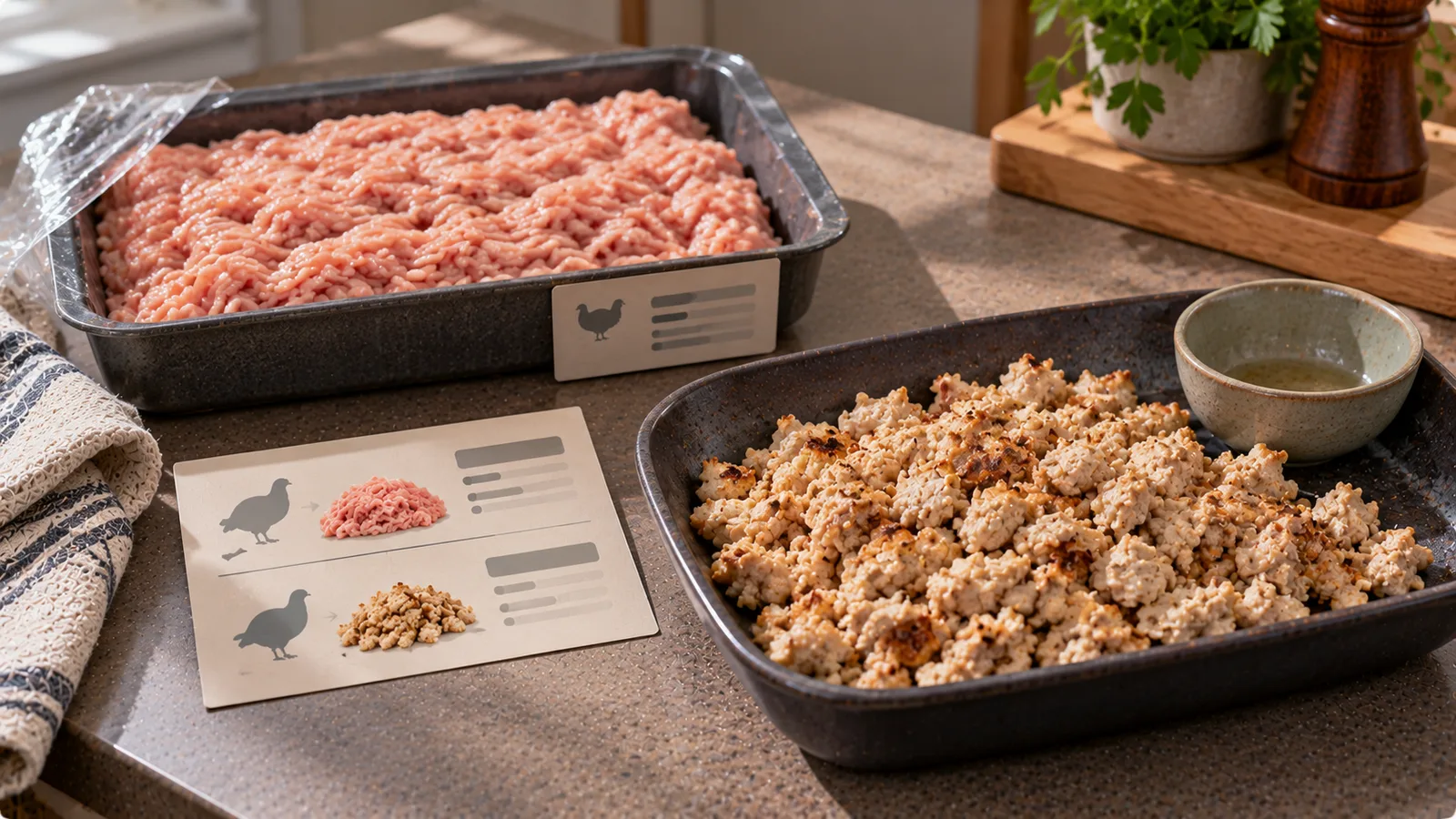
Ground turkey is a versatile ingredient for burgers, meatballs, pasta sauces and quick skillet meals. But there is no single calorie value for every package of ground turkey.
A product made primarily from lean turkey breast can have a different nutritional profile from one containing more dark meat and fat. Cooking also changes the weight of the meat.
For accurate food tracking, check the lean percentage, whether the weight is raw or cooked, and the actual portion size.
How many calories are in 100 g of ground turkey?
The following figures are rounded illustrative estimates for raw, plain ground turkey, rather than guaranteed values for specific brands.
| Ground turkey | Calories per 100 g | Protein | Fat | Carbohydrates |
|---|---|---|---|---|
| 99% lean / 1% fat | ~110 kcal | ~24 g | ~1 g | ~0 g |
| 93% lean / 7% fat | ~155 kcal | ~19 g | ~8 g | ~0 g |
| 85% lean / 15% fat | ~205 kcal | ~17 g | ~15 g | ~0 g |
These estimates have been rounded independently, so calories may not exactly match values calculated from the listed macronutrients.
Actual nutrition can vary with the cut, recipe, fat content and manufacturer. Use the current product label when available. For individual food-composition records, consult USDA FoodData Central.
Does lean percentage change the calories?
Yes. The percentage of fat is one of the most important differences between ground turkey products.
- 99% lean turkey is very low in fat and generally provides fewer calories per 100 g.
- 93% lean turkey contains more fat and often has a richer cooking texture.
- 85% lean turkey contains substantially more fat and generally provides more calories.
Using the illustrative table, the difference between 99% lean and 85% lean ground turkey is approximately 95 kcal per 100 g.
This is why selecting a generic entry called simply “ground turkey” can produce inaccurate results.
The package label is a better reference than assuming all turkey mince is low in fat.
Ground turkey calories by serving size
The next table uses an illustrative value of 155 kcal and 19 g protein per 100 g of raw 93% lean ground turkey.
| Raw serving | Calories | Protein |
|---|---|---|
| 50 g | ~78 kcal | ~9.5 g |
| 100 g | ~155 kcal | ~19 g |
| 125 g | ~194 kcal | ~23.8 g |
| 150 g | ~233 kcal | ~28.5 g |
| 200 g | ~310 kcal | ~38 g |
| 250 g | ~388 kcal | ~47.5 g |
These are rounded calculations, not measured values for a particular product.
The formula is:
Calories = calories per 100 g × grams eaten ÷ 100
For a 150 g raw serving:
155 × 150 ÷ 100 = 232.5 kcal, or approximately 233 kcal.
You can apply the same formula to protein, fat and other nutrients.
Raw versus cooked ground turkey
Raw and cooked ground turkey should not be treated as interchangeable weights.
During cooking, ground turkey loses water. Depending on its fat content and cooking method, some fat and cooking juices may also be lost.
The result is that 100 g cooked ground turkey may contain more calories per 100 g than the raw meat, even if no extra oil was added.
That does not mean cooking creates calories. It means the finished meat weighs less, so nutrients can become more concentrated per gram.
Worked example: 500 g raw ground turkey
Suppose you cook:
- 500 g raw ground turkey.
- 155 kcal per 100 g.
- 19 g protein per 100 g.
The raw batch contains approximately:
- 775 kcal.
- 95 g protein.
Imagine the cooked meat weighs 375 g.
If, for illustration, you assume no meaningful calories or protein were discarded with the cooking juices, the whole cooked batch still contains approximately 775 kcal and 95 g protein.
The resulting values would be:
| Calculation | Approximate result |
|---|---|
| Calories per 100 g cooked | 207 kcal |
| Protein per 100 g cooked | 25.3 g |
| Total cooked batch | 775 kcal |
This is a simplified mathematical example, not a measured composition value.
If you discard rendered fat or protein-containing juices, the actual nutrient totals can change. Cooked weight alone cannot tell you exactly how much was lost.
Should you weigh turkey mince raw or cooked?
Either method can work, but the nutrition data must match the weight.
When you weigh raw
- Read the package's nutrition values.
- Weigh the uncooked meat.
- Record it using raw ground turkey data.
- Add oil and other ingredients separately.
- Divide the finished recipe into portions if needed.
This is often the simplest approach when preparing a meal at home.
When you weigh cooked
- Weigh the portion after cooking.
- Choose a cooked ground turkey entry.
- Match the lean percentage and preparation method as closely as possible.
- Do not apply raw per-100-g nutrition values directly to the cooked weight.
If your app only has a generic cooked turkey entry, understand that it may not represent the exact product or amount of fat retained.
How much protein is in ground turkey?
Ground turkey provides protein containing all the essential amino acids.
The protein concentration depends on the amount of fat and water in the meat.
Using the illustrative raw values above:
| Ground turkey | Protein per 150 g raw |
|---|---|
| 99% lean | ~36 g |
| 93% lean | ~28.5 g |
| 85% lean | ~25.5 g |
A leaner product can provide more protein per 100 g because a greater proportion of the food is lean tissue rather than fat.
However, individual products vary, and the label remains the best choice for exact tracking.
Is ground turkey lower in calories than ground beef?
Not necessarily.
The calorie difference depends heavily on the fat percentage of each product.
For example, using illustrative raw values:
| Product | Calories per 100 g |
|---|---|
| Ground turkey, 99% lean | ~110 kcal |
| Ground turkey, 93% lean | ~155 kcal |
| Ground beef, 90% lean | ~175 kcal |
| Ground turkey, 85% lean | ~205 kcal |
| Ground beef, 80% lean | ~255 kcal |
These are broad comparisons, not guaranteed brand-specific values.
Very lean turkey will usually have fewer calories than high-fat beef, but a lean beef product can have fewer calories than a higher-fat turkey product.
When comparing meat, match the fat percentage and raw or cooked state, not just the animal.
Does ground turkey contain carbohydrates?
Plain, unseasoned ground turkey generally contains negligible carbohydrates.
Prepared products can be different.
Check the ingredients in:
- Turkey meatballs containing breadcrumbs.
- Ready-made turkey burgers with binders.
- Seasoned ground turkey mixes.
- Turkey sausages.
- Pre-cooked turkey fillings and sauces.
These may contain carbohydrates or additional fat from ingredients other than turkey.
Calories in common ground turkey dishes
Ground turkey is often eaten as part of a larger meal.
Turkey burger
A burger may contain ground turkey, a bun, cheese, vegetables and sauce.
The patty's calories are only one part of the total. Include cooking oil and toppings.
Turkey meatballs
Meatballs may contain breadcrumbs, eggs, cheese or oil.
Calculate the complete recipe, then divide the total by the number of meatballs or the weight of the cooked batch.
Turkey Bolognese
A pasta sauce may contain ground turkey, tomatoes, onions, carrots, oil and other ingredients.
Calculate the sauce as one recipe and record the pasta separately unless you are calculating the entire meal.
Turkey and rice bowl
Record the turkey, rice, vegetables, dressing and any cooking fat.
A meal can be relatively high in calories even when its main protein source is very lean.
Example: calculating a turkey Bolognese portion
Imagine you prepare a sauce with:
- 500 g raw 93% lean ground turkey.
- 400 g canned tomatoes.
- 150 g onion.
- 100 g carrot.
- 15 g olive oil.
The turkey contributes approximately 775 kcal based on the illustrative value used above.
The other ingredients must be added using their actual nutrition labels or suitable composition data.
Suppose the finished sauce weighs 950 g and the calculated recipe total is 1,100 kcal.
These last two figures are hypothetical examples.
If you eat 190 g of sauce:
190 ÷ 950 = 20% of the batch.
1,100 × 0.20 = 220 kcal from the sauce.
Pasta, cheese or bread served alongside it would be counted separately.
This method is often easier than estimating the amount of turkey in each spoonful.
What happens if you drain the cooking liquid?
Ground turkey can release both water and fat during cooking.
Removing liquid may reduce the calories of the final dish if it contains fat, but the exact change cannot be inferred from the liquid's weight alone.
Avoid assuming that all discarded liquid is pure fat.
For consistent tracking:
- Start with the raw ingredients when possible.
- Use an appropriate cooked entry if weighing only after cooking.
- Account for discarded fat only when the estimate is supported.
- Avoid mixing raw and cooked weights in the same calculation.
Food safety: cook ground turkey thoroughly
Ground turkey is raw poultry and must be cooked thoroughly.
The USDA recommends an internal temperature of 165°F (74°C) for ground poultry, checked with a food thermometer. USDA FSIS — Safe Temperature Chart.
Do not rely only on colour to determine whether ground turkey is safely cooked.
Keep raw poultry separate from ready-to-eat foods and clean utensils and surfaces after handling it.
Common tracking mistakes
Using a generic turkey entry: A 99% lean product and an 85% lean product are nutritionally different.
Mixing raw and cooked weights: Cooking changes the meat's weight and nutrient concentration.
Ignoring cooking oil: Added oil contributes calories.
Assuming drained liquid is all fat: It often contains water as well.
Logging a finished dish as plain turkey: Buns, breadcrumbs, rice, sauces and other ingredients also matter.
Assuming turkey is always leaner than beef: Fat content is more informative than the species alone.
Which nutrition values should you use?
For the best everyday estimate, use the current label on your package, including the lean percentage and whether the values apply to raw or prepared meat.
If the package is unavailable, choose a composition record that matches the type of ground turkey and its preparation state as closely as possible.
The key principle is straightforward: ground turkey calories depend on fat content, cooking and portion size—not simply on the fact that the meat is turkey.