
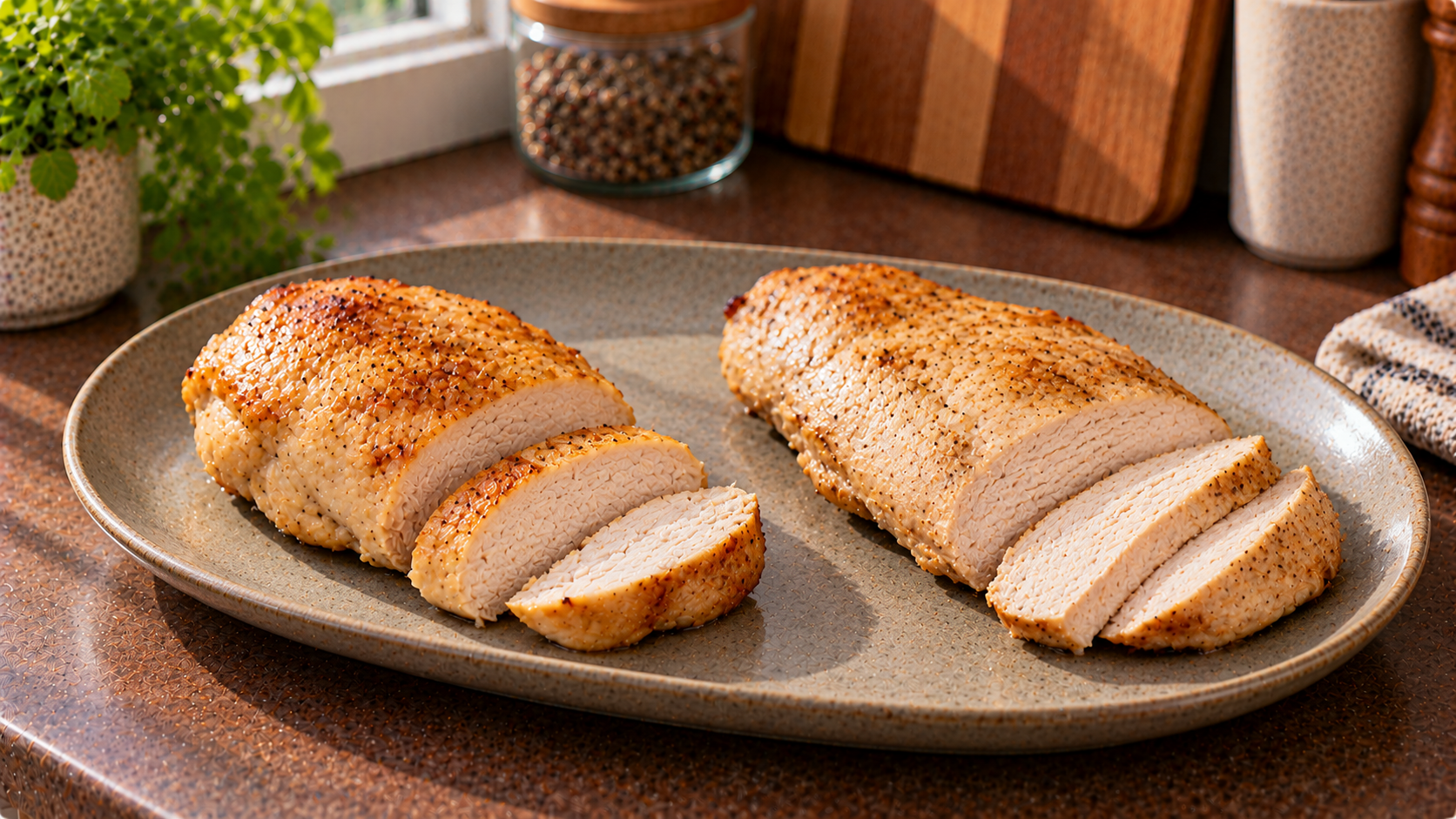
Chicken breast and turkey breast are both practical, high-protein foods. When you compare the same cut, without skin, at the same stage of cooking, their nutrition is much closer than many online charts suggest. The useful question is therefore not “Which bird is always healthier?” but “Which product delivers the protein, taste, price and convenience I want in this meal?”
A label on a raw supermarket package should not be compared directly with a database entry for roasted meat. Cooking drives off water, concentrates nutrients per 100 g of finished food and changes the weight on your plate. This guide keeps those distinctions visible and gives you a repeatable way to make your own comparison.
Chicken breast versus turkey breast at a glance
| Feature | Skinless chicken breast | Skinless turkey breast | What matters |
|---|---|---|---|
| Protein | High | High | Both can supply a substantial protein serving |
| Calories | Generally modest in lean cuts | Generally modest in lean cuts | Brand, added fat and cooking method matter |
| Total and saturated fat | Usually low when skinless | Usually low when skinless | Check whether a product includes skin or added oil |
| Carbohydrate | Virtually none in plain meat | Virtually none in plain meat | Breaded or seasoned products can differ |
| Fibre | None | None | Add vegetables, beans or whole grains to the meal |
| Sodium | Naturally present; usually modest in plain meat | Naturally present; usually modest in plain meat | Brined, cured and ready-to-eat products can be much saltier |
| Preparation | Widely available in small fillets | Available as fillets, steaks and larger joints | Choose a size you can cook evenly |
Bottom line: neither plain, skinless breast has a decisive nutritional advantage for everyone. Compare the actual package and use a consistent weight basis before drawing conclusions.
A fair comparison: raw with raw, cooked with cooked
Food-composition databases contain separate entries for raw skinless chicken breast, roasted chicken breast, raw turkey breast and roasted turkey breast. Entries may also differ in which muscle was sampled and whether the manufacturer added water or brine. That is why exact gram-for-gram claims should be attached to a defined entry rather than presented as universal facts.
As a rounded planning illustration, not a brand specification, plain raw skinless poultry breast often falls in the broad neighbourhood of 100–120 kcal and 21–25 g protein per 100 g. Cooked, unbreaded breast may be around 135–170 kcal and 28–32 g protein per 100 g, depending on retained moisture and fat. These deliberately broad ranges overlap; they are not evidence that a particular turkey pack or chicken pack must have those numbers.
For authoritative food-specific figures, check USDA FoodData Central or a local food database, selecting the exact raw or cooked description. For packaged meat in Germany, France or elsewhere in the EU, the declared nutritional table on the product is the most directly applicable source for that product.
What a 150 g or 200 g portion changes
If a label says 23 g protein per 100 g of raw product, the calculation is straightforward:
| Raw weight you use | Protein at 23 g per 100 g | Calories at a hypothetical 110 kcal per 100 g |
|---|---|---|
| 100 g | 23 g | 110 kcal |
| 150 g | 34.5 g | 165 kcal |
| 200 g | 46 g | 220 kcal |
| 250 g | 57.5 g | 275 kcal |
These numbers illustrate the arithmetic and do not represent one verified brand. Use the numbers printed on your chosen package. The formula is `label value × portion weight ÷ 100`.
After cooking, that 200 g raw portion might weigh less because water evaporates. Its total protein does not magically increase merely because the number of grams on the scale falls. If it finishes at 150 g, compare it with other cooked entries or log the original raw weight and ingredients. Do not multiply the cooked weight by a raw-food nutrition value unless the tracking method deliberately accounts for yield.
Example: a cooked serving can look “more protein-rich” per 100 g
Imagine 200 g of raw breast contains 46 g protein according to its label. After cooking it weighs 150 g. Dividing 46 by 150 and multiplying by 100 gives approximately 30.7 g protein per 100 g cooked. The serving still contains approximately 46 g before accounting for small cooking losses; the density increased because of water loss. That is a moisture calculation, not a species advantage.
The ingredient guides for chicken breast and turkey breast provide more detail on common portions. Match raw with raw, cooked with cooked, and skinless with skinless before using their numbers.
Protein quality and muscle-building goals
Both chicken and turkey breast provide complete animal protein, including essential amino acids. For a person using these foods to meet a daily protein target, portion size, total daily intake and the rest of the diet typically matter more than choosing one bird over the other.
For example, a lunch with 150 g raw chicken breast and a dinner with the same label-protein amount of raw turkey breast can contribute similar protein totals. Neither is automatically a muscle-building shortcut, and you do not need both in the same week. Pair either with vegetables, a starch or legumes, and some unsaturated fat when appropriate. A varied menu supplies fibre and nutrients missing from meat alone.
If you are comparing the protein efficiency of two products, calculate protein per 100 kcal using values on the same basis. Suppose Chicken A lists 23 g protein and 110 kcal per 100 g, while Turkey B lists 24 g and 115 kcal. Chicken A provides about 20.9 g per 100 kcal and Turkey B about 20.9 g. The practical difference is negligible compared with variations in cooking oil or serving size. These are hypothetical label examples, not measured rankings.
Fat, skin and added ingredients
Plain skinless breast is usually a lean choice. Yet a skin-on cut, a ready-marinated turkey steak and a breaded chicken escalope are not equivalent to skinless fillets. The biggest difference in a real shopping basket may come from processing rather than from the bird.
For example, adding 10 g of olive oil to a pan contributes roughly 90 kcal to the entire recipe if all the oil is eaten. If two people share the dish equally, the added oil contributes roughly 45 kcal to each serving. Butter, creamy sauces, breading and cheese also change the final nutrition. Count those ingredients separately instead of assigning all extra calories to chicken or turkey.
Check ingredient lists for added salt, sugar, starch, seasoning mixes, coatings and water. A product labelled “turkey breast slices” may be a cured ready-to-eat deli meat rather than an uncooked breast fillet. Compare processed deli turkey with processed chicken only if that is the actual decision you are making.
Vitamins and minerals: useful but not a landslide
Both poultry meats supply B vitamins and minerals involved in normal metabolism. Depending on the exact cut and entry, niacin, vitamin B6, selenium, phosphorus and vitamin B12 may be present in different amounts. The numbers can vary with feed, species, preparation and analytical method. It would be misleading to claim a fixed winner for every vitamin or mineral without specifying the food entry.
Look at the whole day rather than choosing poultry solely on a marginal difference in one micronutrient. If you are planning for iron, vitamin B12 or another specific nutrient, use precise product information and consider the other foods you eat. Poultry breast is not a meaningful source of dietary fibre; a grain-and-vegetable side makes a larger difference to that part of meal quality.
Chicken or turkey for weight management?
Either can fit a calorie-conscious diet because both are filling protein foods when cooked with moderate added fat. Choosing turkey rather than chicken will not automatically cause weight loss. The total energy balance over time, portion size and the additions on the plate are more consequential.
A practical 200 g raw serving paired with roasted vegetables and potatoes can be a balanced main meal. The same breast served in a large creamy pasta dish has different calories, even if the poultry itself is unchanged. Rather than searching for an absolute calorie winner, use a repeatable method: weigh the raw meat, log any oil or sauce, add the side dishes, and assess the full portion.
If you often feel hungry after a protein-only meal, add fibre-containing vegetables, beans, lentils or whole grains. Increasing the breast portion indefinitely is not the only way to make lunch more satisfying.
Cooking: texture and the risk of dryness
Both breasts are relatively lean and can become dry if overcooked. Turkey breast may be sold in thicker portions or larger roasts, while chicken fillets are often smaller; thickness rather than species is the main reason cooking times differ.
For pan-cooking, choose similarly thick pieces, cook over controlled heat and use a thermometer. For a larger turkey breast roast, check temperature in the thickest part; surface colour and juices are not reliable indicators of safety. A marinade with yoghurt, lemon and herbs can improve flavour without turning a lean cut into a heavy sauce. Acidic marinades alter surface texture but do not replace safe handling.
The USDA FSIS poultry temperature chart specifies a minimum internal temperature of 74°C / 165°F for chicken and turkey. National authorities may give validated time–temperature alternatives; follow the guidance applicable where you live. Always measure in the thickest area and avoid touching bone with the probe.
Food safety: shopping, thawing and leftovers
Raw chicken and turkey can carry harmful bacteria. Keep raw poultry separate from produce and cooked foods; wash hands, utensils and worktops after handling it. Do not rinse raw poultry under the tap, because splashes can spread microorganisms around the sink.
Defrost frozen poultry in the refrigerator, in cold water with appropriate controls, or using a microwave followed by immediate cooking—not on the kitchen counter. After preparation, refrigerate leftovers promptly in shallow containers. The USDA FSIS food-safety basics advises using most cooked leftovers within 3–4 days under proper refrigeration and reheating to 74°C / 165°F. Check stricter local guidance when applicable, and discard food if handling conditions were unsafe.
These precautions are identical for chicken and turkey: neither bird has a special exemption from correct refrigeration or cooking.
Cost: compare edible protein, not just the sticker
Chicken breast is often more widely available, while turkey breast can be competitively priced depending on the country, shop, cut and promotion. There is no permanent cheaper winner. To make the comparison useful, calculate cost per amount of protein from the nutrition labels.
| Hypothetical shop example | Chicken fillet | Turkey fillet |
|---|---|---|
| Price for 1 kg raw | €10.00 | €12.00 |
| Protein per 100 g raw (illustrative) | 23 g | 24 g |
| Protein in 1 kg | 230 g | 240 g |
| Cost per 30 g protein | €1.30 | €1.50 |
Formula: `cost per 30 g protein = (price per kg ÷ protein grams per kg) × 30`. The figures above are invented to demonstrate the method; they are not current German supermarket prices. If a turkey offer brings its price below chicken, the ranking can reverse immediately. Also consider bones, excess trimming, skin and whether you will use the whole package before it spoils.
For a two-person dinner, calculate cost using the actual amount purchased and cooked, not merely an attractive price per kilo. For meal prep, a large pack is only a saving if it can be safely portioned, chilled or frozen.
Which breast works best in different meals?
| Meal | Practical choice | Reason |
|---|---|---|
| Fast weekday stir-fry | Either, thinly sliced | Similar cook time if pieces are equal thickness |
| Oven tray bake | Chicken fillets or turkey steaks | Add vegetables and monitor centre temperature |
| Larger family roast | Boneless turkey breast or chicken portions | Choose by size and cooking equipment |
| Cold lunch sandwich | Home-cooked, safely chilled leftovers | Lets you control seasoning and salt |
| Salad with beans | Either | Beans add fibre that meat cannot provide |
| Budget meal-prep | The best-priced suitable plain cut | Price and usable yield matter more than species |
Use your preferred flavour and the recipe's method as tie-breakers. A chicken recipe generally adapts well to turkey breast if you adjust for thickness and internal temperature, and vice versa.
A simple shopping checklist
Before deciding, ask whether you are looking at the same kind of product: raw, boneless, skinless and unbreaded; whether nutrition is given per 100 g raw or cooked; whether salt or water was added; and whether price refers to the same edible quantity. Then choose the portion you will eat and check the finished recipe—not just the central protein.
If two plain products have similar nutrition but one is cheaper, fresher or easier to cook, there is little reason to pay more simply for a presumed macro advantage. If you enjoy turkey's flavour or have a recipe that works better with it, that is a good practical reason to buy turkey.
Sources and calculation notes
- USDA FoodData Central: search the specific skinless, boneless chicken or turkey breast entry and match raw versus cooked conditions.
- USDA FSIS: Safe Minimum Internal Temperature Chart: poultry cooking temperatures.
- USDA FSIS: Keep Food Safe: safe handling, refrigeration and leftovers.
All shop prices and the labelled numerical examples in the tables are hypothetical worked examples. Product labels and standardized food-composition entries should be used for actual nutrient tracking.