
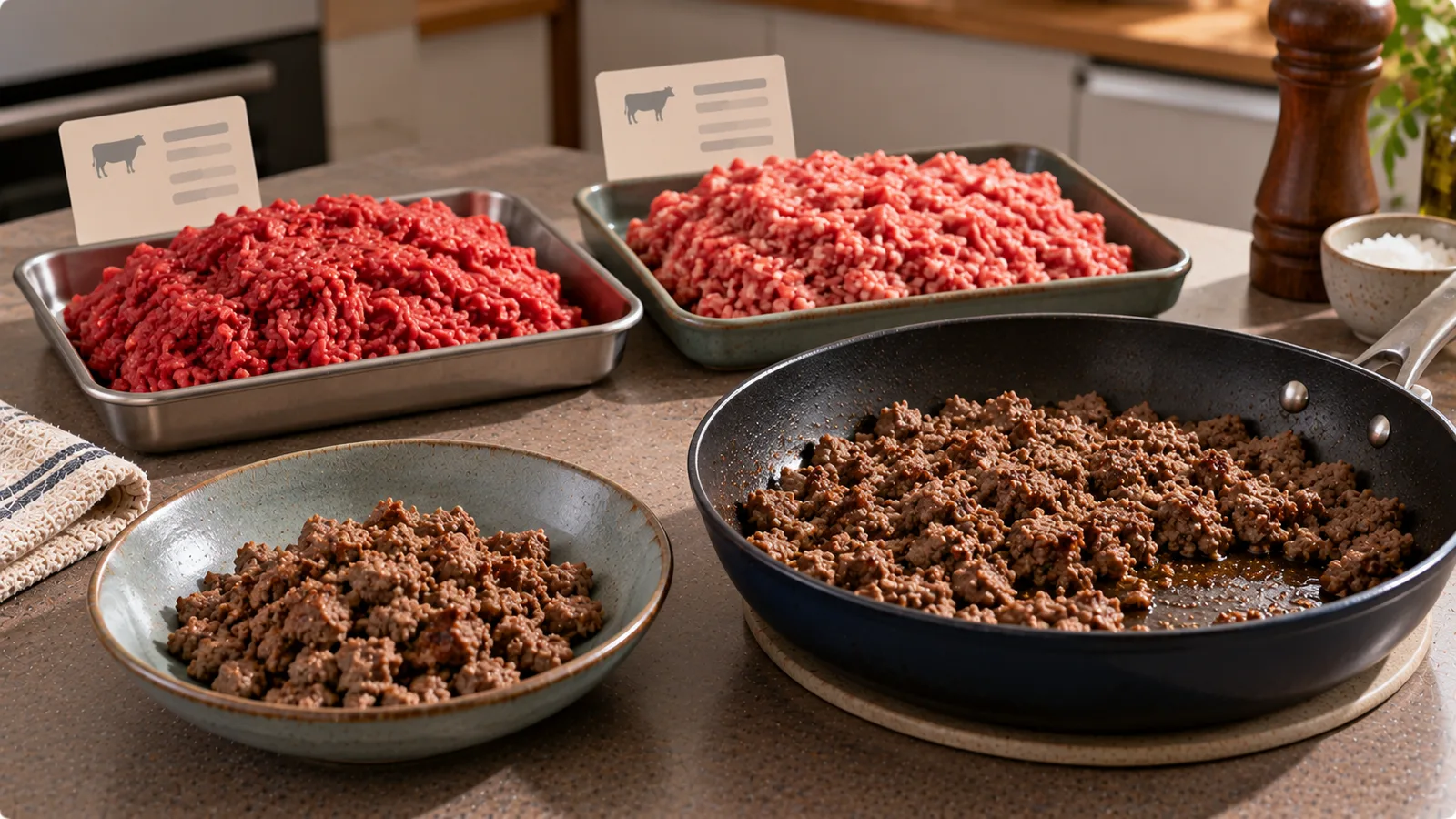
Ground beef can be a useful source of protein, but its calorie content varies substantially depending on the amount of fat in the meat and whether you weigh it before or after cooking.
A serving of lean ground beef and the same weight of higher-fat ground beef may contain similar amounts of protein but noticeably different amounts of energy.
The most reliable approach is to identify the fat percentage, match the nutrition values to the raw or cooked state, and weigh the portion you actually use.
How many calories are in 100 g of ground beef?
The table below gives illustrative approximate values for raw, unseasoned ground beef at several commonly sold lean-to-fat ratios.
These are planning estimates, not universal nutrition declarations. The values of actual products depend on the cut, formulation, analytical method and brand.
| Ground beef | Calories per 100 g | Protein | Fat | Carbohydrates |
|---|---|---|---|---|
| 95% lean / 5% fat | ~140 kcal | ~21 g | ~5 g | 0 g |
| 90% lean / 10% fat | ~175 kcal | ~20 g | ~10 g | 0 g |
| 85% lean / 15% fat | ~215 kcal | ~19 g | ~15 g | 0 g |
| 80% lean / 20% fat | ~255 kcal | ~17 g | ~20 g | 0 g |
These rounded figures represent approximate examples; do not use them instead of a product's current label when exact tracking matters.
For specific food composition records, consult USDA FoodData Central, selecting the entry that matches the lean percentage and preparation state.
Why fat percentage matters
Ground beef is often described using a lean-to-fat ratio such as 90/10 or 80/20.
- 90/10 means approximately 90% lean meat and 10% fat by weight.
- 85/15 means approximately 85% lean meat and 15% fat.
- 80/20 means approximately 80% lean meat and 20% fat.
Fat contributes more energy per gram than protein. As a result, higher-fat ground beef usually has more calories per 100 g.
For a direct comparison using the illustrative table:
- 100 g of 90/10 ground beef: approximately 175 kcal.
- 100 g of 80/20 ground beef: approximately 255 kcal.
That is a difference of about 80 kcal per 100 g.
The comparison does not mean one option is automatically right for everyone. Taste, cooking method, budget and the overall meal also matter.
Ground beef calories by serving size
Using the illustrative value of 175 kcal and 20 g protein per 100 g of raw 90/10 ground beef:
| Raw portion | Calories | Protein |
|---|---|---|
| 50 g | ~88 kcal | ~10 g |
| 100 g | ~175 kcal | ~20 g |
| 125 g | ~219 kcal | ~25 g |
| 150 g | ~263 kcal | ~30 g |
| 200 g | ~350 kcal | ~40 g |
| 250 g | ~438 kcal | ~50 g |
All values are rounded.
The formula is:
Calories in your portion = calories per 100 g × portion weight in grams ÷ 100
For a 150 g raw portion:
175 × 150 ÷ 100 = 262.5 kcal, or approximately 263 kcal.
Use the same calculation for protein and fat.
Raw versus cooked ground beef
One of the most common tracking errors is applying raw nutrition values to cooked weight.
Ground beef usually loses water during cooking. Some fat may also render out and be discarded.
That means 100 g of cooked ground beef is not equivalent to 100 g of the original raw product.
Cooked ground beef often has more calories and protein per 100 g than its raw counterpart because it contains less water. However, the final energy content also depends on how much fat is retained or drained.
Example: a batch that loses weight
Suppose you start with:
- 500 g raw 90/10 ground beef.
- An illustrative 175 kcal per 100 g.
- An illustrative 20 g protein per 100 g.
Before cooking, the batch contains approximately:
- 875 kcal.
- 100 g protein.
After browning, suppose the cooked beef weighs 375 g.
If you assume no meaningful energy-containing material was discarded, the batch still contains approximately 875 kcal.
On that simplified assumption:
875 ÷ 375 × 100 = 233 kcal per 100 g cooked beef.
This is a mathematical illustration, not a measured cooked-food nutrition value.
If rendered fat or meat juices were discarded, the actual retained calories and nutrients could be lower. You cannot determine the exact difference from the cooked weight alone.
What if you drain the fat?
Draining rendered fat can change the calorie content of the finished meat.
But the amount removed varies with:
- The original fat percentage.
- Cooking temperature and duration.
- Pan shape and method.
- How thoroughly the meat is drained.
- Whether the liquid contains water, fat or both.
Do not assume that draining converts 80/20 ground beef into a precise lean percentage such as 90/10.
For accurate tracking, use an appropriate cooked-and-drained food composition entry when available, or record the raw ingredients and account for discarded fat only when you have a defensible estimate.
Avoid subtracting a guessed number of calories without supporting information.
Protein in ground beef
Ground beef supplies complete protein containing the essential amino acids.
The amount per 100 g varies with the fat percentage and water content.
Leaner raw ground beef generally provides more protein per 100 g than higher-fat raw ground beef because a greater proportion of its weight consists of lean tissue.
Using the illustrative values above:
| Ground beef | Protein per 150 g raw |
|---|---|
| 95/5 | ~31.5 g |
| 90/10 | ~30 g |
| 85/15 | ~28.5 g |
| 80/20 | ~25.5 g |
These are approximate calculations, not brand-specific guarantees.
Ground beef also contributes nutrients such as vitamin B12, zinc and iron. Exact amounts depend on the product and preparation.
Is ground beef high in carbohydrates?
Plain, unseasoned ground beef typically contains negligible carbohydrates.
However, prepared products can be different.
Examples include:
- Meatballs containing breadcrumbs.
- Burger patties with added fillers.
- Seasoned minced meat mixtures.
- Ready-made meat sauces.
- Ground beef dishes containing beans, vegetables or sugary sauces.
For these foods, use the label or calculate the whole recipe rather than applying plain ground beef values.
Ground beef in burgers, tacos and pasta
The calories of the meat are only one part of a finished dish.
Burger
A burger may include:
- Ground beef patty.
- Bun.
- Cheese.
- Sauce.
- Vegetables.
- Cooking oil.
Calculate the patty using its actual meat weight and appropriate nutrition values, then add the other ingredients separately.
Tacos
For tacos, count the ground beef alongside tortillas, beans, cheese, avocado and sauces.
If you cook a large batch of filling, calculate the full recipe and divide it by the amount actually served.
Bolognese sauce
For a meat sauce, include the ground beef, oil, tomatoes, vegetables and any other ingredients.
Pasta should be counted separately unless you are calculating the nutritional value of the entire plated meal.
How to track ground beef accurately
Choose one consistent method.
Method 1: Weigh raw
- Check the lean percentage on the package.
- Record the raw weight.
- Use nutrition values for raw ground beef with that fat percentage.
- Add any oil, sauces and other ingredients.
- If the finished recipe is divided into portions, allocate the total across those portions.
This method is often the simplest for home cooking when you know the raw ingredients.
Method 2: Weigh cooked
- Weigh the cooked portion.
- Select nutrition data specifically for cooked ground beef.
- Match the fat content and cooking or draining method as closely as possible.
- Avoid using raw per-100-g values for cooked weight.
Cooked entries can differ substantially depending on whether the meat was pan-browned, drained or prepared another way.
How to calculate portions from a cooked batch
Suppose a recipe contains 600 g of raw ground beef.
After cooking and combining it with other ingredients, the finished dish weighs 1,200 g.
If you eat 300 g of the finished dish:
300 ÷ 1,200 = 25% of the recipe.
You can assign approximately 25% of the recipe's calculated calories and nutrients to that portion, assuming the ingredients are distributed reasonably evenly.
This method is often more useful than trying to estimate how many grams of raw beef are in an individual spoonful of sauce.
If fat or cooking liquid is discarded, the recipe calculation should reflect that where possible.
Ground beef versus other meats
Ground beef is not a single nutritional category with one fixed calorie value.
When comparing it with ground turkey, chicken or pork, match:
- Raw versus cooked state.
- Fat percentage.
- Edible weight.
- Added ingredients.
- Cooking method.
A lean ground beef product may contain fewer calories than a higher-fat ground poultry product.
The animal species alone does not determine the calorie content.
Frequently encountered tracking mistakes
Using one generic ground beef entry for every product. Fat percentages can differ considerably.
Confusing raw and cooked weights. Cooking changes water content and may remove fat.
Assuming all fat is discarded. Some fat remains in the meat or finished dish.
Forgetting cooking oil. Added oil contributes calories unless it is demonstrably left behind.
Logging only the meat in a mixed dish. Bread, pasta, sauces and other ingredients also count.
Using package weight after cooking. A 500 g raw package will not necessarily yield 500 g cooked meat.
Which number should you use?
For the most accurate everyday result, start with the current package label, including the fat percentage and whether the values refer to raw or prepared meat.
If the label is unavailable, choose a food composition entry that closely matches the product.
Then weigh the amount you actually use and apply the nutrition values to the correct preparation state.
The key takeaway is that ground beef calories depend more on fat content, preparation and portion size than on the name “ground beef” alone.