
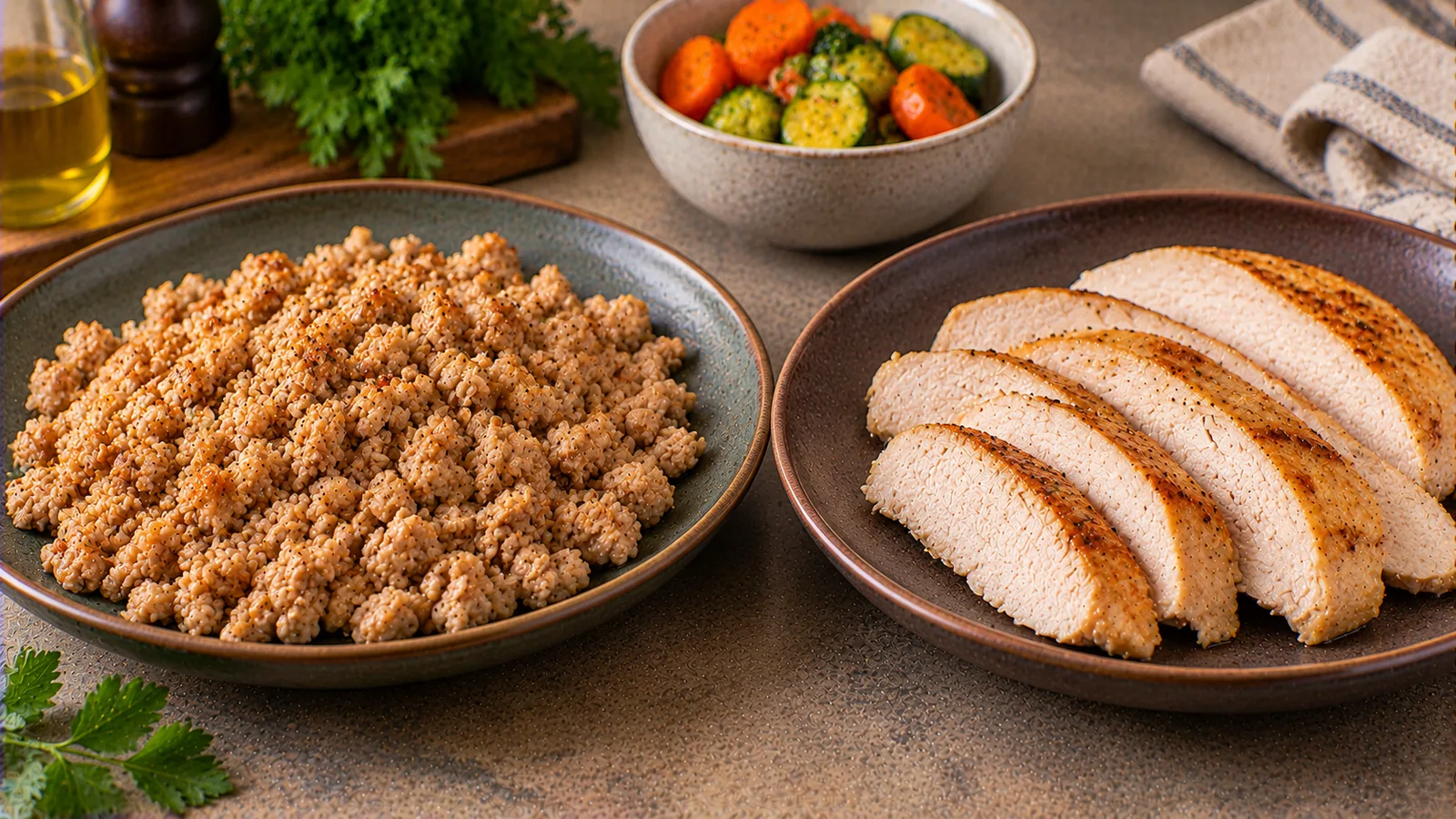
How much protein is in ground turkey? The useful answer depends on whether the weight is raw or cooked and how lean the mince is. For a like-for-like dinner comparison, this guide weighs 150 g after cooking: plain 93% lean ground turkey, pan-broiled into crumbles, versus roasted skinless turkey breast. It then works backwards to the raw weight you need to buy and shows an explicitly hypothetical cost example in euros.
The figures are reference food compositions, not laboratory measurements of your own batch. This is not a second general ground-turkey calories and serving sizes or a repeat of ground beef versus ground turkey by fat percentage. It addresses the different question: Which turkey product supplies protein from a matched cooked portion, and how do cooking loss and purchase price affect the bill?
Match the edible portion, not just the number on the label
Both portions here are 150 g cooked, edible meat only, without sauce, skin, breadcrumbs, cooking oil or side dishes. The mince is 93% lean / 7% fat as a raw-product description, cooked in a pan and weighed after cooking. The breast is plain, skinless roasted meat, weighed once it rests. This comparison does not describe turkey sausages, deli slices, 85/15 mince, or 99% lean breast mince.
For a traceable illustration we use USDA FoodData Central SR Legacy records: 93/7 ground turkey, pan-broiled crumbles (FDC 172851) and whole turkey breast, meat only, roasted (FDC 171496). The first supplies 27.1 g protein and 11.6 g fat per 100 g cooked. The second supplies 30.13 g protein and 2.08 g fat per 100 g cooked. Exact composition differs with supplier, fat grade and cooking method.
| Cooked meat only | Protein per 100 g | Protein per 150 g | Fat per 150 g |
|---|---|---|---|
| Ground turkey, 93/7, pan-broiled | 27.1 g | 40.65 g | 17.40 g |
| Turkey breast, skinless, roasted | 30.13 g | 45.195 g | 3.12 g |
The breast delivers 4.545 g more protein in the same 150 g cooked portion, and the selected ground turkey supplies 14.28 g more fat. Rounding to practical figures gives 40.7 g versus 45.2 g protein. These are not promises about every packaged mince or home roast. A different breast roast can have different water loss; a lower-fat grind can narrow the fat gap.
Why 150 g raw is not 150 g cooked
A supermarket price and the label's per-100-g nutrition usually refer to raw product as sold. The table above refers to the cooked food. Heat changes water content; a pan of crumbles can also lose drippings, while a roast loses moisture. Using raw mass to multiply a cooked-food protein value is an invalid shortcut.
For the shopping illustration only, assume a 75% cooked yield for the ground turkey and a 72% cooked yield for skinless turkey breast. These are planning assumptions, not measured yields or mandatory USDA yield factors. Moreover, the raw purchase assumptions and the two cooked USDA compositions were not measured on one batch: do not treat the separate records as an exact protein mass-balance experiment. The USDA's food-yield tables show why yield depends on cut and cooking technique. A home cook should weigh both the raw ingredient and the edible cooked result instead of assigning these percentages to every recipe.
| To serve 150 g cooked | Hypothetical yield | Raw edible meat to buy | Estimated cooking weight loss |
|---|---|---|---|
| Ground turkey 93/7 | 75% | 200.0 g | 50.0 g |
| Skinless turkey breast | 72% | 208.3 g | 58.3 g |
The raw requirement is the cooked target divided by yield: 150 / 0.75 = 200.0 g; 150 / 0.72 = 208.3 g (rounded). These weights exclude skin, bones and discarded packaging. If you buy a bone-in turkey joint, the usable purchased quantity must allow for bones and trimming in addition to cooking loss. A 500 g tray or fillet is not automatically one 500 g cooked serving.
Cost of one 150 g cooked portion: a transparent example
Here are illustrative prices, not current German shelf quotes: ground turkey €10.00 per kg raw and skinless turkey breast €14.00 per kg raw. Your supermarket, region, brand, promotions and packaging may differ. Both calculations apply a price per raw kilogram to the required raw meat, not to cooked weight.
| Item | Illustrative raw price | Raw amount used | Cost of 150 g cooked |
|---|---|---|---|
| Ground turkey | €10.00/kg | 200.0 g | €2.00 |
| Turkey breast | €14.00/kg | 208.3 g | €2.92 |
In this scenario the breast serving costs €0.92 more. The exact unrounded breast cost is €14 × (150 / 0.72) / 1,000 = about €2.9167, displayed as €2.92. It would be wrong to multiply the cooked 150 g by the raw €14/kg price without allowing for weight loss. Also distinguish an ingredient cost used from the checkout payment: a whole pack can cost more upfront while leaving raw meat for other meals.
At these same assumptions, the ground portion supplies about 20.3 g of protein per €1 used, and the breast about 15.5 g per €1 used. That makes the mince the cheaper protein in this hypothetical basket, despite the breast having slightly more protein per equal cooked weight. Change the purchase price or measured yield and the ranking may reverse. This is neither a national price survey nor a universal nutrition value calculation.
The break-even price formula
If you know your local prices and cooking yields, you can find the price of breast that would equal the mince cost for a 150 g cooked serving. With both foods weighed after cooking:
Cost for 150 g cooked = (150 ÷ cooking yield) × (raw price per kg ÷ 1,000), where the yield is written as a decimal such as 0.75.
For a purely cost-based tie, using the example mince price of €10.00/kg and the assumed yields of 75% and 72%, the corresponding breast raw price is €9.60/kg. This follows from €10 × 0.72 / 0.75, not from assuming the two cooked products have equal protein. Above that breast price the ground option is cheaper per 150 g cooked; below it the breast is cheaper under the stated yield assumptions. For cost per gram of protein, use the separate protein-per-serving figures rather than this equal-weight break-even.
Three comparisons that give the wrong answer
Mistake one: raw label against cooked reference. A raw 93/7 mince nutrition panel could list considerably less protein per 100 g than a cooked reference because the latter has lost water. That does not mean cooking manufactured protein. Compare both foods in the same state, or perform a recipe calculation that tracks total ingredients and final portions.
Mistake two: '93/7' means 7 g fat in every 100 g cooked. The ratio names the raw product. USDA's selected pan-broiled cooked entry has 11.6 g fat per 100 g cooked. Changes in moisture and retained drippings affect the denominator. Do not automatically use 7 g for cooked portions.
Mistake three: a whole cooked breast and a deli turkey slice are equivalent. Packaged sliced turkey may contain salt, water and other ingredients; a bone-in roast may include considerable waste. This article measures roasted skinless breast meat only. Compare prepared products with their specific labels.
A fourth common error is treating 'turkey mince' as necessarily leaner than breast. Turkey mince can include dark meat and skin, and declared fat percentages vary. Check the fat content rather than inferring it from the bird species or front-of-pack marketing.
An executable dinner for each option
For a mince plate, start with approximately 200 g raw 93/7 turkey mince, season with black pepper, garlic and herbs, and pan-cook until thoroughly done. Weigh the cooked edible result. If it is more than 150 g, save the surplus safely; if less, your meal does not magically contain 150 g. Serve with roughly 200 g cooked potatoes and 200 g vegetables. The added ingredients contribute their own calories, protein and cost; none is included in the meat-only table.
For a breast plate, start with approximately 208.3 g raw skinless turkey breast under the example 72% yield. Roast or pan-cook to the same food-safety standard, rest, then weigh 150 g cooked meat. Pair with the same potatoes and vegetables if you want a controlled whole-plate comparison. The actual yield may be different: record the raw and cooked weights before assigning a shopping cost.
Cooking oil, sauces, salt and marinades should be recorded separately if you are counting full-plate nutrition. A teaspoon of oil in the pan is not part of the reference data for plain roast breast or plain pan-broiled ground turkey. To compare total dinner costs, add the potatoes, vegetables, seasoning and any extra ingredients to each meat-only amount, using what you actually consumed rather than the receipt total.
Food safety, storage and meaningful shopping decisions
Raw turkey is poultry, whether minced or in a fillet. The German Federal Institute for Risk Assessment (BfR) recommends heating poultry so the core reaches at least 70 °C for 2 minutes and avoiding cross-contamination with raw meat. See the official BfR poultry hygiene advice. A clean meat thermometer is more reliable than judging doneness only by colour. Keep raw poultry separate from ready-to-eat foods; clean utensils and counters after contact, and refrigerate promptly.
Select fresh turkey from a retailer that maintains refrigeration, check the use-by date and cook or freeze according to the package guidance. Avoid rinsing raw poultry under the tap: splashes can spread microorganisms. If food is prepared in batches, follow safe cooling, refrigeration and reheating practice rather than using an arbitrary storage time for every recipe.
At the shop, compare the price per raw kg, the cut, the fat grade, packaging quantity and edible yield. Ground turkey is convenient for patties, crumbles and sauces; a whole breast gives neat slices and usually less fat in the specific entries compared here. Convenience is a legitimate factor, but it is separate from protein per 150 g cooked. In the EU, regulated protein-content claims have specific conditions; a large printed protein number is not a substitute for reading the actual serving size.
The practical verdict
Using these two defined USDA cooked entries, 150 g of 93/7 ground turkey provides 40.65 g protein, while 150 g of roasted skinless turkey breast provides 45.195 g. Turkey breast wins on protein per equal cooked weight and is much lower in fat for these records. At the illustrative raw prices and yields, mince wins on cost per 150 g cooked: €2.00 versus €2.92. Neither ranking should be transferred to another fat grade, supermarket price or cooked yield without recalculating.
Sources
- USDA FoodData Central: ground turkey 93/7 pan-broiled, SR Legacy FDC 172851 — 27.1 g protein and 11.6 g fat per 100 g cooked.
- USDA FoodData Central: roasted turkey breast without skin, SR Legacy FDC 171496 — 30.13 g protein and 2.08 g fat per 100 g cooked.
- USDA Agricultural Research Service: cooking-yield research tables — demonstrates that edible yield depends on food and preparation; the 75% and 72% examples here are explicitly hypothetical.
- German BfR: poultry hygiene and adequate heating.
- European Commission: EU nutrition and health claims.
Method note: no observed German retail prices, tested home yields or added side-dish nutrition are claimed. Cost and yield examples are illustrative and must be replaced with local package data for shopping.