
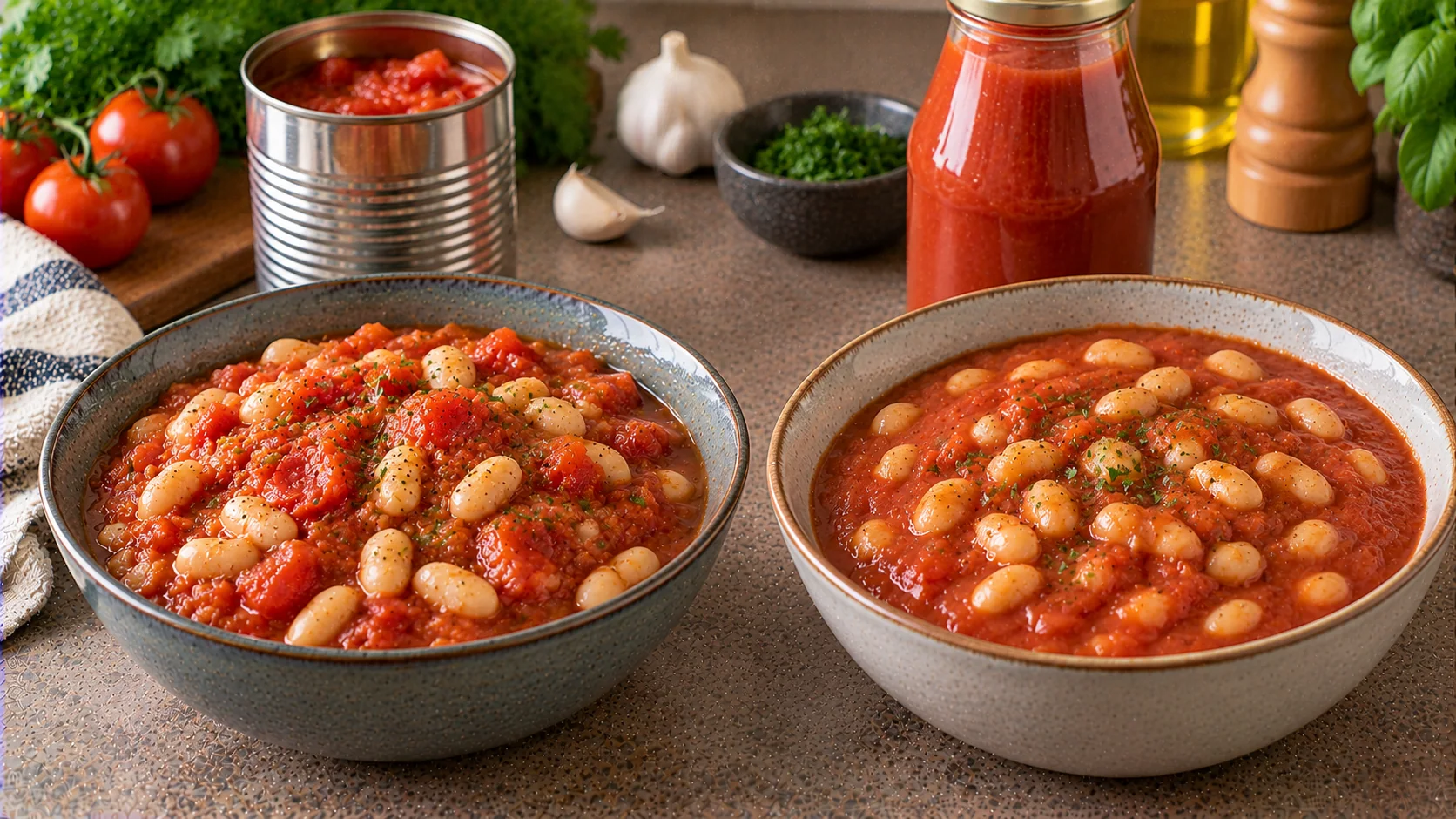
Canned Tomatoes vs Passata for Quick Bean Dinners
Canned chopped tomatoes and passata both make affordable sauces for beans. They are not interchangeable in texture, though, and their salt, pack size and price can differ substantially. The best choice depends on whether you want distinct tomato pieces or a smooth sauce, how much liquid your beans add, and which label is actually on the shelf. This guide compares like-for-like amounts and demonstrates two stove-top dinners, rather than claiming one tomato product is always healthier or cheaper.
What exactly are you buying?
Canned chopped tomatoes normally contain tomato pieces suspended in juice. Passata is a sieved tomato product with a smoother, more uniform consistency; some brands include added salt, herbs or other ingredients. Neither word guarantees a particular sugar or salt value. Look beyond the front of the package to the ingredient list and nutrition declaration. Tomato purée or concentrated paste is a different, thicker product: do not substitute it one-for-one for passata without adjusting the liquid.
Same-weight comparison before cooking
Compare the labels per 100 g of product as sold, not per whole can or bottle. The table is an illustrative shopping example, not laboratory results or claims about particular brands.
| Detail | Chopped tomatoes | Passata |
|---|---|---|
| Package and shelf price | 400 g can, €0.89 | 500 g bottle, €1.19 |
| Price per 100 g | €0.22 | €0.24 |
| Declared salt per 100 g, example | 0.08 g | 0.12 g |
| Salt in 250 g of product | 0.20 g | 0.30 g |
| Texture | Pieces and juice | Smooth and strained |
The price calculations are €0.89 ÷ 400 × 100 = €0.2225 and €1.19 ÷ 500 × 100 = €0.238. Rounded values are shown in the table. For 250 g, multiply each salt declaration by 2.5. These are deliberately hypothetical pack prices and label values; inspect the product before using them in a real meal. The European Commission explains that EU prepacked-food nutrition information is generally stated per 100 g or 100 ml: nutrition labelling.
Compare salt fairly
A sauce with a lower salt number per 100 g can still contribute more salt to dinner if you use substantially more of it. As an example, 300 g of a tomato product declaring 0.12 g salt/100 g contributes 0.36 g salt. Canned beans, stock cubes and cheese can add more. Do not compare sodium milligrams from one database directly with label salt grams: in EU labelling, salt is calculated using a sodium-to-salt conversion factor. If choosing a lower-salt dinner, examine the whole ingredient list, particularly canned beans in salted brine.
How texture changes a bean dinner
Chopped tomatoes keep some pieces intact and are ideal if you want a chunky skillet with visible beans and vegetables. Passata coats beans evenly and makes a smoother sauce without blending. Neither automatically reduces faster to the same thickness: canned tomatoes may release more visible free liquid, whereas passata can already be relatively thick. Use a wide pan, simmer uncovered when needed, and judge the final thickness rather than relying on a rigid minute count. Acidic tomato sauces can taste sharper after reduction; balance with cooked onion, herbs or vegetables before reaching for sugar.
Recipe 1: chunky white-bean tomato skillet
Serves two. Ingredients: 400 g canned chopped tomatoes, 240 g drained cooked white beans, 100 g onion, 120 g frozen spinach, 10 g olive oil, 1 garlic clove (about 4 g), 1 tsp dried oregano and black pepper. The beans are weighed after draining; the tomatoes use package net weight. No added salt is assumed in the sample method.
- Dice the onion and mince the garlic. Heat the oil in a wide pan over medium heat; soften the onion for about 4–5 minutes.
- Add garlic and oregano for 30 seconds, then the chopped tomatoes and frozen spinach. Simmer 7–10 minutes, stirring until the spinach is heated through and the liquid visibly thickens.
- Add rinsed, drained beans. Stir gently for another 3–5 minutes until thoroughly hot. Taste before adding any salt and divide evenly between two bowls.
Total practical time is about 20–25 minutes. Serve with wholegrain bread if desired, calculating bread separately. The recipe demonstrates why tomato chunks are useful; it is not a claim that chopped tomatoes contain more nutrients than passata.
Recipe 2: smooth chickpea-passata pan
Serves two. Ingredients: 350 g plain passata, 240 g drained cooked chickpeas, 150 g diced courgette, 80 g onion, 10 g olive oil, 1 tsp paprika, 1 tsp dried basil and pepper. Use the chickpeas' drained weight, not the can's total net weight.
- Sauté onion and courgette in oil for 5–7 minutes until beginning to soften.
- Add paprika, passata and basil. Simmer gently for 7–9 minutes, stirring often so the smooth sauce does not catch on the bottom.
- Add chickpeas and cook another 3–5 minutes until hot throughout. Divide between two servings. Add water a tablespoon at a time only if the sauce becomes too thick.
Total time is approximately 18–22 minutes. The remaining 150 g from an illustrative 500 g passata bottle needs prompt refrigeration in a clean covered container and use according to the manufacturer's instructions; it is not an unopened shelf-stable portion.
Cost per bean dinner: purchased packs versus used ingredients
Using the illustrative tomato prices above, the first skillet uses the entire €0.89 can. The second uses 350/500 × €1.19 = €0.83 of passata, while the cashier still charges €1.19 for the full bottle. It would be misleading to call the second tomato purchase €0.83 at checkout. Add beans, vegetables, oil and seasoning to evaluate total meal cost. For example, if both recipes use €2.00 of other ingredients, the ingredient-use totals become €2.89 and €2.83 respectively, while the checkout basket for the passata-based dinner may require the full bottle. These €2.00 additions are a sensitivity assumption, not surveyed German supermarket prices.
What if you have leftovers?
Unused tomato product and finished bean dishes are no longer shelf-stable once opened or cooked. Cool prepared food promptly, refrigerate in shallow covered containers, and follow the pack's after-opening guidance. For general handling of cooked leftovers consult USDA FSIS guidance. Freeze portions when they cannot be eaten in time. Discard an item with a damaged, bulging or leaking package; never taste it to test safety.
Which should you buy?
Choose chopped tomatoes when you want pieces, a rustic texture and a familiar full-can portion. Choose passata when you want a smoother sauce or an ingredient that distributes evenly around beans. Both can fit a budget diet. Compare salt per 100 g, the exact amount you will use, and the shelf price divided by the product weight. If the package differs from the examples, replace every assumption with the actual label. For a broader way to assess ingredient cost in home cooking, see our guide to comparing grocery ingredient costs; for another practical bean dinner, see another practical budget bean dinner guide.