
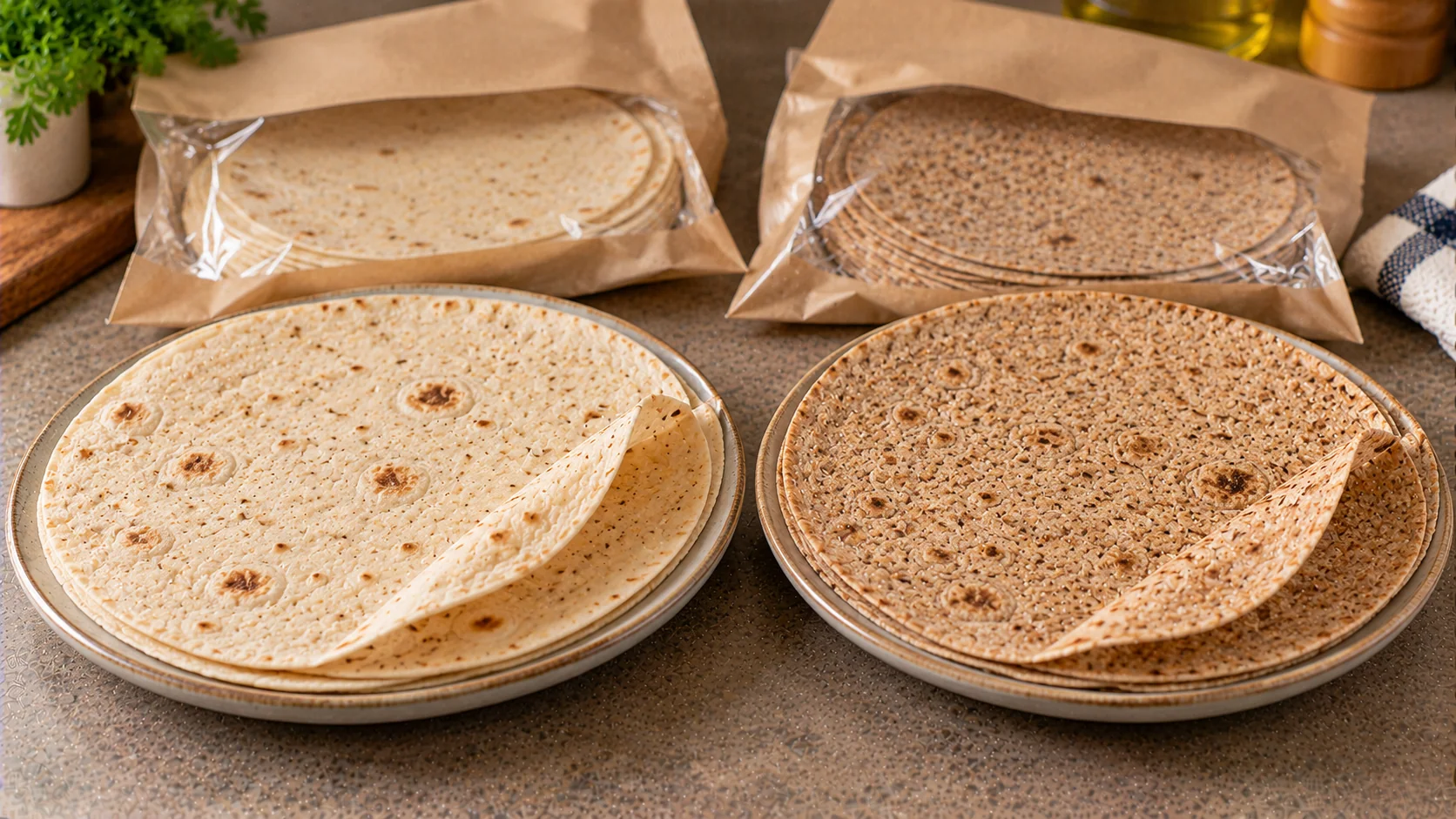
Fiber-Enriched Wraps vs Wholegrain Wraps: What Labels Show
Why these wraps are not the same
“High fibre” and “wholegrain” answer different questions. The former is a regulated nutrient claim where used as such in the European Union; the latter describes the grain ingredients. A fibre-enriched white-flour wrap may contain added wheat fibre or inulin. A wholegrain wrap may obtain much of its fibre from wholemeal flour. Neither label alone tells you the serving size, salt or price. related Mealisa nutrition guides can help with the claim itself.
Compare the numbers before choosing
Check fibre, protein, energy and salt in the nutrition table per 100 g; then use the weight of one tortilla. Next read the first ingredients and compare package price against the number and weight of wraps. Do not compare one manufacturer’s 40 g wrap directly with another manufacturer’s 65 g wrap without adjusting.
Two example labels, not two verified brands
The following values are invented teaching examples, not real listings or current supermarket prices. Prices, fibre and salt can differ substantially in actual products. Use them to learn the arithmetic, not to claim that one category always contains more fibre.
| Model pack | Fibre/100 g | Salt/100 g | Wrap mass | Pack size | Pack price |
|---|---|---|---|---|---|
| Fibre-enriched A | 10 g | 1.3 g | 50 g | 6 wraps | €2.70 |
| Wholegrain B | 7 g | 1.0 g | 60 g | 6 wraps | €2.40 |
How much fibre does one wrap deliver?
Multiply the value per 100 g by the wrap weight divided by 100. Model A gives 10 × 50/100 = 5.0 g fibre in one wrap; model B gives 7 × 60/100 = 4.2 g. For salt, A gives 1.3 × 50/100 = 0.65 g and B gives 1.0 × 60/100 = 0.60 g per wrap. Check whether your dinner uses one or two wraps before interpreting the result.
Price per wrap and price per gram of fibre
Divide package price by the number of wraps: A costs €2.70/6 = €0.45 per wrap, while B costs €2.40/6 = €0.40. To estimate price per gram of fibre in a single wrap, divide €0.45 by 5.0 = €0.09/g, versus €0.40 by 4.2 ≈ €0.095/g. This is a narrow cost metric, not a judgement about taste or nutritional quality.
| Model | Fibre/wrap | Salt/wrap | Price/wrap | Price/g fibre |
|---|---|---|---|---|
| A | 5.0 g | 0.65 g | €0.45 | €0.090 |
| B | 4.2 g | 0.60 g | €0.40 | €0.095 |
Read the ingredient list
For wholegrain wraps, look for explicit wholemeal or wholegrain flour and assess its position and percentage where declared. Words such as “multigrain”, “seeded” or a brown colour do not prove that most flour is wholegrain. For fibre-enriched wraps, identify added ingredients such as wheat fibre, oat fibre, chicory-root fibre or inulin. A long ingredients list does not automatically make a product bad; it can, however, clarify where the fibre comes from. our guide to wholegrain ingredients explains a related bread-label distinction.
European fibre claims: exact thresholds
Under Regulation (EC) No 1924/2006, “source of fibre” requires at least 3 g per 100 g or 1.5 g per 100 kcal. “High fibre” requires 6 g per 100 g or 3 g per 100 kcal. These are alternative tests. The nutrition table ordinarily shows fibre per 100 g; it does not mean a single wrap must provide six grams. Verify the actual declaration and applicable energy basis instead of inferring a claim from packaging appearance.
Which wrap suits your meal?
If your goal is a convenient high-fibre lunch, either type can fit. Fill a wrap with beans, vegetables and a protein source, and include a moist sauce separately if packing it ahead. The fillings often contribute meaningful fibre in addition to the tortilla. If you dislike the texture of added fibre, try a wholegrain option; if salt matters, prefer the lower salt value calculated for your actual portion. Choose based on the whole meal, not a single front-of-pack word.
A practical supermarket checklist
At the shelf, record: (1) grams of fibre per 100 g; (2) weight of one wrap; (3) salt per 100 g; (4) principal flour and any added fibres; (5) pack price and count; and (6) whether the product makes a legally defined fibre claim. Check serving instructions separately. A calculator or photo of the rear label is more useful than remembering a promotional banner.
Storage and food safety
Keep unopened wraps according to their package instructions. Once opened, reseal carefully and follow the manufacturer’s shorter storage guidance. If you add cooked beans, dairy, fish or cut vegetables, the filled wrap has different food-safety needs from an unopened dry tortilla. Keep perishable fillings chilled and do not assume a lunch can stay safely at room temperature all day.
What this comparison does not prove
The model comparison cannot establish that fibre-enriched wraps are healthier, that wholegrain wraps are always less processed, or that any brand has these prices. Nutritional values change by recipe and market. Some added fibres also affect digestive tolerance; gradually increasing fibre and drinking enough fluid may be more comfortable than suddenly changing several foods. This article is a label-reading method rather than a brand ranking.
Sources
- European Commission — authorised nutrition claims. Legal thresholds for fibre claims.
- European Commission — nutrition labelling. Reading nutrient declarations.