
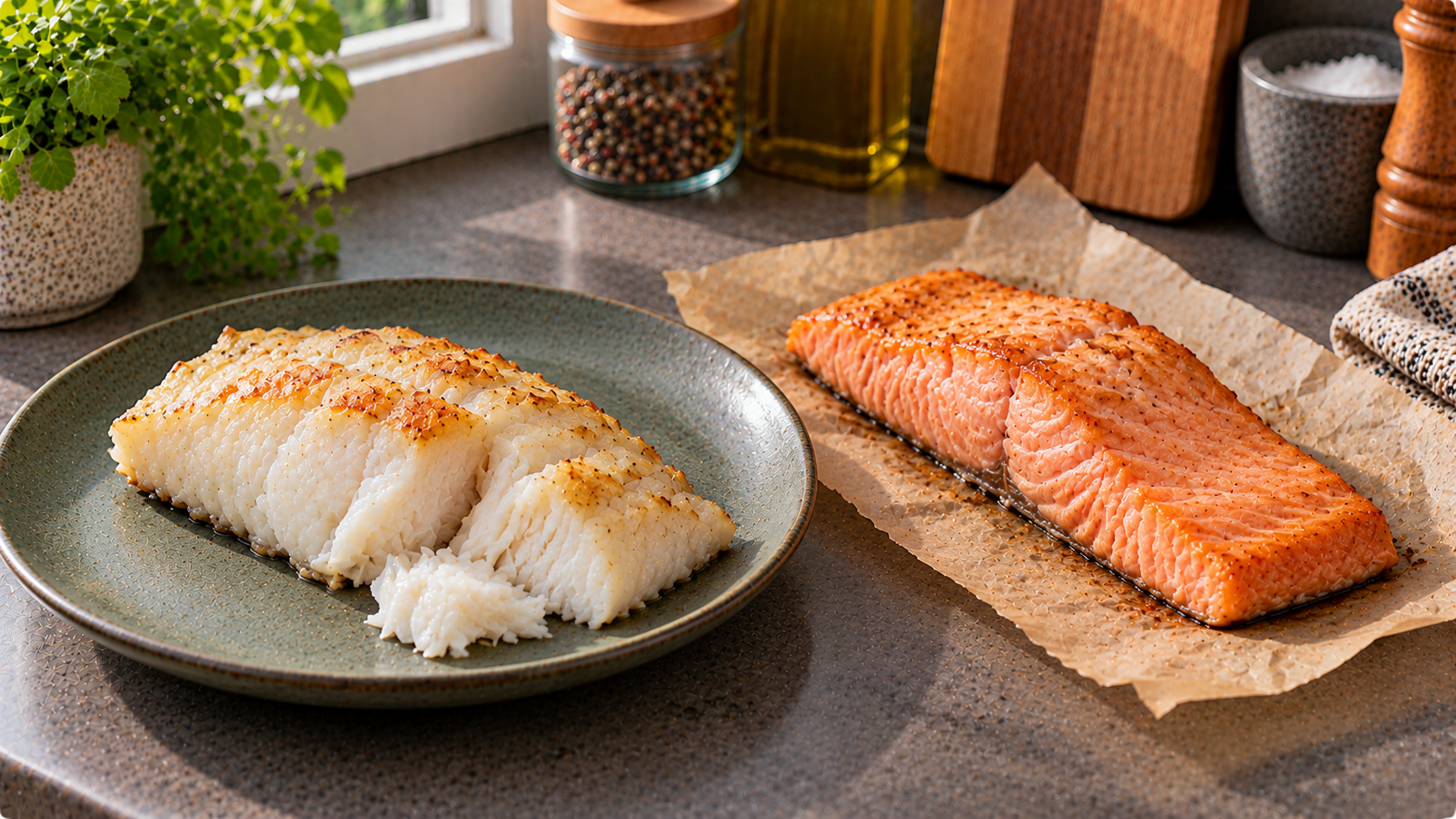
Cod and salmon are both excellent sources of complete protein, but they serve different nutritional and cooking purposes. Cod is a lean white fish with relatively little fat and a mild flavour. Salmon is an oily fish that generally provides more calories, considerably more fat and much more of the long-chain omega-3 fatty acids EPA and DHA.
That distinction matters more than declaring one fish universally healthier. Cod may suit a meal where you want a large lean protein portion with flexibility to add your own fats. Salmon may be preferable when you want omega-3-rich fish with a naturally richer texture.
The comparison below focuses on ordinary boneless cod and salmon fillets, not breaded fish, smoked salmon, fish fingers or ready meals.
Cod vs salmon: the main differences
| Feature | Cod | Salmon | Practical significance |
|---|---|---|---|
| Fish category | Lean white fish | Oily fish | Different fat and energy density |
| Protein | High | High | Both help meet protein requirements |
| Total fat | Usually very low | Usually substantially higher | Changes calories and texture |
| Omega-3 EPA and DHA | Present in relatively small quantities | Usually much higher | Salmon has a meaningful advantage |
| Calories | Generally lower | Generally higher | Compare the same raw or cooked basis |
| Vitamin D | Variable, often modest | Can be a useful source | Check the exact species and product |
| Vitamin B12 | Present | Present | Amounts vary |
| Iodine | Cod can be a useful source | Variable | Origin and food composition matter |
| Texture | Delicate, flaky and mild | Richer, firmer and more succulent | Influences cooking choices |
| Price | Depends on species and retailer | Depends on species and farming | Compare edible portions |
The central difference: Cod is typically the leaner choice, while salmon usually provides substantially more EPA and DHA. Both deliver useful protein, and the better choice depends on what your meal needs.
Calories, fat and protein per 100 g
Comparisons become misleading when raw cod is placed next to cooked salmon, or when farmed Atlantic salmon is treated as nutritionally identical to every wild species.
For cod-specific nutrition and portions rather than a broad range, use the cod calorie and serving guide.
Different food-composition entries produce different values. The following table is a rounded, illustrative planning comparison, not a verified label for any particular brand.
| Nutrient per 100 g raw edible fish | Lean cod: example | Atlantic salmon: example |
|---|---|---|
| Energy | About 80–90 kcal | About 190–220 kcal |
| Protein | About 17–19 g | About 19–21 g |
| Fat | About 0.5–1.5 g | About 12–15 g |
| Carbohydrate | Essentially 0 g | Essentially 0 g |
| Fibre | 0 g | 0 g |
These broad ranges are useful for illustrating why cod and salmon differ, but they are not guaranteed values for a specific fillet. Salmon species, farming conditions and processing can significantly change the figures.
For actual nutritional tracking, use a matching entry from USDA FoodData Central or the package label, with the same species and preparation state.
A difference in fat content explains much of the calorie difference: each gram of fat contributes approximately 9 kcal.
Cod does not lack nutritional value because it is low in fat. Salmon is not nutritionally inferior because it contains more calories. Their fat contents simply suit different dietary goals.
How much protein is in a 150 g or 200 g portion?
A fair comparison begins with a stated portion weight and the product's actual label.
For a hypothetical example, assume raw cod contains 18 g protein and 85 kcal per 100 g, while a raw salmon product contains 20 g protein and 205 kcal per 100 g.
| Raw edible portion | Cod protein | Cod energy | Salmon protein | Salmon energy |
|---|---|---|---|---|
| 100 g | 18 g | 85 kcal | 20 g | 205 kcal |
| 150 g | 27 g | 128 kcal | 30 g | 308 kcal |
| 200 g | 36 g | 170 kcal | 40 g | 410 kcal |
| 250 g | 45 g | 213 kcal | 50 g | 513 kcal |
Energy values are rounded. These are hypothetical examples, not claims about particular supermarket fillets.
The formula is:
Nutrient in portion = nutrient per 100 g × portion weight ÷ 100.
At 200 g, the illustrative salmon provides only 4 g more protein but substantially more calories. That does not make it a poor choice: salmon also supplies fat, including valuable omega-3 fatty acids.
If your objective is specifically to obtain the greatest protein quantity per calorie, lean cod will usually perform better.
If your objective includes increasing EPA and DHA intake, salmon offers a different benefit that protein-per-calorie rankings do not capture.
Protein quality: does one fish build more muscle?
Cod and salmon both contain complete animal proteins providing essential amino acids.
For muscle maintenance or growth, the overall amount of protein consumed, adequate energy intake and resistance exercise are generally more important than choosing cod over salmon when the protein portions are similar.
For example, a 200 g serving of cod containing 18 g protein per 100 g would provide 36 g protein before accounting for cooking changes.
A 200 g salmon portion containing 20 g per 100 g would provide 40 g.
Both amounts can contribute meaningfully to a daily protein target.
A useful metric for calorie-conscious planning is:
Protein per 100 kcal = protein per 100 g ÷ calories per 100 g × 100.
Using the hypothetical products above:
| Product | Protein per 100 kcal |
|---|---|
| Cod | About 21.2 g |
| Salmon | About 9.8 g |
This measures protein density, not overall healthfulness. It excludes omega-3, vitamins, minerals, flavour and other important food characteristics.
Omega-3 fatty acids: salmon has the clearer advantage
Both fish contain the long-chain marine omega-3 fatty acids EPA and DHA, but salmon usually supplies much more of them per comparable serving.
If your goal is omega-3 intake rather than protein alone, the guide to omega-3 food sources distinguishes EPA and DHA from plant ALA.
Cod is exceptionally lean, so its flesh contains relatively little total fat. It can still contribute some EPA and DHA, but it should not be treated as nutritionally interchangeable with oily salmon.
EPA and DHA are distinct from ALA, the omega-3 fatty acid commonly found in flaxseed, chia seeds and walnuts.
Exact omega-3 content depends on salmon species, feed, wild or farmed origin and the particular cod product.
A nutrition label may not specify EPA and DHA separately. If these values matter, use reliable species-specific food-composition data rather than estimating them from total fat.
Salmon can therefore complement a diet that otherwise contains little oily fish. Cod can provide lean protein on another day. Including both may be more useful than relying on one fish exclusively.
Vitamin D, iodine, selenium and vitamin B12
Cod and salmon supply different micronutrient profiles.
Salmon can be a useful dietary source of vitamin D, although the content varies between species and products.
Cod can contribute iodine, a nutrient important for normal thyroid function. Iodine concentration varies according to origin and other factors, so an exact figure should be attached to a defined food entry.
Both fish can supply selenium and vitamin B12.
A blanket statement that salmon always contains more of every micronutrient would be inaccurate. The appropriate comparison depends on the particular nutrient and the exact product.
For nutrient-specific decisions, refer to USDA FoodData Central and choose entries that distinguish cod from salmon, and raw from cooked preparations.
Neither fish contains dietary fibre. Pair either with vegetables, beans, lentils or whole grains for a more varied meal.
Which fish is better for weight management?
Cod is often the more calorie-efficient source of protein when both fish are prepared without substantial added fat.
That can help if you want to allocate more of your meal's energy budget to potatoes, rice, vegetables or other ingredients.
Salmon supplies more energy because of its higher fat content. This is not inherently undesirable: its fats, including EPA and DHA, are a valuable part of its nutritional profile.
The completed meal matters more than the fish in isolation.
For example, cod fried in a thick coating with abundant oil may contain more calories than a modest portion of salmon baked without added fat.
Likewise, salmon served with vegetables and potatoes can fit comfortably into a calorie-controlled eating pattern.
Compare the full recipe: fish weight, cooking oil, breadcrumbs, sauces and side dishes.
If a meal is unsatisfying, including fibre-rich vegetables or legumes can be more useful than simply increasing the fish portion.
Cooking: why cod and salmon behave differently
Oven baking
Cod flakes easily and can become dry or fall apart when overcooked. A modest amount of liquid, vegetables or a tomato-based sauce can protect its delicate texture.
Salmon contains more fat and often retains a richer mouthfeel during baking. It can still become dry if overcooked, especially in thin portions.
For either fish, fillet thickness affects cooking time more than a generic recipe timer.
Pan cooking
Cod benefits from careful handling because its flesh is delicate. Use appropriate heat, avoid repeated turning and consider a non-stick surface or a small measured quantity of oil.
Salmon generally holds together better as a fillet and can develop an appealing browned surface.
Record the oil actually used when calculating calories.
Soups and stews
Cod works well in light tomato or vegetable-based fish stews. Add it late enough to avoid breaking it into very small pieces.
Salmon can produce a richer fish soup because of its natural fat content.
Both work with potatoes, beans and vegetables, but they produce different textures and flavours.
Breaded fish and ready meals
Breaded cod is not nutritionally equivalent to plain cod.
Coatings, frying oil and sauces can raise the calories and fat content substantially.
Likewise, smoked salmon may contain more salt than plain salmon fillets. Compare the actual food rather than assuming a nutritional profile based solely on the fish name.
Mercury and seafood choices
Cod and salmon both appear in the FDA/EPA Best Choices category for fish lower in mercury.
The FDA/EPA Advice About Eating Fish recommends choosing a variety of lower-mercury fish, particularly for pregnancy, breastfeeding and childhood.
Its US advice for people who are or might become pregnant or are breastfeeding includes two to three adult servings per week from the Best Choices category.
Local recommendations may differ. People who catch fish themselves should consult regional contamination advisories.
Cooking cannot remove mercury already present in fish tissue. Species selection, origin and dietary variety are more relevant than cooking technique for this exposure.
Food safety: prepare both fish correctly
The USDA FSIS safe temperature guidance specifies a minimum internal temperature of 63°C / 145°F for fish.
Follow applicable national guidance and use a food thermometer when appropriate.
Keep raw fish refrigerated, prevent cross-contamination, respect use-by instructions and thaw frozen fish safely.
Cod and salmon may also contain parasites when consumed raw or inadequately processed. Raw, lightly cured and cold-smoked fish require additional precautions, especially for pregnant people and other vulnerable groups.
Do not assume that a fish suitable for cooking is automatically suitable for raw consumption.
Price: compare cost per edible serving
Prices differ significantly by country, shop, cod or salmon species and whether the product is fresh or frozen.
A fair comparison uses the price of the edible portion rather than package weight when bones, skin, glaze or other components will be discarded.
Consider this entirely hypothetical example:
| Measure | Cod | Salmon |
|---|---|---|
| Price per kg edible fish | €14.00 | €20.00 |
| Protein per 100 g | 18 g | 20 g |
| Protein per kg | 180 g | 200 g |
| Cost per 30 g protein | €2.33 | €3.00 |
Formula:
Cost per 30 g protein = price per kg ÷ protein grams per kg × 30.
These are invented prices intended to demonstrate a method, not current supermarket quotations.
Cod may be the cheaper protein source in one shop, but promotions and different products can reverse that result.
Consider also how much fish will be used, the amount of added cooking fat and whether the package can be safely stored.
Which fish should you choose?
| Priority | More practical choice | Reason |
|---|---|---|
| Higher protein per calorie | Usually cod | Leaner fillet |
| More EPA and DHA | Usually salmon | Oily fish |
| Lower total fat | Usually cod | Naturally low-fat flesh |
| Richer texture | Salmon | Higher natural fat |
| Light vegetable stew | Cod | Mild taste and delicate flakes |
| Baked fillet | Either | Different textures |
| Vitamin D contribution | Often salmon | Check actual product data |
| Iodine contribution | Cod may be useful | Amount varies |
| Lowest meal cost | Compare real prices | Neither is always cheaper |
Cod and salmon are complementary choices, not direct nutritional substitutes in every respect.
Choose cod when lean protein and flexibility over added fat are priorities. Choose salmon when you value its oily-fish nutrient profile and richer texture.
For an everyday balanced diet, using different fish across different meals can deliver more variety than trying to identify one permanent winner.
Sources and calculation notes
- USDA FoodData Central — matched raw and cooked food-composition entries.
- FDA/EPA Advice About Eating Fish — lower-mercury fish categories and consumption advice.
- USDA FSIS Safe Temperature Chart — safe minimum fish cooking temperature.
All shopping prices, product examples and serving calculations identified as illustrative are hypothetical. Use actual package labels or accurately matched food-composition data for personal nutrition tracking.