
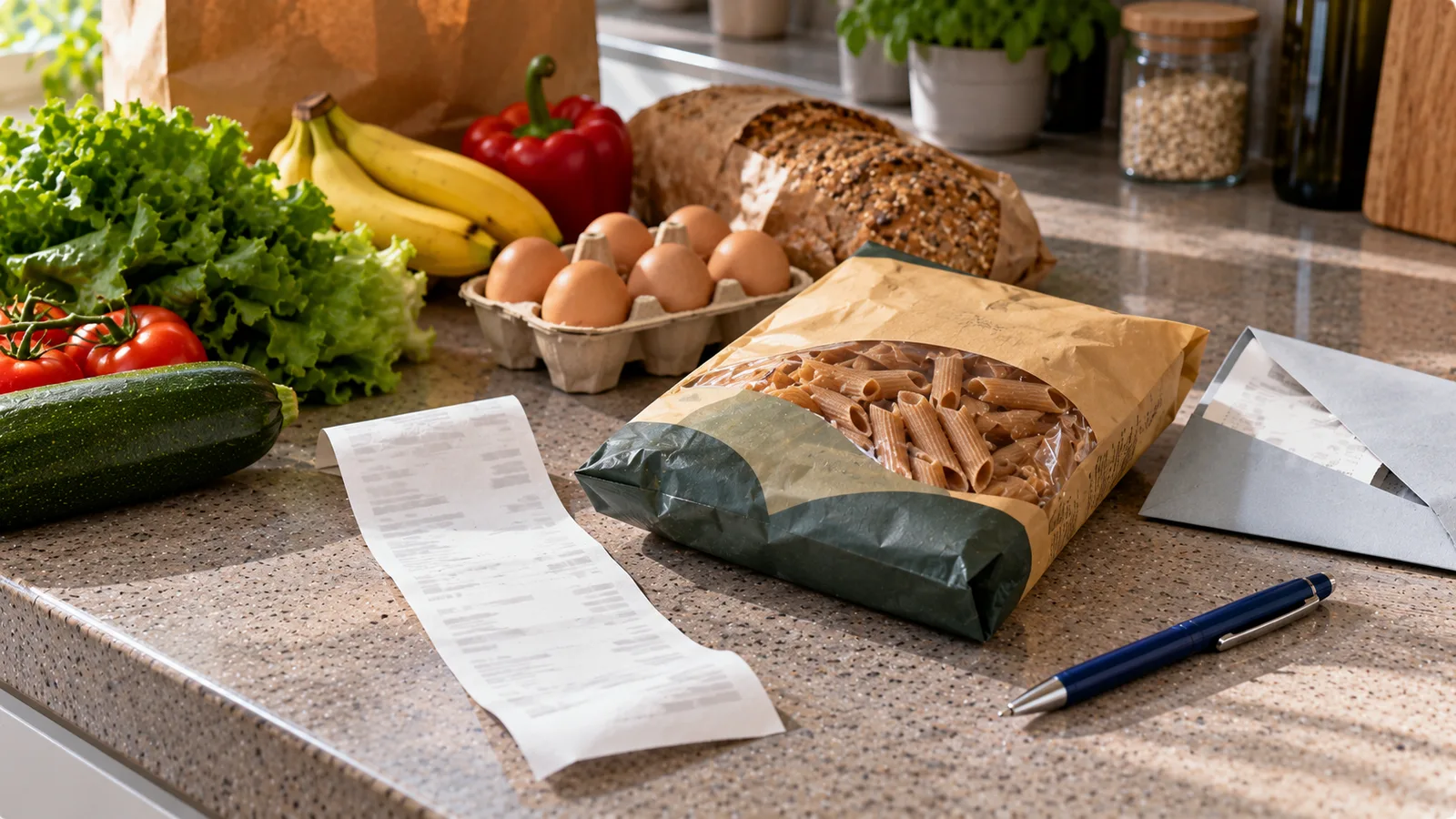
A grocery refund looks simple: you paid for food, returned something and received money back.
But once you track weekly spending, pantry inventory and the actual cost of meals, refunds become less straightforward.
Should a €4 refund reduce this week's grocery spending or last week's? What if the supermarket gives you a voucher instead of cash? What happens when a missing delivery item is replaced rather than refunded?
The most reliable approach is to record the original purchase, the refund and the food actually received as separate events.
That keeps your food budget accurate without making your spending history difficult to understand.
The three amounts you should distinguish
A grocery budget becomes more useful when you separate three figures.
| Measure | Meaning |
|---|---|
| Gross grocery spending | Total value of purchases before refunds |
| Refunds and adjustments | Money or qualifying credit returned for purchases |
| Net grocery spending | Gross spending minus applicable refunds |
The basic formula is:
Net grocery spending = gross grocery spending − refunds.
Suppose you spend €76 at the supermarket and later receive €6 back for an unavailable or defective product.
Your net spending for that purchase is:
€76 − €6 = €70.
This does not mean you consumed €70 worth of food that week.
Some purchases may remain in your pantry, while some ingredients may be used in later weeks.
Why recording only the final amount is a mistake
Imagine you buy groceries for €80.
Two days later, you return a product worth €5.
If you simply change the original transaction from €80 to €75, the final total may be correct.
However, you lose useful information:
- The original checkout amount.
- Which product was returned.
- When the refund occurred.
- Whether the refund was cash or store credit.
- Whether the product had already been counted as available inventory.
For a simple personal budget, editing the original amount may sometimes be sufficient.
For reliable spending analysis, a separate adjustment record is more transparent.
A practical transaction structure
Use a record with the following fields.
| Field | Example |
|---|---|
| Transaction date | 8 October |
| Transaction type | Refund |
| Related purchase | Grocery receipt 1042 |
| Product | Yogurt |
| Quantity | 2 × 500 g |
| Refund amount | €3.60 |
| Refund method | Original payment card |
| Status | Completed |
The receipt reference can be a store receipt number, a transaction ID or a simple personal note.
Avoid recording unnecessary payment-card details.
The important thing is to link the adjustment to the original purchase.
Example 1: A full refund
You buy groceries for €54.
One packaged product costs €4.50 and is refunded in full.
| Entry | Amount |
|---|---|
| Original grocery purchase | +€54.00 |
| Refund received | −€4.50 |
| Net grocery spending | €49.50 |
The negative adjustment reduces spending.
If the product was returned and is no longer available to eat, remove it from your pantry or food inventory as well.
The financial adjustment and inventory adjustment describe different changes.
Both may be necessary.
Example 2: A partial refund
A supermarket delivers strawberries that are damaged.
You paid €5 for the package.
The retailer refunds €2 but allows you to keep the usable portion.
| Entry | Amount |
|---|---|
| Original purchase | +€5.00 |
| Partial refund | −€2.00 |
| Net cost | €3.00 |
The food is not necessarily removed entirely from inventory.
Record the quantity that remains usable.
This is especially important when you also calculate food waste or ingredient costs.
Example 3: A missing delivery item
You order groceries online.
The order total is €65, including a €3.20 item that never arrives.
The retailer later refunds €3.20.
Your net spending becomes:
€65 − €3.20 = €61.80.
The missing item should not be added to your available food inventory.
If the meal plan depended on that ingredient, you may also need to update the shopping list or recipe.
A refund fixes the financial record; it does not replace the missing food.
Example 4: A replacement instead of a refund
You order a 1 kg package of rice.
The package is damaged and the supermarket sends a replacement at no additional charge.
Your spending remains the original purchase amount.
Do not record a fictional refund merely because the first package was replaced.
Instead, record the replacement as an inventory correction.
If the retailer both refunds the original item and charges for a replacement, record those actual transactions separately.
The rule is simple:
Record what actually happened to the money, not what you expected the retailer to do.
Example 5: Store credit or a voucher
Store credit is more complicated than a cash refund.
Suppose a retailer issues a €10 credit for a returned grocery item.
The credit can be used only for a future purchase.
You have not received €10 in your bank account.
For a personal budget, you can track it as a separate balance:
| Event | Grocery spending | Store-credit balance |
|---|---|---|
| Original purchase | +€40 | €0 |
| Credit issued | No new cash movement | +€10 |
| Later purchase of €25, paid €15 cash + €10 credit | +€25 of new goods | −€10 |
There are different valid accounting approaches.
If you treat the issued credit as a refund of the original purchase, do not subtract it again from grocery costs when redeeming it.
If you track cash outflows only, the credit reduces the cash required for the later purchase, but it should not be mistaken for a reduction in the value of food acquired.
Never count the same €10 benefit twice.
Cash spending versus food acquisition cost
Two different questions may require different reports.
Cash-flow report: How much money left your bank account or wallet?
Food-cost report: What was the net value of groceries acquired?
Example:
You purchase €30 of groceries using a €10 refund credit and €20 from your bank account.
Cash outflow is €20.
The value of groceries purchased is €30.
If the €10 credit was already recorded as a refund against a previous purchase, counting it as another €10 discount on the new purchase would understate total grocery costs across the two transactions.
Choose one consistent method for your budget.
Which week should receive the refund?
Consider this timeline:
- Week 1: You buy groceries for €80.
- Week 2: You receive a €6 refund for an item from Week 1.
There are two useful reporting approaches.
Method A: Record the refund when received
| Week | Net cash movement |
|---|---|
| Week 1 | €80 spending |
| Week 2 | €6 refund |
This approach is useful for monitoring actual bank or card movements.
Method B: Attribute the refund to the original purchase
| Week | Adjusted grocery cost |
|---|---|
| Week 1 | €74 |
| Week 2 | No adjustment |
This approach is useful when evaluating the actual cost of each week's shopping basket.
Neither approach is inherently wrong.
The mistake is switching between them without explanation or counting the refund in both periods.
Recommended method for a household food budget
For most detailed grocery budgets, use two dates:
- Refund date: When the money or credit was actually received.
- Original purchase date: The transaction to which the refund belongs.
Then you can produce two reports:
- Cash-flow spending by transaction date.
- Adjusted grocery costs by original purchase date.
This gives a clearer picture without changing historical bank transactions.
Refunds and grocery categories
Refunds should normally reduce the category of the original product.
For example:
| Returned item | Category adjustment |
|---|---|
| Apples | Fruit |
| Milk or plant drink | Dairy or alternatives |
| Pasta | Grains |
| Chicken | Meat or protein foods |
| Olive oil | Oils and pantry |
| Dish soap | Household supplies, not food |
If you combine food and household purchases in one supermarket receipt, a refund for detergent should not reduce the cost of your diet.
Categorizing refunds correctly makes food spending reports more meaningful.
Discounts are not the same as refunds
A discount applied before payment is different from money returned after payment.
Suppose a product has a shelf price of €5 and a checkout discount of €1.
You pay €4.
For most household budgets, record the actual purchase cost as €4.
There is no separate refund because the extra euro was never paid.
By contrast, if you paid €5 and later received €1 back, record the purchase and subsequent refund.
Both situations may produce the same final cost, but their transaction histories differ.
Cashback and loyalty points
Cashback programs and loyalty points can complicate spending reports.
Not every reward is a refund of a particular grocery item.
For example:
- A refund for spoiled fruit directly adjusts the fruit purchase.
- A general loyalty reward may apply to several purchases.
- Credit-card cashback may be a payment-card benefit rather than a grocery-price reduction.
- Promotional points may have restrictions or expire.
Keep these categories separate unless you have a clear, consistent allocation rule.
Do not assume a loyalty-point balance is equivalent to cash that can be withdrawn.
How to handle deposits and returned containers
In countries with beverage-container deposits, the deposit is not necessarily the cost of the beverage itself.
For example, a bottle might involve:
- Beverage price: €1.20.
- Refundable deposit: €0.25.
- Checkout payment: €1.45.
If the container is returned and €0.25 is refunded, the net cost of the beverage is €1.20.
For a detailed food budget, track refundable deposits separately from grocery consumption costs.
This avoids treating the return of a container as a discount on an unrelated food purchase.
What if the refund amount is incorrect?
Do not automatically replace the expected refund with the amount actually received without checking the difference.
Suppose you expect €4.80 but receive €3.80.
Record:
- Expected refund: €4.80.
- Actual refund: €3.80.
- Difference to investigate: €1.00.
Your completed financial record should reflect the amount actually received.
Keep the unresolved difference separate until the retailer confirms the outcome.
Pending refunds versus completed refunds
A refund promised by customer service is not necessarily a completed refund.
Use simple statuses:
| Status | Meaning |
|---|---|
| Requested | Refund has been requested |
| Approved | Retailer has agreed to refund |
| Pending | Processing or payment is incomplete |
| Completed | Money or usable credit has been received |
| Rejected | Refund was not granted |
For cash-flow reporting, include only completed refunds.
For projected spending, you may display pending refunds separately, clearly labeled.
This prevents a promised refund from making your current balance look better than it is.
Returns and consumer rights
The right to return an item depends on the circumstances.
EU consumer rules distinguish between defective goods, online purchases and purchases made in physical shops.
Certain goods and situations are subject to exceptions.
The European Union's consumer guidance on guarantees and returns explains the general framework.
A shop's voluntary return policy is not the same as a statutory right.
For groceries, especially perishable products, do not assume every item can be returned simply because you changed your mind.
The purpose of budget tracking is to record the retailer's actual decision, not to presume a refund is legally available.
How refunds affect cost per meal
Suppose you purchase ingredients for a four-portion meal.
The original ingredient cost is €12.
A damaged ingredient receives a €2 partial refund, and the remaining food is sufficient for all four portions.
Adjusted ingredient cost:
€12 − €2 = €10.
Cost per portion:
€10 ÷ 4 = €2.50.
If the damaged ingredient had to be discarded and replaced at an additional cost, include that replacement purchase too.
The refund alone does not establish the final meal cost.
A weekly grocery refund worksheet
| Date | Product | Original cost | Refund | Method | Status |
|---|---|---|---|---|---|
| 5 Oct | Yogurt | €3.60 | €3.60 | Card | Completed |
| 6 Oct | Strawberries | €5.00 | €2.00 | Card | Completed |
| 7 Oct | Missing rice | €3.20 | €3.20 | Card | Pending |
This is a fictional example.
Completed refunds total €5.60.
The pending €3.20 should not yet be included in a completed cash-flow report.
When it arrives, update its status and refund date.
A simple monthly reconciliation
At the end of the month:
- Total all grocery purchases.
- Total completed refunds.
- Separate pending reimbursements.
- Check store-credit balances.
- Match refunds to original receipts.
- Correct inventory for returned or missing products.
- Review grocery categories.
- Compare cash-flow and adjusted-cost totals.
A consistent monthly review prevents small corrections from accumulating into misleading annual spending figures.
The practical rule
Record grocery purchases and refunds as separate linked events.
Use the refund date for cash-flow reporting and the original purchase date for adjusted grocery-cost analysis.
Track store credit, replacements and refundable deposits separately, and never count the same refund twice.
This makes your weekly food budget easier to audit and more useful for understanding what groceries actually cost.